

Satellite launch is one of the most demanding quality environments in any industry. A satellite that fails in orbit cannot be retrieved, repaired, or replaced at reasonable cost. A launch vehicle component that does not meet specification can result in mission loss. The supply chains that produce these systems involve hundreds of suppliers across multiple tiers, each contributing components that must perform correctly under extreme thermal, vibrational, and radiation conditions.
Six Sigma is a data-driven quality improvement methodology that uses statistical tools to reduce process variation and defects. Applied to aerospace supply chains, Six Sigma’s DMAIC framework — Define, Measure, Analyze, Improve, Control — gives quality professionals a structured, documented method for identifying and eliminating defects before they reach the launch pad.
This article explains how Six Sigma principles and tools apply to satellite launch supply chains, what standards govern quality in this environment, and what skills quality professionals need to contribute effectively.
Table of contents
- How does Six Sigma apply to satellite launch supply chains?
- Why Satellite Launch Supply Chains Require Near-Zero Defect Quality
- What Six Sigma Means in an Aerospace Context
- The Governing Quality Standards for Satellite Launch Supply Chains
- Applying DMAIC to Satellite Launch Supply Chain Quality
- Key Six Sigma Tools for Satellite Launch Supply Chain Quality
- Frequently Asked Questions: Six Sigma and Satellite Launch Supply Chains
How does Six Sigma apply to satellite launch supply chains?
Six Sigma applies to satellite launch supply chains by using the DMAIC framework to identify, measure, and eliminate sources of process variation and defects across supplier networks. Tools including SIPOC, FMEA, Statistical Process Control, and Measurement System Analysis are used at each phase to ensure that components and processes meet the precise quality requirements set by aerospace quality standards such as AS9100D and NASA’s quality assurance requirements.
Key Takeaways
- Six Sigma’s goal is to achieve no more than 3.4 defects per million opportunities (DPMO), which corresponds to a process operating at six standard deviations from the mean in a normal distribution.
- The DMAIC framework — Define, Measure, Analyze, Improve, Control — is Six Sigma’s structured methodology for diagnosing and eliminating defects in any process, including aerospace supply chain processes.
- AS9100D is the internationally recognized Quality Management System standard for aviation, space, and defense organizations, developed by the International Aerospace Quality Group (IAQG) and built on ISO 9001:2015.
- NASA’s quality assurance requirements (NPR 8735.2C) require that project managers include supply chain risk management, receiving inspection, and counterfeit part avoidance in their quality programs.
- A published peer-reviewed study in ResearchGate confirmed that a SIPOC + DMAIC hybrid framework effectively improved key supply chain quality dimensions including outgoing quality levels and process capability (Mishra & Sharma, 2014).
- Propulsion system failures account for 49.6% of all space launch vehicle failures, according to a 2025 study published in ScienceDirect — underscoring the critical importance of component-level quality control in the supply chain.
Why Satellite Launch Supply Chains Require Near-Zero Defect Quality
A satellite launch supply chain is not a conventional manufacturing supply chain. The stakes, the operating environment, and the consequences of defects are categorically different from those in consumer or industrial manufacturing.
Satellites operate in environments that combine extreme thermal variation, hard vacuum, radiation exposure, and intense vibration during launch. Components must function correctly from the moment they are powered on in orbit, in many cases for 10 to 15 years or longer, with no possibility of physical maintenance.
The supply chain for a satellite or launch vehicle spans multiple tiers. Raw materials, electronic components, structural elements, propulsion subsystems, guidance systems, and software all come from different suppliers. Each supplier must consistently produce to the precise specification the system integrator requires. A single out-of-specification part — a fastener, a solder joint, a sensor — can propagate into a system-level failure.
According to a 2025 peer-reviewed study published in ScienceDirect analyzing international space launch industry failures, propulsion system failures account for 49.6% of all launch vehicle failures, with feed system issues (21.7%) and turbopump failures (18.3%) being the most critical sub-failure points.
The study found that failures arise across multiple subsystems, each of which depends on supply chain quality at the component level.
NASA’s Office of Inspector General, in its 2023 audit of the Artemis campaign supply chain, documented that supply chain challenges — including limited industrial base capacity, workforce issues, and materials availability — directly affected the Artemis campaign’s schedule and costs.
NASA obligated approximately $40 billion to 860 contractors from fiscal years 2012 to 2022 for Artemis-related programs, each dependent on networks of subcontractors and suppliers for hardware, raw materials, electronic parts, and other resources.
These realities make the case for applying a rigorous, data-driven quality methodology to every level of the satellite launch supply chain. Six Sigma provides that methodology.

Public, Onsite, Virtual, and Online Six Sigma Certification Training!
- We are accredited by the IASSC.
- Live Public Training at 52 Sites.
- Live Virtual Training.
- Onsite Training (at your organization).
- Interactive Online (self-paced) training,
What Six Sigma Means in an Aerospace Context
Six Sigma is a quality management methodology that uses statistical tools and a structured improvement framework to reduce defects and process variation. The name comes from the statistical concept of standard deviation (sigma). A process operating at Six Sigma quality produces no more than 3.4 defects per million opportunities (DPMO), which corresponds to a process where the defect rate falls more than six standard deviations from the mean of a normal distribution.
In aerospace manufacturing, Six Sigma is used to improve manufacturing processes, supply chain management, and overall operational quality. According to a published analysis of Six Sigma in the aerospace industry by Invensis Learning, aerospace companies use Six Sigma methodologies to reduce waste, increase profitability, and provide high-quality products. The principles have been applied in aircraft production, satellite manufacturing, maintenance, and support services.
The zero-defect philosophy — which aims to eliminate errors entirely — has roots in aerospace. The concept emerged in the 1960s when Martin Marietta, an aerospace manufacturer, reduced defects by 54% in one year through a focused quality program, as documented by SixSigma.us. Quality expert Philip Crosby later formalized the zero-defect approach in his 1979 book Quality is Free.
It is important to note a distinction that quality professionals in the field recognize: Six Sigma accepts a statistical quality standard (3.4 DPMO) rather than literal zero defects.
As documented by iSixSigma, quality professionals distinguish between applying continuous improvement tools to minimize defects across the supply chain and a “zero escapes” methodology applied at the final gate before product reaches the customer. In practice, the most effective approach for satellite supply chains combines both: continuous Six Sigma-based defect reduction throughout the supply chain and rigorous final inspection before hardware is accepted for integration.
Also Read: Six Sigma in Travel and Tourism: How Data Creates Perfect Guest Experiences
The Governing Quality Standards for Satellite Launch Supply Chains
Before describing how Six Sigma tools apply, it is essential to understand the official quality standards that govern this environment. Six Sigma tools do not replace these standards — they are the structured methodology used to meet and exceed them.
AS9100D — The International Aerospace Quality Management Standard
AS9100D is the internationally recognized Quality Management System (QMS) standard for aviation, space, and defense organizations. It was developed by the International Aerospace Quality Group (IAQG) and published by SAE International. AS9100D is recognized globally as EN 9100:2018 in Europe and JISQ 9100:2016 in Japan.
AS9100D builds on ISO 9001:2015 — the global standard for quality management systems — and adds aerospace-specific requirements for the safe design, production, and delivery of aerospace parts and products.
Key additional requirements in AS9100D beyond ISO 9001:2015 include:
- Operational risk management — Managing potential issues proactively to ensure safety and quality.
- Counterfeit part prevention — Requirements for counterfeit avoidance in electronic and electromechanical parts, including adherence to standards AS5553C and SAE AS6174A.
- Configuration management — Ensuring the documented design baseline is maintained throughout production.
- Product safety — Explicit requirements for identifying and managing risks related to product safety throughout the supply chain.
- Human factors — Attention to how human performance variability affects manufacturing quality.
- Special processes — Controls on processes such as welding, heat treatment, and surface finishing where the output cannot be fully verified by inspection alone.
AS9100D has been endorsed by the Federal Aviation Administration (FAA), the U.S. Department of Defense (DoD), and NASA. Aerospace manufacturers, defense contractors, and government agencies require their suppliers to be AS9100D-certified. All AS9100D-certified organizations are listed in the Online Aerospace Supplier Information System (OASIS), maintained by the IAQG.
NASA NPR 8735.2C — NASA Quality Assurance Requirements
NASA’s quality assurance requirements for mission hardware are documented in NPR 8735.2C, the NASA Procedural Requirements for Hardware Quality Assurance. This document establishes quality requirements for NASA programs and projects.
Key requirements relevant to supply chain quality include:
- Supply Chain Risk Management (SCRM) — Project managers must include SCRM requirements in their project quality assurance program plans, including supplier audit and assessment data in NASA’s Supply Chain Insight Central (SCIC) database.
- Counterfeit avoidance — Adherence to SAE AS6174A for non-electronic parts and AS5553C for electronic parts.
- Electrostatic discharge (ESD) control — In accordance with NASA-STD-8739.6 and ANSI/ESD S20.20-2014.
- “Building quality in” — NASA’s NPR 8735.2C explicitly recognizes that proactive quality control and quality assurance techniques — used during the design phase rather than applied only at inspection — are the most impactful strategy for meeting mission objectives and reducing long-term technical risk. This principle is directly aligned with Six Sigma’s philosophy of designing quality into processes rather than inspecting it in after the fact.
- Supplier surveillance — Second-party quality surveillance is required in addition to, not as a substitute for, supplier quality responsibilities.
Six Sigma professionals working in satellite launch supply chains must understand these standards. The DMAIC framework provides the structured process for achieving and sustaining the quality levels these standards require.
Applying DMAIC to Satellite Launch Supply Chain Quality
The DMAIC framework — Define, Measure, Analyze, Improve, Control — is the core improvement methodology of Six Sigma. The following section describes how each phase applies to satellite launch supply chain quality management.
Phase 1: Define — Scope the Supply Chain Quality Problem
In the Define phase, the project team establishes what quality problem is being addressed, which process or supplier tier is in scope, and what the measurable goal of the project is.
Key activities in the Define phase for satellite supply chain projects include:
SIPOC Diagram — A SIPOC (Suppliers, Inputs, Process, Outputs, Customers) diagram maps the high-level view of the supply chain process: who supplies inputs, what those inputs are, what the process steps are, what outputs the process produces, and who the customer of those outputs is. According to the Six Sigma Institute, the SIPOC tool is used during the Define phase to map a high-level view of a process and identify key components and their relationships. In a satellite supply chain context, a SIPOC diagram might map the flow from a raw material supplier through component manufacturing, incoming inspection, integration, and delivery to the prime contractor.
Project Charter — The charter documents the problem statement, the business case (what the cost of the defect problem is), the scope boundaries, the team members, and the measurable project goal. For a satellite supply chain project, the charter might identify a specific component category with a documented non-conformance rate and define the target DPMO for that component family.
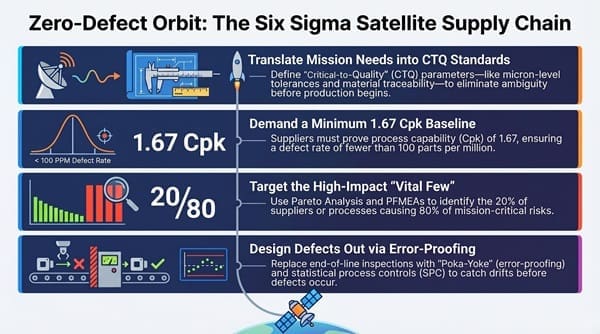
Critical-to-Quality (CTQ) Trees — CTQ trees translate customer requirements (in this case, the prime contractor’s or agency’s specification) into measurable process characteristics. For satellite components, CTQs might include dimensional tolerances, material purity levels, or functional test pass rates.
Phase 2: Measure — Establish the Current Quality Baseline
In the Measure phase, the team collects data to establish the current performance of the supply chain process under investigation.
Key activities in the Measure phase for satellite supply chain projects include:
Measurement System Analysis (MSA) — Before collecting quality data, the team validates that the measurement system itself is capable. An inspection process that produces unreliable measurements will generate false data. MSA quantifies the variation introduced by the measurement system versus the variation in the process being measured. This is particularly important in satellite manufacturing, where dimensional and functional tolerances are tight and inspection equipment must be calibrated and validated.
DPMO and Sigma Level Calculation — The team calculates the Defects Per Million Opportunities for the process being studied and converts that to a Sigma level. This gives a baseline quality performance number that can be compared before and after improvement.
Baseline Data Collection — The team collects incoming inspection data, non-conformance reports, supplier audit scores, and first-article inspection results to establish the baseline. NASA’s NPR 8735.2C requires that supplier past performance data be tracked in the SCIC database, which provides a structured source of baseline data for projects involving NASA-certified suppliers.
Phase 3: Analyze — Find the Root Causes of Defects
In the Analyze phase, the team uses statistical and process analysis tools to identify the root causes of the supply chain defects documented in the Measure phase.
Key tools used in the Analyze phase for satellite supply chain projects include:
Failure Mode and Effects Analysis (FMEA) — FMEA is a systematic method for identifying potential failure modes in a product or process, assessing their severity, probability of occurrence, and detectability, and prioritizing corrective action by Risk Priority Number (RPN).
According to the Six Sigma Institute, FMEA is integrated within the Analyze phase of DMAIC to predict where failures might occur and shape prioritization of corrective actions. In aerospace supply chains, FMEA is used both for product design and for manufacturing process steps. AS9100D explicitly requires risk-based thinking and proactive risk management, which FMEA directly supports.
Fishbone Diagram (Ishikawa) — A fishbone diagram maps all potential causes of a defect across six categories: Machines, Methods, Materials, Measurement, Man (People), and Environment. For a satellite supply chain defect, this might identify causes such as supplier process variation, incoming material inconsistency, inadequate inspection capability, or insufficient supplier training.
Pareto Analysis — A Pareto chart identifies which defect types or suppliers account for the majority of non-conformances. In practice, a small number of failure modes or a small number of suppliers typically account for the majority of quality escapes. Prioritizing improvement effort on the top Pareto items produces the greatest reduction in overall defect rate.
Statistical Hypothesis Testing — For complex supply chain problems where multiple variables may be contributing to defects, statistical hypothesis testing (t-tests, ANOVA, regression analysis) confirms whether a suspected cause actually has a statistically significant relationship with the defect outcome. This prevents teams from implementing fixes for causes that are not actually driving the problem.
Also Read: Six Sigma in Precision Agriculture to Maximize Crop Yields
Phase 4: Improve — Implement Solutions That Eliminate Root Causes
In the Improve phase, the team designs and tests solutions that address the confirmed root causes identified in the Analyze phase.
Common improvements in satellite supply chain quality projects include:
Supplier Process Qualification — Requiring suppliers to demonstrate process capability (Cpk) at or above the specified threshold for critical characteristics before production begins. A Cpk of 1.33 or higher is a common minimum requirement for critical aerospace processes, indicating that the process mean is at least four standard deviations from the nearest specification limit.
Design of Experiments (DOE) — DOE is a statistical method for systematically varying process input parameters to identify which parameters most significantly affect output quality. In satellite component manufacturing, DOE might be used to optimize a soldering process, a surface treatment process, or a composite layup process to minimize dimensional variation.
Poka-Yoke (Error-Proofing) — Error-proofing designs the process so that defects physically cannot occur or are automatically detected. In satellite assembly supply chains, error-proofing might include torque-limiting tools for fastener installation, color-coded connectors to prevent incorrect mating, or automated inspection stations that halt the line when a measurement is out of specification.
Supplier Development Programs — For suppliers with confirmed capability gaps, structured development programs provide training, process improvement support, and defined milestones for reaching the required Cpk level. This aligns with AS9100D’s requirements for supplier quality management.
Phase 5: Control — Sustain the Improvement and Prevent Recurrence
In the Control phase, the team puts monitoring and governance structures in place to ensure the improved quality level is maintained over time. In satellite supply chains, where the consequence of a quality regression can be mission loss, the Control phase is not optional and must be robust.
Key activities in the Control phase for satellite supply chain projects include:
Statistical Process Control (SPC) Charts — SPC charts track a key process characteristic over time and signal when the process has shifted in a statistically significant way. Control charts are a core tool of Six Sigma’s Control phase. When a data point or pattern falls outside the control limits, the process is investigated before defective product is produced. NASA’s NPR 8735.2C’s emphasis on “building quality in” is directly supported by SPC implementation at the supplier level.
Control Plans — A control plan documents which process characteristics are monitored, how they are measured, at what frequency, by whom, and what the reaction plan is when a characteristic goes out of control. For satellite supply chains, control plans are maintained for critical characteristics and reviewed during supplier audits.
Supplier Quality Audits — Ongoing supplier audits verify that the documented process controls are being followed and that quality metrics remain within the established targets. AS9100D requires documented supplier surveillance. NASA’s NPR 8735.2C requires supplier audit and assessment data to be entered into the SCIC database.
Non-Conformance Management — A documented non-conformance management process ensures that any out-of-specification parts are identified, segregated, and dispositioned before they can escape to the next level of assembly. The disposition options — use-as-is, rework, repair, return to supplier, or scrap — must be reviewed and approved by the appropriate authority based on the criticality of the characteristic.
Key Six Sigma Tools for Satellite Launch Supply Chain Quality
The following table summarizes the Six Sigma tools most applicable to satellite launch supply chain quality management, organized by the DMAIC phase in which they are primarily used:
| DMAIC Phase | Tool | Application in Satellite Supply Chain |
| Define | SIPOC Diagram | Maps the full supplier-to-customer flow for the process under study |
| Define | Project Charter | Documents the problem, scope, team, and measurable goal |
| Define | CTQ Tree | Translates launch system specifications into measurable supplier process requirements |
| Measure | Measurement System Analysis | Validates that inspection equipment is capable of detecting specification violations |
| Measure | DPMO / Sigma Level | Quantifies current supplier defect rate as a comparable metric |
| Measure | Baseline Data Collection | Establishes current non-conformance rates from inspection and audit records |
| Analyze | FMEA | Identifies potential failure modes, their severity, and risk priority numbers |
| Analyze | Fishbone Diagram | Maps root causes of defects across people, materials, machines, methods, and environment |
| Analyze | Pareto Chart | Identifies which defect types or suppliers account for the majority of non-conformances |
| Analyze | Hypothesis Testing | Statistically confirms which variables are causing defects |
| Improve | Design of Experiments (DOE) | Identifies optimal process parameters to minimize variation in critical characteristics |
| Improve | Supplier Process Qualification | Verifies supplier Cpk meets the required threshold before production |
| Improve | Error-Proofing (Poka-Yoke) | Prevents defects from occurring or from escaping detection |
| Control | Statistical Process Control (SPC) | Monitors critical characteristics over time to detect process drift |
| Control | Control Plans | Documents ongoing monitoring responsibilities and reaction plans |
| Control | Supplier Audits | Verifies that process controls are being followed and sustained |
The Relationship Between Six Sigma and AS9100D in Satellite Supply Chains
AS9100D and Six Sigma are complementary, not competing.
AS9100D defines what a quality management system for aerospace must include: risk management, configuration management, counterfeit avoidance, product safety, and supplier quality requirements.
Six Sigma’s DMAIC defines how to find and eliminate defects within the processes that AS9100D governs.
An AS9100D-certified organization has documented its quality management system, assigned ownership, and established processes. Six Sigma provides the data analysis tools and structured improvement methodology to identify where those processes are producing defects, confirm the root causes, and implement changes that measurably reduce the defect rate.
Quality professionals in satellite supply chains who understand both AS9100D requirements and Six Sigma tools are equipped to contribute at a level that neither framework alone provides. AS9100D tells them what must be controlled. Six Sigma tells them how to measure it, analyze it, and improve it.
What Training Satellite Supply Chain Quality Professionals Need
Quality professionals working in satellite launch supply chains need both the domain knowledge of aerospace quality standards and the statistical and process improvement tools that Six Sigma provides.
Six Sigma Green Belt training is the most practical starting point. Green Belt training covers the full DMAIC methodology, SIPOC, FMEA, Statistical Process Control, Measurement System Analysis, hypothesis testing, and process capability analysis. These are the exact tools that apply to the supply chain quality problems described in this article.
Six Sigma Black Belt training is appropriate for professionals leading complex, cross-functional supply chain improvement projects. Black Belt training adds Design of Experiments, advanced statistical analysis, organizational change management, and project leadership skills.
At Six Sigma Development Solutions Inc, we offer Lean Six Sigma training designed for working professionals across all industries, including aerospace and defense supply chain environments. Our training is available in three formats to fit different team structures and schedules:
- Onsite training — Delivered at your facility, with your supply chain processes as the working context for exercises and projects.
- Live virtual training — Instructor-led sessions delivered online, with real-time interaction and cross-industry peer learning.
- Online training — Self-paced courses that allow professionals to earn Six Sigma certification on their own schedule without interrupting ongoing project work.
Each format covers the DMAIC methodology, the tools used in each phase, and their practical application to real quality problems.
Frequently Asked Questions: Six Sigma and Satellite Launch Supply Chains
What is the goal of Six Sigma quality in an aerospace supply chain?
Six Sigma aims to achieve no more than 3.4 defects per million opportunities (DPMO) in any process. In an aerospace supply chain, this means reducing the rate at which out-of-specification components are produced, escape inspection, or are delivered to the next level of assembly. Six Sigma’s DMAIC framework provides the structured process for reaching and sustaining this quality level.
What is AS9100D and why does it matter for satellite supply chains?
AS9100D is the internationally recognized Quality Management System standard for aviation, space, and defense organizations. It was developed by the International Aerospace Quality Group (IAQG) and builds on ISO 9001:2015 with aerospace-specific requirements including operational risk management, counterfeit part prevention, configuration management, and product safety. Aerospace manufacturers, defense contractors, and government agencies — including NASA — require their suppliers to be AS9100D-certified.
How does FMEA support satellite supply chain quality?
Failure Mode and Effects Analysis (FMEA) is used in the Analyze phase of DMAIC to systematically identify potential failure modes in a product or process, assess their severity and probability of occurrence, and prioritize corrective actions by Risk Priority Number (RPN). In satellite supply chains, FMEA is applied to both product design and manufacturing processes to identify risks before they result in defects.
What does “building quality in” mean in the NASA context?
NASA’s NPR 8735.2C states that using proactive quality control and quality assurance techniques during the design phase — rather than relying on inspection after production — is the most impactful quality strategy for meeting mission objectives and reducing long-term technical risk. This is described in the standard as “building quality in.” Six Sigma’s DMAIC framework supports this principle by identifying and eliminating defect sources before they produce non-conforming parts.
Final Words
Satellite launch tolerates no ambiguity about quality. A component that does not meet specification does not get a second chance once the mission is underway.
Six Sigma’s DMAIC framework — combined with tools including SIPOC, FMEA, Statistical Process Control, Measurement System Analysis, and Design of Experiments — gives supply chain quality professionals the structured, data-driven approach to find where defects originate, confirm their root causes, eliminate them, and sustain the improvement over time.
When applied within the framework of established aerospace quality standards — AS9100D and NASA’s quality assurance requirements — Six Sigma becomes the practical methodology that turns those standards from documented requirements into measured, improving performance.
Ready to build Six Sigma capability in your aerospace or defense supply chain team? Six Sigma Development Solutions offers Green Belt and Black Belt training through onsite, live virtual, and online formats. Explore our training programs or contact our team to find the right program for your organization.
About Six Sigma Development Solutions, Inc.
Six Sigma Development Solutions, Inc. offers onsite, public, and virtual Lean Six Sigma certification training. We are an Accredited Training Organization by the IASSC (International Association of Six Sigma Certification). We offer Lean Six Sigma Green Belt, Black Belt, and Yellow Belt, as well as LEAN certifications.
Book a Call and Let us know how we can help meet your training needs.


