
A control plan is a living document, not a one-time form. It lists exactly how a team monitors and controls each critical process step. The Automotive Industry Action Group, or AIAG, defines the standard format most manufacturers use. Every entry in a good control plan traces back to a PFMEA risk. This guide covers the column structure, the three plan types, and the PFMEA link.
Key Takeaways
- A control plan documents how a team monitors and controls each process step.
- AIAG defines the standard control plan format used across the auto industry.
- Three types exist: Prototype, Pre-Launch, and Production control plans.
- Every control plan entry should trace back to a PFMEA risk.
- IATF 16949 and AS9100 both require documented, linked control plans.
What Is a Control Plan?
A control plan is a structured document, not a narrative description. It lists the process steps, the characteristics measured, and the control method used. Teams also record the sample size, the frequency, and the reaction plan. The reaction plan tells operators what to do if a value drifts.
Control plans exist to prevent defects, not just detect them. A good control plan connects directly to the process FMEA. It gives every control a documented reason for existing.
The Three Types of Control Plans

AIAG defines three control plan types across a product’s life. Each type matches a stage of the APQP process.
- Prototype: This is the first control plan, and it fits early builds. It tracks basic dimensional and material checks during development.
- Pre-Launch: This plan governs pilot runs before full production. Teams use this version to catch problems before the launch.
- Production: This is the live, maintained plan for full-volume manufacturing. Auditors review this version during IATF 16949 audits.
All three plans follow the same column structure. Only the scope and timing change between them.

Public, Onsite, Virtual, and Online Six Sigma Certification Training!
- We are accredited by the IASSC.
- Live Public Training at 52 Sites.
- Live Virtual Training.
- Onsite Training (at your organization).
- Interactive Online (self-paced) training,
What Goes Into a Control Plan
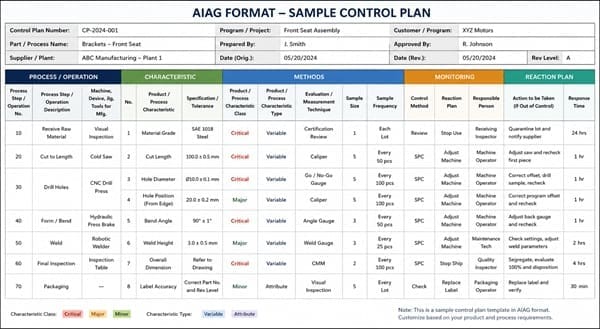
AIAG’s format uses a fixed set of columns. Every control plan should include these fields.
| Column | What It Captures |
| Process/Operation Number | Which process step this row controls |
| Process Description | The critical step being monitored |
| Characteristic | The specific dimension, feature, or output measured |
| Special Characteristic | Whether this characteristic carries extra risk or regulatory weight |
| Specification/Tolerance | The acceptable range for the characteristic |
| Measurement Method | How the characteristic gets measured |
| Sample Size and Frequency | How much and how often to check |
| Control Method | The tool used to control the characteristic (SPC chart, checklist, poka-yoke) |
| Reaction Plan | What to do when a value falls out of range |
Missing any one column weakens the whole plan. A control plan without a reaction plan leaves operators guessing during a real deviation.
Also Read: Acceptance Sampling: Quality Control Without Testing Everything
How a Control Plan Connects to PFMEA
A control plan should never stand alone. Its real value comes from its link to the process FMEA.
In the AIAG-VDA FMEA methodology, high-risk failure modes get an Action Priority rating. Failure modes rated High or Medium require a documented process control. That control then appears as a row in the control plan.
This link creates a clear audit trail. An auditor can trace any row back to the risk that created it. A control plan with no traceable PFMEA link signals a real gap. IATF 16949 auditors specifically look for this connection.
When to Update a Control Plan
A control plan is never finished once and filed away. Update it whenever the process itself changes.
Trigger events include a design change, a new material, or new tooling. A new measurement method also requires an update.
Beyond triggered updates, review the plan on a regular schedule. Most teams review their control plans at least once a year.
Where Control Plans Are Required
Control plans started in the automotive industry. IATF 16949 requires them for every automotive supplier.
Aerospace manufacturers use the same approach under AS9100. Any APQP-based quality system can adopt the same structure.
Lean Six Sigma teams borrow this tool outside regulated industries too. A Six Sigma project can use a simplified control plan to sustain any process improvement.
Common Mistakes with Control Plans
The biggest failure point is not the document itself. It is the gap between the binder and the shop floor.
Operators sometimes work from memory instead of the actual control plan. That gap shows up immediately during a layered process audit.
Another common mistake is copying old plans without updating them. A stale reaction plan can leave a real defect uncaught.
The fix is simple, but it takes discipline. Review the plan often, and train operators directly from it.
Also Read: How to Integrate Control Charts with Six Sigma Tools
How Six Sigma Development Solutions Inc. Can Help
Building a control plan that survives an audit takes real practice. Six Sigma Development Solutions Inc. covers control plans inside our Green Belt and Black Belt courses.
We offer onsite, live virtual, and online Six Sigma training. Learners build a real control plan linked to a real PFMEA, not a generic template.
Ready to build control plans your team will actually use? Explore our training options and get certified today.
Frequently Asked Questions on Control Plan
Q: What is a control plan in Six Sigma?
A: A control plan documents how a team monitors a process. It lists the characteristics, methods, and reaction plans used.
Q: What are the three types of control plans?
A: The three types are Prototype, Pre-Launch, and Production. Each matches a different stage of APQP.
Q: How does a control plan connect to a PFMEA?
A: High-risk failure modes in a PFMEA require a documented control. That control becomes a row in the control plan.
Q: Who requires a control plan?
A: IATF 16949 requires control plans for automotive suppliers. AS9100 requires them in aerospace manufacturing.
Q: How often should a control plan be updated?
A: Update it whenever the process changes. Most teams also review it at least once a year.
Want a control plan your team will actually follow on the floor? Six Sigma Development Solutions Inc. offers onsite, live virtual, and online training for every belt level.
About Six Sigma Development Solutions, Inc.
Six Sigma Development Solutions, Inc. offers onsite, public, and virtual Lean Six Sigma certification training. We are an Accredited Training Organization by the IASSC (International Association of Six Sigma Certification). We offer Lean Six Sigma Green Belt, Black Belt, and Yellow Belt, as well as LEAN certifications.
Book a Call and Let us know how we can help meet your training needs.


