

Employers who hire for process improvement roles test candidates on three things. They test technical knowledge of Six Sigma tools. They test practical experience applying DMAIC. And they test how candidates think when facing a real process problem.
This article covers the most common Lean Six Sigma interview questions. Each question includes a clear, practical answer. Use these to prepare for your next interview or benchmark your current knowledge.
Table of contents
- What are the most common Lean Six Sigma interview questions?
- Category 1: Foundational Six Sigma Questions
- Category 2: Lean and Waste Questions
- Category 3: Six Sigma Statistical and Tool Questions
- Q10: What is a Critical-to-Quality characteristic?
- Q11: What is process capability?
- Q12: What is the difference between common cause and special cause variation?
- Q13: What is a fishbone diagram?
- Q14: What is a control chart?
- Q15: What is the difference between a defect and a defective?
- Q16: What is Gauge R&R?
- Category 4: Scenario-Based Questions
- Category 5: Behavior-Based Questions
- Frequently Asked Questions: Lean Six Sigma Interviews
- How Six Sigma Certification Strengthens Your Interview Performance
What are the most common Lean Six Sigma interview questions?
Interviewers most frequently ask candidates to define DMAIC and its five phases, explain the difference between Lean and Six Sigma, describe the eight wastes, explain process capability using Cp and Cpk, define Critical-to-Quality (CTQ) characteristics, explain the difference between common cause and special cause variation, and describe how they have used Six Sigma tools in a real project.

Questions fall into three categories: subject-based (technical concepts), scenario-based (practical application), and behavior-based (past project experience). According to Invensis Learning, reviewing key concepts, methodologies, and tools is the most important preparation step before a Lean Six Sigma interview.
Key Takeaways
- Lean Six Sigma interview questions fall into three types: subject-based, scenario-based, and behavior-based.
- DMAIC questions appear in almost every Lean Six Sigma interview. Know each phase, its key tools, and its deliverable.
- According to UMass Amherst’s bootcamp blog, roughly 1.4 million professionals hold Lean Six Sigma certifications. Employers use interview questions to separate certified professionals from those who apply the tools.
- Interviewers frequently test the difference between DMAIC and DMADV. Know when to use each.
- Behavior-based questions ask candidates to describe real projects. Use the STAR method: Situation, Task, Action, Result.
- The eight wastes, the difference between defects and defectives, and the role of the control plan are high-frequency technical questions.
- Six Sigma Development Solutions offers onsite, live virtual, and online training programs. They prepare candidates for both certification exams and real-world interviews.

Public, Onsite, Virtual, and Online Six Sigma Certification Training!
- We are accredited by the IASSC.
- Live Public Training at 52 Sites.
- Live Virtual Training.
- Onsite Training (at your organization).
- Interactive Online (self-paced) training,
Category 1: Foundational Six Sigma Questions
These questions test whether you understand the core concepts. Most interviewers start here.
Q1: What is Six Sigma?
Six Sigma is a data-driven methodology for reducing process defects and variation. It aims to achieve no more than 3.4 defects per million opportunities. Companies use it to improve quality, reduce costs, and increase customer satisfaction. The name comes from the statistical measure sigma, which represents standard deviation.
Q2: What does Lean Six Sigma mean?
Lean Six Sigma combines two improvement approaches. Lean focuses on eliminating waste and reducing cycle time. Six Sigma focuses on reducing variation and defects. Together, they target both speed and quality at the same time. Lean tells you where to focus; Six Sigma tells you how to fix it precisely.
Q3: What is DMAIC?
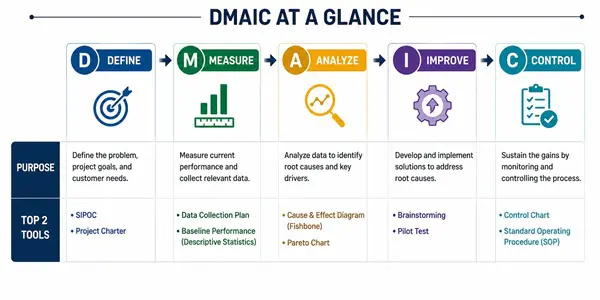
DMAIC stands for Define, Measure, Analyze, Improve, and Control. It is the core problem-solving methodology of Six Sigma. Each phase has specific tools and a specific deliverable. The Define phase produces a project charter. The Measure phase produces a process baseline. The Analyze phase confirms root causes. The Improve phase tests and implements solutions. The Control phase sustains the improvement.
Q4: When do you use DMAIC versus DMADV?
Use DMAIC when an existing process is not meeting customer requirements. It improves what already exists. Use DMADV when no process exists and you need to design one from scratch. DMADV stands for Define, Measure, Analyze, Design, and Verify. According to Shiksha Online, DMADV also applies when an existing process has been fully optimized but still fails to meet the required Six Sigma performance level.
Q5: What is a SIPOC diagram?
A SIPOC diagram maps the high level of a process. SIPOC stands for Suppliers, Inputs, Process, Outputs, and Customers. Teams build it in the Define phase to understand the process scope before collecting data. It shows what feeds the process, what the process produces, and who receives the output.
Also Read: How Difficult Is the Lean Six Sigma Exam? What the Facts Show by Belt Level
Category 2: Lean and Waste Questions
These questions test your understanding of the Lean side of Lean Six Sigma.
Q6: What are the eight wastes in Lean?

The eight wastes are defects, overproduction, waiting, non-utilized talent, transportation, inventory, motion, and excess processing. Many practitioners use the acronym DOWNTIME to remember them. Every waste consumes resources without adding value for the customer. Lean practitioners eliminate or reduce each waste to improve flow and speed.
Q7: What is value-added versus non-value-added activity?
A value-added activity changes the product in a way the customer cares about. The customer would pay for it if they could see it. A non-value-added activity consumes time or resources without adding that value. Lean improvement targets non-value-added steps first.
Q8: What is a Value Stream Map?
A Value Stream Map shows the complete flow of materials and information through a process. It displays each step, the time taken at each step, and the wait time between steps. Teams use it to find bottlenecks, excess inventory, and waste in the overall flow. It is one of the most powerful diagnostic tools in the Lean toolkit.
Q9: What is Kaizen?
Kaizen is a Japanese term meaning continuous improvement. In practice, a Kaizen event is a focused three to five day improvement effort. A cross-functional team works on a specific problem and implements a solution within the event window. Kaizen events produce fast, visible results and build team ownership of the improvement.
Category 3: Six Sigma Statistical and Tool Questions
These questions test technical depth. Green Belt candidates face most of these. Black Belt candidates face all of them plus more advanced statistical questions.
Q10: What is a Critical-to-Quality characteristic?
A Critical-to-Quality (CTQ) characteristic is a measurable attribute of a product or service that directly affects customer satisfaction. The Define phase translates customer requirements into specific, measurable CTQs. These become the project Y variables that the DMAIC project measures and improves.
Q11: What is process capability?
Process capability measures how well a process produces output within customer specification limits. Cp compares the specification width to the process spread. Cpk measures both the spread and whether the process is centered within the specification. A Cpk of 1.33 or above meets most customer requirements. A Cpk below 1.0 means the process produces defects regularly.
Q12: What is the difference between common cause and special cause variation?
Common cause variation is the natural, random variation present in every stable process. It comes from many small, uncontrollable factors acting together. Special cause variation comes from a specific, identifiable event — a machine malfunction, a bad batch of material, or an operator error. Control charts distinguish between the two. Common cause variation requires a process redesign. Special cause variation requires finding and removing the specific cause.
Q13: What is a fishbone diagram?
A fishbone diagram (also called an Ishikawa diagram or cause-and-effect diagram) maps the potential causes of a problem across six categories: Man, Machine, Method, Material, Measurement, and Environment. Teams use it in the Analyze phase to brainstorm root causes before confirming them with data. Shiksha Online describes it as a visualization tool for categorizing the potential causes of a problem to identify its root causes.
Q14: What is a control chart?
A control chart monitors process performance over time. It plots data points against a centerline and Upper and Lower Control Limits set at three standard deviations from the mean. Points outside the control limits or systematic patterns within them signal that a special cause has entered the process. Control charts are the primary tool of the Control phase.
Q15: What is the difference between a defect and a defective?
A defect is a single instance of a product failing to meet a specific requirement. A defective is a unit that contains one or more defects. One defective product might contain multiple defects. This distinction matters when setting up attribute control charts. The p-chart and np-chart track the proportion or count of defectives. The c-chart and u-chart track defect counts per unit.
Q16: What is Gauge R&R?
Gauge R&R (Repeatability and Reproducibility) is a Measurement System Analysis technique. Repeatability measures whether the same operator gets the same result when measuring the same part multiple times. Reproducibility measures whether different operators get the same result on the same part.
A measurement system contributing more than 10% of tolerance variation is marginal. More than 30% is unacceptable. Teams run Gauge R&R in the Measure phase to validate their data before drawing conclusions from it.
Also Read: Performance Baseline Measure: What It Is and How to Build One
Category 4: Scenario-Based Questions
These questions test your judgment. Interviewers present a realistic situation and ask what you would do.
Q17: A process has a high defect rate. How would you approach it?
Start by defining the problem clearly with data. Map the process with a SIPOC. Collect baseline data and validate the measurement system. Then use root cause tools — a fishbone diagram and Pareto analysis — to identify the most significant causes. Confirm those causes statistically. Implement and test solutions on a small scale before full deployment. Put a control plan in place to sustain the improvement.
Q18: Stakeholders resist your proposed process change. What do you do?
Use data to lead the conversation. Show stakeholders the current defect rate and its cost. Explain why the proposed change addresses the confirmed root cause. Invite stakeholders into the improvement process early. Involve them in piloting the solution so they own the result. Invensis Learning summarizes this as communicating benefits clearly and involving stakeholders throughout.
Q19: Your baseline data appears inconsistent. What is your next step?
Inconsistent data usually signals a measurement system problem. Run a Gauge R&R study to check whether the gauge is repeatable and reproducible. Review how operators collect data and whether the process was stable during data collection. Validate your data sources before drawing any conclusions. Building a project on unreliable data wastes every phase that follows.
Q20: How do you prioritize which improvement projects to pursue?
Prioritize based on three factors: business impact, feasibility, and return on investment. Projects with high defect costs, clear customer impact, and achievable root causes deliver the most value. A project selection matrix scores potential projects against these criteria. This keeps the improvement program focused on problems that matter to the business and to customers.
Category 5: Behavior-Based Questions
These questions ask about your real experience. Interviewers use them to evaluate how you apply the methodology, not just whether you know the terminology.
Q21: Describe a Lean Six Sigma project you led.

Structure your answer using the STAR method. Describe the Situation and why the problem mattered. Describe your Task as the project leader. Walk through the Actions you took at each DMAIC phase. Share the measurable Result. According to Invensis Learning, the strongest answers emphasize data-driven decisions, team collaboration, and quantified results — not just process steps.
Q22: Describe a time when a Six Sigma project did not go as planned.
Be honest and specific. Describe what happened, what you learned, and how you applied that learning to the next project. Interviewers value candidates who can diagnose failure and improve their own approach. A candidate who has never experienced a project challenge is either inexperienced or not being truthful.
Q23: How do you ensure that improvements are sustained after a project closes?
A control plan is the primary mechanism for sustainability. It documents what is monitored, how, and by whom. It defines what triggers a response and who is responsible. Process documentation and operator training reinforce the new standard. Regular audits detect early signs of regression. The project is not complete until these mechanisms are in place and functioning.
Frequently Asked Questions: Lean Six Sigma Interviews
Q: What types of questions appear in a Lean Six Sigma interview?
A: Lean Six Sigma interview questions fall into three categories. Subject-based questions test technical knowledge of tools and concepts such as DMAIC, process capability, and the eight wastes. Scenario-based questions test judgment by presenting a realistic process problem and asking what you would do. Behavior-based questions ask you to describe real projects and past experiences using the STAR method (Situation, Task, Action, Result).
Q: What is the most important topic to know for a Six Sigma interview?
A: DMAIC is the most important topic. Almost every Lean Six Sigma interview includes at least one question on the five phases, their key tools, and their deliverables. Beyond DMAIC, interviewers frequently test process capability (Cp and Cpk), the eight wastes, the difference between common cause and special cause variation, and what a control plan contains.
Q: Do I need to be certified to interview for a Six Sigma role?
A: Certification is not always required, but it significantly strengthens your candidacy. A Green Belt or Black Belt certification validates technical knowledge before the interview begins. It also demonstrates that you have completed documented training, which gives interviewers confidence in your foundation. Many employers list certification as a preferred or required qualification in their job postings.
Q: How do I answer behavior-based Six Sigma interview questions?
A: Use the STAR method: describe the Situation you faced, the Task you owned, the Actions you took at each DMAIC phase, and the measurable Result you achieved. Be specific. Name the tools you used, the data you collected, and the quantified improvement you delivered. Vague answers that describe the methodology without connecting it to a specific project are less persuasive than concrete examples.
Q: What is the difference between DMAIC and DMADV, and why do interviewers ask about it?
A: DMAIC improves an existing process that does not meet customer requirements. DMADV designs a new process from scratch when no adequate process exists. Interviewers ask about this because confusing the two is a common error. Using DMAIC on a problem that requires a new process design wastes project resources. Choosing correctly demonstrates that a candidate understands when each framework applies.
Q: How should I prepare for a Lean Six Sigma interview?
A: Review the core DMAIC phases and their tools thoroughly. Know the eight wastes by name and be able to give an example of each. Practice explaining process capability, control charts, and Gauge R&R clearly without jargon. Prepare two or three real project examples using the STAR method. Review any tools specific to the belt level you are interviewing for — Green Belt candidates need statistical tools including hypothesis testing and capability analysis.
How Six Sigma Certification Strengthens Your Interview Performance
Certification validates your technical knowledge before you walk into the room. It also gives you documented project experience to reference when answering behavior-based questions.
According to the UMass Amherst bootcamp, roughly 1.4 million professionals hold a Lean Six Sigma certification. Employers know what each belt level represents. A Green Belt tells an interviewer that you can lead a DMAIC project part-time while working in your primary role. A Black Belt tells them you can lead complex, cross-functional projects and mentor others.
At Six Sigma Development Solutions Inc., our training programs prepare candidates for both the certification exam and the job interview. We teach DMAIC tools in the context of real projects. Candidates leave with the vocabulary, the analytical skills, and the project experience that interviewers test for.
We offer training in three formats:
- Onsite training — delivered at your facility, with real process examples from your industry.
- Live virtual training — instructor-led sessions online with real-time interaction and Q&A.
- Online training — self-paced Green Belt and Black Belt programs you complete on your own schedule.
Explore our Six Sigma training programs or contact our team to find the right program for your career goals.
About Six Sigma Development Solutions, Inc.
Six Sigma Development Solutions, Inc. offers onsite, public, and virtual Lean Six Sigma certification training. We are an Accredited Training Organization by the IASSC (International Association of Six Sigma Certification). We offer Lean Six Sigma Green Belt, Black Belt, and Yellow Belt, as well as LEAN certifications.
Book a Call and Let us know how we can help meet your training needs.


