

Every new Lean Six Sigma practitioner makes mistakes. That is expected. The methodology is rigorous, the statistical tools are demanding, and the organizational dynamics are complex. But most beginner mistakes are not random. They follow a predictable pattern. The same errors appear across industries, across belt levels, and across every type of improvement project.
Recognizing these mistakes before you make them saves weeks of wasted effort. It protects your first project from the most common failure modes. And it separates practitioners who understand Lean Six Sigma deeply from those who have only memorized the terminology.
Table of contents
- What are the biggest mistakes beginners make in Lean Six Sigma?
- Key Takeaways
- Mistake 1: Choosing the Wrong Project
- Mistake 2: Writing a Problem Statement That Contains the Solution
- Mistake 3: Skipping or Rushing Measurement System Validation
- Mistake 4: Calculating Business Impact Too Late — or Not at All
- Mistake 5: Treating Lean and Six Sigma as Separate Programs
- Mistake 6: Jumping to Root Causes Without Data
- Mistake 7: Overcrowding the Project With Too Many Tools
- Mistake 8: Misidentifying Data Type
- Mistake 9: Ignoring Stakeholder Management
- Mistake 10: Treating the Control Phase as Optional
- Frequently Asked Questions: Lean Six Sigma Beginner Mistakes
What are the biggest mistakes beginners make in Lean Six Sigma?

The most common beginner mistakes include: selecting the wrong project, embedding a solution in the problem statement, skipping measurement system validation, jumping to solutions before confirming root causes, ignoring stakeholder management, under-investing in training, treating the Control phase as optional, misidentifying data types, overcrowding projects with too many tools, and failing to calculate the financial impact of the project.
Most of these mistakes occur in the Define and Measure phases, before the real analysis work has even started.
Key Takeaways
- Most Lean Six Sigma failures trace back to the Define phase. Weak problem statements, poor project selection, and missing business impact calculations doom projects before data collection begins.
- According to SixSigma.us, potential business impact must be calculated in the first DMAIC phase. Projects without a quantified financial case struggle to maintain stakeholder support.
- Skipping measurement system validation (Gauge R&R) is one of the most damaging early mistakes. Unreliable data produces unreliable analysis.
- CertiProf identifies embedding a solution in the problem statement as a fundamental error. Problem statements must describe the problem only. Solutions belong in the Improve phase.
- According to Lean 6 Sigma Hub, overcomplicated tool selection is a common beginner trap. A Pareto chart that identifies 80% of defects often outperforms an unnecessary multivariate analysis.
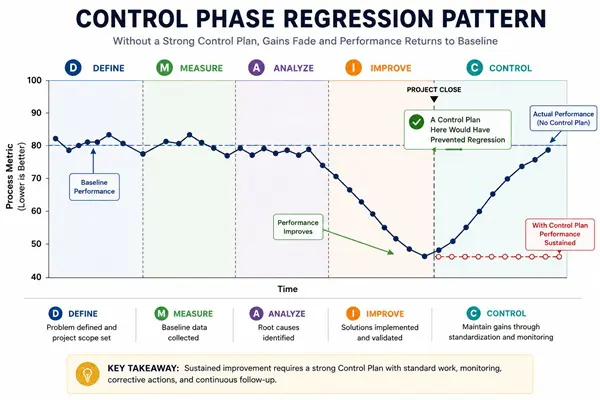
- Treating the Control phase as optional is a mistake that erases gains. Without a control plan and monitoring system, process improvements regress within months.
- Six Sigma Development Solutions offers onsite, live virtual, and online training. Our programs specifically teach practitioners to avoid these mistakes using real project examples.

Public, Onsite, Virtual, and Online Six Sigma Certification Training!
- We are accredited by the IASSC.
- Live Public Training at 52 Sites.
- Live Virtual Training.
- Onsite Training (at your organization).
- Interactive Online (self-paced) training,
Mistake 1: Choosing the Wrong Project
Project selection is the most consequential decision a beginner makes. Choose the wrong project and the entire DMAIC cycle produces nothing of value to the business.
CertiProf identifies this as one of the most common failures: “Many teams make the mistake of addressing areas with no significant impact on the organization. Choosing vague problems or those not aligned with strategic objectives.”
A good Six Sigma project has three characteristics. It has a measurable problem with documented data. It connects to a strategic organizational priority. And it has a quantified financial or quality impact that justifies the time and resources the project will consume.
Beginners often select projects that are interesting to them personally or convenient to access. They pick problems that are already well-understood and need only execution, not investigation. Or they pick problems so large and complex that no single DMAIC project can address them.
The fix is a formal project selection process. Use a project prioritization matrix that scores potential projects on impact, feasibility, and strategic alignment. Only start a project that scores well on all three.
Also Read: What Is Six Thinking Hats? The Six Hats, and How It Connects to Six Sigma
Mistake 2: Writing a Problem Statement That Contains the Solution
The Define phase produces a problem statement. That statement describes the problem. It does not describe the solution.
Beginners consistently embed solutions into problem statements. Airacad calls this one of the most predictable errors: “Teams often embed solutions within problem descriptions, which predetermines the improvement approach before analyzing data. This violates the fundamental Six Sigma principle of data-driven decision making. Solutions belong in the Improve phase, not the Define phase.”
A problem statement that reads “We need to retrain the operators on the assembly line” is not a problem statement. It is an improvement action. The actual problem might be “The assembly line produces a 4.2% defect rate on Product X, against a target of below 1%.”
The correct problem statement quantifies the current performance, states the target, and leaves the cause and solution open for investigation. Any statement that names a cause or a solution has crossed the line from defining a problem to prescribing an answer.
Mistake 3: Skipping or Rushing Measurement System Validation

Before collecting process data, the team must confirm that the measurement system produces reliable results. This step — Measurement System Analysis (MSA), specifically Gauge R&R — is one of the most skipped in beginner DMAIC projects.
A gauge contributing more than 10% of the tolerance variation is marginal. More than 30% is unacceptable. Building a DMAIC project on data from an unvalidated gauge produces a false baseline, a misleading capability index, and an analysis that points at the wrong root causes.
The fix is simple: run Gauge R&R before collecting baseline data. Confirm the measurement system is acceptable before trusting the numbers it produces.
Mistake 4: Calculating Business Impact Too Late — or Not at All
Beginners frequently begin a DMAIC project without calculating what the improvement is worth. They identify a problem, build a project charter, and start collecting data before anyone has quantified why the problem matters financially.
This creates two downstream problems. The project lacks a compelling business case to maintain leadership support when the work gets difficult. And the team has no quantified target to anchor the Improve phase’s success criteria.
Calculate Cost of Poor Quality (COPQ) during the Define phase. Show the financial impact of the current defect rate: scrap costs, rework hours, warranty claims, customer return costs, and lost production capacity. A project with a $250,000 annual COPQ attracts and keeps sponsor attention throughout the full DMAIC cycle.
Mistake 5: Treating Lean and Six Sigma as Separate Programs
Beginners sometimes apply one framework and ignore the other. They run a Lean event to reduce cycle time and never address process variation. Or they run a Six Sigma DMAIC project focused purely on statistics and never map the value stream or address waste.
Lean and Six Sigma are complementary. Lean identifies and removes waste. Six Sigma identifies and reduces variation. A process with waste produces slow, costly output. A process with variation produces unpredictable, defect-prone output. Most real processes have both problems simultaneously.
The strongest improvement projects address both. Use value stream mapping to identify waste during the Analyze phase. Use hypothesis testing and capability analysis to address variation. Apply both frameworks to the same problem.
Mistake 6: Jumping to Root Causes Without Data
The Analyze phase exists to confirm root causes using data. Many beginners enter the Analyze phase with a hypothesis already formed — and spend the phase finding evidence to support it rather than testing it rigorously.
LinkedIn process improvement experts describe this pattern clearly: “Another common mistake is to jump to conclusions based on assumptions, opinions, or biases, rather than on data and facts.”
Root cause analysis tools (fishbone diagrams, 5 Whys, fault tree analysis) generate hypotheses about what might be causing the problem. Those hypotheses must then be confirmed statistically before the Improve phase begins. A fishbone session produces a list of possible causes. Hypothesis testing confirms which ones actually drive the outcome.
Implementing a solution based on an unconfirmed hypothesis is the most common reason why Six Sigma improvements fail to hold. The team fixed the wrong thing.
Also Read: What Is Stakeholder Mapping? Why It Matters in Six Sigma Projects
Mistake 7: Overcrowding the Project With Too Many Tools
Lean Six Sigma provides a large toolkit. Beginners sometimes feel pressure to demonstrate technical sophistication by using as many tools as possible.
Tool selection should follow the problem. Use the simplest tool that answers the question completely. A Pareto chart that clearly identifies the top defect sources is more useful than a DOE that produces the same answer in a format no stakeholder can interpret.
The purpose of Six Sigma tools is to produce actionable insight. When the tools become the goal rather than the means, projects slow down and stakeholders disengage.
Mistake 8: Misidentifying Data Type
Whether process data is continuous or attribute determines which statistical tool is valid. Beginners frequently misclassify their data type, then apply the wrong control chart or the wrong hypothesis test.
Continuous data (cycle time, weight, temperature, dimension) requires X-bar and R charts, t-tests, and ANOVA. Attribute data (pass/fail, defective/conforming, error/no error) requires p-charts, np-charts, chi-square tests, and proportion tests.
Using an X-bar chart on attribute data produces meaningless control limits. Using a t-test on attribute data assumes normality that does not apply. The misclassification corrupts the entire analytical output.
The fix is to identify data type explicitly during the data collection plan phase. Write it as a column in the plan. Decide which chart and which test you will use before the data is collected. Then stick to that plan.
Mistake 9: Ignoring Stakeholder Management
Beginners focus on the technical work and treat stakeholder communication as secondary. They present a final report at the end and expect acceptance. By then, key stakeholders who were not involved during the project have developed their own understanding of the problem — often incorrect — and resist solutions that contradict their mental model.
Effective stakeholder management starts in the Define phase. Identify every stakeholder who is affected by the process or the improvement. Communicate with them regularly throughout the project. Involve them in the problem confirmation, the root cause discussion, and the solution design. People support what they help build.
Mistake 10: Treating the Control Phase as Optional
The Control phase is where improvement projects die most quietly. Beginners complete the Improve phase, declare success, and move on. Within three to six months, the process reverts to its previous performance as old habits and process conditions return.
A control plan specifies what to monitor, how often, who monitors it, and what action to take when performance drifts toward the previous baseline. A statistical process contcontrol chart makes drift visible before it becomes a problem. Without these mechanisms, every improvement is temporary.
Frequently Asked Questions: Lean Six Sigma Beginner Mistakes
Q: What is the most common mistake beginners make in Lean Six Sigma?
A: The most common mistake is poor project selection — choosing a problem with no significant business impact, no measurable data, or no connection to strategic priorities. CertiProf identifies this as the starting point for most project failures. A poorly selected project wastes the team’s time even when executed flawlessly, because it produces improvements that no one needed.
Q: Why do so many Six Sigma projects skip measurement system validation?
A: Beginners typically skip Gauge R&R because they assume the measurement instruments they already use are reliable. They treat validation as a formality rather than a prerequisite. This assumption is frequently wrong. A gauge contributing 25% or more of tolerance variation produces data that reflects instrument error as much as process performance. Every analysis built on that data leads in the wrong direction.
Q: What is the problem with embedding a solution in the problem statement?
A: A problem statement that contains a solution predetermines the outcome of the entire DMAIC investigation before any data is collected. According to Airacad, this violates Six Sigma’s fundamental principle of data-driven decision making. The solution may be correct, but the team has no way to confirm it because they never properly investigated alternative root causes. Projects built on assumed solutions frequently fix the wrong thing.
Q: Why do Six Sigma improvements fail to hold after the project closes?
A: Improvements fail to hold when the Control phase is treated as optional. Without a documented control plan, a monitoring system (SPC charts), and trained process owners, the process gradually reverts to its old behavior. SixSigma.us identifies weak post-project control as one of the most consistent Six Sigma management mistakes. A project is only complete when the control mechanisms are installed and functioning.
Q: Is it always better to use more complex statistical tools?
A: No. Lean 6 Sigma Hub explicitly identifies over-complexity as a common beginner trap. Simple tools used correctly outperform complex tools used unnecessarily. A Pareto chart that identifies the top three defect sources in 20 minutes provides more actionable insight than a multivariate analysis that takes two weeks and produces a result no stakeholder can interpret. Match the tool to the problem’s complexity.
Q: How important is stakeholder involvement in a Six Sigma project?
A: Stakeholder involvement is critical throughout the project, not just at the end. Anexas lists stakeholder neglect as a core Six Sigma failure category. Key stakeholders who are not involved during the project develop their own understanding of the problem. When they receive a final report, they often resist solutions that contradict their mental model. Early and consistent communication prevents this resistance from derailing the Improve phase.
How Six Sigma Training Prevents These Mistakes
Most of these mistakes are predictable precisely because they are not unique. They appear in the same phases, for the same reasons, across thousands of DMAIC projects. That makes them preventable.
Structured Six Sigma training addresses each mistake directly. Green Belt training teaches project selection criteria, operational definition writing, Gauge R&R, root cause confirmation, and control plan design. It builds the skills that prevent beginners from repeating the most common errors on their first real project.
At Six Sigma Development Solutions, our Green Belt and Black Belt programs teach DMAIC using real project examples. Practitioners learn to recognize mistake patterns before they encounter them.
We offer training in three formats:
- Onsite training — delivered at your facility, using your real processes as the project context.
- Live virtual training — instructor-led sessions online with real-time problem-solving exercises.
- Online training — self-paced Green Belt and Black Belt certification programs at your own pace.
Explore our Six Sigma training programs or contact our team to find the right program for your goals.
About Six Sigma Development Solutions, Inc.
Six Sigma Development Solutions, Inc. offers onsite, public, and virtual Lean Six Sigma certification training. We are an Accredited Training Organization by the IASSC (International Association of Six Sigma Certification). We offer Lean Six Sigma Green Belt, Black Belt, and Yellow Belt, as well as LEAN certifications.
Book a Call and Let us know how we can help meet your training needs.


