
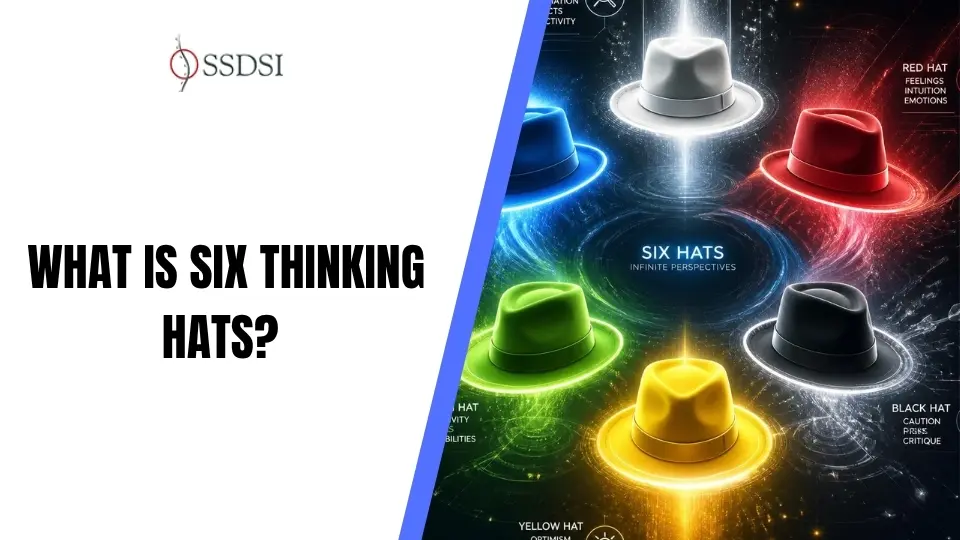
Six Thinking Hats is a structured thinking method created by Dr. Edward de Bono and published in his 1985 book of the same name. It divides thinking into six distinct modes, each represented by a colored hat. Teams use it to examine a problem from six separate angles in sequence. Wikipedia’s DMAIC article names Six Thinking Hats directly as a tool for generating solutions in the Improve phase of DMAIC.
Table of contents
What Is Six Thinking Hats?
Six Thinking Hats is a parallel thinking method. Dr. Edward de Bono introduced it in his 1985 book, published by Little, Brown and Company.
The De Bono Group’s official product page describes it this way: “Six Thinking Hats is a simple, effective parallel thinking process that helps people be more productive, focused, and mindfully involved.”
The De Bono Group’s book page states: “The Six Hats method is a devastatingly simple technique based on the brain’s different modes of thinking.” (Source: debono.com)
The core idea is straightforward. People naturally try to evaluate facts, emotions, risks, and creative possibilities all at once. That creates confusion. It slows discussion. It leads to argument rather than analysis.
Six Thinking Hats solves this. It focuses the entire team on one mode of thinking at a time. When everyone wears the same hat, everyone thinks in the same direction simultaneously.
That principle is called parallel thinking. De Bono contrasted it with the traditional Western approach to discussion, which is based on argument and debate.
Mindtools describes the result: “By wearing each of the Six Thinking Hats in turn, you can gain a rich understanding of the issues you face and the best ways forward. You also encourage everyone to be fully involved in the decision-making process.”
About Dr. Edward de Bono
Dr. Edward de Bono was a Maltese physician, psychologist, and philosopher.
He coined the term “lateral thinking” in 1967. The term now appears in the Oxford English Dictionary. He was nominated for the Nobel Prize in Economics in 2005. He died in 2021.
His concepts shaped practices at major companies worldwide. His methods have been adopted in school curricula in multiple countries.
Six Thinking Hats is one of his most widely applied frameworks. The book rates 4.6 stars on Amazon across 1,987 reviews and 3.7 stars on Goodreads across 13,656 reviews as of the Readingraphics summary published in March 2026.
De Bono chose the hat as his central metaphor deliberately. A hat can be put on and taken off quickly. Switching hats signals a deliberate change in thinking direction. It externalizes the switch so the whole team sees it and follows it.

Public, Onsite, Virtual, and Online Six Sigma Certification Training!
- We are accredited by the IASSC.
- Live Public Training at 52 Sites.
- Live Virtual Training.
- Onsite Training (at your organization).
- Interactive Online (self-paced) training,
The Six Hats: What Each One Means

De Bono defined six thinking directions. Each has a color. The colors are not arbitrary. They reflect the nature of each thinking mode.
White Hat: Facts and Data
The white hat covers objective information. What do we know? What data do we have? What information is missing?
De Bono described white hat thinking as imitating a neutral computer. It delivers facts without opinion, emotion, or interpretation. White is the color of paper, associated with neutral information.
Red Hat: Emotions and Intuition
The red hat covers feelings, emotions, and gut reactions. No justification is required. The red hat gives everyone permission to express how they feel about an idea without having to defend that feeling logically.
Red represents fire and warmth, associated with emotion.
Black Hat: Caution and Critical Judgment
The black hat covers critical thinking. What are the risks? Why might this idea fail? What are the legal, regulatory, or financial problems?
De Bono considered the black hat the most used and most abused hat. Overusing it shuts down creative thinking. But using it at the right moment prevents costly mistakes.
The University of South Australia’s faculty resource on Six Thinking Hats provides this example of black hat thinking in practice: “Costs: This proposal would be too expensive. Regulations: I don’t think the regulations allow it. Design: This design might look nice, but it is not functional.”
Yellow Hat: Optimism and Positive Value
The yellow hat covers the benefits and positive possibilities of an idea. Why might it work? What value does it create? What are the opportunities?
Yellow represents sunshine and optimism. Yellow hat thinking requires effort. De Bono noted that positive thinking is not always natural. It needs to be deliberately practiced.
Green Hat: Creativity and New Ideas
The green hat covers creative thinking, alternatives, and new possibilities. Teams use it to generate ideas without judgment.
Green represents growth and vegetation. When the group wears the green hat, criticism is suspended. The goal is to produce ideas. Evaluation comes later under the black hat.
Blue Hat: Process Control
The blue hat manages the thinking process itself. The facilitator or session leader typically uses it. The blue hat opens and closes sessions. It summarizes outputs and decides which hat comes next.
Blue represents the sky. It is the overview hat. De Bono described the blue hat as the conductor of the orchestra. It does not play an instrument. It directs what happens and in what order.
Also Read: System Thinking
The Parallel Thinking Principle
The key to Six Thinking Hats is that everyone wears the same hat at the same time.
This is parallel thinking. It is the opposite of debate.
In traditional debate, one person argues for and another argues against. Everyone defends their position. The goal is to win. This produces conflict, not insight.
In parallel thinking, the whole group looks in the same direction together. Then the group switches direction together. The result is a more complete picture of any problem.
Toolshero summarizes this clearly: “In de Bono’s six thinking hats, everybody shares each other’s opinions about the problems, advantages, and facts, reducing distraction and supporting thought cross pollination.”
The hats also remove ego from the discussion. Toolshero notes: “There is no ego to be exerted from attacking and putting down others to get your way or show off how clever you are. The only way to exert your ego with Six Hats is to be a good thinker.”
How to Run a Six Thinking Hats Session

Use the following steps to run a structured Six Thinking Hats session.
Step 1: Define the topic or problem. State the topic clearly before the session starts. Everyone needs to understand what they are thinking about. The blue hat facilitator leads this step.
Step 2: Plan your hat sequence. The order of hats depends on the goal of the session. A common sequence for problem-solving is: Blue (open the session and agree the process), White (review available facts), Red (collect initial reactions), Black (identify risks and weaknesses), Yellow (explore benefits and opportunities), Green (generate creative alternatives), and Blue again (summarize and decide next steps).
De Bono noted that the sequence can be adapted to fit the specific need. The sequence is planned, not fixed.
Step 3: Run each hat round. Everyone thinks under the same hat at the same time. Contributions are made in turn or as a group. The facilitator ensures no one switches hats mid-round.
Step 4: Summarize each round. Before moving to the next hat, the facilitator summarizes what was said. This keeps the session focused and builds a shared record.
Step 5: Close with the blue hat. The final blue hat round reviews what the session produced. It identifies decisions made, questions still open, and next steps assigned.
Session length: A focused Six Thinking Hats session on a single problem can run 20 to 45 minutes. Complex problems with multiple rounds may take longer. The method is designed to replace unfocused meetings of equal or greater length with a structured process that produces clearer outputs in less time.
Also Read: Critical Thinking
Six Thinking Hats in Six Sigma DMAIC
Six Thinking Hats connects directly to DMAIC project work.
Wikipedia’s DMAIC article states directly in the Improve phase section: “Identify creative solutions to eliminate the key root causes in order to fix and prevent process problems. One can use brainstorming or techniques like Six Thinking Hats and random word.”
The DEV Community’s comprehensive Six Sigma guide confirms its role: “The Improve phase converts root causes into practical solutions. It includes generating ideas through techniques like Six Thinking Hats or expert input.”
Here is how Six Thinking Hats maps to DMAIC phases:
Define phase: The blue hat opens team meetings. White hat thinking reviews what is known about the problem. Red hat collects initial reactions to the problem statement from the team.
Analyze phase: Black hat thinking identifies what risks and weaknesses the data reveals. White hat ensures the team focuses on facts, not opinions. Green hat generates possible root causes when brainstorming causes for a fishbone diagram.
Improve phase: This is the primary phase for Six Thinking Hats in Six Sigma. Green hat generates solution ideas freely. Yellow hat evaluates the positive case for each solution. Black hat identifies risks in each proposed solution before it is selected. This sequence replaces unstructured idea generation with a disciplined process.
Control phase: Black hat thinking identifies risks in the control plan. Yellow hat confirms the value of proposed monitoring steps. Blue hat facilitates the handover meeting with the process owner.
Six Thinking Hats does not replace DMAIC tools like fishbone diagrams, hypothesis testing, or Design of Experiments. It structures how the team thinks and communicates during those activities.
Why Six Thinking Hats Matters for Six Sigma Teams
Six Sigma projects involve cross-functional teams. Engineers, operations staff, finance representatives, and managers often sit in the same room.
Each person brings a different perspective. Without structure, those perspectives collide rather than combine. The loudest voice wins. The quietest voice never speaks.
Six Thinking Hats prevents this. Every person contributes under each hat. The process creates space for the cautious person to speak under the black hat and the creative person to contribute under the green hat. Both are equal when everyone is wearing the same hat.
De Bono noted that traditional business meetings often produce “spaghetti thinking,” where one person focuses on benefits while another challenges facts and a third worries about risk simultaneously. Nobody hears the full picture. Six Thinking Hats sequences those perspectives to give every angle its full attention.
FAQ: Six Thinking Hats
What is the Six Thinking Hats method?
Six Thinking Hats is a parallel thinking method created by Dr. Edward de Bono and published in his 1985 book of the same name. It divides thinking into six distinct modes, each represented by a colored hat: White (facts), Red (emotions), Black (caution), Yellow (optimism), Green (creativity), and Blue (process). Teams use it to examine a problem from one perspective at a time, with everyone thinking in the same direction simultaneously.
Who created the Six Thinking Hats?
Dr. Edward de Bono created the Six Thinking Hats method. De Bono was a Maltese physician, psychologist, and philosopher. He coined the term lateral thinking in 1967. He published the Six Thinking Hats book in 1985 through Little, Brown and Company. He was nominated for the Nobel Prize in Economics in 2005. He died in 2021.
What does each hat in Six Thinking Hats represent?
White hat: objective facts and data. Red hat: emotions and gut reactions without justification. Black hat: risks, caution, and critical judgment. Yellow hat: benefits, optimism, and positive possibilities. Green hat: creativity, alternatives, and new ideas. Blue hat: process control, facilitation, and session management.
How does Six Thinking Hats connect to Six Sigma?
Wikipedia’s DMAIC article lists Six Thinking Hats as a specific technique for generating solutions in the Improve phase of DMAIC. Six Sigma teams use it during brainstorming sessions to structure idea generation, evaluate solutions systematically, and identify risks before selecting a course of action. It replaces unstructured team debate with a focused, sequential thinking process.
When should you use Six Thinking Hats in a DMAIC project?
Use it most often in the Improve phase when generating and evaluating solution ideas. It is also useful in the Define phase to surface team reactions to a problem statement and in the Analyze phase to organize brainstorming of potential root causes. The blue hat is useful in any DMAIC phase gate meeting to structure the agenda and summarize outputs.
Can Six Thinking Hats be used by an individual, not just a team?
Yes. De Bono designed the method for both individual and group use. An individual can work through each hat in sequence when evaluating a decision or solving a problem alone. In a team setting, the impact is greater because it prevents one perspective from dominating the discussion and gives every team member a structured role in the thinking process.
How SSDSI Teaches Team Thinking Tools
At Six Sigma Development Solutions, we train Green Belts and Black Belts to lead projects and facilitate teams effectively.
Team facilitation is a core Black Belt skill. Running a brainstorming session, managing diverse perspectives, and producing structured outputs from a team meeting are all taught in our programs.
Six Thinking Hats is one of the structured thinking tools our practitioners learn to apply in the Improve phase of DMAIC. It pairs directly with brainstorming, affinity diagrams, and solution prioritization tools.
We deliver training in three formats. Onsite training brings instructors to your organization. Live virtual training delivers instructor-led sessions in real time online. Online self-paced training lets individuals build skills on their own schedule.
Every format prepares you for the IASSC certification exam. SSDSI is an IASSC Accredited Training Organization.
Ready to build stronger project facilitation skills?
Explore SSDSI’s Green Belt and Black Belt programs in onsite, live virtual, or online formats.
About Six Sigma Development Solutions, Inc.
Six Sigma Development Solutions, Inc. offers onsite, public, and virtual Lean Six Sigma certification training. We are an Accredited Training Organization by the IASSC (International Association of Six Sigma Certification). We offer Lean Six Sigma Green Belt, Black Belt, and Yellow Belt, as well as LEAN certifications.
Book a Call and Let us know how we can help meet your training needs.


