

Most Six Sigma exam mistakes fall into three groups: preparing the wrong way, losing time on test day, and falling for concept traps. The biggest ones are studying for the wrong exam format, using an outdated blueprint, skipping statistics, and leaving questions blank. This guide groups 22 mistakes and gives a fix for each.
Check whether your exam is open book (ASQ) or closed book (IASSC). Study to the current weights. On the 2026 IASSC Green Belt blueprint, Measure is 32% and Analyze is 22%. Take timed mocks, answer every question, and log each miss by type. You need 70% to pass the IASSC exam.
The Biggest Mistakes at a Glance
| Six mistakes that cost the most marks | |
| Mistake | Quick fix |
| Wrong exam format | Learn your issuer’s rules: ASQ is open book, IASSC is closed book. |
| Outdated blueprint | Use the current syllabus weights. |
| Weak statistics | Drill capability, MSA, and test selection. |
| Poor pacing | Plan about 1.8 minutes per question on the IASSC Green Belt. |
| Blank answers | Answer every question after you confirm there is no penalty. |
| Repeat errors | Log each miss by type and fix the pattern. |
Details for each mistake follow below.
Exam mistakes fall into three groups.
Three columns. Preparation: wrong format, outdated blueprint, skipped statistics. Test day: poor pacing, blank answers, misread questions. Concept traps: averaging yields, Cp versus Cpk, wrong hypothesis test.
Table of contents
Key Takeaways
- Know your exam rules first. ASQ allows bound references. IASSC allows only its provided reference document.
- Study to the current blueprint. Measure and Analyze make up 54% of the IASSC Green Belt exam.
- The exam tests application up to the Evaluate level. Definitions alone are not enough.
- Pace yourself. The IASSC Green Belt gives 1.8 minutes per question.
- Answer every question. The IASSC syllabus lists one mark per question and no penalty.
- Track mistakes by type: knowledge, calculation, reading, or timing.
Why People Miss the Pass Mark
The IASSC Green Belt pass mark is 70%, or 70 marks out of 100. The exam targets five levels of thinking: remember, understand, apply, analyze, and evaluate. Many candidates prepare only for the first two.
The blueprint is also uneven. The January 2026 PeopleCert syllabus gives Define 19%, Measure 32%, Analyze 22%, Improve 8%, and Control 19%. Several study pages still say each phase gets about 20%. A candidate who follows that older claim can under-study Measure and Analyze, which carry most of the marks.
Exam bodies do not publish common error data. So the mistakes below come from the exam rules, the syllabus, and standard exam technique. They fall into three groups.

Public, Onsite, Virtual, and Online Six Sigma Certification Training!
- We are accredited by the IASSC.
- Live Public Training at 52 Sites.
- Live Virtual Training.
- Onsite Training (at your organization).
- Interactive Online (self-paced) training,
Group 1: Preparation Mistakes
Most marks are lost before exam day. These seven mistakes are the most costly:
| Preparation mistakes, why they cost marks, and fixes | ||
| Mistake | Why it costs marks | Fix |
| 1. Preparing for the wrong exam format | IASSC is closed book. ASQ is open book with bound references only. | Confirm your issuer and read its rules first. |
| 2. Using an outdated blueprint | Some guides assume 20% per phase. The 2026 IASSC syllabus gives Measure 32% and Improve 8%. | Study to the current syllabus weights. |
| 3. Memorizing terms instead of applying them | The exam targets up to the Evaluate level. | Practice scenario questions. Explain each answer in your own words. |
| 4. Skipping the statistics | Measure and Analyze together make up 54% of the IASSC exam. | Drill capability, measurement systems, and test selection first. |
| 5. Never practicing with a formula reference | IASSC provides a reference document of formulas and tables. You cannot bring your own. | Ask your provider what the document covers. Practice choosing the right formula. |
| 6. Relying on leaked or “real” questions | IASSC draws tests from a regularly updated bank. No one gets the same test twice. | Use original practice questions and learn the reasoning. |
| 7. Skipping timed mocks | Untimed practice hides pace problems. | Take a timed mock when you are about two-thirds through the syllabus. |
Weights and the reference document rule come from the January 2026 PeopleCert IASSC Green Belt syllabus.
Mistake 6 deserves a note. Leaked questions teach answers, not reasoning. The exam tests scenarios, so a changed number or a new context breaks a memorized answer. Use original practice instead, such as SSDSI’s 20 sample Green Belt questions.
Know Your Exam Rules: ASQ vs IASSC
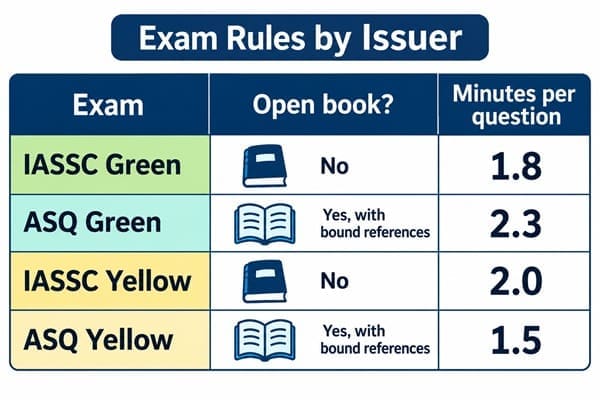
The two main issuers run very different exams. Candidates who prepare for one and sit the other lose marks.
| Exam rules by issuer and belt | ||||
| Item | IASSC Green | ASQ Green | IASSC Yellow | ASQ Yellow |
| Questions | 100 | 110 (100 scored, 10 unscored) | 60 | 90 (80 scored, 10 unscored) |
| Exam time | 180 minutes | 258 minutes | 120 minutes | 138 minutes |
| Minutes per question | 1.8 | About 2.3 | 2.0 | About 1.5 |
| Open book? | No. Provided reference document only. | Yes. Bound references only. | No (closed book) | Yes. Bound references only. |
Sources: PeopleCert syllabus, ASQ certification pages, and SSDSI and Invensis Learning for the IASSC Yellow Belt. ASQ’s unscored questions look like scored ones.
Three points matter most:
- IASSC is closed book. You may use only the reference document provided.
- ASQ is open book, but only for bound references. Loose sheets are not allowed, and collections of questions and answers are banned.
- Open book is not a shortcut. At about 2.3 minutes per question, you cannot look up unfamiliar topics. Study as if the exam were closed book.
Read SSDSI’s guide to ASQ vs IASSC if you are still choosing a route.
Open-book rules and pace differ by issuer.
IASSC Green Belt: closed book, 1.8 minutes per question. ASQ Green Belt: open book with bound references, about 2.3 minutes per question. IASSC Yellow Belt: closed book, 2.0 minutes per question. ASQ Yellow Belt: open book with bound references, about 1.5 minutes per question.
Yellow Belt Exam Mistakes
Yellow Belt candidates make two extra mistakes. First, they study Analyze and Improve topics. The IASSC Yellow Belt covers Define, Measure, and Control only. Second, they assume the exam is open book. The IASSC Yellow Belt is closed book and proctored. Check the syllabus for your exact topics.
Group 2: Test-Day Mistakes
Good preparation can still fail under time pressure. Avoid these six errors:
| Test-day mistakes, why they cost marks, and fixes | ||
| Mistake | Why it costs marks | Fix |
| 8. Spending too long on one question | At 1.8 minutes per question, one stuck item can cost you two others. | Set a two-minute limit. Guess, flag if allowed, and return later. |
| 9. Leaving answers blank | Each question is worth one mark. The IASSC syllabus lists no penalty for wrong answers. | Answer every question. Confirm the rule with your provider. |
| 10. Misreading the question | Words like NOT, EXCEPT, and “most likely” flip the answer. Units can too. | Underline the ask. Read every option before you choose. |
| 11. Skipping “unscored” items on ASQ exams | Ten of the 110 questions are unscored, but you cannot tell which. | Treat every question as scored. |
| 12. Packing the wrong ASQ references | ASQ requires bound references and bans collections of questions and answers. | Check ASQ’s open-book rules before you bind anything. |
| 13. Skipping the proctoring checks | IASSC exams run by web proctor or in a classroom. | Test your setup and ID rules the day before. |
A two-minute limit is a suggestion. Adjust it to your pace.
A Simple Time Budget
Here is a pacing plan for the 180-minute IASSC Green Belt exam. First, move through all 100 questions at about 1.2 minutes each. That takes about 120 minutes. Answer what you know and flag the rest. Then use the last 60 minutes for flagged questions and a final check. This plan is a suggestion, so try it in a timed mock first.
Group 3: Concept Traps
These traps appear again and again in practice questions. Each one has a clear right move.
| Concept traps and the right move | ||
| Trap | The wrong move | The right move |
| 14. Averaging yields | Average 98%, 95%, and 90% to get 94.3%. | Multiply them. RTY is 83.8%. |
| 15. Ignoring opportunities in DPMO | 30 defects in 400 units gives 75,000. | Divide by 400 × 5 opportunities. DPMO is 15,000. |
| 16. Confusing Cp and Cpk | Report Cp of 1.67 for a limit of 90 to 110, mean 104, and sigma 2. | Report Cpk. It is 1.00 because the process runs off center. |
| 17. Misreading the p-value | “A p of 0.03 means a 3% chance the null is true.” | Reject the null when p is below alpha. The p-value is not that chance. |
| 18. Picking the wrong hypothesis test | A t-test for three groups, or for skewed data. | One-way ANOVA for three or more normal groups. Mann-Whitney for two skewed groups. |
| 19. Mixing up control charts | A P chart for defects per unit. | U chart for defects per unit. P or NP for defective items. I-MR for single readings. |
| 20. Confusing control limits with spec limits | “Out of control means out of spec.” | Control limits come from process data. Spec limits come from the customer. |
| 21. Learning only one Lean waste list | Memorize seven wastes and miss “non-utilized talent.” | Learn both lists in the syllabus and match them by meaning. |
| 22. Treating significance as value | “A significant result is worth doing.” | Check the size of the effect and the cost. Practical and statistical significance differ. |
The syllabus intro lists eight wastes (Defects, Over-Production, Waiting, Non-Utilized Talent, Transportation, Inventory, Motion, Extra-Processing). Its detailed table lists seven (Overproduction, Correction, Inventory, Motion, Overprocessing, Conveyance, Waiting).
Many of these traps appear in SSDSI’s sample set: yields (Question 3), DPMO (Question 2), Cpk (Question 10), the p-value (Question 11), test choice (Questions 12 and 13), and control limits (Question 18). Work through the sample questions and compare your answers.
Three calculation traps, with the wrong and right answers.
Three cards. RTY: wrong is averaging to 94.3 percent, right is multiplying to 83.8 percent. DPMO: wrong is 75,000 from ignoring opportunities, right is 15,000. Cpk: wrong is reporting Cp of 1.67, right is Cpk of 1.00.
Where to Spend Your Study Time
Match your study hours to the exam weights. The table assumes 20 study hours. Each figure is the exam share times 20.
| Suggested study hours by phase (20-hour plan) | |||
| Phase | Exam share | Study hours | Top traps |
| Define | 19% | 3.8 | Wrong waste list, DPMO opportunities, vague problem statements |
| Measure | 32% | 6.4 | Cp versus Cpk, Gage R&R limits, using RPN alone |
| Analyze | 22% | 4.4 | Test choice, p-value meaning, Type I versus Type II |
| Improve | 8% | 1.6 | What R² means, residual patterns |
| Control | 19% | 3.8 | Chart choice, control versus spec limits, response plans |
The study hours are a suggestion. They add up to 20 hours.
Then adjust for your own weak spots. A strong statistician can shift hours from Analyze to Define. A new learner may need more time in Measure.
The Four-Type Error Log
The four-type error log turns every wrong answer into a fix. After each practice set, tag each miss with one type:
- Knowledge: you did not know the concept.
- Calculation: you knew the concept but made a math error.
- Reading: you misread the question or the units.
- Timing: you rushed or ran out of time.
| Example error log (illustrative entries) | |||
| Topic | Phase | Mistake type | Fix |
| Cpk calculation | Measure | Calculation | Redo three Cpk problems by hand. |
| Choosing ANOVA or t-test | Analyze | Knowledge | Study the test selector and drill 10 scenarios. |
| “Which is NOT a waste” | Define | Reading | Underline NOT before reading options. |
| Last 15 questions rushed | All | Timing | Practice a two-minute limit per question. |
Entries are examples. Build your own after every practice set.
Look at the pattern. If most misses are Reading or Timing, more content study will not help. Practice pacing and careful reading instead. If most misses are Knowledge, return to the syllabus topic and its phase weight.
Tag each miss by type, then fix the pattern.
A four-column table template with columns topic, phase, mistake type, and fix. Below it, four color-coded types: knowledge, calculation, reading, timing.
Final-Week Checklist
- Confirm the exam rules, ID needs, and proctoring setup.
- Re-read the syllabus weights.
- Take one full timed mock exam.
- Review your error log.
- Drill the formulas you still miss.
- For ASQ, check that your references are bound and allowed.
- Plan your time per question.
- Rest well the night before.
What to Do If You Fail
- Do not rebook right away. First note the topics you missed.
- Tag each miss. Use the four-type log.
- Fix the weakest phase first. Use the weights to set priority.
- Confirm the retake rules. Ask your issuer about fees and wait times.
IASSC does not give a repeat candidate the same test twice. So fix your understanding, not your memory of the last paper.
Six Sigma Exam Mistakes FAQs
What are the most common mistakes on the Six Sigma exam?
Common mistakes include preparing for the wrong exam format, using an outdated blueprint, skipping statistics, poor timing, and leaving answers blank. Exam bodies do not publish error statistics, so this list rests on exam rules and the syllabus.
Is there negative marking on the Six Sigma exam?
The IASSC Green Belt syllabus gives one mark per question and lists no penalty for wrong answers. Confirm the rule with your exam provider, then answer every question.
Is the Six Sigma exam open book?
ASQ exams are open book, but all references must be bound. The IASSC exam is closed book. You may use only the reference document it provides.
How much time do I get per question?
The IASSC Green Belt gives 1.8 minutes per question (100 questions in 180 minutes). The ASQ Green Belt gives about 2.3 minutes (110 questions in 258 minutes).
Can I use a calculator on the Six Sigma exam?
ASQ computer exams include an on-screen scientific calculator, and programmable calculators are not allowed. IASSC’s syllabus does not state a calculator rule, so confirm it before exam day.
What score do I need to pass the IASSC exam?
You need 70%. On the Green Belt exam, that is 70 marks out of 100.
Should I use exam dumps to prepare?
No. IASSC builds tests from a regularly updated question bank, and no candidate gets the same test twice. Dumps teach answers, not reasoning. ASQ also bans collections of questions and answers in reference materials.
What should I do first if I fail?
Note the topics you missed and fix the weakest phase first. Confirm the retake fee and wait rules with your issuer before you rebook.
Final Words
Most exam mistakes are avoidable. Know your exam rules, study to the current weights, practice under time, and learn from every miss. Fix the pattern behind your errors, and the pass mark follows.
Next Step: Practice With SSDSI
Six Sigma Development Solutions (SSDSI) is an IASSC accredited trainer. You can verify us on the PeopleCert list. Our Lean Six Sigma trainings hold a five-star rating on Google reviews. We have certified more than 5,322 people at over 600 organizations in 52 cities.
Master Black Belt mentors guide learners through real projects. You can add the IASSC exam for a separate fee. SSDSI does not give the IASSC exam at the end of class. Our Green Belt training prepares you for the IASSC exam. Practice with SSDSI’s Green Belt mock exam or its 100-question practice exam. Book a call to plan your prep.
About Six Sigma Development Solutions, Inc.
Six Sigma Development Solutions, Inc. offers onsite, public, and virtual Lean Six Sigma certification training. We are an Accredited Training Organization by the IASSC (International Association of Six Sigma Certification). We offer Lean Six Sigma Green Belt, Black Belt, and Yellow Belt, as well as LEAN certifications.
Book a Call and Let us know how we can help meet your training needs.


