
BAE Systems builds some of the world’s most advanced defence and security solutions. The company employs approximately 90,500 skilled people across more than 40 countries. It develops, engineers, manufactures, and supports products across air, land, sea, space, and cyber domains. Delivering at this scale demands rigorous, repeatable quality at every level.
BAE Systems does not leave quality to chance. Its quality framework is documented, enforced, and consistently updated. The principles embedded in that framework align closely with DMAIC thinking and data-driven Six Sigma discipline.
This article explores those verified points of alignment. Every observation comes directly from BAE Systems’ own published quality standards and public documentation.
Table of contents
- How do Six Sigma principles align with BAE Systems’ quality approach?
- A Quality Culture Embedded in BAE Systems’ DNA
- Statistical Process Control: A Direct Requirement From BAE Systems
- Process Capability: Not Optional, but Mandatory
- Advanced Product Quality Planning: DMAIC Thinking Built Into Contracts
- First Article Inspection: Building Quality In From the Start
- FMEA and Proactive Risk Management: A 2025 Requirement
- Counterfeit Part Prevention: Eliminating Defects at the Source
- Frequently Asked Questions (FAQs) on Six Sigma at BAE Systems
- The Role of Six Sigma Training in Aerospace Supply Chains
- Related Articles
How do Six Sigma principles align with BAE Systems’ quality approach?
BAE Systems publicly requires Statistical Process Control (SPC), a minimum process capability of Cpk ≥ 1.33, Measurement System Analysis (MSA), Failure Mode and Effects Analysis (FMEA), Advanced Product Quality Planning (APQP), and documented corrective action management from its supply chain.
These are the core tools taught in Six Sigma Green Belt and Black Belt training. BAE Systems enforces them as binding contractual requirements under its Quality Assurance Code Requirements document (No. 00-315, September 2025) and its aerospace quality standards including AS9100, AS9102, AS9103, and AS9145.
Key Takeaways
- BAE Systems employs approximately 90,500 people across more than 40 countries. Its official quality documentation states that quality and product safety are the responsibility of everyone in the organisation.
- BAE Systems’ Quality Assurance Code Requirements (Document No. 00-315, September 2025) is a publicly available, binding supplier document. It requires SPC, Cpk ≥ 1.33, FMEA, APQP, MSA, and corrective action systems from every supplier.
- Quality Code 173 mandates a Variability Reduction Plan (VRP) and Statistical Process Control plan. This mirrors Six Sigma’s Analyze and Control phase tools directly.
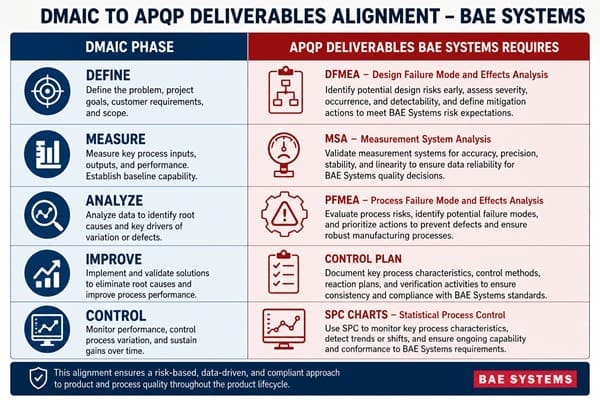
- Quality Code 199 requires Advanced Product Quality Planning (APQP) per AS9145. Its deliverables — DFMEA, PFMEA, Control Plan, MSA, and Process Capability — map one-to-one with DMAIC phases.
- Quality Code 285 (added September 2025) explicitly requires FMEA and a Risk Register as part of proactive supplier risk management.
- BAE Systems requires First Article Inspection (FAI) per AS9102 before any production run ships. This is the aerospace equivalent of Six Sigma’s “build quality in” principle.
- Six Sigma Green Belt and Black Belt training builds the specific competencies that BAE Systems demands: SPC, Cpk analysis, MSA, FMEA, and corrective action management.

Public, Onsite, Virtual, and Online Six Sigma Certification Training!
- We are accredited by the IASSC.
- Live Public Training at 52 Sites.
- Live Virtual Training.
- Onsite Training (at your organization).
- Interactive Online (self-paced) training,
A Quality Culture Embedded in BAE Systems’ DNA
BAE Systems states clearly that quality is everyone’s responsibility. Its official quality documentation states the company is “committed to providing quality products and services that meet customers’ requirements and exceed their expectations of safety and value.”
That is not a passive statement. BAE Systems builds it directly into its procurement process. Every purchase order carries documented quality codes. Every supplier must comply before a single component ships.
Six Sigma teaches exactly this mindset. Quality does not begin at inspection. It is designed into every step of the process from the start.
BAE Systems calls this same principle out explicitly. Its products are, per official documentation, “designed from inception with quality and safety in mind.”
At Six Sigma Development Solutions Inc., our training programmes teach practitioners to embed quality at the process level. Green Belts and Black Belts learn to identify defect sources before they produce defects. This is the principle BAE Systems contractually enforces across its entire supply chain.
Also Read: Six Sigma at General Electric: A Case Study in Results
Statistical Process Control: A Direct Requirement From BAE Systems
One of the clearest Six Sigma connections sits inside BAE Systems’ official Quality Assurance Code Requirements document. This is a binding document that governs every supplier to BAE Systems’ Electronic Solutions division. The most recent revision is dated September 22, 2025.
Quality Code 173 in that document requires suppliers to implement a Variability Reduction Plan and Statistical Process Control plan. The document states directly:
“The supplier shall implement a Variability Reduction Plan (VRP) / Statistical Process Control (SPC) plan for those key processes or Key Characteristics that affect form, fit, function, reliability or service.”
That requirement mirrors the core work of Six Sigma’s Analyze and Control phases. Six Sigma practitioners use SPC charts to detect special cause variation. BAE Systems requires exactly this from suppliers.
The document also sets a specific capability target. Suppliers must achieve a minimum Cpk of 1.33 for each control characteristic. Attribute data must show at least 99.9% conformance. Any out-of-control condition must have a documented corrective and preventive action plan.
These are Six Sigma Control phase standards applied as binding supplier requirements.
Six Sigma Development Solutions Inc. covers SPC, control charts, and Cpk calculations in depth in our Green Belt and Black Belt programmes. Practitioners learn to build and interpret these tools in the context of real DMAIC projects.
Process Capability: Not Optional, but Mandatory
The Cpk threshold of 1.33 carries real weight. Six Sigma practitioners know this number well. It represents a capable, predictable process with adequate margins inside specification limits.
BAE Systems embeds this standard into supplier contracts directly. Every key characteristic on a controlled purchase order must demonstrate Cpk ≥ 1.33 before delivery begins.
Code 111 reinforces this further. It requires 100% variable data for end-item acceptance parameters. Attribute data applies only to pass/fail conditions. Every critical measurement must be continuous, traceable, and recorded.
This is Six Sigma’s Measure phase logic translated into enforceable requirements. BAE Systems will not accept parts without the measurements that prove they are right.
Also Read: Six Sigma at 3M: A Verified Case Study in Corporate-Wide Implementation
Advanced Product Quality Planning: DMAIC Thinking Built Into Contracts
BAE Systems requires suppliers to implement Advanced Product Quality Planning (APQP) per Quality Code 199. Suppliers must comply with AS9145, the aerospace and defence APQP standard.
APQP is a structured, cross-functional process. It begins at concept and runs through production. Its deliverables include a Design Risk Analysis (DFMEA), Production Process Flow, Production PFMEA, Production Control Plan, Measurement System Analysis, and Process Capability data.
Every APQP deliverable maps to a specific DMAIC phase:
- The DFMEA maps to the Define and Analyze phases. It identifies risks before they produce defects.
- The Production PFMEA maps to the Analyze phase. It identifies failure modes in the manufacturing process.
- The Production Control Plan maps to the Control phase. It specifies what is monitored, how, and how often.
- The MSA maps to the Measure phase. It validates that measurement systems are reliable before data collection begins.
BAE Systems requires Measurement System Analysis explicitly. No capability data has value if the measurement system itself is unreliable. Six Sigma teaches this in the Measure phase. BAE Systems enforces it through PPAP submission requirements.
Suppliers must submit all APQP and PPAP documentation. BAE Systems Program Quality must approve it before hardware ships. This gate prevents uncontrolled variation from entering the supply chain at the source.
First Article Inspection: Building Quality In From the Start
BAE Systems requires First Article Inspection from suppliers under Quality Code 214. This mandates formal FAI in accordance with AS9102, the international aerospace standard for first article inspection.
FAI is the aerospace equivalent of Six Sigma’s “build quality in” principle. Before any production run begins, the first article must be fully inspected against every drawing requirement. The complete inspection package must be submitted and approved in BAE Systems’ Net-Inspect system. Parts cannot ship until the FAI receives written approval.
Six Sigma’s DMAIC methodology teaches the same discipline. Validate the process against requirements before releasing it to full production. BAE Systems enforces this principle at the supplier level for every controlled part.
FMEA and Proactive Risk Management: A 2025 Requirement
Quality Code 285, added to the BAE Systems supplier requirements in September 2025, goes beyond corrective action. It requires suppliers to maintain a documented proactive risk identification process. The document specifically names FMEA and a Risk Register as tools for this requirement.
FMEA is a core Six Sigma tool. Six Sigma practitioners use it in the Analyze and Improve phases to identify where a process could fail before it does. BAE Systems now contractually requires this same tool from its suppliers.
Code 285 also requires a documented Supplier Corrective Action Management System and a documented process for supplier performance management. BAE Systems reserves the right to audit sub-tier process controls at any time.
This is the Control phase principle embedded in supply chain management. The Analyze, Improve, and Control phases do not end at the project boundary. They become permanent features of how the supply chain operates.
Counterfeit Part Prevention: Eliminating Defects at the Source
BAE Systems’ Quality Code 100 requires suppliers to provide full traceability for every electronic component. This includes traceability to the original equipment manufacturer or original component manufacturer for every part, subpart, and subcomponent.
This is anti-defect discipline applied upstream. A counterfeit electronic component represents a defect that cannot be caught at final inspection. It must be prevented at the point of procurement.
BAE Systems requires each supplier to certify that all parts come from verified original sources. Suppliers must retain traceability records for a minimum of ten years.
Six Sigma’s goal is to eliminate defects at the source. BAE Systems’ counterfeit prevention framework applies this principle to procurement. It eliminates an entire category of unacceptable product before it enters the production process.
Frequently Asked Questions (FAQs) on Six Sigma at BAE Systems
Q: Does BAE Systems use Six Sigma?
A: BAE Systems does not publicly brand its quality approach as “Six Sigma.” However, its official quality standards contractually require Six Sigma tools from its supply chain. These include Statistical Process Control, a minimum Cpk of 1.33, Measurement System Analysis, FMEA, APQP, and corrective action systems — all of which are core Six Sigma competencies taught at Green Belt and Black Belt level.
Q: What quality standards does BAE Systems operate under?
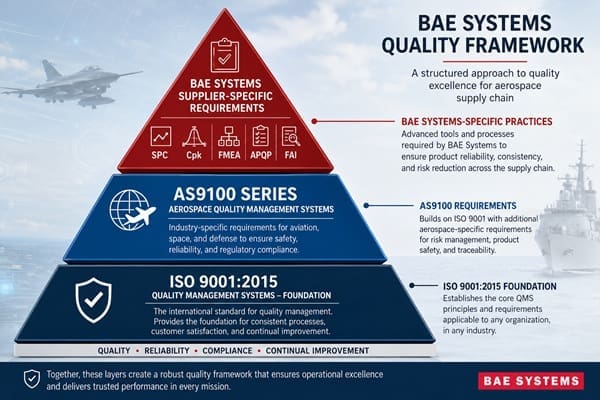
A: BAE Systems operates under ISO 9001:2015 and the AS9100 series of aerospace quality management standards. Its supplier requirements additionally reference AS9102 (First Article Inspection), AS9103 (Statistical Process Control), AS9145 (Advanced Product Quality Planning), AS9146 (Foreign Object Debris prevention), Nadcap accreditation for special processes, and MIL-PRF specifications for military-grade components.
Q: What is the minimum Cpk BAE Systems requires from suppliers?
A: BAE Systems’ Quality Assurance Code Requirements document (No. 00-315, September 2025) specifies a minimum Cpk of 1.33 for each key control characteristic under a Variability Reduction Plan. Attribute data must show at least 99.9% conformance to specification. Out-of-control conditions must have documented corrective and preventive actions.
Q: What is APQP and why does BAE Systems require it?
A: APQP stands for Advanced Product Quality Planning. It is a structured, cross-functional product development process defined in AS9145. BAE Systems requires APQP from suppliers under Quality Code 199 to ensure that manufacturing processes are validated before production begins. APQP deliverables include DFMEA, PFMEA, Control Plan, MSA, and Process Capability data — the same tools used in Six Sigma’s DMAIC methodology.
Q: What Six Sigma skills does a BAE Systems supplier need?
A: A BAE Systems supplier needs competency in Statistical Process Control, process capability analysis (Cpk), Measurement System Analysis, Failure Mode and Effects Analysis (FMEA), Advanced Product Quality Planning (APQP), corrective and preventive action management, and First Article Inspection documentation. Six Sigma Green Belt training covers all of these directly.
Q: Why does Six Sigma training help professionals in aerospace and defence?
A: Aerospace and defence quality standards — including those required by BAE Systems — embed Six Sigma tools directly into their requirements. Statistical Process Control, capability analysis, FMEA, and APQP are not optional enhancements in this industry. They are contractual conditions of supply. Six Sigma Green Belt and Black Belt training equips professionals to meet these requirements with demonstrated, certified competency.
The Role of Six Sigma Training in Aerospace Supply Chains
BAE Systems operates across more than 40 countries and 90,500 employees. Its global supplier network must meet documented quality requirements consistently. Many of those requirements demand Six Sigma competencies: SPC, Cpk analysis, MSA, FMEA, APQP, and corrective action management.
Professionals who supply to or work within aerospace and defence environments need to speak this language fluently. Six Sigma Green Belt training provides the SPC, capability analysis, and FMEA skills that BAE Systems demands from its supply chain. Black Belt training adds the statistical depth and project leadership skills needed to lead enterprise-level improvement programmes.
At Six Sigma Development Solutions, our training builds exactly these competencies. We offer Green Belt and Black Belt certification in three formats:
- Onsite training — delivered at your facility, using your real process data and supply chain requirements.
- Live virtual training — instructor-led sessions online, covering SPC, capability, and DMAIC in real time.
- Online training — self-paced programmes you complete on your own schedule.
Explore our Six Sigma training programmes or contact our team to find the right programme for your goals.
About Six Sigma Development Solutions, Inc.
Six Sigma Development Solutions, Inc. offers onsite, public, and virtual Lean Six Sigma certification training. We are an Accredited Training Organization by the IASSC (International Association of Six Sigma Certification). We offer Lean Six Sigma Green Belt, Black Belt, and Yellow Belt, as well as LEAN certifications.
Book a Call and Let us know how we can help meet your training needs.


