
A failure effect is the consequence of a failure mode, what actually happens as a result of something going wrong. It’s one of the three core building blocks of an FMEA (Failure Mode and Effects Analysis), alongside the failure mode itself (how it fails) and the cause (why it fails).
A failure effect isn’t a single statement; it’s usually described at three levels: the local effect (what happens right at the point of failure), the next-level effect (what happens one level up, in the surrounding system), and the end effect (what the customer or end user actually experiences).
Getting the end effect right matters most, because it’s what directly determines the Severity rating, one of the three scores (along with Occurrence and Detection) that make up a failure mode’s Risk Priority Number.
Quick Reference Table
| Term | What It Means | Example |
| Failure Mode | How something fails | A steering pump produces inadequate outlet pressure |
| Failure Effect | What happens as a result of the failure | Increased steering effort for the driver |
| Failure Cause | Why the failure happened | A worn seal inside the pump |
| Local Effect | The impact right at the point of failure | Low-pressure fluid moves into the steering gear |
| Next-Level Effect | The impact one level up in the system | Increased friction at the steering gear |
| End Effect | The impact on the customer or end user | The driver has to use noticeably more effort to steer |
| Severity Rating | A score reflecting how serious the effect is | Based specifically on the end effect, not the local one |
Table of contents
Key Takeaways
- A failure effect is not the same as a failure mode. The mode is how something fails; the effect is what happens because it failed.
- A failure effect is described at three levels: local, next-level, and end. Each level answers a different question about where the consequence shows up.
- The end effect is what usually determines the Severity rating, since Severity is meant to capture what the customer or end user actually experiences.
- In a Process FMEA, effects are considered at both the plant level and the customer level, and the higher of the two Severity scores is the one that’s used.
- A poorly written effect statement is the most common reason Severity ratings are inconsistent. If the effect is vague, the Severity score becomes a guess instead of a judgment against a clear standard.
- Writing a good effect statement means describing a real, specific consequence, not repeating the failure mode in different words.
- Every failure mode should have its effects considered at every applicable level, not just the most obvious or immediate one.
What Is a Failure Effect?
A failure effect is the specific consequence of a failure mode, the actual result that happens when something fails. It’s a core element of FMEA (Failure Mode and Effects Analysis), a structured method for identifying potential ways a product, process, or system could fail, and understanding what happens if it does.
FMEA reviews components, assemblies, and process steps to identify potential failure modes and their causes and effects. For each identified failure mode, the team records its effects on a specific FMEA worksheet, which is what ties the effect directly into the risk-scoring process that follows.

Public, Onsite, Virtual, and Online Six Sigma Certification Training!
- We are accredited by the IASSC.
- Live Public Training at 52 Sites.
- Live Virtual Training.
- Onsite Training (at your organization).
- Interactive Online (self-paced) training,
Failure Effect vs. Failure Mode vs. Cause: What’s the Real Difference?
This is the distinction the existing content never actually makes, and it’s the most important thing to understand before filling out an FMEA worksheet.
| Term | Answers the Question | Example |
| Failure Mode | How does it fail? | Pump produces inadequate outlet pressure |
| Failure Cause | Why does it fail? | Worn internal seal |
| Failure Effect | What happens because it failed? | Increased steering effort for the driver |
How do these connect in practice?
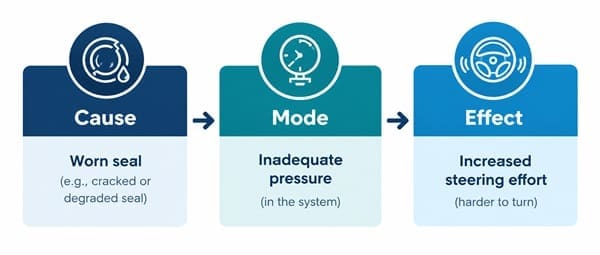
A failure cause (worn seal) leads to a failure mode (inadequate pressure), which produces a failure effect (increased steering effort). These three elements move in a clear chain: cause creates mode, mode creates effect. Confusing any two of them, especially restating the mode as if it were the effect, is one of the most common mistakes teams make when filling out an FMEA.
Also Read: Failure Rate
The Three Levels of a Failure Effect

This is the single most valuable, expert-level piece of information about failure effects, and it’s completely absent from most competing glossary pages on this term.
A failure effect isn’t described just once. It’s typically assessed at three distinct levels, each answering a different version of “what happens next”:
| Level | What It Describes | Example (Steering Pump) |
| Local Effect | What happens right at the point of failure itself | Low-pressure fluid goes to the steering gear |
| Next-Level Effect | What happens one level up, in the surrounding subsystem | Increased friction at the steering gear |
| End Effect | What the customer or end user ultimately experiences | The driver needs increased effort to steer the vehicle |
Why does this three-level structure matter?
Each level traces the consequence further outward, from the specific point of failure, through the surrounding system, to what the person actually using the product notices. A team that only records the local effect misses the bigger picture; a team that only records the end effect loses the detail needed to actually understand and fix the failure. A complete FMEA records all three levels where applicable.
How Does a Failure Effect Determine the Severity Rating?
This is where getting the effect right stops being an academic exercise and starts directly affecting your risk analysis. The Severity rating, one of the three scores (along with Occurrence and Detection) used to calculate the Risk Priority Number (RPN), is based specifically on the effect, not the failure mode or the cause.
For a Design FMEA, the team typically assesses Severity based on the end effect, how the failure affects the overall system or the end user. This is what determines whether a failure poses a genuine safety or performance risk.
For a Process FMEA, the team considers the effect at both the manufacturing/assembly level and the customer/system level. If the two differ, the higher of the two Severity scores is the one used, ensuring the more serious potential consequence is what actually drives the risk analysis, rather than the milder one.
A practical tip worth calling out directly: if a team is struggling to agree on a Severity rating, the real problem is usually an unclear or vaguely worded effect statement, not a flaw in the severity scale itself. A clearly defined effect makes the Severity rating almost self-evident by comparison against the scale’s criteria.
How Do You Write a Good Failure Effect Statement?
1. Start From the Failure Mode, Then Ask “So What Happens?”
Take the identified failure mode and ask what actually results from it. Avoid simply rephrasing the failure mode itself; the effect needs to describe a genuine downstream consequence.
2. Describe the Local Effect First
Write down what happens immediately, right at the point of failure, before tracing the consequence any further outward.
3. Trace the Consequence to the Next Level and the End Effect
Ask what that local consequence causes one level up in the system, and then what the customer or end user ultimately experiences as a result. Not every failure will have a meaningfully different next-level effect, but the end effect should almost always be identified.
4. Be Specific Enough to Support a Severity Rating
A vague effect (“product doesn’t work well”) makes Severity scoring inconsistent between reviewers. A specific effect (“steering requires noticeably more physical effort from the driver”) can be matched clearly against a Severity scale’s criteria.
Also Read: Root Cause Failure Analysis
Design FMEA vs. Process FMEA: Does the Effect Change?
Yes, in an important way. The type of FMEA changes what questions the team should be asking when identifying effects.
| FMEA Type | Question the Team Asks | Effect Focus |
| Design FMEA | How does this failure affect the overall system or end user? | Primarily the end effect, on system performance or user safety |
| Process FMEA | What is the consequence of the failure on the manufacturing plant, and on the end user? | Both plant/assembly-level effects and end-user effects |
A Design FMEA is concerned with how a product performs once it’s in the customer’s hands. A Process FMEA has to additionally consider what happens on the factory floor itself, since a failure can disrupt manufacturing even if it never reaches the customer at all.
Real-World Example (Hypothetical)
Problem: An FMEA team is reviewing a hydraulic steering pump and has identified a failure mode: the pump produces inadequate outlet pressure.
Analysis: The team recognizes that simply stating “pump fails” as the effect wouldn’t be specific enough to support a meaningful Severity rating. They work through the three levels of effect systematically.
Six Sigma approach: Local effect: low-pressure fluid moves into the steering gear. Next-level effect: increased friction at the steering gear. End effect: the driver has to apply noticeably more physical effort to steer the vehicle.
Action: Because the end effect describes a real degradation in vehicle control, the team assigns a high Severity rating, referencing the specific end-effect wording against their Severity scale’s criteria, rather than debating the score in the abstract.
Result (hypothetical): The clearly defined, three-level effect statement makes the Severity rating easy for the whole team to agree on, and gives engineers a precise consequence to design against. This is a hypothetical illustration based on a common automotive FMEA example, not a proprietary case study.
Common Mistakes When Identifying Failure Effects
- Restating the failure mode as the effect. “Pump fails” is a mode; “driver experiences increased steering effort” is an effect. These need to describe genuinely different things.
- Only recording the local effect. Stopping at the immediate consequence misses the bigger picture the Severity rating is actually meant to capture.
- Writing a vague effect statement. A vague effect makes Severity scoring inconsistent across reviewers, since there’s nothing specific to match against the scale’s criteria.
- Using the wrong effect level for Severity in a Process FMEA. Forgetting to compare plant-level and customer-level effects, and take the higher Severity score, can understate a real risk.
- Skipping the next-level effect entirely. While not every failure needs a distinct next-level effect, skipping this step as a habit can leave gaps in understanding how a failure actually propagates through the system.
Frequently Asked Questions (FAQs) on Failure Effect
Q: What is a failure effect in FMEA?
A: A failure effect is the consequence of a failure mode, what actually happens as a result of something going wrong. It’s typically described at three levels: local, next-level, and end effect.
Q: What is the difference between a failure effect and a failure mode?
A: A failure mode describes how something fails (inadequate pressure); a failure effect describes what happens as a result of that failure (increased steering effort). They answer different questions and shouldn’t be used interchangeably.
Q: What are local, next-level, and end effects?
A: Local effect describes what happens right at the point of failure. Next-level effect describes the consequence one level up in the surrounding system. End effect describes what the customer or end user ultimately experiences.
Q: How does failure effect relate to severity rating?
A: The Severity rating is based specifically on the failure’s effect, usually the end effect for a Design FMEA, or the higher of the plant-level and customer-level effects for a Process FMEA, not on the failure mode or cause directly.
Q: How do you write a good failure effect statement?
A: Start from the failure mode and ask what actually results from it. Describe the local effect first, trace it to the next level and the end effect, and be specific enough that a Severity rating can be matched clearly against your severity scale’s criteria.
Q: Is failure effect the same in Design FMEA and Process FMEA?
A: The concept is the same, but the focus differs. Design FMEA typically emphasizes the end effect on system performance or user safety. Process FMEA also considers the effect at the manufacturing or assembly level, using the higher of the two Severity scores if they differ.
Final Words
A failure effect is more than a single line on an FMEA worksheet; it’s the specific, traceable consequence of a failure, described at the local, next-level, and end-effect stages so the Severity rating that follows is actually grounded in something concrete. Teams that write vague or rushed effect statements end up with inconsistent Severity scores and a weaker FMEA overall.
Teams that trace the effect carefully through all three levels get a Risk Priority Number that genuinely reflects what matters most: what the customer or end user actually experiences when something goes wrong.
Writing a clear, well-traced failure effect statement is what makes an FMEA’s Severity rating, and the Risk Priority Number built on top of it, actually meaningful.
Six Sigma Development Solutions, Inc. (SSDSI) is IASSC-accredited and 5-star rated on Google Reviews, having certified 5,322+ professionals across 600+ organizations in 52 cities. Our onsite, live virtual, public, and online FMEA training walks through failure modes, effects, causes, and risk scoring with real practice, so your team can complete a defensible FMEA with confidence. Explore SSDSI’s FMEA training to build that capability.
About Six Sigma Development Solutions, Inc.
Six Sigma Development Solutions, Inc. offers onsite, public, and virtual Lean Six Sigma certification training. We are an Accredited Training Organization by the IASSC (International Association of Six Sigma Certification). We offer Lean Six Sigma Green Belt, Black Belt, and Yellow Belt, as well as LEAN certifications.
Book a Call and Let us know how we can help meet your training needs.


