The digital transformation of industry requires methods that can manage vast amounts of data to achieve process perfection. Six Sigma and the Internet of Things (IoT) represent a powerful synergy in this regard. Six Sigma is a robust methodology focused on minimizing defects and variation in processes.
The Internet of Things (IoT) is the network of physical devices that collect and exchange data. When these two concepts combine, the result is an unprecedented ability to analyze real-time performance, predict failures, and achieve superior operational excellence.
Table of contents
What is the Internet of Things (IoT)?
Let us start by understanding the fundamental concept of the Internet of Things (IoT).
The Internet of Things (IoT) refers to the vast network of physical objects embedded with sensors, software, and other technologies. These devices connect and exchange data with other systems and devices over the internet. These objects range from household appliances to industrial machinery and complex production assets.
In simple words, IoT means connecting everyday physical items to the internet. This connectivity allows them to collect data continuously. This raw data is often called big data due to its volume, variety, and velocity.
- IoT is more than just connectivity; it is about gathering actionable information.
- IoT devices produce crucial data points about their operational status and environment.
- IoT implementation has revolutionized industries by making assets “smart” and trackable.
This constant flow of operational data provides the foundation for powerful process improvement efforts.

Public, Onsite, Virtual, and Online Six Sigma Certification Training!
- We are accredited by the IASSC.
- Live Public Training at 52 Sites.
- Live Virtual Training.
- Onsite Training (at your organization).
- Interactive Online (self-paced) training,
What is Six Sigma?
First of all, we need to understand the principles behind Six Sigma.
Six Sigma is defined as a set of techniques and tools for process improvement. The main goal of this methodology is to reduce variation and eliminate defects. It aims for near-perfection, meaning only 3.4 defects per one million opportunities (DPMO).
Six Sigma uses a data-driven approach to solve problems systematically. It relies on statistical analysis rather than assumptions or guesswork. The disciplined framework ensures that improvements are sustained over time.
The core process model for implementing Six Sigma is known as DMAIC.
- DMAIC stands for Define, Measure, Analyze, Improve, and Control.
- DMAIC provides a structured roadmap for optimizing any process.
- DMAIC ensures that solutions are based on facts and data, leading to reliable outcomes.
Also Read: Quantum Communication
The Synergy: Six Sigma and the Internet of Things (IoT)
The combination of data collection technology and data analysis methodology creates a powerful synergy.
Six Sigma and the Internet of Things (IoT) integration means using the real-time, comprehensive data from IoT devices to fuel the DMAIC process. Historically, data collection in Six Sigma projects was often manual, expensive, and limited. Six Sigma and the IoT overcome this limitation by providing continuous, automated, and accurate input.
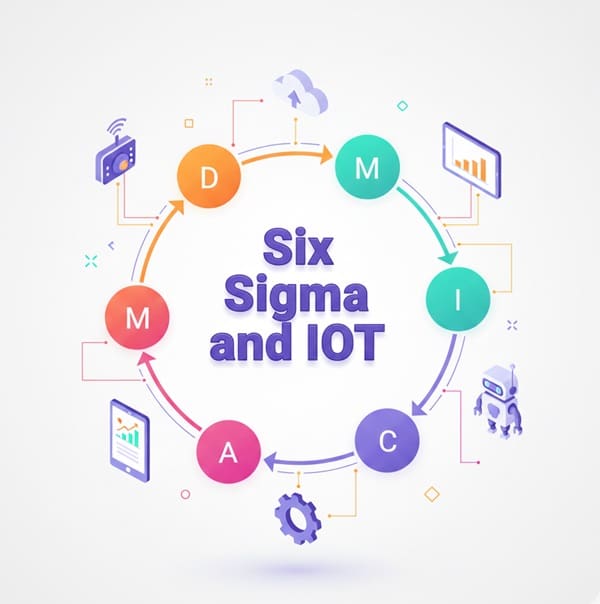
Six Sigma and the IoT
They provide a clearer, more objective view of process performance. IoT sensors continuously monitor key process inputs (KPIs) and outputs (KPOs). This eliminates the time delay and bias associated with human observation or periodic checks.
In this way, Six Sigma and the IoT turn big data into smart data. The immense volume of raw data generated by the network of connected devices is cleansed, managed, and analyzed using the statistical rigor of Six Sigma tools. Therefore, manufacturers and service providers can understand customer behavior and product performance in detail.
- The synergy allows for predictive maintenance, a key benefit.
- The synergy enables companies to refine products and customer experiences faster.
- The synergy moves process improvement from reactive problem-solving to proactive prevention.
Six Sigma IoT in Action: Applying DMAIC
This section breaks down how the continuous flow of IoT data strengthens each phase of the DMAIC roadmap.
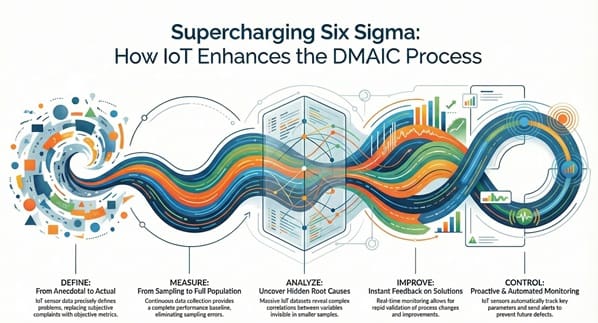
Define Phase: IoT and Defining the Problem
The Define phase sets the scope and objectives of the project. This is where the problem is articulated.
IoT data provides crucial initial context about the magnitude and location of a problem. Instead of relying on anecdotal evidence or generalized complaints, project teams can look at real-world data trends. For example, if a machine is frequently failing, IoT sensor readings showing excessive temperature or vibration define the problem precisely.
Six Sigma requires defining the Voice of the Customer (VOC) and translating it into measurable metrics. IoT devices, like smart products, directly report usage patterns and failure modes. This provides an objective VOC input. This objective data helps establish clear boundaries and targets for the project.
Measure Phase: Leveraging IoT Data Collection
The Measure phase focuses on collecting data to determine the current process performance, or the baseline.
Six Sigma traditionally uses sampling to measure the process sigma level. However, IoT devices collect data continuously, providing a complete population data set, not just a sample. This dramatically improves the accuracy of the baseline measurement.
IoT data provides unprecedented accuracy and volume. Sensors automatically record measurements like cycle time, temperature, pressure, and flow rates. This eliminates human error in data collection, which is a common source of measurement variation.
- IoT data is also crucial for validating Measurement System Analysis (MSA).
- IoT data streams ensure that Key Performance Indicators (KPIs) are tracked in real-time.
- IoT data helps the team create highly detailed process maps that reflect actual operation.
Analyze Phase: Finding Root Causes with IoT
The Analyze phase uses statistical tools to identify the root causes of defects and variation.
Six Sigma tools like regression analysis, hypothesis testing, and ANOVA require large, reliable data sets. IoT data provides this necessary foundation. Teams can correlate multiple variables—such as machine usage, environmental conditions, and material properties—to process outputs.
IoT data allows analysts to look for patterns and correlations that are invisible in smaller, manually collected datasets. For example, IoT data might show that defects only occur when the external humidity sensor reads above 70% and the machine speed exceeds a certain RPM. This precise correlation points directly to a primary root cause.
- Six Sigma analysis becomes more powerful with this granular data.
- Six Sigma teams can quickly narrow down the list of potential X variables.
- IoT data supports advanced predictive analytics to model failure scenarios.
Improve Phase: Designing Solutions with IoT Insights
The Improve phase involves generating and testing potential solutions to eliminate the identified root causes.
Six Sigma improvement solutions are often tested using pilot programs or experiments. IoT sensors allow for real-time monitoring of the pilot solution’s effectiveness. Teams can deploy a modified process or a new parameter setting to a small group of connected assets.
IoT data provides immediate feedback on the impact of changes. If a change is made, the project team does not have to wait weeks for defects to be recorded manually. IoT data shows whether the targeted metric is moving in the right direction almost instantly. This rapid feedback loop drastically shortens the time required for improvement and validation.
Control Phase: Maintaining Gains using IoT Sensors
The Control phase ensures that the improvements are sustained and the process does not revert to its old level of performance.
Six Sigma relies on control plans, which include monitoring mechanisms and response procedures. IoT sensors are the perfect tool for implementing an automated control plan. The sensors continuously track critical process parameters (CTQs).
IoT data feeds directly into statistical process control (SPC) charts. When a process parameter drifts outside the established control limits, the system can send an alert automatically. This allows operators to intervene immediately, preventing a defect rather than reacting to a failure. IoT data provides the consistent monitoring needed for long-term control.
- Six Sigma controls become highly automated and proactive.
- IoT data ensures that the process sustains its high sigma level.
- IoT data provides ongoing evidence of the project’s success and Return on Investment (ROI).
Also Read: Risk Management Information System
Advantages of Six Sigma and the Internet of Things (IoT) Integration
The integration of these two powerful concepts yields significant benefits across various business operations.
Six Sigma and the Internet of Things (IoT) improve efficiency by moving from reactive maintenance to predictive maintenance. IoT sensors monitor machine health continuously. Instead of repairing a machine after it breaks or sticking to a calendar-based schedule, maintenance is performed only when the data predicts an imminent failure. This saves time and money.
Six Sigma and the IoT drive quality improvement. By analyzing precise data on how products are used by customers, companies can identify quality issues related to real-world operating conditions. This enables the design team to eliminate sources of customer dissatisfaction before they become widespread defects.
They lead to significant cost reduction. Reduced defects mean less rework and scrap material. Predictive maintenance minimizes unexpected downtime, which is costly in production environments. Additionally, the automation of data collection lowers administrative costs associated with manual monitoring.
Six Sigma and the IoT accelerate decision-making. The availability of real-time, cleansed data means that business leaders and process owners can make fact-based decisions much faster. There is no waiting period for data collection or cleansing, thereby speeding up the entire improvement lifecycle.
- It provides a competitive advantage in markets reliant on efficiency.
- The synergy fosters a culture of continuous, data-driven improvement.
- It ensures product designs are continuously optimized for customer use.
Key Takeaways
- Six Sigma and the Internet of Things (IoT) work together by using vast amounts of real-time IoT sensor data to drive the statistical analysis required by Six Sigma.
- IoT eliminates the historical challenge of manual and limited data collection, providing a complete, accurate, and objective baseline measurement.
- The integration allows for powerful statistical process control (SPC) by enabling automated, continuous monitoring of critical process inputs and outputs.
- Benefits include improved efficiency through predictive maintenance, enhanced product quality based on real-world usage data, and substantial cost reduction from defect prevention.
- Six Sigma IoT moves organizations beyond simple reactive troubleshooting and toward proactive, predictive operational excellence.
Frequently Asked Questions on Six Sigma and IoT
1. What is the fundamental synergy between Six Sigma and the Internet of Things (IoT)?
The fundamental synergy lies in data and methodology. IoT provides a massive volume of real-time, objective data about process performance. Six Sigma provides the necessary statistical framework (DMAIC) to clean, analyze, and convert that raw data into actionable insights, ensuring that process improvements are accurate, effective, and sustained.
2. How does IoT specifically enhance the Measure and Control phases of DMAIC?
- Measure Phase: IoT sensors collect continuous population data, not just samples. This eliminates human error and provides an incredibly accurate baseline of the current process performance, validating the starting point of the project.
- Control Phase: IoT enables automated Statistical Process Control (SPC). Sensors constantly monitor critical process parameters (CTQs), automatically alerting operators when a process drifts outside control limits, ensuring long-term sustainment of gains.
3. What kind of data do IoT devices supply to a Six Sigma project?
IoT devices supply crucial process and operational data, including cycle time, temperature, pressure, vibration, machine utilization rates, and environmental conditions. This data is critical for root cause analysis because it allows Six Sigma teams to correlate specific inputs (X variables) with defects (Y variables) with high precision.
4. How does the integration of Six Sigma and IoT lead to cost reduction?
The integration reduces costs primarily through predictive maintenance and defect prevention. Predictive maintenance, fueled by IoT sensor data, allows maintenance to occur before a failure, minimizing expensive, unplanned downtime. Defect prevention, achieved through rigorous Six Sigma analysis of IoT data, reduces scrap, rework, and waste.
Final Words
The blending of Six Sigma and the Internet of Things (IoT) is not merely a technological trend; it is a fundamental evolution in how we achieve process control. This powerful combination shifts process improvement from periodic problem-solving to continuous, automated perfection.
The rigor of the DMAIC method, when fueled by the accurate, pervasive data from IoT devices, allows businesses to operate at levels of quality and efficiency that were once impossible. Organizations that embrace this synergy will successfully translate raw data into sustained operational success.

About Six Sigma Development Solutions, Inc.
Six Sigma Development Solutions, Inc. offers onsite, public, and virtual Lean Six Sigma certification training. We are an Accredited Training Organization by the IASSC (International Association of Six Sigma Certification). We offer Lean Six Sigma Green Belt, Black Belt, and Yellow Belt, as well as LEAN certifications.
Book a Call and Let us know how we can help meet your training needs.