
Definition: Attribute agreement analysis is a statistical tool used to assess the consistency and accuracy of subjective ratings or classifications provided by human appraisers. It serves as a measurement system analysis (MSA) technique for discrete data, ensuring that your inspectors or evaluators categorize items correctly against a known standard and each other.
To be honest, we often trust our data too much. We assume that if an inspector marks a part as “Good” or “Bad,” they’re right. But what if two different people see the same scratch differently? Or what if the same person changes their mind on Monday morning compared to Friday afternoon?
The significance of attribute agreement analysis lies in its ability to quantify this human error. This concept emerged because industries needed a way to validate “soft” measurements, like visual inspections or taste tests, that don’t use a ruler or a scale. One may wonder why we need such a complex process for a simple “Pass/Fail” check, but without it, your quality data is essentially a guess.
Table of contents
Comparison Chart: Attribute vs. Variable MSA
To understand where this tool fits, let’s look at how it compares to the more common Gauge R&R used for physical measurements.
| Basis for Comparison | Attribute Agreement Analysis | Variable Gauge R&R |
| Data Type | Qualitative / Discrete (Pass/Fail, Go/No-Go) | Quantitative / Continuous (Length, Weight) |
| Primary Metric | Kappa Statistic and Percent Agreement | % Study Variation and P-values |
| Complexity | High (Requires many samples and replicates) | Moderate (Standardized procedures) |
| Subjectivity | Very High (Relies on human judgment) | Low (Relies on calibrated tools) |
| Goal | Assess categorization consistency | Assess measurement precision and accuracy |
Definition of Attribute Agreement Analysis
Attribute agreement analysis can be understood as a rigorous checkup for your “human gauges.” In a manufacturing or service environment, many decisions are binary or ordinal. For instance, a loan officer deciding “Approved” or “Denied” is an attribute-based decision.
This analysis measures the level of agreement between appraisers (inter-appraiser agreement), the consistency of an appraiser with themselves (intra-appraiser agreement), and the accuracy of everyone compared to a “Gold Standard” or master value. It is essentially a way to put a number on how much you can trust your team’s eyes.

Public, Onsite, Virtual, and Online Six Sigma Certification Training!
- We are accredited by the IASSC.
- Live Public Training at 52 Sites.
- Live Virtual Training.
- Onsite Training (at your organization).
- Interactive Online (self-paced) training,
Why Use Attribute Agreement Analysis?
Attribute agreement analysis is crucial because it helps you identify where your training or standards are failing. Have you ever noticed two supervisors arguing over whether a product is “slightly scratched” or “rejectable”? That’s a measurement system failure.
Here’s the thing: if your measurement system is broken, your process data is junk. You might be throwing away perfectly good parts (Alpha Risk) or, worse, shipping defects to customers (Beta Risk). By performing this analysis, you identify which appraisers need more training and which inspection standards are too vague to be useful.
In my experience, most companies find that their visual inspection is only about 70% accurate before they run their first attribute agreement analysis. That is a frightening thought for any quality manager. Don’t you want to know if your team is actually seeing the same thing?
Also Read: Multi-Criteria Decision Analysis (MCDA)
Key Components and Metrics of Attribute Agreement Analysis
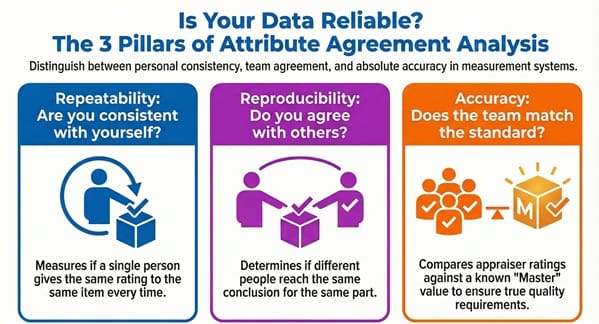
Let us discuss the specific metrics used in this analysis to evaluate performance:
Within Appraiser (Repeatability)
This measures how consistently a single person categorizes the same items across multiple trials. If Inspector A looks at Part #5 three times, do they give it the same rating every time? If they don’t, your measurement system lacks repeatability.
Between Appraisers (Reproducibility)
This examines whether different people agree with each other. If Inspector A says “Pass” and Inspector B says “Fail” for the same part, you have a reproducibility issue. It usually means your “Standard Operating Procedure” is open to interpretation.
Appraiser vs. Standard (Accuracy)
This is the ultimate test. Even if everyone agrees, they could all be wrong. This metric compares the team’s ratings against a known “Master” value. This tells you if your team truly understands the quality requirements set by the customer.
How to Conduct the Attribute Agreement Analysis?
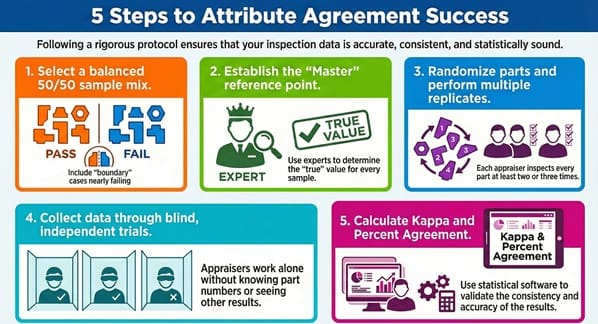
The attribute agreement analysis involves the following steps to ensure statistical validity:
- Select the Samples: You must pick a range of items. It is vital to include “boundary” cases—those parts that are almost bad but just barely good. A mix of 50/50 good and bad parts is often recommended for a strong study.
- Identify the Master: An expert or a group of experts must determine the “true” value for each sample. This becomes your reference point for accuracy.
- Set Up the Trials: Randomize the parts so appraisers don’t memorize them. Each appraiser should inspect each part at least twice (replicates), but three times is better for better statistical power.
- Collect Data: Appraisers work independently. They shouldn’t see each other’s results or know which part number they are looking at.
- Run the Statistics: Use software like Minitab to calculate the Kappa statistics and Percent Agreement.
Also Read: Bow-tie Analysis
Interpreting Kappa Statistics
When you look at your report, the Kappa value is the most important number. While percent agreement is easy to understand, it doesn’t account for “lucky guesses.”
Kappa is a coefficient that measures agreement while subtracting the probability of agreeing by chance. It generally ranges from -1 to 1. Here is a simple way to read it:
- Kappa > 0.90: Excellent. You can trust this measurement system.
- 0.70 to 0.90: Good, but there is room for improvement.
- Less than 0.70: Unacceptable. Your data is unreliable and you need to retrain your team or clarify your standards.
According to authoritative sources a Kappa of 0.7 is often the minimum threshold for many industries. However, for critical safety components, you should aim for much higher.
Advantages and Disadvantages
Advantages
- Quantifies Subjectivity: It turns “I think they know what they’re doing” into “The team is 92% accurate.”
- Highlights Training Gaps: You can pinpoint exactly which appraiser is struggling.
- Reduces Waste: By improving accuracy, you stop rejecting good parts.
- Standardizes Quality: It forces the team to agree on what “Good” actually looks like.
Disadvantages
- Resource Intensive: You need a large number of samples (often 30-50) and multiple trials, which takes time.
- Sample Degradation: If you are testing food or fragile parts, the samples might change during the study.
- Binary Limits: It is harder to apply to complex rankings (e.g., a scale of 1-10) than simple Pass/Fail.
Key Takeaways
- Attribute agreement analysis assesses the consistency and accuracy of subjective ratings given by human appraisers.
- It identifies human error in evaluations and quantifies agreement between appraisers.
- The analysis compares appraisers’ judgments against a master value to measure consistency, repeatability, and accuracy.
- Organizations often find visual inspections only around 70% accurate before conducting attribute agreement analysis.
- This statistical tool helps improve quality by highlighting training gaps and preventing defective products from reaching customers.
Final Words
Therefore, attribute agreement analysis is an essential bridge between human judgment and statistical certainty. It ensures that your qualitative data is just as robust as your quantitative data. By measuring repeatability, reproducibility, and accuracy, you gain a clear picture of your measurement system’s health.
Thus, this process allows you to stop guessing and start knowing. If you value quality, you must value the way you measure it. At our core, we believe that empowering your team with clear standards is the fastest way to achieve operational excellence.

About Six Sigma Development Solutions, Inc.
Six Sigma Development Solutions, Inc. offers onsite, public, and virtual Lean Six Sigma certification training. We are an Accredited Training Organization by the IASSC (International Association of Six Sigma Certification). We offer Lean Six Sigma Green Belt, Black Belt, and Yellow Belt, as well as LEAN certifications.
Book a Call and Let us know how we can help meet your training needs.