

No, it is not too early for most students to start Six Sigma. A Yellow Belt has no prerequisites and suits almost any student. A Green Belt also fits students who can finish a real project, such as a capstone, an internship task, or a club process. A Black Belt is usually too early.
ASQ’s Green Belt needs three years of work experience, so most students choose IASSC, which has no prerequisites. Plan your timing too. IASSC certifications last 3 years, so a first-year certificate may expire before you graduate. Pick a belt only if you can show a real result on your resume.
Is It Too Early? Belts at a Glance
| A belt-by-belt view for students | ||||
| Belt | Too early? | Entry rule | Recommended training | Best fit |
| Yellow Belt | Rarely | None at ASQ or IASSC | 16 hours | Any major, any year |
| Green Belt | Not if you can run a real project | IASSC: none. ASQ: 3 years of work | 80 hours | Juniors, seniors, and graduate students with project access |
| Black Belt | Usually yes | ASQ: a full-time paid role | 120 hours | Graduates with real project experience |
Training hours come from the January 2026 PeopleCert IASSC syllabus. ASQ rules come from ASQ and SSDSI’s ASQ vs IASSC guide.
Each belt asks for more proof than the last.
A three-step ladder. Step 1 Yellow Belt: no entry rule, about 16 training hours. Step 2 Green Belt: needs a real project, about 80 training hours. Step 3 Black Belt: needs work experience, about 120 training hours.
Table of contents
Key Takeaways
- Yellow Belt is rarely too early. It has no entry rule and needs about 16 hours of training.
- Green Belt works for students who can finish a real project.
- ASQ’s Green Belt needs three years of work. Students usually choose IASSC.
- A Yellow Belt alone adds little pay. ASQ’s 2020 survey found $880 over no training, versus $10,736 for Green Belts.
- Timing matters. IASSC certifications last 3 years, while ASQ’s Yellow and Green Belts do not expire.
- A measured project result gives you something concrete to discuss in interviews.
Is It Too Early to Learn Six Sigma as a Student?
Six Sigma is a method that cuts defects and waste in processes. Most projects follow DMAIC: Define, Measure, Analyze, Improve, and Control. The answer to “too early?” depends on the belt.
- Yellow Belt: no. It covers the basics of the Define, Measure, and Control phases. A student can learn it in a few weeks.
- Green Belt: maybe. It covers all five DMAIC phases, plus statistics such as hypothesis testing and regression. A student who has taken a statistics course can follow it.
- Black Belt: usually yes. It expects project leadership experience that most students do not have yet.
“Too early” is about proof, not age. A student can learn the tools. The risk is a certificate with no project behind it.

Public, Onsite, Virtual, and Online Six Sigma Certification Training!
- We are accredited by the IASSC.
- Live Public Training at 52 Sites.
- Live Virtual Training.
- Onsite Training (at your organization).
- Interactive Online (self-paced) training,
Why Students Study Six Sigma
Many entry-level jobs improve how work gets done. The U.S. Bureau of Labor Statistics (BLS) lists these examples:
- Industrial engineers: median pay of $102,440 in May 2025, with 12% job growth from 2025 to 2035. The entry-level education is a bachelor’s degree.
- Logisticians: median pay of $80,880 in May 2024, with 17% growth from 2024 to 2034.
- Management analysts: median pay of $101,860 in May 2025, with 10% growth from 2025 to 2035.
BLS does not tie these jobs to a Six Sigma credential. A belt is a way to show related skills, such as data analysis and root cause thinking.
The pay data is clear on one point. ASQ’s 2020 survey found Yellow Belt holders earned only $880 more than people with no Six Sigma training. Green Belt holders earned $10,736 more. So a Yellow Belt is a starting point, not a pay lever. Read SSDSI’s Six Sigma salary guide for current pay by belt.
Schools Already Do This
Students earn belts at many universities:
- Boston University’s MET college awarded Green Belts to 64 students in May 2022. Its course is required for supply chain students, and 216 students had earned the belt by then.
- The University of Oklahoma’s engineering college says it was the first US university to offer Lean and Six Sigma certification to its students, starting in 2006.
- The University of Iowa’s industrial engineering department funded five Yellow Belt scholarships in spring 2022.
- University of Scranton students earn the ASQ Yellow Belt. One student reported studying for a few days with the ASQ handbook.
What Students Can Take: ASQ vs IASSC
Two bodies issue the most common credentials. Their rules decide what a student can take.
| Yellow Belt and Green Belt rules at ASQ and IASSC | ||||
| Item | ASQ Yellow | IASSC Yellow | ASQ Green | IASSC Green |
| Entry rule | None | None | 3 years of paid work | None |
| Exam fee | $434 | $250 | $483 | $350 |
| Validity | Lifetime | 3 years | Lifetime | 3 years |
| Student fit | Yes | Yes | Usually not yet | Yes |
ASQ members save $100 on the first exam. Fees come from ASQ’s pages and SSDSI’s ASQ vs IASSC guide. Training costs extra, and IASSC recommends training but does not require it. Check current fees before you register.
The key point for students: IASSC lets you sit for a Green Belt exam with no work history. ASQ does not. For more detail, read SSDSI’s guides on ASQ vs IASSC and the best certification for beginners.
The Three-Gate Readiness Test
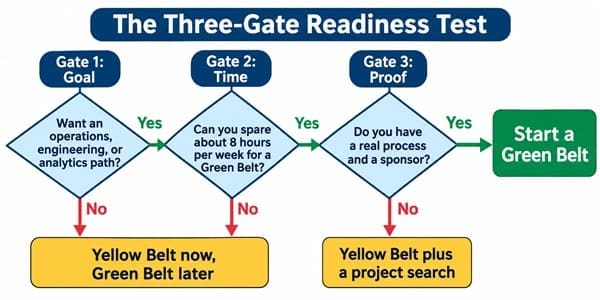
The Three-Gate Readiness Test is a simple screen SSDSI suggests for students. Check the gates in order.
- Gate 1: Goal. Do you want work in operations, supply chain, engineering, quality, healthcare administration, or analytics? If yes, you pass.
- Gate 2: Time. A Green Belt needs about 80 training hours plus project time. Over a 10-week term, that is about 8 hours per week. A Yellow Belt needs about 16 hours. If you cannot spare the time, start with a Yellow Belt.
- Gate 3: Proof. Do you have a real process to improve and a person who can confirm the results? A club adviser, a campus staff member, or an internship manager all work.
| What to do based on your gate results | |
| Gate results | Best move |
| All three pass | Start a Green Belt. |
| Goal and Time pass, Proof fails | Start a Yellow Belt and look for a project. |
| Goal passes, Time fails | Take a Yellow Belt now and a Green Belt later. |
| Goal fails | Skip it, or take a short Yellow Belt for problem-solving skills. |
The 8-hours-per-week figure is simple math: 80 hours over 10 weeks. Your pace may differ.
Three gates point to the right belt.
Gate 1 asks about career goal. Gate 2 asks about time. Gate 3 asks about access to a real project. Three passes lead to Green Belt. A failed proof gate leads to Yellow Belt plus a project search. A failed time gate leads to Yellow Belt now and Green Belt later. A failed goal gate leads to skipping or a short Yellow Belt.
Which Students Benefit Most
| Six Sigma fit by student path | ||
| Student path | Why it helps | Suggested start |
| Industrial, mechanical, and manufacturing engineering | The tools match the core work of process and production improvement. | Yellow Belt in year 2. Green Belt with a capstone. |
| Business, supply chain, and operations | Projects cut cost, time, and errors in logistics and operations. | Yellow Belt. Green Belt after an internship. |
| Healthcare administration | Patient flow and error reduction are common Lean Six Sigma topics. | Yellow Belt. Add a project through a volunteer or clinical placement. |
| Computer science and data analytics | The statistics and root cause skills carry over. | Green Belt, since it is statistics-heavy. |
| Other majors | It builds problem-solving and teamwork. | Yellow Belt only. |
These suggestions are SSDSI’s guidance, not job requirements.
How to Get a Real Project as a Student
A real project is the best proof you can show. Look for a process with a clear number to improve:
- Dining hall or coffee shop line. Measure wait time in minutes.
- Print center or library desk. Measure turnaround time.
- Club event check-in. Measure time per guest and sign-in errors.
- Club budget approvals. Measure days to approve a request.
- Internship order entry. Measure the percent of orders with errors.
- Lab equipment scheduling. Measure idle time as a percent of open hours.
Ask permission first. Get a sponsor who can confirm your numbers. Record the baseline before you change anything.
Example: A Campus Print Center
This example uses made-up numbers to show the flow.
| Illustrative DMAIC project for a student team | |
| Phase | What the team does |
| Define | Students wait too long for printouts. The goal is a shorter wait. |
| Measure | The team times 50 jobs. The average wait is 9 minutes. |
| Analyze | One queue makes short jobs wait behind long jobs. |
| Improve | The center adds an express lane for jobs under 5 pages. |
| Control | Staff check 20 jobs each week. The average falls to 5.5 minutes. |
The drop from 9 to 5.5 minutes is a 39% cut. All numbers are examples.
A small campus project can follow all five DMAIC phases.
Five boxes in a row. Define: long waits. Measure: 9-minute average from 50 jobs. Analyze: single queue. Improve: express lane for jobs under 5 pages. Control: weekly 20-job check, average 5.5 minutes, a 39 percent cut.
How Much It Costs and How to Pay Less
Exam fees alone run from $250 to $483, as the eligibility table shows. Training costs extra. Use these ideas to pay less:
- Ask your department. Iowa’s industrial engineering department funded Yellow Belt scholarships.
- Look for student pricing. The University of Oklahoma listed its Green Belt workshop at $470 to $495 for OU students and $995 for others. That page is undated, so check current prices.
- Use a course that includes the belt. Boston University’s MET college awards the Green Belt through a required course.
- Weigh the ASQ member discount. It saves $100 on the first exam. Compare that with the membership fee.
Be careful with very cheap offers. A badge with no exam and no project proves little. SSDSI’s guide to Six Sigma certification scams explains how to check a provider.
How to Time Your Six Sigma Certification as a Student?
Timing matters because some credentials expire. PeopleCert’s January 2026 IASSC syllabus lists a 3-year validity for the Green Belt. A first-year student who certifies right away may need to recertify before graduating. ASQ lists its Yellow Belt and Green Belt as lifetime credentials.
| A suggested timeline for a four-year student | ||
| Stage | Move | Why |
| First year | Learn the basics. Consider a Yellow Belt. | Low cost and no entry rule. |
| Second and third year | Run a small project. Consider a Green Belt. | You gain proof before job hunting. |
| Final year | Finish the certification or project. | It stays fresh on your resume. |
| After graduation | Add a Green or Black Belt as work projects grow. | ASQ’s Green Belt needs 3 years of work. |
This timeline is a suggestion. Adjust it to your degree plan and your issuer’s renewal rules.
Time your belt so it is fresh when you apply for jobs.
A timeline with four stops: first year Yellow Belt, second and third year small project and Green Belt, final year finish and keep it fresh, after graduation add Green or Black Belt. A note marks IASSC validity as 3 years.
How to Prepare for a Student Yellow or Green Belt Exam
- Read the syllabus. The IASSC syllabus lists every topic. Use it as a checklist.
- Learn the tools by using them. Apply each tool to your own project.
- Practice under time. Take a timed mock exam. SSDSI offers a Yellow Belt mock exam, and our 20 sample Green Belt questions give you a Green Belt warm-up.
- Review your misses. Group them by phase and study those topics first.
Four Myths About Six Sigma for Students
- “It is only for engineers.” Not true. Boston University requires its Green Belt course for supply chain students. The University of Georgia’s business college offers Yellow and Green Belt programs.
- “You need work experience.” Only for some credentials. ASQ’s Green Belt needs three years of work. IASSC and ASQ’s Yellow Belt have no entry rule.
- “A belt guarantees a job.” It does not. BLS does not require a Six Sigma credential for the jobs listed above, so a belt works best as proof of skill.
- “More belts beat one good project.” A new belt should add a new result. A second badge with no project adds little.
Risks to Avoid
- Paper belts. A certificate is not competence. Read SSDSI’s guide on paper belts.
- Weak providers. Verify the issuer and the certificate number before you pay.
- Stacking belts without projects. Each belt should add a new result, not only a new badge.
- Overspending. Compare exam fees, course fees, and renewal costs first.
How to List Six Sigma on a Resume
- Name the credential. Include the issuer, the belt level, and the year.
- Add a result bullet. Use numbers and name your role.
- Offer proof. Add the certificate number so employers can verify it.
Here is an example bullet, built on the made-up print center numbers: “Led a Green Belt project at the campus print center. Cut the average wait from 9 to 5.5 minutes (39%) across 50 sampled jobs.”
Six Sigma for Students FAQs
Is it too early to get Six Sigma certified as a student?
No, not for a Yellow Belt. It has no entry rule and needs about 16 hours of training. A Green Belt fits if you can complete a real project. A Black Belt is usually too early.
Can a college student get a Six Sigma Green Belt?
Yes. IASSC has no prerequisites for its Green Belt exam. ASQ’s Green Belt needs three years of work experience, so most students choose IASSC or a university course.
Is a Yellow Belt worth it for students?
It is a low-cost start. ASQ’s 2020 survey found a Yellow Belt added only $880 in pay over no training. The value comes from learning the tools and pairing them with a real project.
How long does a Yellow Belt take?
The IASSC syllabus recommends about 16 hours of training. SSDSI’s online Yellow Belt has about 100 minutes of video and around 40 hours of project work.
Can high school students get a Six Sigma certification?
IASSC lists no formal entry criteria, and ASQ’s Yellow Belt has no education or experience rule. Providers may set their own age rules, so ask before you enroll.
How much does Six Sigma certification cost for students?
Exam fees alone run from $250 for an IASSC Yellow Belt voucher to $483 for ASQ’s Green Belt exam. Training costs extra. Some universities and departments offer lower student prices or scholarships.
Do Six Sigma certifications expire?
It depends on the issuer. IASSC certifications are valid for 3 years and need recertification. ASQ lists its Yellow Belt and Green Belt as lifetime credentials.
Which Six Sigma belt is best for students?
Start with a Yellow Belt. Move to a Green Belt when you can run a real project. Wait on a Black Belt until you have work experience.
Final Words
For students, Six Sigma is rarely too early. The real question is proof. Start with a Yellow Belt, find a real project, and time your certification so it works for you when you apply.
Next Step: Start With a Project-Based Yellow Belt
Six Sigma Development Solutions (SSDSI) is an IASSC accredited trainer. You can verify us on the PeopleCert list. Our Lean Six Sigma trainings hold a five-star rating on Google reviews. We have certified more than 5,322 people at over 600 organizations in 52 cities.
Our online Yellow Belt has about 100 minutes of video and around 40 hours of project work. You finish a real project within six months of training. Master Black Belt mentors guide learners through projects. You can add the IASSC exam for a separate fee. See how SSDSI helps students earn the belt.
About Six Sigma Development Solutions, Inc.
Six Sigma Development Solutions, Inc. offers onsite, public, and virtual Lean Six Sigma certification training. We are an Accredited Training Organization by the IASSC (International Association of Six Sigma Certification). We offer Lean Six Sigma Green Belt, Black Belt, and Yellow Belt, as well as LEAN certifications.
Book a Call and Let us know how we can help meet your training needs.


