
A Six Sigma certification scam sells a credential that no recognized body backs. The top warning signs are a vague or made-up accreditor and a price below the cost of a real exam. Others include a guaranteed pass and a demand to pay for certification before a job.
To check a credential, ask for the issuer’s name and the certificate number. Then verify it with the issuer. ASQ runs a public registry. PeopleCert checks IASSC certificate numbers. Real credentials always leave a record that you can check. If you already paid a fake seller, dispute the charge with your card issuer and report the seller at ReportFraud.ftc.gov.
Legitimate vs Scam: Six Checks at a Glance
| How a real Six Sigma credential differs from a scam | ||
| Check | Legitimate pattern | Scam pattern |
| Issuer | A named body such as ASQ or IASSC | A vague name such as “International Six Sigma Institute” |
| Proof of skill | A proctored exam or a reviewed real project | No exam, or a guaranteed pass |
| Verification | A certificate number you can check with the issuer | A badge image with no way to verify it |
| Price | Fees that cover real exams and instructors | A price below the exam fee alone |
| Accreditation | A claim you can confirm with the accreditor | A logo from an accreditor the seller made up |
| Jobs | The employer pays for any training | “Pay for certification to get the job” |
Use this table as a first screen. The sections below explain each check.
Six checks separate a real credential from a scam.
Two columns. The legitimate column lists a named issuer, an exam or project, a verifiable certificate number, a fair price, a confirmable accreditation, and employer-paid training. The scam column lists a vague issuer, no exam, no verification, a very low price, an invented accreditor, and a fee to get a job.
Table of contents
- Legitimate vs Scam: Six Checks at a Glance
- Are Six Sigma Certification Scams Real?
- Why Scammers Target Six Sigma Learners
- Four Types of Six Sigma Certification Scams
- 10 Warning Signs of a Six Sigma Certification Scam
- The Five-Check Test: Issuer, Exam, Evidence, Record, Price
- How to Verify a Six Sigma Certificate
- How Employers Can Spot a Fake Belt in an Interview
- What to Do If You Already Paid a Scam Provider
Key Takeaways
- Six Sigma is a real method, and real credentials exist. The scams come from sellers who copy the look of those credentials.
- An IASSC-accredited trainer is not the same as an IASSC-certified person. The person must pass the IASSC exam.
- An exam-only credential is not a scam. It simply proves less than a credential built on a real project.
- ASQ’s Green Belt exam alone costs $483. A course that sells a full belt and exam for less needs a close look.
- Never pay for certification to get a job. The FTC treats that as a classic job scam sign.
- Verify every credential with the issuer. Do not trust a badge image.
Are Six Sigma Certification Scams Real?
Yes, scams exist in the Six Sigma training market. The method itself is legitimate. The risk comes from how the market is built.
Several bodies issue Six Sigma credentials, and no single regulator governs belt names. That gap lets weak sellers print a “Black Belt” certificate with no real test behind it. The same pattern shows up in other fields. The FTC notes that some fake degree programs invent an accreditor or lie about being accredited by a real one.
Three terms explain most of the confusion:
- A certification is a credential granted after you meet set rules, such as an exam or a project.
- A certificate of completion only shows you attended a course.
- An accredited training organization (ATO) is a provider whose course a body such as IASSC has reviewed.
Sellers blur these three terms on purpose. They call a course certificate a “certification.” They call a course review “accredited certification.” Knowing the difference protects your money and your resume.

Public, Onsite, Virtual, and Online Six Sigma Certification Training!
- We are accredited by the IASSC.
- Live Public Training at 52 Sites.
- Live Virtual Training.
- Onsite Training (at your organization).
- Interactive Online (self-paced) training,
Why Scammers Target Six Sigma Learners
Six Sigma credentials link to higher pay, so they attract fraud. ASQ’s 2020 Quality Progress survey found certified Green Belts earned $10,736 more than people with no Six Sigma certification. Certified Black Belts earned $15,761 more. Scammers use those gains as bait. For current pay by belt, read SSDSI’s Six Sigma salary guide.
Scams also lean on urgency. A countdown timer, a “today only” price, or a job start date all push you to skip checks. Slow down and run the checks in this guide.
Four Types of Six Sigma Certification Scams
1. Providers With Fake or Made-Up Accreditation
These sellers show a seal from a body no one has heard of. Some list wrong addresses or phone numbers that do not work. Some owners also run the “accreditor” themselves. Real accreditors publish directories you can search.
2. Completion Certificates Sold as Credentials
Many online courses give a certificate of completion. That is honest when the seller says so. It becomes a problem when the page calls the same paper a “certified Black Belt” credential. Ask what exam or project stands behind the title.
3. Pay-to-Hire Job Scams
A fake recruiter offers a process improvement job. Then a sudden “mandatory certification” appears before your start date, and you must pay for it. The FTC warns that a fee for certification or training in exchange for a job promise signals a scam. Real employers do not charge you to start.
4. Forged or Bought Certificates
Some sellers deliver a printed certificate with no training at all. The buyer then lists a belt on a resume. The FTC warns that using a fake degree can lead to lost job offers, firing, or even prosecution. A fake belt carries the same kind of risk.
10 Warning Signs of a Six Sigma Certification Scam
One sign alone does not prove fraud. Several signs together should stop you. Use the table to decide your next step.
| Ten warning signs, why each one matters, and what to do | ||
| Warning sign | Why it matters | What to do |
| 1. The issuer has no clear name | “Six Sigma Black Belt” means little without the issuer behind it. | Ask who issues the credential and who tests you. |
| 2. Accreditation is only a logo | Fake programs sometimes invent an accreditor or misuse a real one, says the FTC. | Search the accreditor’s own directory. Contact the accreditor if unsure. |
| 3. You cannot verify anything | ASQ and PeopleCert both let others check a credential. | Ask for the certificate number before you pay. |
| 4. A pass is guaranteed | A real exam can be failed. ASQ even lists a retake fee. | Walk away from any pass guarantee. |
| 5. No exam and no project | Either one proves skill. Neither one means you only get a badge. | Ask which one applies to your belt. |
| 6. The price sits below the exam fee | ASQ’s Green Belt exam alone costs $483. | Ask what the price includes and who runs the exam. |
| 7. A job needs a certification fee | The FTC calls paying for a job promise a scam sign. | Never pay. Confirm the employer through its official site. |
| 8. Payment by gift card or personal transfer | Real training companies take normal business payments. | Refuse. Pay only by card so you can dispute the charge. |
| 9. Renewal terms are vague | Unclear renewal rules suggest no one tracks the credential. | Get the renewal rules in writing. |
| 10. No trainer names, address, or references | Real providers share who teaches and who has used their service. | Call the phone number. Ask for trainer bios and references. |
Sources: FTC guidance, ASQ pages, PeopleCert pages, and industry guides on fake accreditors.
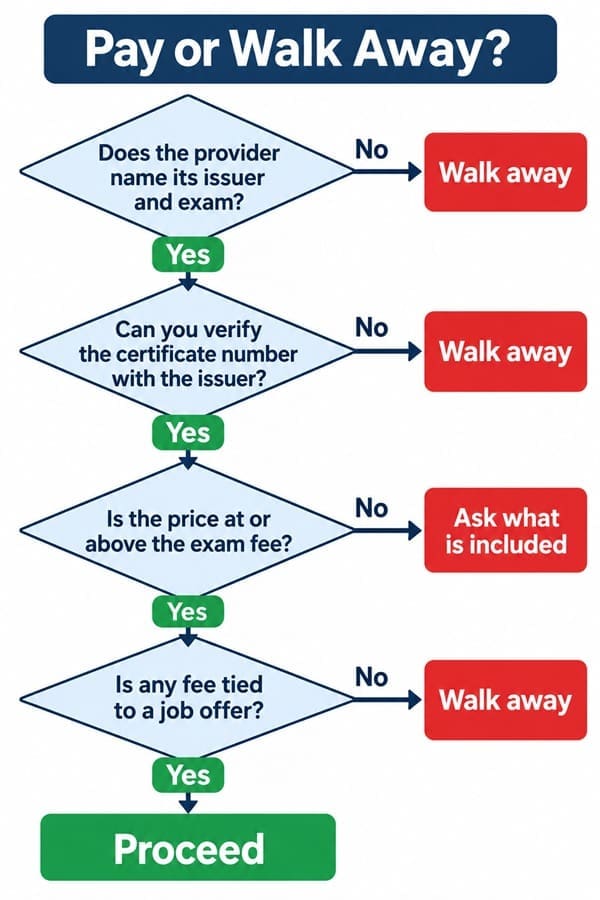
Five quick questions decide whether to pay or walk away.
A flowchart starts with the question: does the provider name its issuer and exam? A no leads to walk away. A yes leads to: can you verify the certificate number with the issuer? A no leads to walk away. A yes leads to: is the price at or above the exam fee?
A no leads to ask what is included. A yes leads to: is any fee tied to a job offer? A yes leads to walk away. A no leads to proceed.
What Real Six Sigma Certification Looks Like
Real credentials follow clear rules. The table compares three common routes. It shows what each route requires and how you can verify it.
| Three legitimate routes to a Green Belt credential | |||
| Feature | ASQ Green Belt (CSSGB) | IASSC Green Belt | Provider project certificate |
| Issuer | ASQ | IASSC (PeopleCert) | The training provider |
| Entry rule | 3 years of full-time paid work in the subject areas | No prerequisites | Set by the provider |
| Proof of skill | 110-question exam of about 4 hours | 100-question, 3-hour exam with a 70% pass mark | A completed, reviewed project |
| Exam cost | $483 (retake $283) | $350, per IASSC’s on-demand page as reported by SSDSI | Set by the provider |
| Renewal | Lifetime for Green Belt | Every 3 years | Set by the provider |
| How to verify | ASQ Certification Registry | PeopleCert certificate check | Ask the provider for records and the project report |
ASQ figures come from ASQ’s Green Belt page and recertification handbook. IASSC details come from BSI and Umbrex. The IASSC fee comes from SSDSI’s guide to the IASSC Green Belt exam, which cites IASSC’s on-demand page. Check current fees before you register.
Exam-Only Credentials Are Not Scams
An IASSC Green Belt needs no project. That design is legitimate. It proves you know the material. It does not prove you can lead a project, because an exam does not observe stakeholder work or real results.
Many employers want both. A project-based credential shows you can apply the tools. SSDSI’s own certification path centers on a real project with Master Black Belt mentoring. SSDSI also states it is not a boot camp for the IASSC test.
An Accredited Provider Is Not a Certified Person
An IASSC-accredited trainer can teach a course without giving the exam. Finishing that course does not make you IASSC certified. You still must pass the IASSC exam. Any seller who blurs this point deserves extra questions.
What About Free or Low-Cost Courses?
Free and low-cost courses can be honest. Many teach the method and issue a certificate of completion. The problem starts when a free course sells a paid “official certification” as an upgrade. Ask what the upgrade adds: an exam, a project review, or only a nicer certificate. Read the refund and renewal terms before you pay.
Accredited training and personal certification are two different steps.
Two steps side by side. Step one: an accredited training organization teaches the course. Step two: the candidate passes the issuer’s exam and receives a certificate number. An arrow shows both steps are needed for IASSC certification.
The Five-Check Test: Issuer, Exam, Evidence, Record, Price
The Five-Check Test is a simple screen SSDSI uses to size up any Six Sigma offer. Run all five checks before you pay.
- Issuer. Find the name of the body that issues the credential. A real issuer has a website, a standards page, and contact details.
- Exam. Learn who runs the exam. A proctored test run apart from the course seller is a strong sign.
- Evidence. Ask what proves skill: an exam, a project, or both. Know what the title really shows.
- Record. Ask how anyone can check the credential later. You want a certificate number and a public check.
- Price. Compare the price with real exam fees. This is the price-floor check.
Here is how the price-floor check works. ASQ charges $483 for its Green Belt exam. A provider that sells a full course plus a “certified” exam for far less must explain what the exam is. The low price proves nothing alone. It does mean you should ask more questions.
A credential that fails two or more checks is not worth your money.
How to Verify a Six Sigma Certificate
You can verify most credentials in a few minutes. Follow these five steps:
- Ask for the issuer and the number. Request the issuer’s name and the exact certificate number.
- Check ASQ credentials in the registry. ASQ’s public registry lets you search by credential, country, and last name. It shows status, date earned, and location.
- Check IASSC credentials with PeopleCert. PeopleCert’s certificate check needs the number exactly as printed. Its public register is opt-in, so a missing name does not prove a fake.
- Check the training provider. PeopleCert lists the training firms that IASSC has approved. Match any IASSC claim against that list.
- Ask for project proof on other belts. For provider or employer belts, ask the issuer to confirm in writing. Then request the project report.
Five steps verify a Six Sigma credential in minutes.
Five numbered steps in a row: ask for issuer and number, check the ASQ registry, check the PeopleCert certificate page, check the accredited training organization list, and ask for project proof.
How Employers Can Spot a Fake Belt in an Interview
A real practitioner talks about real projects. Ask these five questions:
- Which body issued your belt, and what is your certificate number?
- What was your project’s starting metric, and what was the result?
- How did you find the root cause?
- Who validated the savings, and how?
- What control plan kept the gain after the project ended?
Clear, specific answers point to real work. Vague answers point to a badge with no project behind it.
What to Do If You Already Paid a Scam Provider
Act fast and follow these steps:
- Stop paying. Do not send any more fees.
- Save the records. Keep emails, receipts, and screenshots.
- Dispute the charge. Ask your card issuer to reverse it.
- Report the seller. File a report at ReportFraud.ftc.gov.
- Protect your accounts. If a fake job offer was involved, stop sharing personal data and report the listing to the job site.
- Fix your resume. Remove any credential you cannot verify.
Six Sigma Certification Scam FAQs
Is Six Sigma certification a scam?
No. Six Sigma is a real method, and credentials from bodies such as ASQ and IASSC are real. Scams come from sellers who sell look-alike credentials with no real exam or project.
How can I tell if a Six Sigma certification is fake?
Ask for the issuer’s name and a certificate number, then verify both with the issuer. A fake credential usually has a vague issuer, no way to verify it, or a made-up accreditor.
Is IASSC legitimate?
Yes. IASSC is a certification body for Lean Six Sigma that tests candidates and accredits training providers. IASSC exams are now run through PeopleCert, which lets you verify a certificate by number.
Is a certificate of completion the same as certification?
No. A certificate of completion shows you attended a course. Certification shows you met an issuer’s rules, such as passing an exam or finishing a reviewed project.
Is a cheap online Six Sigma certification legitimate?
A low price alone does not prove fraud. It does call for questions. Compare the price with real exam fees, such as ASQ’s $483 Green Belt exam, and ask who runs the exam.
Do real employers charge for certification before hiring?
No. The FTC treats a certification fee tied to a job offer as a sign of a scam. Real employers pay for the training they require.
How do I verify a Six Sigma certificate?
Use the issuer’s own tool. ASQ has a public registry. PeopleCert checks IASSC certificate numbers. For provider-issued belts, ask the provider to confirm in writing and share the project report.
What should I do if I paid a fake provider?
Stop paying, save your records, and dispute the charge with your card issuer. Then report the seller at ReportFraud.ftc.gov.
Final Words
Real Six Sigma credentials share three traits: a named issuer, proof of skill, and a record anyone can verify. Scams skip at least one of them. Run the Five-Check Test, verify with the issuer, and never pay a fee to get a job.
Next Step: Train With a Provider You Can Verify
Six Sigma Development Solutions (SSDSI) teaches Yellow, Green, and Black Belt courses onsite, live virtual, public, and online. We are an IASSC accredited training organization, and our Lean Six Sigma trainings hold a five-star rating on Google reviews.
SSDSI has certified more than 5,322 professionals at over 600 organizations across 52 cities. Master Black Belt mentors guide learners through their projects. You may add the IASSC exam for a separate fee, or earn your certificate through a project. SSDSI does not give the IASSC exam at the end of class. Explore SSDSI’s programs and verify us with the same five checks.
About Six Sigma Development Solutions, Inc.
Six Sigma Development Solutions, Inc. offers onsite, public, and virtual Lean Six Sigma certification training. We are an Accredited Training Organization by the IASSC (International Association of Six Sigma Certification). We offer Lean Six Sigma Green Belt, Black Belt, and Yellow Belt, as well as LEAN certifications.
Book a Call and Let us know how we can help meet your training needs.


