
Fake practitioners are individuals who claim expertise in Lean Six Sigma without having the practical experience or rigorous training required to deliver real results. These individuals often hold certifications from “diploma mills” that prioritize fees over foundational knowledge. This issue creates a significant credibility gap in the industry, as businesses hire these “experts” only to find that their complex problems remain unsolved.
To be honest, I’ve seen this happen more times than I care to count. A company hires a “Black Belt” who has a shiny certificate but has never actually led a project from start to finish. It’s a bit like hiring a pilot who has only read a book about flying but has never sat in a cockpit. The results, as you can imagine, are often disastrous for the company’s bottom line.
Table of contents
Comparison Chart: Real vs. Fake Practitioners
| Basis for Comparison | Real Six Sigma Practitioner | Fake Practitioner (Paper Belt) |
| Certification Source | Accredited organizations with project requirements. | Online “instant” certifications or unverified entities. |
| Project Experience | Has successfully led multiple high-impact projects. | Zero to minimal hands-on project experience. |
| Statistical Knowledge | Deep understanding of Minitab, JMP, or statistical logic. | Relies on templates without knowing the “why.” |
| Mentorship | Has been mentored by a Master Black Belt (MBB). | Self-taught or “learned” via 4-hour video courses. |
| Problem Solving | Focuses on root cause and sustainable change. | Focuses on “quick fixes” that don’t last. |
| Tool Usage | Selects tools based on the specific data and problem. | Uses the same 3 tools for every single problem. |
Why Fake Practitioners Damage the Six Sigma Brand?
Fake practitioners act as a poison to the reputation of the entire methodology. When a business leader invests thousands of dollars into a Six Sigma initiative and sees no Return on Investment (ROI), they don’t usually blame the individual. Instead, they blame the system. They say, “Six Sigma doesn’t work for our industry,” when the truth is that the person leading the charge didn’t know what they were doing.
In my experience, the methodology is sound—it’s the execution that fails. These “paper belts” often focus on the jargon rather than the results. They use fancy terms like DMAIC or heteroscedasticity to sound smart, but they can’t actually reduce the defect rate in a production line. This leads to “Six Sigma fatigue” where employees roll their eyes at the mere mention of a new project.
The industry is currently flooded with people who have passed a multiple-choice test but have never used data to drive a decision. Does it surprise you that so many Lean initiatives fail within the first year? It shouldn’t. Without the statistical rigor and the change management skills that come from real-world practice, these projects are doomed from the start.

Public, Onsite, Virtual, and Online Six Sigma Certification Training!
- We are accredited by the IASSC.
- Live Public Training at 52 Sites.
- Live Virtual Training.
- Onsite Training (at your organization).
- Interactive Online (self-paced) training,
The Rise of the “Paper Belt” Syndrome
The term Paper Belt refers to someone who is certified on paper but lacks the muscle memory of process improvement. This syndrome has exploded because of the demand for “lean” resumes. Everyone wants to add those four magic words—Six Sigma Black Belt—to their LinkedIn profile. Unfortunately, many training providers have turned into “certification factories,” selling titles for a few hundred dollars.
Here’s the thing: you can’t learn how to manage a hostile stakeholder or how to clean messy data from a 20-minute YouTube video. Real Six Sigma is messy. It involves late nights looking at control charts and difficult conversations about process waste. When fake practitioners bypass this struggle, they miss the “art” of the science. They become “tool-bound,” following a checklist without understanding the underlying variance of the process.
Have you ever wondered why some “experts” seem to struggle when the data doesn’t look perfect? It’s because they were never taught how to handle real-world complexity. They are used to the “textbook” examples where every p-value is clearly below 0.05.
Also Read: How SSDSI Helps Students with Six Sigma Yellow Belt Certification?
How to Spot a Fake Six Sigma Practitioner?
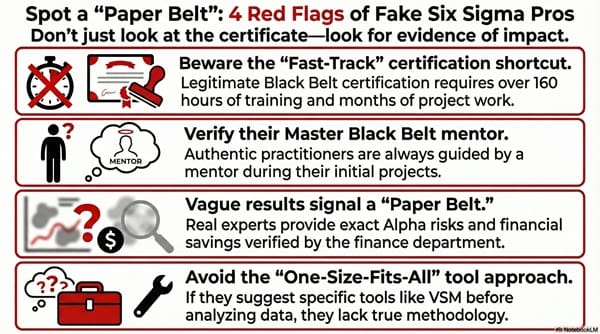
Fake practitioners usually leave a trail of clues if you know where to look. If you are a hiring manager or a business owner, you need to be a bit of a detective. Don’t just look at the certificate; look at the evidence of impact. A real practitioner will talk about their “failures” and “pivots” just as much as their successes.
- The “One-Size-Fits-All” Approach: If they suggest using a Value Stream Map (VSM) for every single problem before even seeing the data, be careful.
- Vague Results: If their resume says they “Improved efficiency,” but they can’t tell you the exact Alpha risk they accepted or the financial savings verified by the finance department, they might be a “paper belt.”
- Lack of Mentorship: Ask them who their Master Black Belt was. Real practitioners always have a mentor who guided them through their first few projects.
- The “Fast-Track” Certification: If they got their Black Belt in three days, they are a fake. There is no shortcut to the 160+ hours of training and months of project work required for a legitimate certification.
I once interviewed a candidate who claimed to be a Master Black Belt. When I asked him to explain the difference between common cause and special cause variation in a real-world scenario, he froze. He knew the definitions, but he couldn’t apply them to a simple manufacturing problem. That’s the hallmark of a fake.
Impact of Unqualified “Experts” on Organizational Growth
Fake practitioners don’t just fail to save money; they actually cost the company more in the long run. When an unqualified person leads a project, they often implement “solutions” that add more complexity and Non-Value-Added (NVA) steps to a process. This is the opposite of Lean.
- Erosion of Trust: When a project fails, the frontline workers lose faith in the management. They see Six Sigma as a “corporate fad” rather than a tool for improvement.
- Resource Drain: Companies tie up their best employees in “Kaizen events” led by people who don’t understand the Voice of the Customer (VOC).
- Financial Mismanagement: “Paper belts” often claim savings that never actually show up in the bank account. They might reduce “theoretical time” but fail to reduce actual overhead.
- Operational Risk: In industries like healthcare or aerospace, an incorrectly applied Six Sigma tool can lead to safety issues. If you don’t understand FMEA (Failure Mode and Effects Analysis), you might miss a critical risk factor.
To be honest, the damage to the company culture is often harder to fix than the financial loss. Once the staff believes that Six Sigma is “just more paperwork,” it takes years to win them back. This is why fake practitioners are so dangerous—they burn the bridge for the real experts who come after them.
Also Read: How SSDSI Guides Your Six Sigma Green Belt Certification Journey?
Case Study: The Cost of a Failed Lean Project
Let’s look at a hypothetical (but very realistic) example. “Company A” hired a Green Belt who received their certification through a weekend online course with no project requirement. The task was to reduce the cycle time of an invoice approval process.
The fake practitioner jumped straight to a solution: they purchased expensive new software to automate the approvals. They didn’t do a Gemba walk, and they didn’t analyze why the delays were happening in the first place.
After six months and $50,000 in software costs, the cycle time actually increased. Why? Because the underlying process was broken. The software simply “automated the mess.” If they had used a real Root Cause Analysis, they would have found that the delay was caused by a lack of clear approval criteria, not a lack of technology.
This is a classic example of how fake practitioners focus on the “what” instead of the “why.” They love shiny new toys but hate the hard work of process discipline.
Essential Questions to Ask During the Interview
When you are looking for a real expert, you need to dig deep. Don’t be afraid to ask technical questions that require practical answers. You want to see if they can think on their feet using statistical logic.
- “Can you describe a project where your initial hypothesis was wrong? How did the data change your mind?”
- “How did you handle a stakeholder who was actively trying to sabotage your project?”
- “What statistical software do you prefer, and can you explain how you would test for Normality?”
- “Show me a project charter you’ve written. How did you define the Problem Statement to ensure it wasn’t too broad?”
- “How did you ensure the gains from your last project were sustained after you handed it back to the process owner?”
In my experience, a real Six Sigma Black Belt will light up when you ask these questions. They will have stories, data points, and maybe even a few “war stories” about difficult data sets. A fake practitioner will give you “textbook” answers that feel rehearsed and hollow.
Also Read: How SSDSI Helps Students with Six Sigma Black Belt Certification?
Key Takeaways
- Certification is not competence: A piece of paper does not mean someone can actually solve a business problem. Always verify project history.
- The brand is at stake: Every failed project led by a fake practitioner makes it harder for the next professional to succeed.
- Focus on the “Why”: Real experts look for root causes; “paper belts” look for quick, visible fixes that rarely last.
- Investment in quality training: Companies should only trust certifications from reputable organizations like ASQ or the IASSC, or those that require a verified, completed project.
- Protect your culture: Avoid “Six Sigma fatigue” by ensuring your projects are led by people who understand Change Management as much as they understand Statistics.
Frequently Asked Questions on Paper Belt
Q: Can I get Six Sigma certified without doing a project?
A: You can get a “certificate of completion” for a course, but most reputable bodies do not consider you a “Certified Belt” until you have completed at least one or two real-world projects with proven financial or operational impact.
Q: Why are there so many fake practitioners now?
A: Because the demand for Lean Six Sigma skills is high, and many people want the career benefits without the 4-6 months of rigorous study and application required to actually master the material.
Q: Does an online certification automatically mean someone is a “paper belt”?
A: Not necessarily. There are excellent online programs. However, if the program does not require a Master Black Belt to review a live project, it is much easier for someone to “fake” their way through it.
Q: How do I fix a Six Sigma program that has been run by unqualified people?
A: You have to start small. Bring in a verified Master Black Belt to audit the current projects, stop the ones that aren’t working, and focus on one “win” to rebuild trust with the staff.
Q: What is the most important skill for a real Six Sigma practitioner?
A: Critical thinking. While statistics are important, the ability to look at a process objectively and ask “Why?” until you reach the root cause is what separates the experts from the fakes.
Final Words
At the end of the day, Six Sigma is about making things better for the customer and the company. It’s a beautiful, data-driven way to solve the world’s most annoying problems. But when we allow fake practitioners to take the wheel, we aren’t just wasting money—we are devaluing a methodology that has saved billions of dollars for organizations worldwide.
SSDSI believes in the power of authentic expertise. We don’t just “check boxes” or hand out titles. We focus on creating real, lasting change that you can see in your reports and your bank account.
Don’t settle for a “paper belt” when your business deserves a champion. We are committed to the highest standards of the industry because we know that when Six Sigma is done right, the results are nothing short of transformative.
Contact us today for Six Sigma Certifications.

About Six Sigma Development Solutions, Inc.
Six Sigma Development Solutions, Inc. offers onsite, public, and virtual Lean Six Sigma certification training. We are an Accredited Training Organization by the IASSC (International Association of Six Sigma Certification). We offer Lean Six Sigma Green Belt, Black Belt, and Yellow Belt, as well as LEAN certifications.
Book a Call and Let us know how we can help meet your training needs.