

Lean Six Sigma workforce development is the organizational practice of building tiered process-improvement capability across an entire workforce, not just certifying one or two individuals, so that continuous improvement becomes a distributed organizational skill rather than something a handful of specialists do in isolation.
It matters because a single trained Black Belt, however skilled, can only touch a fraction of an organization’s problems; real capability requires a structured pathway (White through Master Black Belt) matched to different roles, diagnosed against an actual skills matrix rather than guesswork, and delivered in a sequence that builds momentum rather than overwhelming the organization all at once.
Done well, workforce development turns Lean Six Sigma from a project a few specialists run into a genuine organizational capability that survives staff turnover and compounds over time.
Quick Reference Table
| Element | What It Means | Why It Matters |
| Workforce Development | Building tiered capability across many roles, not just certifying individuals | Turns Six Sigma into a distributed skill, not a specialist function |
| Skills Matrix | A tool comparing current workforce capability against what’s actually needed | Diagnoses the real gap before choosing training |
| Belt Structure | White through Master Black Belt, each level tied to different responsibility | Functions as a built-in career pathway, not just a training curriculum |
| Wave-Based Deployment | Rolling out training in structured phases | Builds momentum and proof before scaling further |
| Cross-Training | Building overlapping capability across multiple people, not just one specialist | Protects against skill loss when someone leaves or changes roles |
Table of contents
- Quick Reference Table
- Key Takeaways
- What Is Lean Six Sigma Workforce Development?
- How Do You Build a Workforce Development Plan?
- Matching Format to the Actual Gap
- Why Does Project-Based Certification Matter More for Workforce Capability?
- Preventing Skill Decay: The Part Most Programs Skip
- Real-World Example (Hypothetical)
- Common Mistakes in Lean Six Sigma Workforce Development
- Frequently Asked Questions on Lean Six Sigma workforce development
- Final Words
- Related Articles
Key Takeaways
- Workforce development is broader than certification. Certifying one Black Belt is a training event; workforce development is the ongoing organizational practice of building distributed capability across many roles over time.
- A skills matrix should come before a training plan, not after. Diagnosing where your actual capability gaps sit is what determines which belt levels and how many people actually need training, rather than defaulting to a generic program.
- The belt structure doubles as a career pathway. Each level, White through Master Black Belt, reflects a different, demonstrable set of skills, giving employees a visible way to grow rather than a single, isolated certificate.
- Certification without applied project work is a weaker signal of real capability. The credentialing bodies that require assessed, real project work (rather than exam performance alone) produce certificates that more reliably demonstrate what an employee can actually do.
- Skill decay is a real, underplanned risk. Without refresher training and regular skills matrix updates, capability built through a training initiative quietly erodes, particularly for skills used infrequently.
- Matching training format to the actual gap matters more than defaulting to full certification everywhere. A skills gap in one specific tool might call for a short custom workshop; a genuine capability gap across a whole function calls for structured certification instead.
- Workforce development should be planned in waves, not delivered all at once. A staged rollout, targeting a smaller group first, builds visible proof and momentum before the harder work of reaching the broader organization.
What Is Lean Six Sigma Workforce Development?
Lean Six Sigma workforce development is the practice of building process-improvement capability across an organization’s workforce in a structured, tiered way, rather than training a small number of specialists in isolation. It treats Six Sigma capability the way a mature organization treats any other critical skill: something to be planned for, measured, and sustained across many people and roles, not a one-time event tied to a handful of individuals.
The distinction matters practically. Training an individual is a single event: person X completes Green Belt certification. Workforce development is an ongoing organizational system: which roles need which level of capability, how that capability gets built and verified, how it’s sustained as people change roles or leave, and how the organization’s overall improvement capacity grows over time as a result.

Public, Onsite, Virtual, and Online Six Sigma Certification Training!
- We are accredited by the IASSC.
- Live Public Training at 52 Sites.
- Live Virtual Training.
- Onsite Training (at your organization).
- Interactive Online (self-paced) training,
The Skills Matrix: Diagnosing Your Actual Gap
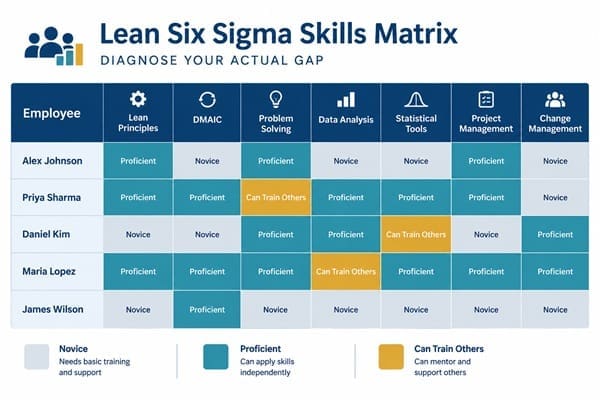
Before building any training plan, a skills matrix (sometimes called a competency or cross-training matrix) should map current capability against what the organization actually needs. This is a visual tool comparing the people in a given function against the specific skills required, showing not just who has a given skill, but their level of proficiency and whether they’re capable of teaching it to others.
This step matters because it prevents the most common workforce development mistake: defaulting to a generic training rollout without first confirming where the real gap sits. An organization might discover, once it actually builds this matrix, that its problem isn’t a lack of Green Belts generally, but a specific concentration risk: only one person in an entire department can actually run a DOE, and that person is nearing retirement. That’s a very different, more urgent problem than “we should train more people,” and it changes what gets prioritized first.
A skills matrix should be a living document, not a one-time exercise. Organizations that treat cross-training and skills matrices well conduct regular (often quarterly) reviews, updating the matrix as people develop, change roles, or leave, and adjusting the training plan based on what the updated matrix reveals.
Also Read: Employee Voice: Strengthening Your Workforce for Success
The Belt Structure as a Career Ladder

This is a genuinely underused feature of the standard Six Sigma belt structure: it already functions as a built-in career pathway, not just a training curriculum, if an organization frames it that way deliberately.
| Belt Level | What It Demonstrates | Typical Organizational Fit |
| White Belt | Basic awareness of continuous improvement thinking | Broad, organization-wide awareness building |
| Yellow Belt | Ability to support or lead a small improvement project | Frontline employees and team members |
| Green Belt | Ability to lead a moderate-scope departmental project | Middle managers and department leads, per SSDSI’s own certification guide for managers |
| Black Belt | Ability to lead complex, cross-functional projects and mentor others | Engineers, quality specialists, and dedicated improvement leads |
| Master Black Belt | Deep, organization-wide technical and mentoring capability | Senior practitioners overseeing multiple Black Belts and deployment strategy |
Why frame this explicitly as a career ladder rather than just a training sequence?
Employers care about what a credential demonstrably proves someone can do, not just that a course was completed. Presenting the belt structure to employees as a visible growth pathway, each level reflecting a genuinely different, demonstrable capability, gives workforce development a retention and engagement benefit beyond the immediate skills gained, since employees can see a concrete path forward rather than a single, isolated certificate.
How Do You Build a Workforce Development Plan?
1. Build the Skills Matrix First
Map current capability against actual organizational need before deciding on any specific training plan. This step alone often reveals that the real gap is narrower, or in a different place, than initial assumptions suggested.
2. Match Belt Level to Actual Role, Not Job Title
Use the role-based frameworks already established for managers and engineers: a manager who sponsors projects needs different training than one who executes them, and a design engineer needs a different track than a process engineer. Matching training to actual role, not job title, prevents both under- and over-training.
3. Choose the Right Format for Each Gap
Not every gap needs full certification. A specific, narrow skills gap might be better addressed with a custom workshop; a genuine, broad capability gap across a function calls for structured belt-level certification instead.
4. Deploy in Waves, Not All at Once
Structure the rollout in phases, targeting a smaller group first to build visible, credible proof of value before expanding further. SSDSI’s own enterprise deployment content covers this wave-based structure in depth; the underlying logic is the same one Diffusion of Innovation theory describes, early success with a smaller group is what earns the credibility needed to bring the larger, more skeptical majority along.
5. Build in Regular Skills Matrix Reviews and Refresher Training
Treat the skills matrix as a living document, reviewed on a regular cadence (often quarterly), and build refresher training into the plan for skills that are used infrequently and therefore prone to decay.
Also Read: Operational Excellence Training Solutions: What They Are?
Matching Format to the Actual Gap
| Situation | Better-Fit Format |
| A narrow, well-defined skills gap on one specific tool | A custom workshop |
| A broad capability gap across an entire function or role | Structured belt-level certification |
| A leadership team needing sponsorship, not execution, skill | Champion-level training |
| An organization-wide cultural shift, not a single skill gap | A full enterprise deployment |
This table exists because defaulting to the same training format for every gap wastes both budget and employee time. A department needing help with one specific root-cause investigation doesn’t need a six-week Black Belt program; it needs a focused workshop. A department with no process-improvement capability at all does need the fuller, structured pathway.
Why Does Project-Based Certification Matter More for Workforce Capability?
This is a nuance most generic workforce planning content skips: not all certification credibly demonstrates real capability. Certifications that require evidence of actual, assessed project work, rather than exam performance alone, more reliably signal that an employee can genuinely apply what they learned, not just recall it for a test.
This connects directly to a finding covered in SSDSI’s own certification ROI content: a certificate without applied project work behind it consistently underperforms its cost and its promise, both for the individual and for the organization counting on that capability.
Workforce development plans that prioritize real, assessed project work over exam-only credentials build more genuine, more reliably usable organizational capability, even if that path costs somewhat more time up front.
Certification is a staging post, not the finish line. The practitioners, and the organizations, who get the most value keep building complementary skills and applying them to real work afterward, rather than treating a completed certificate as evidence the job is done.
Preventing Skill Decay: The Part Most Programs Skip
Building capability is only half the workforce development challenge; sustaining it is the other half, and it’s the part most initial rollouts fail to plan for at all. Skills used infrequently decay, and an organization that trained twenty Green Belts eighteen months ago, with no refresher training or ongoing project assignment since, likely has meaningfully less real capability today than the original training numbers would suggest.
Practical safeguards against this include:
- Scheduled refresher training for skills that aren’t used regularly, rather than assuming a single training event provides permanent capability.
- Deliberate project assignment ensuring certified employees actually apply their skills soon and regularly after training, echoing the “apply it or lose the ROI” finding covered elsewhere in this content cluster.
- Regular skills matrix updates, catching decay and emerging gaps before they become a real operational risk.
- Succession planning for concentration risk, specifically identifying and addressing situations where only one person in a function holds a critical skill.
Real-World Example (Hypothetical)
Problem: A regional healthcare network has certified a handful of Black Belts over several years, but process improvement capability is concentrated almost entirely in those few individuals; when two of them leave within the same year, several in-progress projects stall with no one qualified to continue them.
Analysis: Building a skills matrix for the first time reveals the real problem clearly: the organization has meaningful depth at the Black Belt level in exactly two departments, and almost no Green Belt or Yellow Belt capability anywhere else to draw from when those specialists are unavailable.
Six Sigma approach: Rather than simply certifying two replacement Black Belts, the organization builds a genuine workforce development plan: Yellow Belt awareness training across a broad frontline population, Green Belt certification matched specifically to department managers per SSDSI’s manager-focused framework, and Black Belt certification reserved for a wider, deliberately cross-departmental group rather than concentrated in just one or two people.
Action: A quarterly skills matrix review is instituted going forward, specifically flagging any department where capability again concentrates in a single individual.
Result (hypothetical): When another Black Belt departs the following year, three other certified practitioners across different departments are able to step in without a project stalling, a direct result of treating capability as a distributed organizational asset rather than a handful of individual credentials. This is a hypothetical illustration of workforce development addressing concentration risk, not a documented case study.
Common Mistakes in Lean Six Sigma Workforce Development
- Certifying individuals without a workforce-level plan behind it. A handful of isolated Black Belts, however skilled, doesn’t constitute real organizational capability if that knowledge is concentrated in just one or two people.
- Skipping the skills matrix and guessing at the gap. Without a real diagnostic step, training plans default to generic assumptions rather than the organization’s actual, specific need.
- Defaulting to full certification for every gap. A narrow, specific skills need often calls for a focused workshop, not a multi-week certification program.
- Treating certification as the finish line. A certificate without ongoing application and refresher training decays in real value faster than most organizations plan for.
- Rolling out training to the entire organization at once. Skipping a staged, wave-based approach removes the chance to build visible proof and momentum before tackling the harder, more skeptical majority of the workforce.
Frequently Asked Questions on Lean Six Sigma workforce development
Q: What is Lean Six Sigma workforce development?
A: It’s the organizational practice of building tiered process-improvement capability across many roles and levels, using tools like a skills matrix and a structured belt pathway, rather than training a small number of individuals in isolation.
Q: What is a Six Sigma skills matrix?
A: A skills matrix (or competency/cross-training matrix) is a visual tool comparing the people in a given function against the specific process-improvement skills needed, showing proficiency levels and highlighting gaps or concentration risk before a training plan is built.
Q: How does the belt structure work as a career pathway?
A: Each belt level, White through Master Black Belt, reflects a genuinely different, demonstrable capability. Framed deliberately as a career ladder rather than just a training sequence, it gives employees a visible growth path tied to real, increasing responsibility.
Q: How do you build a Lean Six Sigma workforce development plan?
A: Start with a skills matrix to diagnose the real gap, match belt level to actual role rather than job title, choose the right format (workshop vs. full certification) for each specific gap, deploy training in waves rather than all at once, and build in regular skills matrix reviews and refresher training.
Q: Should workforce development use workshops or full certification?
A: It depends on the gap. A narrow, well-defined skills need is often better addressed with a focused custom workshop. A broad capability gap across an entire function or role calls for structured, full belt-level certification instead.
Q: How do you sustain Lean Six Sigma skills over time?
A: Through scheduled refresher training, deliberately assigning certified employees to real projects soon after training, regular skills matrix updates to catch decay early, and succession planning specifically to address when critical skills are concentrated in too few people.
Final Words
Lean Six Sigma workforce development succeeds or fails on a distinction most organizations don’t make explicitly: certifying individuals is a training event; building workforce capability is an ongoing organizational system.
A skills matrix diagnoses the real gap, the belt structure provides a built-in career pathway when framed that way deliberately, and a wave-based, format-matched rollout builds capability that’s distributed widely enough to survive staff turnover, rather than concentrated in a handful of people who can walk out the door with it.
Building Lean Six Sigma capability that survives staff turnover, rather than concentrating in a handful of individuals, takes a real workforce development plan, not just isolated certifications.
Six Sigma Development Solutions, Inc. (SSDSI) is IASSC-accredited and 5-star rated on Google Reviews, having certified 5,322+ professionals across 600+ organizations in 52 cities. Our onsite, live virtual, public, and online programs span the full belt pathway, custom workshops, and enterprise deployment, built to match the right format to your organization’s actual capability gap. Contact SSDSI to build a workforce development plan around your team’s real needs.
About Six Sigma Development Solutions, Inc.
Six Sigma Development Solutions, Inc. offers onsite, public, and virtual Lean Six Sigma certification training. We are an Accredited Training Organization by the IASSC (International Association of Six Sigma Certification). We offer Lean Six Sigma Green Belt, Black Belt, and Yellow Belt, as well as LEAN certifications.
Book a Call and Let us know how we can help meet your training needs.


