
Operational excellence training solutions generally fall into four categories: Lean Six Sigma certification programs, live facilitated workshops, executive coaching, and self-paced e-learning. Most organisations eventually need a combination of these approaches rather than relying on a single training format.
It’s also important to understand a common misconception: Operational excellence is not a methodology separate from Lean or Six Sigma. Instead, operational excellence is the broader goal, an organization that consistently turns strategy into results through disciplined execution at every level.
Lean, Six Sigma, and the Toyota Production System provide many of the tools, frameworks, and management practices used to reach that goal.
The most effective operational excellence programs combine three elements:
- A structured improvement methodology such as DMAIC
- Leadership development and sponsorship
- Ongoing reinforcement after formal training concludes
Without all three, even well-designed training programs often struggle to produce lasting operational change
Operational Excellence Training Solutions at a Glance

| Solution Type | Best For | Typical Duration |
| Certification Training | Building repeatable improvement capability across the organization | Days to weeks per certification level |
| Live Facilitated Workshops | Solving specific operational challenges quickly | One to several days |
| Executive Coaching | Strengthening leadership behaviors and sponsorship | Ongoing, typically monthly |
| Self-Paced E-Learning | Creating broad awareness across large populations | Self-directed, several hours per module |
Table of contents
Key Takeaways
- Operational excellence is an outcome, not a standalone methodology. Lean, Six Sigma, and TPS provide the practical systems used to achieve it.
- Most organizations require more than one training solution. Certification develops skills, coaching develops leadership support, and e-learning builds awareness.
- Structured methodologies outperform vague “mindset-only” approaches. Sustainable improvement requires tools and frameworks, not inspiration alone.
- An organization’s maturity level should drive its training strategy. What works for a company just getting started will look very different from what works for a mature deployment.
- Leadership development is just as important as frontline training. Programs frequently stall when managers and executives are not actively engaged.
- Reinforcement determines long-term success. Training without follow-up rarely translates into lasting behavior change.
What is Operational Excellence?
Operational excellence is often discussed as though it were a methodology. In reality, it is better understood as a state of organizational performance.
An organization achieves operational excellence when its day-to-day activities consistently support its strategic objectives. Employees at every level understand priorities, follow standardized improvement practices, and make decisions aligned with business goals.
The challenge is that many training providers position operational excellence as a philosophy or mindset rather than a discipline supported by specific methods.
That’s often where problems begin.
Mindsets can inspire people. Methodologies help them execute.
Without a structured improvement framework behind the message, organizations frequently struggle to turn good intentions into measurable business results.

Public, Onsite, Virtual, and Online Six Sigma Certification Training!
- We are accredited by the IASSC.
- Live Public Training at 52 Sites.
- Live Virtual Training.
- Onsite Training (at your organization).
- Interactive Online (self-paced) training,
Operational Excellence vs. Lean vs. Six Sigma
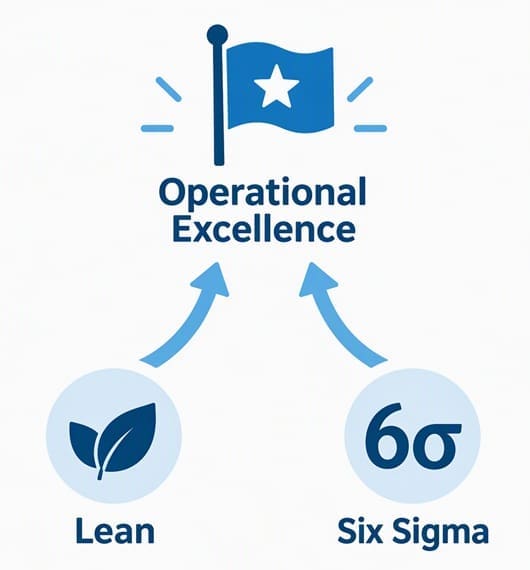
One of the most common sources of confusion in continuous improvement is the relationship between operational excellence, Lean, and Six Sigma.
| Term | What It Actually Represents |
| Operational Excellence | The outcome: consistent execution of strategy across the organization |
| Lean | A methodology focused on eliminating waste and improving flow |
| Six Sigma | A methodology focused on reducing variation and defects through data |
| Toyota Production System (TPS) | The original production system from which Lean evolved |
Operational excellence is the destination.
Lean and Six Sigma are two of the most widely used paths for getting there.
Organizations evaluating training providers should be cautious when a provider emphasizes operational excellence but cannot clearly explain the methodology supporting it. A destination without a roadmap rarely produces meaningful results.
Also Read: How to Apply Six Sigma Tools to Gemba Walks for Process Excellence?
The Four Major Types of Operational Excellence Training
1. Certification Training
Certification programs provide a structured framework for building improvement capability.
Most organizations use a belt-based progression that includes:
- Yellow Belt
- Green Belt
- Black Belt
Certification training teaches participants how to identify opportunities, analyze problems, implement improvements, and sustain results using proven methodologies.
One of the biggest advantages of certification training is durability. Employees develop skills that can be applied repeatedly across projects, functions, and business units.
2. Live Facilitated Workshops
Workshop-based training focuses on solving an immediate operational challenge.
Common examples include:
- Kaizen events
- Rapid improvement workshops
- Process redesign sessions
- Value stream mapping events
Because workshops are centered on current business problems, they often deliver visible results quickly.
However, workshops alone do not typically establish enterprise-wide improvement capability. They solve today’s problem but do not necessarily equip employees to solve the next one.
3. Executive Coaching
Leadership often determines whether operational excellence initiatives thrive or fail.
Executive coaching helps leaders:
- Sponsor improvement projects
- Remove organizational barriers
- Reinforce accountability
- Model improvement behaviors
This component is frequently overlooked, despite being one of the strongest predictors of long-term success.
Organizations can train dozens of Green Belts, but improvement efforts often stagnate if leadership engagement is inconsistent.
4. Self-Paced E-Learning
E-learning platforms provide an efficient way to introduce operational excellence concepts across a large workforce.
These programs are particularly useful for:
- Awareness building
- New employee onboarding
- Foundational improvement education
- Enterprise-wide exposure
Because self-paced learning prioritizes accessibility and scale, it is generally most effective when combined with more hands-on training approaches.
Why One Training Solution Is Rarely Enough?
Every training format addresses a different organizational need.
- Certification training builds capability.
- Executive coaching builds sponsorship.
- E-learning builds awareness.
- Workshops generate practical results.
Relying on only one typically leaves a critical gap elsewhere in the system.
For that reason, mature operational excellence programs usually combine multiple training types and introduce them in a deliberate sequence rather than launching everything simultaneously.
A Practical Training Sequence
Organizations often benefit from a staged approach:
Step 1: Build Awareness
Use e-learning to expose a broad audience to improvement concepts at relatively low cost.
Step 2: Develop Leadership Support
Introduce executive coaching early so leaders understand their role before improvement projects begin.
Step 3: Build Practitioner Capability
Provide certification training to employees who will lead and support projects.
Step 4: Address Immediate Operational Challenges
Use workshops and Kaizen events to solve high-priority business problems while long-term capability continues to grow.
This sequencing creates both quick wins and sustainable capability.
Also Read: Operational Excellence: A Blueprint for Business Success
Matching Training to Organizational Maturity
Not every organization needs the same solution mix.
Stage 1: Exploring
Typical Characteristics
- Leadership is interested
- No formal improvement structure exists
Recommended Focus
- E-learning
- Executive workshops
- Leadership alignment
Stage 2: Building
Typical Characteristics
- Initial pilot projects underway
- Limited internal capability
Recommended Focus
- Green Belt and Yellow Belt training
- Executive coaching
- Early project support
Stage 3: Scaling
Typical Characteristics
- Certified practitioners exist
- Adoption varies by department
Recommended Focus
- Expanded certification
- Department-specific workshops
- Change management reinforcement
Stage 4: Sustaining
Typical Characteristics
- Projects operate independently
- Leadership actively supports improvement
Recommended Focus
- Black Belt and Master Black Belt development
- Mentoring programs
- Refresher training
- Internal capability building
A Stage 1 organization that immediately launches a large-scale certification rollout may move faster than leadership readiness allows. A Stage 3 organization relying solely on awareness training may not invest deeply enough to sustain growth.
How to Evaluate an Operational Excellence Training Provider
Before selecting a provider, ask several practical questions.
Does the training teach a defined methodology?
Providers should clearly identify the framework they use, whether DMAIC, Lean, TPS-based methods, or another structured approach.
Does the provider support multiple learning formats?
Organizations evolve over time. Providers offering certifications, workshops, coaching, and digital learning can typically support that evolution more effectively.
Is leadership development included?
Improvement capability grows faster when leadership receives training alongside practitioners.
What happens after training?
The strongest providers include mentoring, reinforcement, coaching, or follow-up support that extends beyond the initial learning event.
Is the certification accredited?
Credentials associated with recognized accrediting bodies, such as IASSC, generally carry stronger credibility across industries.
Common Mistakes Organizations Make
Focusing on Motivation Instead of Methodology
Inspiration can create enthusiasm, but methodology creates repeatable results.
Ignoring Leadership Development
Even highly trained practitioners struggle when leadership sponsorship is absent.
Using the Same Solution at Every Stage
Training needs evolve as programs mature. What works for a startup initiative often differs from what works in an established deployment.
Treating Training as a One-Time Event
Operational excellence is not a project with an endpoint. Organizations that sustain results view training as an ongoing capability-building effort.
Why Operational Excellence Programs Fail to Produce Lasting Change
Most unsuccessful programs share one or more of three characteristics:
- They focus on concepts without teaching a practical methodology.
- They train employees but not leaders.
- They stop after the initial training event instead of reinforcing behavior over time.
Operational excellence requires consistency. Consistency requires systems. Systems require reinforcement.
Without that final component, even strong programs often fade after the first year.
Frequently Asked Questions (FAQs) on Operational Excellence
What are operational excellence training solutions?
Operational excellence training solutions are programs designed to help organizations improve performance and execute strategy more effectively through structured methodologies, leadership development, and employee training.
Is operational excellence the same as Lean Six Sigma?
No. Operational excellence is the broader organizational outcome. Lean and Six Sigma are methodologies commonly used to achieve that outcome.
Which training solution is best?
The right solution depends on organizational maturity, business goals, leadership involvement, and existing improvement capability.
Do organizations need leadership training?
In most cases, yes. Many improvement initiatives underperform because leaders are not equipped to sponsor and sustain the work.
How long does it take to build an operational excellence culture?
Most organizations move through exploration and initial capability building during the first one to two years. Scaling and sustaining generally become ongoing efforts rather than finite milestones.
How is certification training different from workshops?
Certification training develops long-term practitioner capability. Workshops focus on solving a specific operational challenge in the short term.
Why do many operational excellence programs fail?
Programs often fail because they emphasize concepts over methodology, overlook leadership development, or lack reinforcement after training.
Final Words
Operational excellence training is most effective when organizations understand exactly what they are trying to build. Operational excellence itself is the objective, but methodologies such as Lean and Six Sigma provide the structure required to achieve it.
The strongest programs combine certification training, leadership development, workshops, and awareness-building in a deliberate sequence aligned with organizational maturity. When training is grounded in a proven methodology and reinforced over time, it becomes more than an educational initiative. It becomes a sustainable capability that improves how the organization operates year after year.
Build Operational Excellence Capability with SSDSI
Operational excellence is not created through motivation alone. It is built through disciplined methods, capable leaders, and employees equipped with the right tools.
SSDSI provides IASSC-accredited Yellow Belt, Green Belt, and Black Belt training based on the DMAIC framework through onsite, live virtual, public, and self-paced delivery options tailored to an organization’s current stage of maturity.
SSDSI has certified 5,322+ professionals across 600+ organizations in 52 cities and maintains a 5-star Google review rating.
For organizations looking to move beyond awareness and build lasting operational excellence capability, selecting the right combination of certification, coaching, workshops, and reinforcement is often the first step toward creating measurable, sustainable results.
About Six Sigma Development Solutions, Inc.
Six Sigma Development Solutions, Inc. offers onsite, public, and virtual Lean Six Sigma certification training. We are an Accredited Training Organization by the IASSC (International Association of Six Sigma Certification). We offer Lean Six Sigma Green Belt, Black Belt, and Yellow Belt, as well as LEAN certifications.
Book a Call and Let us know how we can help meet your training needs.


