

The right Six Sigma path for an engineer depends heavily on which discipline you actually work in, a distinction generic belt-comparison guides consistently skip. Design and product engineers, building something new, are generally better served by DFSS (Design for Six Sigma), most often executed through the DMADV roadmap, since it’s built specifically for designing quality in from the start.
Manufacturing, process, and quality engineers, working on something that already exists, are better served by standard DMAIC through Green Belt or Black Belt certification. For an engineer who already has a strong statistics background, Six Sigma’s real value isn’t the math itself; it’s the structured methodology, a repeatable framework for scoping, prioritizing, and communicating improvement work in terms the rest of the business, not just other engineers, can act on.
Quick Reference Table
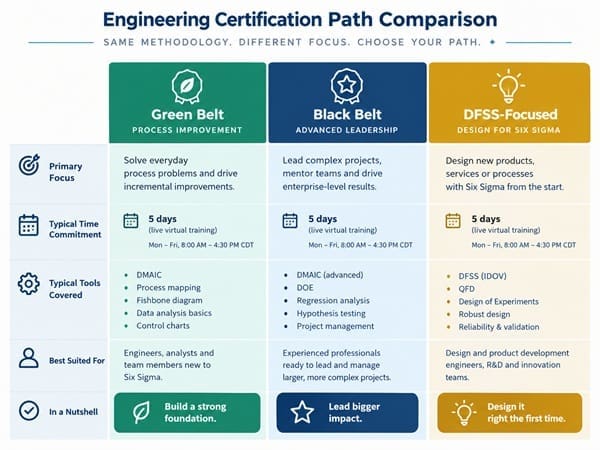
| Engineering Role | Recommended Track | Recommended Level |
| Design / Product Engineer | DFSS (via DMADV) | Green Belt or Black Belt, DFSS-focused |
| Manufacturing / Process Engineer | DMAIC | Green Belt or Black Belt |
| Quality Engineer | DMAIC (often paired with FMEA, SPC) | Green Belt or Black Belt |
| Reliability / Systems Engineer | Both, depending on project (new system = DFSS, existing system = DMAIC) | Black Belt |
| Engineering Manager | DMAIC fluency plus Champion-level sponsorship skill | Black Belt or Champion Training |
Table of contents
Key Takeaways
- The right track depends on discipline, not job title. A “Product Engineer” designing something new needs DFSS; a “Process Engineer” improving something existing needs DMAIC. The title alone doesn’t tell you which.
- DFSS is most relevant to engineers building something that doesn’t exist yet. It’s concentrated in engineering, R&D, product design, and new technology development specifically because those fields most often start from a blank page.
- DMAIC is most relevant to engineers improving something that already exists. Manufacturing, process, and quality engineers spend most of their time here, since their work usually starts from an existing, underperforming process.
- Six Sigma’s real value for an already-technical engineer isn’t the statistics. It’s the structured, repeatable methodology and the shared business vocabulary that lets engineering findings translate into decisions leadership can act on.
- ASQ’s Black Belt (CSSBB) requirement is project-based, not just exam-based. It requires two completed Six Sigma projects with signed affidavits, or one project plus three years of relevant experience, which matters for engineers who already have applicable project history.
- DFSS’s phases aren’t universally standardized across organizations, unlike DMAIC’s fixed five phases; different companies and training providers define DFSS’s specific steps somewhat differently.
- Six Sigma and a Professional Engineer (PE) license are complementary, not competing. A PE license certifies engineering competence and legal authority to practice; Six Sigma certifies a specific quality and process improvement methodology. Many engineers hold both.
Which Certification Track Fits Your Engineering Discipline?
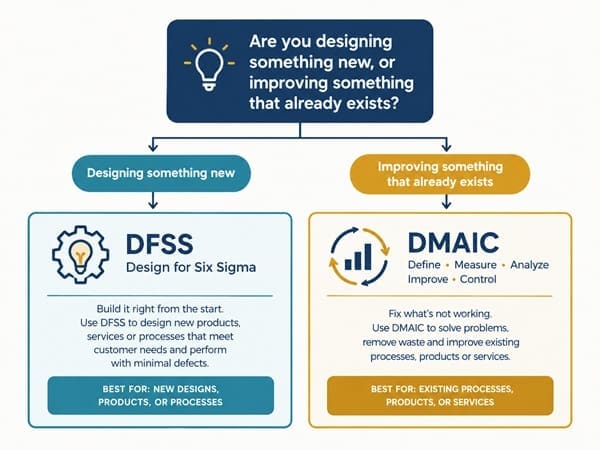
This is the question most generic Six Sigma certification content skips entirely, defaulting to a single, discipline-agnostic Green Belt/Black Belt recommendation. For engineers specifically, the more useful first question is: are you designing something new, or improving something that already exists?
- Design and product engineers, working on new product development, major redesigns, or entering new markets, generally get more direct value from DFSS, since it’s specifically built for situations where customer requirements need to be translated into a new design from scratch.
- Manufacturing, process, and quality engineers, working to reduce defects, variation, or waste in a process that’s already running, get more direct value from standard DMAIC.
- Reliability and systems engineers often work across both, depending on whether a given project involves a new system or improving an existing one.

Public, Onsite, Virtual, and Online Six Sigma Certification Training!
- We are accredited by the IASSC.
- Live Public Training at 52 Sites.
- Live Virtual Training.
- Onsite Training (at your organization).
- Interactive Online (self-paced) training,
DFSS vs. DMAIC: Which Track Fits Your Discipline?
| Factor | DFSS (for Design/Product Engineers) | DMAIC (for Process/Manufacturing Engineers) |
| Applies to | New products, processes, or systems | Existing processes needing improvement |
| Common roadmap | DMADV (Define, Measure, Analyze, Design, Verify) | DMAIC (Define, Measure, Analyze, Improve, Control) |
| Typical industries | Engineering, R&D, product design, automotive, new technology | Manufacturing, operations, quality, IT services, healthcare |
| Standardization | Not universally standardized; varies by organization | A fixed, universally recognized five-phase structure |
| Core engineering tools | QFD/House of Quality, DOE, simulation and parametric analysis, FMEA | Control charts, hypothesis testing, root cause analysis, capability studies |
A specific, practical distinction worth calling out directly: unlike DMAIC’s fixed five phases, DFSS’s specific steps are not universally standardized, almost every company or training organization defines its own version, whether that’s DMADV, IDOV, or DCCDI. This means comparing DFSS certifications across providers matters more than comparing DMAIC certifications, where the underlying structure is consistent regardless of who’s teaching it.
Also Read: Lean Six Sigma Trends 2026 – How AI Is Reshaping DMAIC?
What Does Six Sigma Actually Add for an Engineer?
This is the honest question many engineers ask before enrolling, having already studied statistics, design principles, and quality tools as part of their formal engineering education, and it deserves a direct answer rather than a vague sales pitch.
Six Sigma’s real value for an already-technical professional isn’t teaching statistics from scratch; it’s providing:
- A structured, repeatable methodology. DMAIC and DFSS give a consistent, documented sequence for scoping, investigating, and closing out improvement work, rather than each engineer approaching a problem in their own ad hoc way.
- A shared business vocabulary. Terms like Critical to Quality (CTQ), Voice of the Customer (VOC), and Control Plan translate engineering findings into language operations, quality, and executive stakeholders can act on without needing a statistics background themselves.
- Project management discipline applied to technical work. Six Sigma certification, particularly at the Black Belt level, requires actually leading a real, documented project, building organizational and change management skill that a purely technical education doesn’t typically cover.
- A recognized credential for cross-functional collaboration. Certification signals to non-engineering stakeholders that findings were reached through a rigorous, standardized process, not just internal engineering judgment.
The honest caveat: an engineer already fluent in DOE, hypothesis testing, and control charts from their formal education may find some certification content genuinely redundant. The differentiator is usually the methodology and business communication layer wrapped around those tools, not the underlying statistics themselves.
Green Belt vs. Black Belt for Engineers
| Factor | Green Belt | Black Belt |
| Typical fit | Engineers supporting or leading smaller-scope projects | Engineers leading complex, cross-functional projects |
| Project requirement | Often none, or a lighter capstone requirement | Project-based (ASQ’s CSSBB requires two completed, affidavit-signed projects, or one plus three years of relevant experience) |
| Statistical depth | Moderate | Advanced, including complex DOE and multivariate analysis |
| Best fit for an engineer who… | Wants applied Six Sigma methodology without a major time investment | Wants Six Sigma to become an ongoing part of their technical role |
Many quality engineers run improvement projects without holding a Black Belt at all; DMAIC is a methodology, not a legal requirement to practice. That said, certification, particularly Black Belt, signals structured project leadership capability to employers, and on the job, demonstrated project results tend to carry as much practical weight as the credential itself.
ASQ vs. IASSC: Which Credential Matters More for Engineers?
| Factor | ASQ (CSSGB / CSSBB) | IASSC |
| Certification basis | Exam plus, at Black Belt level, documented project experience | Exam-based |
| Recertification | Green Belt is lifetime; Black Belt requires renewal every three years via recertification units or retesting | Typically lifetime, no recertification cycle |
| Accreditation | Several ASQ programs, including CSSBB, hold ANAB accreditation to ISO/IEC 17024 | Accredits training organizations rather than certifying individuals directly in the same way |
| Best fit for an engineer who… | Wants a credential with a built-in, project-verified experience requirement | Wants a widely recognized, exam-based credential without an ongoing renewal cycle |
Neither credential is universally “better”; the practical difference for an engineer is whether a project-verified, periodically renewed credential (ASQ) or a straightforward, exam-based one (IASSC) better fits their career goals and the expectations of employers in their specific industry.
Does Six Sigma Complement a PE License?
Yes, and the two serve genuinely different purposes rather than overlapping. A Professional Engineer (PE) license certifies that an engineer has met a state’s legal standard of competence and is authorized to practice engineering and stamp certain documents. Six Sigma certification certifies proficiency in a specific quality and process improvement methodology.
An engineer can hold a PE license without any Six Sigma training, and vice versa; many engineers, particularly in manufacturing, quality, and industrial engineering roles, hold both, using the PE for legal and technical authority and Six Sigma for structured process improvement leadership.
Also Read: How Ford Motor Company Uses Six Sigma and the Ford Production System
How Much Time Does Certification Actually Require?
| Certification | Typical Format |
| Yellow Belt | 1–2 days, or a short self-paced course |
| Green Belt | Several weeks part-time, or a 1-week intensive |
| Black Belt | Several weeks part-time, or a multi-week intensive, typically requiring a completed capstone project |
| DFSS-specific training | Varies by provider; often structured similarly to Black Belt in time commitment given the added design-tool depth (QFD, DOE, simulation) |
For a working engineer, DFSS-specific training is worth budgeting comparable time to Black Belt, since the design tools involved (QFD/House of Quality, advanced DOE, simulation-based analysis) carry similar depth to DMAIC’s Black Belt curriculum, even though the underlying roadmap differs.
Real-World Example (Hypothetical)
Problem: An engineering firm has both product design engineers and manufacturing process engineers, and initially enrolls all of them in the same standard DMAIC Black Belt program, assuming Six Sigma training is interchangeable across roles.
Analysis: Feedback after the first cohort reveals the process engineers found the training directly applicable to their daily root-cause and process-improvement work, while the design engineers, who spend most of their time on new product development rather than fixing existing processes, found much of the DMAIC content only loosely relevant to their actual projects.
Six Sigma approach: For the next training cycle, the firm splits the groups by discipline: process and manufacturing engineers continue with standard DMAIC Black Belt training, while design and product engineers move to a DFSS-focused curriculum built around DMADV, QFD, and design-stage FMEA.
Action: The design engineers’ training now walks through translating Voice of the Customer data into design requirements using their own current product line as the working example, rather than a generic manufacturing case study.
Result (hypothetical): Both groups report the training felt directly applicable to their actual engineering work, and the design team specifically credits the DFSS approach with catching a design requirement conflict earlier than their previous, informal design review process would have. This is a hypothetical illustration of discipline-matched certification, not a documented case study.
Common Mistakes When Choosing Engineering-Focused Certification
- Assuming all Six Sigma training is interchangeable across engineering disciplines. A design engineer taking a standard DMAIC-only course misses the DFSS tools most directly relevant to new product development.
- Underestimating how much value the methodology itself adds, even for a statistically strong engineer. Dismissing certification as “statistics I already know” misses the structured project methodology and business communication value that’s the actual differentiator.
- Choosing a DFSS provider without checking their specific roadmap. Since DFSS isn’t universally standardized, one provider’s DMADV-based program can differ meaningfully from another’s IDOV-based curriculum.
- Treating Green Belt and Black Belt as differing only in difficulty. The real difference includes project scope and, for ASQ’s Black Belt specifically, a documented, affidavit-verified project requirement most Green Belt paths don’t require.
- Assuming a PE license makes Six Sigma certification redundant, or vice versa. The two credentials serve different purposes and are commonly held together, not as substitutes for each other.
Frequently Asked Questions (FAQs) on Six Sigma Certification for Engineers
Q: What Six Sigma certification is right for engineers?
A: It depends on discipline. Design and product engineers building something new are generally better served by DFSS (often through DMADV). Manufacturing, process, and quality engineers improving something that already exists are better served by standard DMAIC Green Belt or Black Belt certification.
Q: Should design engineers pursue DFSS or DMAIC?
A: DFSS, in most cases. DFSS is specifically built for designing new products, services, or processes from the ground up, translating customer requirements into a design from scratch, which matches a design engineer’s typical work far more closely than DMAIC’s process-improvement focus.
Q: What does Six Sigma add for an engineer who already knows statistics?
A: Primarily a structured, repeatable methodology and a shared business vocabulary (CTQ, VOC, Control Plan) that translates technical findings into terms non-engineering stakeholders can act on, plus documented project leadership experience, rather than new statistical knowledge itself.
Q: Should engineers get Green Belt or Black Belt?
A: Green Belt fits engineers supporting or leading smaller-scope projects with a lighter time commitment. Black Belt fits engineers who want Six Sigma to become an ongoing, significant part of their role, and requires (for ASQ’s CSSBB specifically) documented, project-based experience.
Q: What is the difference between ASQ CSSBB and IASSC certification?
A: ASQ’s Black Belt (CSSBB) requires documented project experience alongside its exam and requires periodic recertification. IASSC certification is exam-based and typically doesn’t require ongoing recertification. Neither is universally better; the fit depends on career goals and industry expectations.
Final Words
The right Six Sigma path for an engineer starts with an honest look at the actual work: building something new calls for DFSS; improving something that already exists calls for DMAIC.
For an engineer already comfortable with statistics, the real value of certification isn’t the math, it’s the structured methodology, the shared business language, and the documented project leadership experience that turns individual technical skill into organizational improvement capability. Matching the certification track to the actual discipline, rather than defaulting to a generic, one-size-fits-all belt program, is what makes the training genuinely worth an engineer’s time.
Whether your work is designing something new or improving something that already exists, the right certification track should match the engineering you actually do.
Six Sigma Development Solutions, Inc. (SSDSI) is IASSC-accredited and 5-star rated on Google Reviews, having certified 5,322+ professionals across 600+ organizations in 52 cities. Our onsite, live virtual, public, and online programs cover both DMAIC-based Green and Black Belt certification and Design for Six Sigma training for engineers working on new product and process development. Explore SSDSI’s certification programs to find the right fit for your discipline.
About Six Sigma Development Solutions, Inc.
Six Sigma Development Solutions, Inc. offers onsite, public, and virtual Lean Six Sigma certification training. We are an Accredited Training Organization by the IASSC (International Association of Six Sigma Certification). We offer Lean Six Sigma Green Belt, Black Belt, and Yellow Belt, as well as LEAN certifications.
Book a Call and Let us know how we can help meet your training needs.


