

There’s no single certification that offers the best ROI for everyone, it genuinely depends on your starting point, career stage, and whether you’ll actually apply the credential on real projects.
Yellow Belt offers the highest percentage return, since it costs as little as $100–$800 total and still provides meaningful vocabulary and project-support value.
Green Belt offers the best balanced return for most working professionals: a moderate cost (roughly $1,200–$3,800 including training) against a real, documented salary premium.
Black Belt delivers the largest absolute dollar return, but mainly for people who already have project experience to apply it to; the credential alone, without applied project work, underperforms its cost far more often than lower-level certifications do.
The certifying body (ASQ, IASSC, or CSSC) matters less for ROI than which one employers in your specific industry actually recognize.
Quick Reference Table
| Certification | Typical Total Cost | Reported Average Salary (Directional) | Best ROI Profile |
| Yellow Belt | $100–$800 | ~$65,000 | Highest percentage ROI; lowest absolute dollar return |
| Green Belt | $1,200–$3,800 | ~$85,000–$118,000 | Best balanced ROI for most working professionals |
| Black Belt | $3,000–$7,500+ | ~$95,000–$135,000 | Highest absolute ROI, but mainly with applied project experience |
| Master Black Belt | Varies, often employer-sponsored | ~$100,000–$135,000+ | High ROI, but typically requires years of prior Black Belt experience first |
Salary figures are directional averages drawn from multiple third-party sources and vary significantly by industry, region, and role; see the “What’s the Actual Salary Data?” section for sourcing detail and caveats.
Table of contents
Key Takeaways
- “Best ROI” isn’t one answer; it depends on your starting point. A near-free Yellow Belt and an expensive Black Belt can both be the “best” ROI decision, for different people in different situations.
- Certification cost varies far more by delivery format than by certifying body. The exam fee itself is often a small fraction of total cost; instructor-led training typically adds $1,200 to $7,500 depending on belt level and provider.
- ASQ’s Black Belt requires documented project experience; IASSC’s does not. This affects not just cost, but what the credential actually signals to an employer, real, verified project work versus exam knowledge alone.
- The credential alone rarely drives ROI. Applied project experience does. A Black Belt certificate with no real project behind it tends to underperform its cost far more than a Green Belt that’s actually been used on a real improvement effort.
- Reported average salaries by belt level vary meaningfully across sources. Directional figures from CSSC, UTSA, and other trackers broadly agree on the order (Yellow < Green < Black < Master Black Belt) but differ in exact numbers by thousands of dollars, so treat any single figure as a range, not a guarantee.
- The certifying body matters most for employer recognition in your specific industry, not for ROI in the abstract. ASQ credentials tend to carry more weight in manufacturing and quality roles; IASSC credentials are increasingly recognized in healthcare and service sectors.
- Calculating your own ROI is more useful than any generic ranking. A simple framework, comparing total cost against your realistic expected salary or project impact, gives a more honest answer than a one-size-fits-all “best certification” claim.

Public, Onsite, Virtual, and Online Six Sigma Certification Training!
- We are accredited by the IASSC.
- Live Public Training at 52 Sites.
- Live Virtual Training.
- Onsite Training (at your organization).
- Interactive Online (self-paced) training,
Why “Best ROI” Depends on Your Starting Point
Most content answering this question picks a single winner and moves on. That’s a disservice to the actual decision, because ROI is a ratio, and both sides of that ratio, cost and return, change dramatically depending on who’s asking.
A recent graduate with no project experience gets a very different ROI from a Yellow Belt (low cost, meaningful vocabulary and awareness) than an experienced quality engineer would get from the same credential (low cost, but minimal incremental value since they likely already know the material).
Meanwhile, that same experienced quality engineer might see a very strong ROI from Black Belt certification specifically because they have real projects to immediately apply it to, while a newly hired analyst pursuing Black Belt with no project pipeline yet might spend $5,000 and months of study on a credential that sits unused for a year.
What Does Each Certification Level Actually Cost?
Real cost has two components most comparisons blur together: the exam/certification fee itself, and the training needed to actually pass it and use it well.
| Level | Exam Fee Range (ASQ/IASSC/CSSC) | Typical Training Cost | Approximate Total |
| Yellow Belt | $99–$434 | $100–$400 | $200–$800 |
| Green Belt | $295–$483 | $900–$3,300 | $1,200–$3,800 |
| Black Belt | $395–$585 | $2,600–$7,000 | $3,000–$7,500 |
A detail worth calling out directly: exam fees are frequently the smallest part of total cost. For Yellow through Black Belt, the real budget line is training and study time, not the certification fee itself, which is a point most cost comparisons understate.
Also See: Six Sigma Training Detroit, MI | IASSC Accredited
ASQ vs. IASSC vs. CSSC: Does the Certifying Body Affect ROI?
| Factor | ASQ | IASSC | CSSC |
| Pricing model | Exam fee plus documented experience requirement | Exam-only voucher, no experience prerequisite | Lower-cost exam-only model |
| Black Belt requirement | Two completed, affidavit-signed projects, or one project plus three years of relevant experience | Exam-based only | Exam-based, typically lower cost |
| Recertification | Required on a multi-year cycle for Black Belt | Typically none | Typically none |
| Industry recognition pattern | Stronger in manufacturing and quality roles | Growing recognition in healthcare and service sectors | Least widely recognized of the three |
How does this affect ROI specifically?
ASQ’s built-in project requirement means its Black Belt credential inherently signals applied experience, which can carry more weight with employers, but at a higher time and documentation cost. .
IASSC’s exam-only model is faster and cheaper to obtain, which can produce a higher percentage ROI in pure cost terms, but only if the employer or industry actually recognizes it as equivalent.
The practical takeaway: check what certification employers in your specific target industry actually list in job postings before assuming one body’s credential automatically delivers better ROI than another’s.
What’s the Actual Salary Data?
This is where the article needs to be honest about data quality, since reported average salaries by belt level vary meaningfully across sources rather than converging on one clean number.
ASQ’s own Quality Progress salary survey found that professionals with any level of Six Sigma training reported earning an average of $16,411 more than those without certification, a figure specifically sourced from ASQ’s own respondent data rather than a third-party aggregator.
Beyond that baseline finding, directional averages reported by various salary trackers and certifying bodies broadly agree on the order of compensation by belt level (Yellow Belt lowest, Master Black Belt highest) but differ by tens of thousands of dollars in the exact figures, depending on region, industry, and how “belt holder” is defined in the underlying data.
The honest conclusion: treat any specific salary figure by belt level as a directional range, not a guarantee tied to your specific title, industry, or region. The consistent finding across sources is the relative order and the fact that certification correlates with higher pay; the exact dollar amount is far less reliable than that broader pattern.
Also See: SMED Events: The Quickest Way to Get ROI From Your Lean Deployment
Comparing ROI Across Belt Levels
| Level | Total Cost (Approx.) | Time Investment | ROI Profile |
| Yellow Belt | $200–$800 | 1–2 days | Highest percentage return; useful vocabulary and awareness at minimal cost |
| Green Belt | $1,200–$3,800 | Several weeks part-time | Best balanced return for most professionals: meaningful salary correlation at moderate cost |
| Black Belt | $3,000–$7,500 | Several weeks to multiple months, often with a capstone project | Highest absolute return, but heavily dependent on applying it to real projects afterward |
| Master Black Belt | Often internally sponsored after years of Black Belt experience | Years of applied experience plus additional training | Strong ROI, but rarely the first certification anyone pursues |
How do you actually decide?
Ask which side of the ROI equation you can realistically improve. If your budget and time are limited, Green Belt typically offers the best balance of cost against a documented, if imprecise, salary correlation. If you already have real project experience and a clear pipeline of future projects to lead, Black Belt’s higher cost is more likely to be recovered through both salary and expanded project scope.
The Factor That Matters More Than the Certification Itself
This is the point most “which certification is best” content skips entirely, and it’s the single biggest variable in real-world ROI: a certificate without applied project experience underperforms its cost, regardless of belt level.
The salary correlation data cited above reflects professionals who, in most cases, are actually using their certification on real work, not simply holding a credential in a file.
An engineer or manager who completes Black Belt training but never leads a project afterward is unlikely to see anything close to the reported average salary premium, since that premium is driven substantially by demonstrated project impact, not the exam score alone.
This reframes the ROI question productively: the more useful version isn’t “which certification has the best ROI,” but “which certification will I actually apply to real work soon after completing it.” A Green Belt used immediately on a real project this quarter will very likely outperform a Black Belt that sits unused for a year waiting for the right project to come along.
A Simple Framework for Calculating Your Own ROI
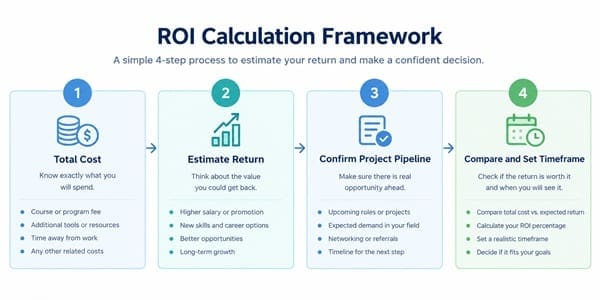
1. Total Your Real Cost
Add the exam fee, training cost, and a reasonable estimate of your own time (hours × your hourly rate, if your employer isn’t covering the training during work hours).
2. Estimate Your Realistic Return
This can include a direct salary increase, a documented project’s cost savings (if you’ll be credited for leading it), or career mobility value (a credential required for a role you’re targeting). Be conservative rather than optimistic here.
3. Confirm You Have, or Will Soon Have, a Project to Apply It To
Given the previous section’s core finding, a realistic project pipeline should factor directly into your estimated return; without one, discount your expected ROI meaningfully.
4. Compare Cost to Return, and Set a Realistic Timeframe
A useful ROI isn’t just “will this pay off eventually,” but “will this pay off within a timeframe that makes sense for my career stage.” A $5,000 Black Belt that pays off over five years is a very different decision than one that pays off within one.
Is Six Sigma Certification Worth It?
For most professionals with a genuine path to applying it, yes, the data broadly supports a real, if imprecise, salary and career correlation. But “worth it” isn’t the same question as “which specific certification has the best ROI,” and the honest answer to the second question is that it depends far more on your own project pipeline and career stage than on which belt color or certifying body logo appears on the certificate.
Real-World Example (Hypothetical)
Problem: Two employees at the same company, a recent graduate analyst and a five-year quality engineer, are both considering Black Belt certification, and the company wants to know which investment is more likely to pay off.
Analysis: The quality engineer already has three completed process improvement projects under her belt and a clear pipeline of two more scheduled this year. The analyst has no project experience yet and no immediate project assigned.
Six Sigma approach: Applying the ROI framework above, the company estimates the quality engineer’s Black Belt investment will very likely be applied within weeks, directly supporting her already-scheduled projects, while the analyst’s certification would sit unused for an unknown period before a suitable project materializes.
Action: The company sponsors the quality engineer for Black Belt immediately and instead starts the analyst on a lower-cost Yellow Belt or Green Belt path, planning to revisit Black Belt once the analyst has real project experience to apply it to.
Result (hypothetical): The quality engineer’s Black Belt investment is actively used within a month, while the analyst builds foundational project experience at a fraction of the cost before committing to the larger Black Belt investment later. This is a hypothetical illustration of matching certification level to actual project readiness, not a documented case study.
Common Mistakes When Evaluating Certification ROI
- Assuming a higher belt level automatically means better ROI. Without a project to apply it to, a more expensive, more advanced certification can actually underperform a cheaper one that gets used immediately.
- Comparing only exam fees, not total cost. Training and study time are usually the larger real expense, and skipping this comparison understates the true cost of a certification path.
- Treating reported salary averages as guarantees. These figures vary meaningfully by source, region, and industry; use them as directional evidence, not a precise promise.
- Choosing a certifying body without checking industry recognition first. The “better” credential for ROI purposes is the one employers in your specific target industry actually expect, not necessarily the cheapest or fastest to obtain.
- Ignoring the time value of a slow-to-apply credential. A certification that sits unused for a year has a meaningfully worse real ROI than the same certification applied to a project within weeks.
Frequently Asked Questions (FAQs)
Q: Which Six Sigma certification offers the best ROI?
A: It depends on your starting point. Yellow Belt offers the highest percentage return due to its low cost; Green Belt offers the best balanced return for most working professionals; Black Belt offers the highest absolute return, but mainly for people who already have project experience to apply it to.
Q: How much does Six Sigma certification cost?
A: Total cost (exam plus training) typically runs $200–$800 for Yellow Belt, $1,200–$3,800 for Green Belt, and $3,000–$7,500 for Black Belt, though exact figures vary by certifying body and training provider.
Q: Does Six Sigma certification increase salary?
A: ASQ’s own salary survey data found professionals with any level of Six Sigma training reporting an average of $16,411 more than uncertified peers. Reported averages by specific belt level vary meaningfully across sources and should be treated as directional rather than precise.
Q: Is Green Belt or Black Belt a better investment?
A: Green Belt typically offers a better balanced ROI for most professionals given its lower cost and time investment. Black Belt can deliver a higher absolute return, but its higher cost is best justified by having real, applied project experience to immediately use it on.
Final Words
There’s no universal answer to which Six Sigma certification has the best ROI, because ROI is a ratio between cost and return, and both sides of that ratio depend heavily on the individual.
What the data does support clearly: certification correlates with real salary and career benefits, training cost is usually the larger expense relative to the exam fee itself, and the single biggest factor in whether that investment actually pays off is whether the certification gets applied to real project work soon after completion. Calculating your own specific ROI, rather than chasing a generic ranking, is the more honest and more useful exercise.
Getting real ROI from a Six Sigma certification depends less on which belt color you choose and more on whether you have a real project to apply it to right away.
Six Sigma Development Solutions, Inc. (SSDSI) is IASSC-accredited and 5-star rated on Google Reviews, having certified 5,322+ professionals across 600+ organizations in 52 cities. Our onsite, live virtual, public, and online Green Belt and Black Belt training includes project mentoring specifically designed to help you apply what you learn immediately, not let it sit unused. Explore SSDSI’s certification programs to find the level that matches your actual project pipeline.
About Six Sigma Development Solutions, Inc.
Six Sigma Development Solutions, Inc. offers onsite, public, and virtual Lean Six Sigma certification training. We are an Accredited Training Organization by the IASSC (International Association of Six Sigma Certification). We offer Lean Six Sigma Green Belt, Black Belt, and Yellow Belt, as well as LEAN certifications.
Book a Call and Let us know how we can help meet your training needs.


