Six Sigma is a set of techniques and tools for process improvement. The primary goal of Six Sigma is to improve the quality of output by identifying and removing the causes of defects and minimizing variability in manufacturing and business processes. While most organizations implement this methodology for defect reduction and cost savings, a more advanced and less commonly applied utilization of Six Sigma is its ability to source innovation within the organization.
Sourcing innovation with Six Sigma refers to using the structured, data-driven framework of the methodology not just to solve existing problems, but to proactively discover, develop, and implement entirely new ideas, processes, products, or service models.
This approach shifts the focus from simple process fixing to the creation of new value. Organizations that embed Six Sigma into their culture often find that constant improvement naturally leads to inventive new solutions and concepts.
Table of contents
What is Sourcing Innovation with Six Sigma?
Innovation is defined as the act of creating new methods, ideas, or inventions. It goes beyond mere incremental improvements; innovation involves bringing a completely new or significantly improved solution into existence. Historically, iconic creations like the assembly line or the smartphone were once pure innovations that revolutionized industries.
Sourcing innovation with Six Sigma requires a cultural shift in how improvement teams operate. Instead of only looking at the defects a process produces, teams are directed to look at the potential value the process could generate for the customer.
This expanded view leverages the core analytical power of Six Sigma to reveal entirely new opportunities hidden within inefficient processes or unexplored customer needs.
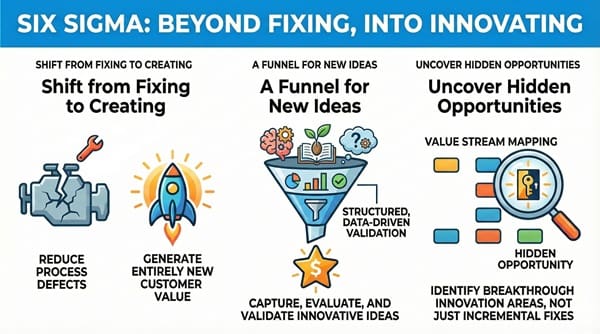
Sourcing innovation is only effective if a company can capture, evaluate, and scale these new ideas. Often, an employee may have a perfect solution to a market share problem but lacks the formal channel to express or prove its value. That is where the Six Sigma methodology provides a structured mechanism. It acts as a funnel, using data and measurement to validate a new idea before heavy resources are committed to it.
The Six Sigma approach leverages tools such as Root Cause Analysis (RCA) and Value Stream Mapping to systematically break down current state processes. By thoroughly understanding the inefficiencies and non-value-added steps, teams naturally identify areas where traditional fixing is not enough, and a breakthrough innovation is required. This shifts the team’s objective from minimizing waste to maximizing potential.

Public, Onsite, Virtual, and Online Six Sigma Certification Training!
- We are accredited by the IASSC.
- Live Public Training at 52 Sites.
- Live Virtual Training.
- Onsite Training (at your organization).
- Interactive Online (self-paced) training,
The DMAIC Roadmap for Sourcing Innovation
The DMAIC cycle—Define, Measure, Analyze, Improve, and Control—is the fundamental framework of Six Sigma. When applied to sourcing innovation, each phase is subtly redefined to focus on discovery and creation rather than solely on correction.
1. Define Phase in Sourcing Innovation with Six Sigma
Define focuses on establishing the project goals and identifying the scope. When sourcing innovation with Six Sigma, the team must define the problem not in terms of defects, but in terms of the gap between the current process and the ideal customer experience. The output of this phase is typically a Project Charter that frames the scope for new value creation.
Six Sigma professionals begin by asking what the customer truly wants, which may be different from what the current product or service provides. They use the Voice of the Customer (VOC) tools to capture explicit and latent needs. Sourcing innovation starts here by transforming these needs into high-level, system-changing opportunities. For instance, instead of defining a problem as “Too many late deliveries,” the team might define it as “How can we create a delivery system that anticipates and meets the customer’s needs before they even formally request it?”
2. Measure Phase for Sourcing Innovation with Six Sigma
Measure involves collecting data on the current process performance. When the objective is sourcing innovation, measurement extends beyond cycle time or defect rates. The team must quantify the untapped potential or the cost of complexity. This phase is critical for establishing a baseline for the innovative solution.
Six Sigma methodology uses process mapping and baseline sigma level calculations. When focused on innovation, the team measures the efficiency of current knowledge capture and idea generation processes. They measure variables related to customer pain points that current solutions cannot fix. This data provides the evidence that a major innovation, not just an incremental fix, is required to achieve the desired performance. The collected data validates the need for a radical shift.
3. Analyze Phase in Sourcing Innovation with Six Sigma
Analyze is where the root causes of problems are identified. For sourcing innovation with Six Sigma, this phase is transformed into root cause discovery—identifying the foundational factors preventing radical improvements and new value creation. Tools like Fishbone Diagrams and Five Whys are used to challenge basic assumptions about the current process.
Sourcing innovation relies heavily on deep data analysis to isolate the critical variables that can be manipulated to create a new outcome. Teams may use regression analysis or hypothesis testing to prove which variables drive customer delight, not just customer satisfaction.
By understanding which variables are constrained by current technology or methodology, the team can justify the exploration of innovative alternatives. The goal is to move past simple root causes and into the core systemic limitations that demand an innovative solution.
4. Improve Phase for Sourcing Innovation with Six Sigma
Improve focuses on developing and testing solutions to eliminate the root causes. When sourcing innovation with Six Sigma, this phase becomes the incubation and piloting of radical concepts. The team moves from brainstorming minor fixes to generating ideas that represent a true breakthrough.
Six Sigma professionals utilize Design of Experiments (DOE) not just to optimize existing variables, but to test completely new process designs. Ideas generated through techniques like Lateral Thinking or SCAMPER are rigorously tested in small-scale pilots.
This ensures that the innovation is not only theoretically sound but also measurably better than the existing system. The structured testing environment of Six Sigma minimizes the risk associated with implementing unproven, groundbreaking ideas.
5. Control Phase in Sourcing Innovation with Six Sigma
Control ensures that the implemented changes are sustained over time. When applied to sourcing innovation, this phase formalizes the new operating process and creates mechanisms to prevent regression to older, less efficient methods. The goal is to standardize the innovative process.
Sourcing innovation necessitates robust control plans that include updated documentation, training, and continuous monitoring of the new performance metrics. The team uses Statistical Process Control (SPC) charts to monitor the new key performance indicators (KPIs) associated with the innovation.
Moreover, the Control Phase for innovation includes building a feedback loop, often formalized as a Design for Six Sigma (DFSS) or Design for Excellence (DFX) stage, that feeds the success of this innovation back into the organizational knowledge base, setting the stage for the next wave of innovation.
Key Roles in Sourcing Innovation with Six Sigma
The success of sourcing innovation with Six Sigma depends heavily on the capability and leadership of trained professionals. These certified individuals are the change agents who ensure the methodology is applied correctly, shifting its focus from corrective to creative.
| Role | Responsibility in Sourcing Innovation |
| Black Belt | Leads cross-functional teams; coaches Green Belts; identifies and scopes complex, high-impact innovation projects; acts as a communication bridge between operational teams and executive management regarding new value propositions. |
| Green Belt | Leads smaller, focused innovation projects; gathers data on emerging customer needs; analyzes current state limitations that require non-traditional solutions; assists Black Belts in developing and testing innovative concepts. |
| Master Black Belt | Defines the strategic framework for innovation sourcing within the business; mentors Black Belts on advanced statistical and creative problem-solving techniques; ensures that Six Sigma principles are integrated into the product design and development pipeline (DFSS). |
Six Sigma Black Belts are the primary drivers of this innovative approach. Their training and experience equip them with the tools needed to facilitate structured creative sessions and manage the risk inherent in implementing novel solutions.
The Six Sigma Black Belt acts as an effective leader who understands that employees closest to the process often hold the greatest insights for new ideas. They create the environment where new concepts are not only tolerated but are actively sought and rigorously tested.
Sourcing innovation requires leadership that can communicate daily with upper management, articulating the potential return on investment (ROI) of a novel idea. Likewise, they must instruct lower-level Six Sigma professionals and subject matter experts, guiding them away from simple fixes and toward fundamental design changes.
Also Read: Quality by Design (QbD): Blueprint for Building Quality
Comparison: Defect Reduction vs. Innovation Sourcing
While both defect reduction and innovation sourcing rely on the Six Sigma methodology, their primary objective and scope differ significantly. Understanding these differences is vital for a company looking to strategically leverage its Six Sigma investment for growth rather than just optimization.
| Basis for Comparison | Six Sigma for Defect Reduction | Six Sigma for Innovation Sourcing |
| Meaning | Focuses on minimizing process variation and eliminating errors (DPMO). | Focuses on creating new value, products, or processes (breakthrough changes). |
| Primary Goal | To stabilize and optimize the current process to meet current specifications. | To disrupt the current process or model to achieve a dramatically superior future state. |
| Key Metric | Defects Per Million Opportunities (DPMO) and Cost of Poor Quality (COPQ). | Market share gain, revenue generation from new products, and customer value increase. |
| Scope | Incremental improvement within the existing framework (exploitation). | Radical change that may lead to new frameworks or markets (exploration). |
| Mindset | Corrective and reactive; fixing what is broken. | Creative and proactive; building what could be better. |
Six Sigma for defect reduction uses the DMAIC framework to bring a process up to the required standard. Six Sigma for innovation sourcing, in contrast, uses the same framework to define a new standard altogether. Sourcing innovation is about moving from a “better” process to a “different and superior” process.
Advantages of Sourcing Innovation through Six Sigma
Integrating the Six Sigma methodology into innovation efforts provides tangible competitive advantages for organizations. It removes the chaotic nature typically associated with creative brainstorming and replaces it with measurable progress.
Sourcing innovation through Six Sigma ensures that new ideas are data-validated before they are scaled. This reduction in risk is one of the most significant benefits. Unlike random R&D projects, innovations sourced through Six Sigma have already proven their connection to customer needs and process feasibility during the Measure and Analyze phases.
Furthermore, Six Sigma’s systematic approach builds an organizational culture of continuous, data-driven creativity. When employees across all levels are trained in basic Six Sigma concepts, they begin to view every operational inefficiency as a potential innovative opportunity. This leads to a wider net for capturing novel ideas, rather than limiting innovation to a small R&D department.
The constant drive for improvement naturally promotes an environment where creativity thrives and is rewarded. Sourcing innovation strengthens the corporate culture, encouraging employees to be proactive rather than complacent.
Final Words
In a nutshell, the Six Sigma methodology provides a robust, professional framework for sourcing, validating, and implementing innovative ideas. It transforms the methodology’s focus from merely correcting defects to strategically creating new business value.
The Six Sigma approach ensures that innovations are not accidental but are the result of structured analysis, data validation, and rigorous testing within the DMAIC cycle. Organizations that successfully use Six Sigma to source innovation unlock greater competitive advantage by minimizing the risk of new ventures while fostering an organizational culture of continuous, data-driven creativity. The ultimate outcome is a stable, controlled process that is fundamentally superior to its predecessor.
Also Read: How Six Sigma can improve DIFOT Rate?
Key Takeaways
The strategic application of the Six Sigma methodology goes beyond defect reduction and actively facilitates the sourcing of innovation. Key principles and outcomes include:
- Focus Shift: Six Sigma moves its focus from merely solving existing process defects to proactively discovering and creating entirely new value propositions for the customer.
- Structured Creativity: The methodology provides a formal, data-driven structure (DMAIC) for capturing, validating, and scaling radical, new ideas, minimizing the risk typically associated with untested innovation.
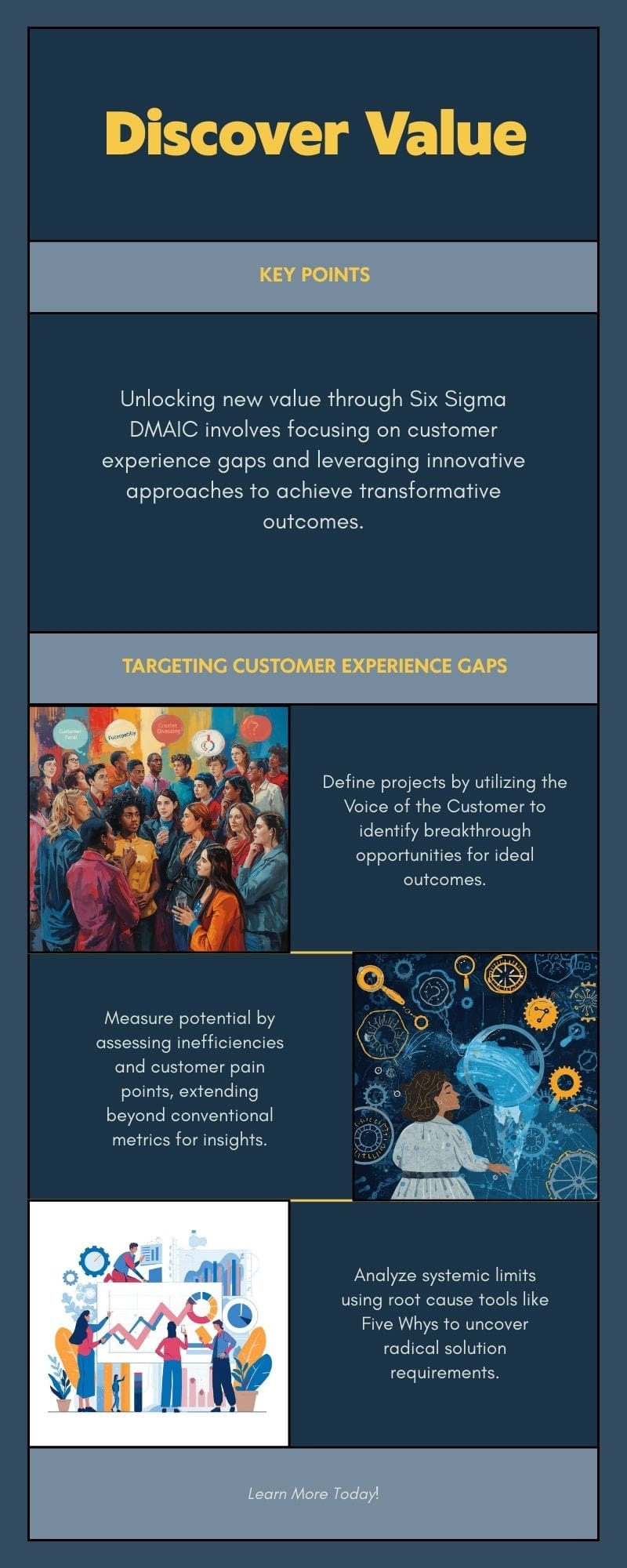
- DMAIC Re-purposed: Each phase of DMAIC is redefined: Define identifies the ideal customer experience gap; Measure quantifies untapped potential; Analyze discovers systemic limitations; Improve pilots radical concepts; and Control formalizes the new, innovative process.
- Leadership Role: Trained Six Sigma Black Belts are essential catalysts. They lead the culture change, providing the necessary statistical and project management expertise to guide teams toward breakthrough changes instead of incremental fixes.
- Competitive Advantage: Utilizing Six Sigma for innovation sourcing results in a robust organizational culture of continuous, measurable creativity, leading to significant market advantage and business growth.
Frequently Asked Questions (FAQs)
1. How does Six Sigma differ when sourcing innovation compared to traditional process improvement?
When applying Six Sigma to traditional process improvement, the objective is to stabilize the current process by reducing variation and defects to meet existing specifications. However, when sourcing innovation with Six Sigma, the objective is to achieve a superior, future state by questioning the specifications themselves.
2. Can the DMAIC roadmap be used for completely new product development, or just for existing processes?
While DMAIC is typically used for existing processes, the concept of sourcing innovation with Six Sigma often leads to the use of Design for Six Sigma (DFSS) or Design, Measure, Analyze, Design, Verify (DMADV). These specialized Six Sigma methodologies are specifically designed for developing entirely new products or processes from the ground up, ensuring that quality and customer value are engineered into the design from the start, which is the ultimate form of sourced innovation.
3. Does sourcing innovation with Six Sigma rely only on internal employees?
No. While internal employees are crucial for identifying opportunities (as they are closest to the processes and customers), effective sourcing innovation requires looking both internally and externally. External sources, such as customer feedback captured through the Voice of the Customer (VOC) and competitive benchmarking data, are essential inputs in the Define and Measure phases.
4. How can an organization measure the success of innovation sourced through Six Sigma?
Success is measured differently than defect reduction. Instead of focusing solely on the reduction of DPMO (Defects Per Million Opportunities) or COPQ (Cost of Poor Quality), organizations should track metrics related to growth and value creation.

About Six Sigma Development Solutions, Inc.
Six Sigma Development Solutions, Inc. offers onsite, public, and virtual Lean Six Sigma certification training. We are an Accredited Training Organization by the IASSC (International Association of Six Sigma Certification). We offer Lean Six Sigma Green Belt, Black Belt, and Yellow Belt, as well as LEAN certifications.
Book a Call and Let us know how we can help meet your training needs.