Let us start by understanding the two core concepts. The field of logistics refers to the detailed organization and implementation of a complex operation. In business, logistics is defined as the movement of goods and services. This process involves moving raw materials, inventory, and final products from a starting point to the final customer.
Logistics is often called the backbone of every organization. Even a small flaw in this system can cause massive issues. For example, the inability to get one small computer chip can stop a whole factory from delivering millions of ordered products. Therefore, organizations seek methods to make logistics flawless and efficient.
Six Sigma is a data-driven methodology for improving business processes. It involves analyzing every step to identify and eliminate defects. Six Sigma focuses on statistical evaluation instead of relying on guesswork or simple observation.
In simple words, Six Sigma seeks perfection. It aims for a process to produce only 3.4 defects per million opportunities (DPMO). This level of quality means that a process is nearly flawless.
When combined, Six Sigma logistics is the application of these data-driven tools to all parts of the supply chain. This approach helps companies analyze and fix any issues in their supply chain. It ensures they always have the right resources to deliver high-quality products with minimal defects.
Table of contents
Importance of Six Sigma in Modern Logistics and Supply Chain
Global supply chains have become complex, especially for large businesses. For instance, a single product like a car can have over thirty thousand individual parts.
Issues can arise from any part of the supply chain. The logistics team must analyze the whole flow of goods to find the problematic component and find solutions.
Six Sigma offers a proven framework for this detailed analysis. The method revolves around finding, diagnosing, and fixing errors in the supply chain. Six Sigma experts are trained to conduct meticulous analysis. They think of creative solutions to challenging logistical issues. This allows a company to move beyond simple troubleshooting and achieve true process variation reduction.
Six Sigma is key to achieving operational excellence. When a logistics process operates closer to the six sigma standard, it means higher predictability. Higher predictability leads to reduced emergency spending and less wasted time. This focus makes Six Sigma logistics essential for long-term business success.

Public, Onsite, Virtual, and Online Six Sigma Certification Training!
- We are accredited by the IASSC.
- Live Public Training at 52 Sites.
- Live Virtual Training.
- Onsite Training (at your organization).
- Interactive Online (self-paced) training,
Key Principles of Six Sigma for Improving Logistics
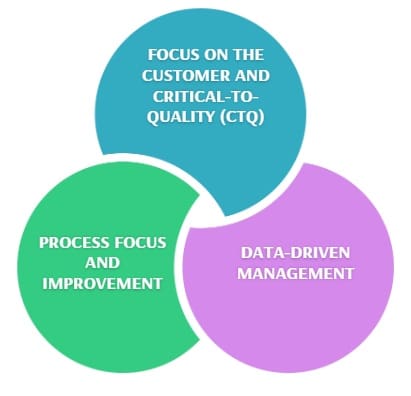
Six Sigma applies several core principles to logistics improvement projects. These principles guide the team’s efforts and ensure that changes are based on facts, not assumptions.
Focus on the Customer and Critical-to-Quality (CTQ)
First of all, we need to understand the customer. Six Sigma always starts by defining what the customer considers high quality. In logistics, this means understanding customer requirements like on-time delivery, accurate order fulfillment, and undamaged goods. These requirements are known as Critical-to-Quality (CTQ) characteristics.
Six Sigma defines a defect as anything that fails to meet a CTQ characteristic. For example, if the customer requires delivery within two days, a three-day delivery is a defect. Six Sigma logistics improvement efforts must center on reducing defects related to these CTQs.
Data-Driven Management
Further, Six Sigma is a highly data-driven methodology. Decisions are made based on verifiable facts and statistical analysis. This means logistics teams must collect accurate data about their supply chain operations. Data points include delivery times, inventory levels, error rates in picking, and transportation costs.
Six Sigma uses statistical tools to analyze this data. This analysis helps identify the root causes of problems, rather than just treating the symptoms. For instance, data might show that delivery delays happen most often at a specific warehouse location. This information directs the improvement efforts to the right place.
Process Focus and Improvement
Additionally, the central belief of Six Sigma is that defects occur because of process variation. If a logistics process is performed exactly the same way every time, the results will be consistent. Variation in the process leads to errors and defects.
Six Sigma focuses on making the logistics process consistent and stable. By standardizing the steps for activities like order processing or shipping, organizations can reduce the chance of defects. The goal is to design processes that make it difficult for errors to occur in the first place.
Also Read: Cost Modelling
Understanding the DMAIC Methodology for Logistics Process Improvement
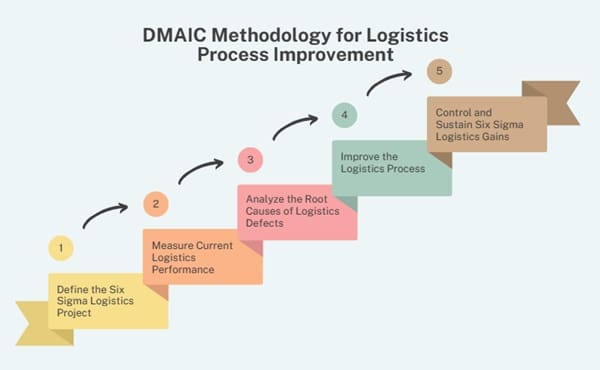
Six Sigma projects follow a structured five-phase roadmap called DMAIC. The DMAIC structure is essential for executing a successful logistics process improvement project.
DMAIC is an acronym. It stands for Define, Measure, Analyze, Improve, and Control. This cycle is systematic. It ensures that improvements are logical, data-based, and sustainable.
Phase 1: Define the Six Sigma Logistics Project
The first step in any Six Sigma logistics project is the Define phase. This phase sets the scope, goals, and team for the project. The team must clearly state the problem they want to solve.
Six Sigma logistics teams often define the problem by creating a Project Charter. This document outlines the business case for the project, the current problem statement, and the desired future state.
For example, a project goal might be: “Reduce the percentage of late customer deliveries from 15% to 5% within six months.” This goal is specific, measurable, and relevant to the customer.
Phase 2: Measure Current Logistics Performance
The second phase in the DMAIC cycle is the Measure phase. Six Sigma requires understanding the current reality. To do this, the team collects data on the current logistics process. This data helps establish a baseline performance.
Six Sigma metrics often include the defect rate, cycle time, and costs associated with the problem. For instance, the team might measure the average time a product spends in the warehouse before being shipped. This is called cycle time.
Logistics teams use tools like process mapping during this phase. Process mapping visually charts every step of the operation. This visual aid helps identify where the delays or errors are most likely to occur. The Measure phase converts the defined problem into a clear statistical understanding.
Phase 3: Analyze the Root Causes of Logistics Defects
The third step is the Analyze phase. This is where the Six Sigma logistics team determines why the defects are happening. It involves moving beyond symptoms to find the true root cause.
Six Sigma analysis tools help identify the key variables that cause the problem. Tools like the Fishbone Diagram (also known as Cause and Effect Diagram) and Pareto Charts are commonly used.
Logistics defects might stem from various causes. These include poor training, outdated software, too much variation in supplier lead times, or bad warehouse layouts. The Analyze phase proves the relationship between the cause and the defect using statistical evidence. For instance, the analysis might show that 80% of delivery errors are caused by mistakes during the picking stage.
Phase 4: Improve the Logistics Process
The fourth phase is the Improve phase. Based on the analysis, the Six Sigma team now develops solutions to fix the root causes. The goal is to eliminate or reduce the sources of process variation.
Six Sigma teams brainstorm solutions and test them on a small scale. This testing ensures the proposed changes work effectively before large-scale implementation. The focus is on implementing simple, cost-effective changes that directly address the root causes.
For example, if the root cause was mistakes in picking, the improvement might be a new barcoding system or a redesigned warehouse aisle. This change in the logistics process aims to make it impossible for the defect to happen.
Phase 5: Control and Sustain Six Sigma Logistics Gains
The final phase is the Control phase. Six Sigma focuses on making sure the improvements last over time. Without a control plan, processes often revert to their old, less efficient state.
Six Sigma logistics teams create new standards, procedures, and monitoring systems. These tools prevent the re-occurrence of the original problems. Control plans include training staff on the new processes and installing statistical process controls.
Control tools might include daily performance charts showing the defect rate. If the rate creeps back up, the team is immediately alerted to take action. This proactive monitoring ensures the improved logistics performance is sustained long after the project ends.
Six Sigma: Reducing Waste and Variation in Logistics Operations
The principles of Six Sigma are often paired with Lean methodology. While Six Sigma focuses on reducing variation and defects, Lean focuses on eliminating non-value-added waste. Together, this combination is very powerful for logistics process improvement. Logistics operations offer many opportunities to remove waste and improve efficiency.
Logistics process improvement focuses on three main areas: inventory, transportation, and warehousing.
Improving Six Sigma Inventory Management
Inventory management is a major part of logistics. Having too much inventory costs money for storage. Having too little inventory can stop production and lead to late customer orders.
Six Sigma inventory management uses data to find the optimal stock levels. By analyzing historical demand and supplier lead times, the team can reduce excess inventory (a form of waste).
For example, Six Sigma can reduce variation in supplier delivery times. If a supplier always delivers within a predictable two-day window, a company does not need a large safety stock. If the lead time varies wildly, more buffer stock is needed. Six Sigma helps stabilize this input process.
Optimizing Six Sigma Transportation Networks
Transportation is one of the most visible and expensive parts of logistics. The goal of Six Sigma transportation networks is to reduce delays, minimize mileage, and ensure goods arrive safely.
Six Sigma analysis helps identify routes that consistently cause delays. The team can look at defects such as “late arrivals” or “damaged goods during transit.”
Transportation teams might use Six Sigma to study the packaging process. If goods arrive damaged (a defect), the root cause might be poor packing procedures, not the truck driver. By improving the packing process (the Improve phase), the transport defect rate is lowered. This saves money and improves customer satisfaction.
Enhancing Six Sigma Warehouse Operations
Warehouse operations are complex. They involve receiving, storing, picking, and packing goods. Errors in these steps are common defects.
Six Sigma warehouse operations focus on minimizing motion and waiting time. These are forms of waste according to Lean principles. The layout of the warehouse is often studied in the Measure and Analyze phases.
Warehouse operations can be improved by standardizing the picking process. For example, a Six Sigma project might set a new standard for how quickly an order must be picked and packed. This ensures that every worker follows the most efficient, defect-free method every time. This standardization reduces process variation in the warehouse.
Also Read: Operational Cost Reduction
Advantages of Implementing Six Sigma in Logistics
Applying Six Sigma to your logistics operations provides three clear benefits. These benefits directly affect the company’s financial health and its culture.
Six Sigma logistics provides a powerful way to enhance business performance.
Reduces Operational Costs
Applying Six Sigma helps identify and eliminate waste from your supply chain. Eliminating waste directly translates to reducing costs. Costs are often incurred due to excess inventory, rush shipping fees, or the labor required to fix errors.
When a logistics process is more efficient, fewer resources are wasted. This reduction in unnecessary spending boosts profits. Six Sigma provides the data to show exactly how much money each improvement saves.
Reduces Errors and Defects
Six Sigma involves identifying and fixing errors before they cause major problems. Defects like wrong shipments, damaged goods, or late deliveries are costly and harm the company’s reputation.
Reduced errors translate to higher product quality and improved customer satisfaction. When customers receive exactly what they ordered, on time and in good condition, they trust your business more. This trust leads to repeat business.
Fosters a Healthy and Collaborative Culture
Collaboration is a critical part of the Six Sigma strategy. Any Six Sigma expert is trained to work closely with other team members to achieve organizational goals. This method emphasizes teamwork over individual effort.
Applying Six Sigma fosters a collaborative culture for your logistics team. The entire team shares the goal of process improvement. This shared focus produces better, long-lasting business results.
Final Words
In a nutshell, Six Sigma is a vital methodology for any company serious about logistics process improvement. The DMAIC framework provides a structured, data-driven path to systematically identify and fix problems. By focusing on reducing process variation and eliminating waste, Six Sigma logistics helps companies achieve operational excellence. This leads to reduced costs, fewer errors, and improved customer satisfaction.
Key Takeaways
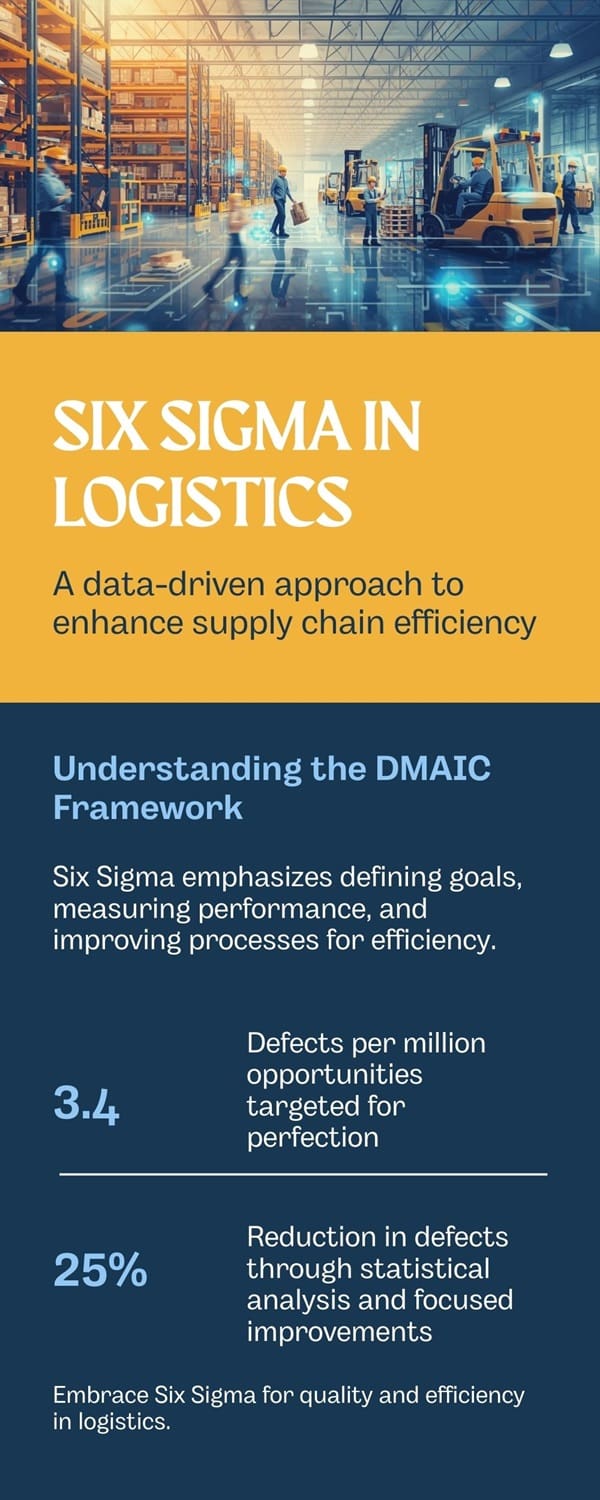
- Six Sigma is a data-driven method aiming for near-perfection (3.4 defects per million units).
- Logistics refers to the critical movement and organization of goods throughout the supply chain.
- The DMAIC cycle (Define, Measure, Analyze, Improve, Control) is the structured path for Six Sigma logistics projects.
- Logistics process improvement focuses on reducing variation in areas like inventory, transportation, and warehousing.
- Implementing Six Sigma saves money by eliminating waste and improves quality by reducing errors.
- The professional, systematic approach of Six Sigma ensures that improvements are sustained over time.
Frequently Asked Questions (FAQs) about Six Sigma in Logistics
1. What is the main goal of implementing Six Sigma in logistics?
The main goal of Six Sigma in logistics is to achieve near-perfect performance. This means reducing errors, delays, and defects to a level of 3.4 defects per million opportunities. The methodology focuses on eliminating process variation. This ensures that every shipment, every pick, and every process is consistent.
2. What does the DMAIC acronym stand for in a logistics project?
The DMAIC acronym is the roadmap for a Six Sigma logistics project. It stands for:
- Define: Clearly state the problem and project goals (e.g., reducing late deliveries).
- Measure: Collect data on current performance to set a baseline.
- Analyze: Determine the root causes of defects using statistical tools.
- Improve: Develop and implement solutions to fix the root causes.
- Control: Set up systems to sustain the improvements and prevent the problem from returning.
3. How does Six Sigma help reduce costs in logistics operations?
Six Sigma reduces costs by finding and eliminating waste. Costs often come from fixing errors, managing excess inventory, and paying for emergency transportation. By using data, Six Sigma identifies the causes of this waste. This methodology helps streamline processes like transportation and inventory management, leading to significant savings and a boost to profit.
4. What are examples of “defects” that Six Sigma addresses in the supply chain?
In the logistics and supply chain, a defect is anything that fails to meet the customer’s requirement. Common examples of logistics defects include:
- Late delivery of goods.
- Shipping the wrong product or quantity.
- Damage to products during transit or in the warehouse.
- Inaccurate counts in inventory management.
- Sending a shipment to the wrong address.
5. Is Six Sigma the same as Lean methodology in the context of logistics?
Six Sigma and Lean are not the same, but they work well together in logistics process improvement. Six Sigma focuses on reducing process variation and defects to increase quality. Lean methodology focuses on eliminating non-value-added waste (like unnecessary movement or waiting time). Most companies use a combined approach, often called Lean Six Sigma, to achieve maximum efficiency and quality in their operations.

About Six Sigma Development Solutions, Inc.
Six Sigma Development Solutions, Inc. offers onsite, public, and virtual Lean Six Sigma certification training. We are an Accredited Training Organization by the IASSC (International Association of Six Sigma Certification). We offer Lean Six Sigma Green Belt, Black Belt, and Yellow Belt, as well as LEAN certifications.
Book a Call and Let us know how we can help meet your training needs.