Are you looking to make your business operations run smarter, faster, and with less waste? You likely see areas in your processes that just do not deliver the value they should. These weaknesses often lead to unhappy customers and higher operational costs.
The core of a successful business is efficient operations. We are going to explore a proven method that leading companies use to fix these problems. This method is Lean Six Sigma. It is nothing but a powerful approach that merges two distinct, yet complementary, methodologies. Lean Six Sigma helps you streamline processes, reduce defects, and dramatically improve efficiency in operations management.
In this section, we will define Lean Six Sigma, compare its two main components, and detail how businesses use it to create superior value.
Table of contents
What is Lean Six Sigma?
Lean Six Sigma can be understood as a business improvement strategy. It focuses on two main goals. The first goal is to eliminate waste from a process flow, which is the Lean approach. The second goal is to reduce process variation and defects, which is the Six Sigma approach.
Lean Six Sigma combines the speed of Lean with the accuracy of Six Sigma. This ensures that processes not only run quickly but also produce high-quality, consistent results.
To understand this better, it is important to note that Operations Management deals with managing the process of creating goods and services. Lean Six Sigma provides the essential tools and framework to perform this management effectively. It provides a data-driven approach. Lean Six Sigma focuses on solving problems and optimizing the entire value stream of the company.

Public, Onsite, Virtual, and Online Six Sigma Certification Training!
- We are accredited by the IASSC.
- Live Public Training at 52 Sites.
- Live Virtual Training.
- Onsite Training (at your organization).
- Interactive Online (self-paced) training,
Lean vs. Six Sigma
The term Lean Six Sigma signifies the power of blending two distinct concepts. While both aim for process improvement, their focus and primary tools differ significantly. Lean focuses on flow and speed, while Six Sigma focuses on quality and consistency.
Let us now discuss the two core components that make up this methodology.
Lean Methodology in Operations Management
Lean methodology refers to a systematic approach to identifying and eliminating waste. The ultimate goal of Lean is to create value for the customer by using fewer resources. Lean operations are centered on flow. This means that work moves through the system smoothly, without stops or delays.
The Lean methodology is nothing but a relentless pursuit of the ideal state. This ideal state is a process with zero waste. Waste is defined as any activity that consumes resources but does not create value for the final customer.
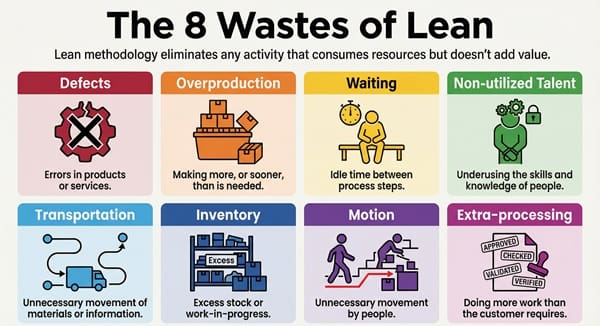
Lean methodology focuses on eight common types of waste, often remembered by the acronym DOWNTIME:
- Defects: Producing faulty products or errors in service.
- Overproduction: Making more than needed or sooner than needed.
- Waiting: Idle time between process steps.
- Non-utilized Talent: Underutilizing the skills of team members.
- Transportation: Moving materials or information unnecessarily.
- Inventory: Excess stock or work-in-progress (WIP).
- Motion: Unnecessary movement by people.
- Extra-processing: Doing more work than required by the customer.
By eliminating these wastes, Lean helps in significantly reducing cycle time and operational costs. This naturally leads to faster delivery and a more competitive advantage.
Also Read: Enterprise Risk Management (ERM)
Six Sigma Methodology in Operations Management
Six Sigma refers to a disciplined, data-driven methodology. It aims at near-perfect quality by reducing variation in any process. The ultimate goal of Six Sigma is to limit defects to a level of 3.4 Defects Per Million Opportunities (DPMO). This level of quality ensures that almost all outputs meet customer requirements.
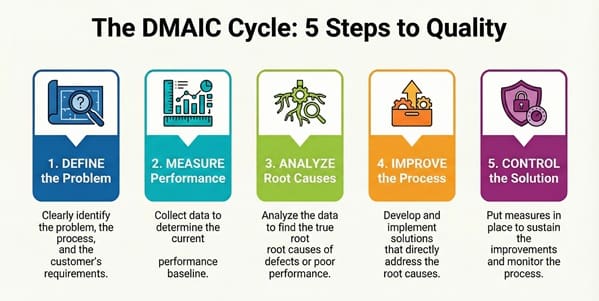
Six Sigma uses a structured problem-solving approach. This approach is known as the DMAIC (Define, Measure, Analyze, Improve, Control) process. DMAIC is a fundamental concept in Six Sigma projects.
- Define: You clearly define the problem, the process, and the customer requirements.
- Measure: You collect data to determine the current performance baseline.
- Analyze: You analyze the data to identify the root causes of defects or poor performance.
- Improve: You develop and implement solutions to address the root causes.
- Control: You put measures in place to sustain the improvements and monitor the process.
The focus on data and root cause analysis is a crucial element of Six Sigma. This is because it ensures that solutions address the actual problem, not just the symptoms. Six Sigma therefore provides consistency and predictability.
Lean Six Sigma: Key Differences in Approach
While both methodologies are essential, their distinct differences are what make their combination so powerful. Lean focuses on the speed and flow of the process. Six Sigma focuses on the quality and consistency of the output.
| Basis for Comparison | Lean Methodology | Six Sigma Methodology |
| Primary Goal | Eliminate waste (non-value-added steps) | Reduce variation and defects |
| Main Focus | Flow and speed (cycle time reduction) | Quality and consistency (defect reduction) |
| Key Question | What are the wastes in the process? | What are the root causes of defects? |
| Problem Solving | Uses methods like Value Stream Mapping | Uses the DMAIC methodology |
| Data Focus | Time and volume data | Defect and variation data |
| Core Concept | Eight types of waste (DOWNTIME) | 3.4 DPMO (Defects Per Million Opportunities) |
Lean Six Sigma applies the Lean tools first to ensure a fast, efficient flow. Then, it uses Six Sigma tools to ensure the process’s outputs are high-quality and free of defects.
Also Read: Integrated Risk Management
Why is Lean Six Sigma Crucial for Operations Management?
Lean Six Sigma plays a vital role in modern operations management. It helps companies reduce costs while simultaneously improving customer satisfaction.
By using Lean Six Sigma, businesses can achieve:
- Cost Reduction: Lean Six Sigma eliminates wasted effort, material, and time. This directly reduces operating costs.
- Increased Speed and Output: Lean principles simplify the process flow. This leads to faster cycle times and allows the operation to handle greater volume.
- Superior Quality: Six Sigma principles minimize errors and product defects. This directly results in higher quality goods or services.
- Enhanced Customer Satisfaction: Providing faster, higher-quality, and more reliable products or services naturally increases customer happiness.
- Better Employee Morale: Employees are given the tools to fix problems. This increases engagement and their sense of ownership over the process.
Lean Six Sigma helps companies focus their limited resources on activities that truly create value for the end customer.
Applying Lean Six Sigma to Processes: The DMAIC Roadmap
Implementing Lean Six Sigma in operations management follows the DMAIC model. This is nothing but a structured, five-phase roadmap. DMAIC ensures that process improvements are data-driven, systematic, and sustainable.
Let us understand how each phase in the DMAIC roadmap helps improve operations management:
1. Define Phase: Setting the Scope and Goal
The Define phase refers to the first step in any Lean Six Sigma project. In this phase, you clearly define the problem the process is facing.
- Define the Customer: You identify the actual recipient of the process output and their specific needs. This involves understanding their Critical-to-Quality (CTQ) requirements.
- Define the Project Scope: You set clear boundaries for the project. What is included and what is not included in the project?
- Define the Goal: You establish clear, measurable, and realistic objectives. For example, “Reduce product defects from 15% to 5% within six months.”
The Define phase ensures that the entire team is focusing on the most critical issues that impact the customer.
2. Measure Phase: Establishing the Baseline
The Measure phase focuses on data collection to understand the current performance of the process. Data collection is a crucial element here.
- Measure the Process: You map out the process using tools like Value Stream Mapping (from Lean). This helps visually identify current process steps and flow.
- Measure Key Metrics: You collect data on current performance metrics, such as cycle time, Defects Per Unit (DPU), and DPMO. This data establishes the performance baseline.
- Measure Variation: You use statistical tools to understand how much the process output is varying.
The Measure phase results in a clear picture of the problem’s size and current process efficiency.
3. Analyze Phase: Finding the Root Cause
The Analyze phase aims to identify the root cause of the problem. Root cause analysis is essential for effective improvement.
- Analyze the Data: You use various analytical and statistical tools. Tools like Pareto Charts and Fishbone Diagrams help point to the most significant factors causing the problem.
- Analyze the Waste: Lean tools are used to analyze the process map and identify where the eight types of waste (DOWNTIME) are occurring.
- Analyze the Variation: You confirm which inputs (X’s) are causing the unwanted variation in the outputs (Y’s).
In this way, the Analyze phase moves the team beyond symptoms to the actual source of the problem. What is truly causing the process to fail?
4. Improve Phase: Developing and Implementing Solutions
The Improve phase focuses on developing, testing, and implementing solutions. These solutions should directly address the root causes found in the Analyze phase.
- Develop Solutions: You brainstorm and select the most effective and feasible solutions. Lean tools focus on process streamlining and eliminating non-value-added steps. Six Sigma tools focus on changing process inputs to reduce variation.
- Test Solutions: You run small-scale pilots or experiments to validate the effectiveness of the proposed changes.
- Implement Solutions: You put the validated solutions into full effect across the entire process.
The Improve phase is where the process changes. This change leads to significant operational improvement.
5. Control Phase: Sustaining the Gains
The Control phase is nothing but the final, but most critical step. It ensures that the gains achieved in the Improve phase are maintained over time.
- Control the Process: You implement standard operating procedures (SOPs) and training. This ensures that the new process is followed correctly by everyone.
- Control the Metrics: You put in place monitoring systems, such as Control Charts. Control Charts automatically track the key metrics and alert the team when the process starts to drift back to its old ways.
- Control the Documentation: You formally document all changes and lessons learned. This allows the organization to transfer this knowledge to other processes.
The Control phase guarantees sustainability. It ensures that the process continues to deliver high quality and efficiency long after the project team moves on.
Also Read: Supply Chain Risk Management (SCRM)
Key Takeaways for Operations Management Success
Lean Six Sigma is a powerful methodology that changes how you view and manage your operations. It provides a structured, data-driven approach to solving business problems.
- Focus on Value: Always remember that a Lean Six Sigma project must ultimately create value for the customer.
- Data is Essential: Never rely on assumptions. You must use data to define, measure, and analyze problems. This is the core strength of Six Sigma.
- Eliminate Waste: Look for DOWNTIME in every process. Eliminating waste is the fastest way to reduce costs and improve speed. This is the power of Lean.
- Control for Sustained Success: You must control the process with tools like SOPs and Control Charts. This is the only way to maintain the gains you have achieved.
Lean Six Sigma acts as a long-term strategy for building a culture of continuous improvement in your organization.
Frequently Asked Questions About Lean Six Sigma
What is the difference between DPMO and DPU?
DPU (Defects Per Unit) refers to the average number of defects found in a single unit. If a defect-free unit is the goal, then a unit with multiple defects still counts as one unit. DPMO (Defects Per Million Opportunities) is more specific. It refers to the number of defects found per one million opportunities for a defect to occur. DPMO is the metric used to determine the actual Sigma level of a process.
Which is better: Lean or Six Sigma?
Neither is better; they are complementary. Lean excels at making processes faster, eliminating non-value steps, and improving process flow. Six Sigma excels at making processes more accurate, reducing output variation, and solving complex quality problems. Lean Six Sigma combines both for a truly optimal solution.
Does Lean Six Sigma only apply to manufacturing?
No, Lean Six Sigma applies to any process. It is just as effective in service operations like banking, healthcare, and IT as it is in manufacturing. All operations have process steps, waste (like waiting time or excess paperwork), and opportunities for defects (like billing errors or incorrect information). Lean Six Sigma helps analyze and improve all of these.
How long does a typical Lean Six Sigma project take?
The duration of a Lean Six Sigma project varies greatly. A small, focused improvement (Just-Do-It or Kaizen event) may take only a few days. A complex, company-wide DMAIC project can take anywhere from three to six months. The time depends heavily on the project’s scope, the complexity of the process, and the availability of resources.
Final Words
Lean Six Sigma is nothing short of an essential framework for operations management excellence. It allows businesses to move beyond simply managing existing processes to actively improving and optimizing them. By committing to the dual focus of eliminating waste (Lean) and reducing variation (Six Sigma), you can significantly enhance your company’s performance.
We believe that every operation holds the potential for greater efficiency and higher quality. Lean Six Sigma gives you the systematic, data-driven methodology to realize that potential. Continuous improvement is not just a goal; it is a necessity in today’s competitive environment.
Are you ready to transform your processes and create more value for your customers? We offer expert training and implementation support to help your team master the Lean Six Sigma methodology and deliver superior operational results.
Contact us today to discuss how a Lean Six Sigma project can benefit your organization’s bottom line.

About Six Sigma Development Solutions, Inc.
Six Sigma Development Solutions, Inc. offers onsite, public, and virtual Lean Six Sigma certification training. We are an Accredited Training Organization by the IASSC (International Association of Six Sigma Certification). We offer Lean Six Sigma Green Belt, Black Belt, and Yellow Belt, as well as LEAN certifications.
Book a Call and Let us know how we can help meet your training needs.