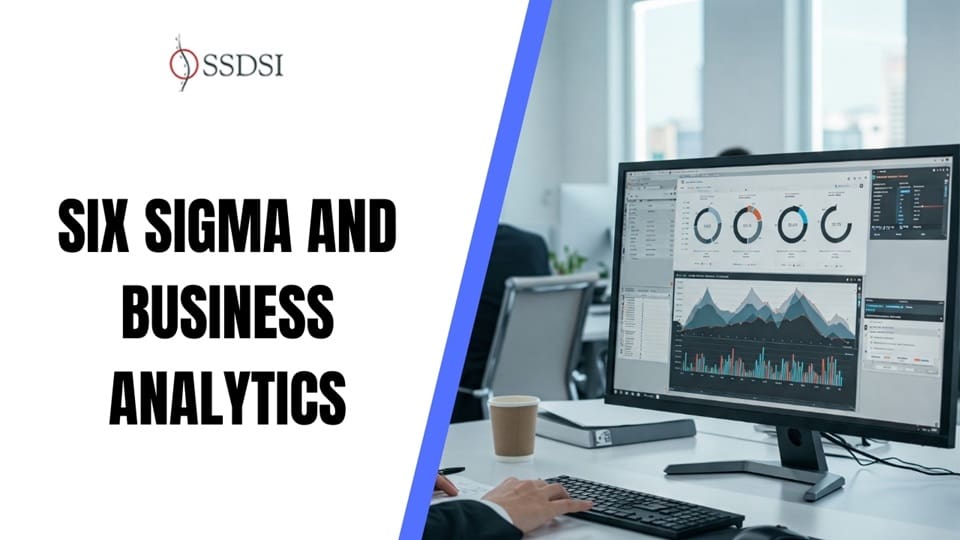
Lean Six Sigma Analytics refers to the systematic integration of the Lean Six Sigma methodology with Business Analytics tools and techniques. This combined approach creates a powerful framework for continuous process improvement. Lean Six Sigma Analytics moves beyond simple process mapping by using advanced data analysis to drive critical decision-making.
In simple words, Lean Six Sigma Analytics takes the quality and efficiency goals of Lean Six Sigma and uses the deep data insights from Business Analytics to achieve them. It is a data-driven decision-making approach that targets waste reduction and variation elimination.
Table of contents
Defining Six Sigma and Business Analytics
Before discussing the integration, it is essential to define the two core concepts.
- Six Sigma is a set of techniques and tools for process improvement. The main goal of Six Sigma is to identify and eliminate the causes of defects and variation in manufacturing and business processes. It uses a rigorous, five-phase approach known as DMAIC (Define, Measure, Analyze, Improve, Control). The ultimate objective is to achieve a process quality level where only $3.4$ defects occur per million opportunities (DPMO).
- Business Analytics is the practice of using statistical methods and technologies to analyze past business performance. Business Analytics gives businesses insight into their operations, which allows them to make informed, data-driven decisions. This field primarily involves descriptive, predictive, and prescriptive analysis to discover trends, forecast outcomes, and recommend actions.
Goal of Lean Six Sigma Analytics
Lean Six Sigma Analytics aims to create highly efficient and highly effective business processes. By combining Lean’s focus on speed and waste reduction with Six Sigma’s focus on quality and variation reduction, an organization can achieve superior operational performance.
The Lean Six Sigma Analytics framework ensures that every process improvement project is grounded in reliable data. You move from simply observing a problem to using sophisticated analytical models to understand its root causes and predict the impact of changes. This focus on analytical rigor is what sets it apart.
The Problem It Solves
Businesses often struggle with either too much process variation (a Six Sigma problem) or too much waste and non-value-added steps (a Lean problem). Business Analytics allows the team to pinpoint exactly which is the primary issue.
- For example, without Business Analytics, a team might assume a delay is due to a slow step.
- Lean Six Sigma Analytics uses time-series data and statistical modeling to prove that the delay is actually caused by uneven demand, which requires a scheduling change, not just speeding up a single step.

Public, Onsite, Virtual, and Online Six Sigma Certification Training!
- We are accredited by the IASSC.
- Live Public Training at 52 Sites.
- Live Virtual Training.
- Onsite Training (at your organization).
- Interactive Online (self-paced) training,
Key Components of Lean Six Sigma Analytics
Lean Six Sigma Analytics successfully merges methodologies and tools from both domains. This integration ensures a balanced and powerful approach to process improvement.
The Methodological Components
Lean Six Sigma Analytics is built on these foundational concepts:
- Process Mapping and Value Stream Analysis: This is a Lean concept. It identifies all steps in a process and categorizes them as value-added, non-value-added, or necessary non-value-added.
- Statistical Process Control (SPC): This is a core Six Sigma concept. SPC uses control charts to monitor a process and determine whether it is in a state of statistical control.
- Advanced Statistical Tools: Lean Six Sigma Analytics heavily relies on tools like Regression Analysis, Analysis of Variance (ANOVA), and Design of Experiments (DOE). These tools move beyond simple charts and graphs to uncover hidden relationships in process data.
- Data Visualization: This is a Business Analytics component. Effective visualization is critical for communicating complex analytical findings to stakeholders who may not be statisticians. Data visualization transforms raw numbers into actionable insights.
Also Read: How Predictive Analytics Works and Why It’s Important?
The Analytical Tools
The power of Lean Six Sigma Analytics comes from using the right analytical tools at the right time.
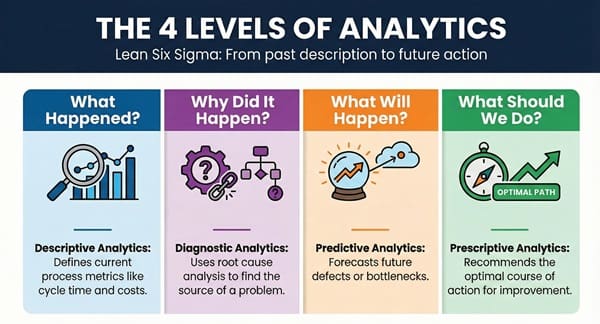
- Descriptive Analytics: Descriptive analytics defines what happened. In Lean Six Sigma, this involves calculating current process metrics like DPMO, cycle time, and costs.
- Diagnostic Analytics: Diagnostic analytics defines why something happened. This aligns with the Analyze phase of the DMAIC method, using root cause analysis tools.
- Predictive Analytics: Predictive analytics defines what will happen. This is crucial for forecasting defects or bottlenecks under different operating conditions before making actual process changes.
- Prescriptive Analytics: Prescriptive analytics defines what should be done. This recommends the optimal course of action for process improvement, providing a direct path to implement process changes.
Integrating Six Sigma and Business Analytics
The integration of Six Sigma and Business Analytics is not merely placing them side-by-side; it is a synergistic merging where each component strengthens the other.
Six Sigma provides the structured, problem-solving roadmap (DMAIC), while Business Analytics provides the engine (the data) and the navigational tools (the models) to traverse that map accurately.
| Basis for Comparison | Six Sigma (The Method) | Business Analytics (The Engine) |
| Meaning | A methodology for reducing variation and defects in a process. | The use of data, statistical, and quantitative analysis to derive insights. |
| Primary Goal | Process quality and variation reduction. | Informed, data-driven decisions and forecasting. |
| Core Toolset | DMAIC, Control Charts, Hypothesis Testing. | Regression, Data Mining, Visualization, Predictive Modeling. |
| Focus | Eliminating defects (Y=f(X), finding the X’s). | Understanding trends and making predictions based on data. |
Lean Six Sigma Analytics uses the Six Sigma structure to ensure the analytical efforts are focused on high-priority process problems. The Analytics ensures that the Six Sigma solutions are not based on assumptions but on statistical proof.
The DMAIC Framework in Analytics
The DMAIC framework is the backbone of any Lean Six Sigma Analytics project. Each phase of DMAIC is significantly enhanced by leveraging Business Analytics.
- Define: The team uses descriptive analytics to understand the scope and scale of the problem. They define the process, the customers, and the measurable goals. Data visualization is used here to create clear project charters.
- Measure: The team collects reliable data on the current process performance. Business Analytics tools are essential for establishing the baseline performance metrics. Data mining and sampling techniques ensure the data is complete and accurate.
- Analyze: This is where the bulk of Lean Six Sigma Analytics occurs. The team uses diagnostic and predictive analytics to identify the root causes (the critical X’s). Hypothesis testing and regression analysis are powerful tools to prove the relationship between the root causes and the problem.
- Improve: Based on the analytical findings, the team develops and tests potential solutions. Prescriptive analytics can be used to model the best possible solution before implementation. The team runs small experiments (Design of Experiments) to statistically prove the improvement will work.
- Control: The team ensures the improvements hold over time. They use Statistical Process Control (SPC) and automated dashboards (a Business Analytics tool) to monitor the new process. Control charts are constantly updated with real-time data to prevent the process from slipping back to its old performance level.
Advantages of Lean Six Sigma Analytics
Lean Six Sigma Analytics provides compelling benefits that justify the effort of integrating the two disciplines.
- Improved Accuracy of Root Cause Analysis: Lean Six Sigma Analytics replaces guesswork with statistical certainty. This ensures that the time and resources invested in solutions are targeting the true problems, leading to a higher success rate for process improvement projects.
- Better Predictive Capabilities: By using Business Analytics models, organizations can forecast how process changes will impact key performance indicators. This allows project teams to select the optimal solution, minimizing risk. Predictive capabilities are key to proactive management.
- Enhanced Stakeholder Buy-in: Data visualization and statistically proven results are powerful tools for communicating with management. When you present solutions backed by rigorous Lean Six Sigma Analytics, it is easier to gain approval and resources.
- Focus on Strategic Problems: The integration helps direct Six Sigma project resources toward the processes that have the greatest financial or strategic impact on the organization. This aligns improvement efforts with broader business goals.
Key Takeaways
- Lean Six Sigma Analytics combines the structured process improvement of Lean Six Sigma with the deep insights of Business Analytics.
- The primary goal is to achieve superior efficiency and quality through data-driven decision-making.
- The DMAIC framework is enhanced in every phase by using descriptive, diagnostic, predictive, and prescriptive analytics.
- Statistical process control and advanced modeling tools are essential to the methodology.
- The major advantage is replacing assumptions with statistically proven root causes, leading to more accurate and effective process improvement.
Also Read: Big Data Analytics
FAQs on Lean Six Sigma and Business Analytics
1. What is the fundamental difference between Six Sigma and Lean Six Sigma Analytics?
Six Sigma is a methodology focused on reducing defects and process variation to achieve high quality. Lean Six Sigma Analytics is the integration of that methodology with Business Analytics tools. This means it uses advanced statistical modeling, predictive analytics, and data mining to drive the entire process improvement effort. In short, Lean Six Sigma Analytics adds a powerful, data-driven engine to the Six Sigma structure.
2. Does Lean Six Sigma Analytics use specific software tools?
Yes, Lean Six Sigma Analytics projects typically use a mix of specialized and general analytical tools. These include:
- Statistical Software: Programs like Minitab, R, or Python are used for complex analyses, hypothesis testing, and process capability studies.
- Business Intelligence (BI) Tools: Platforms like Tableau or Power BI are essential for data visualization, creating real-time control dashboards, and performing descriptive analytics.
- Data Management Systems: SQL databases and data warehouses are used to ensure the accuracy and accessibility of the data used for the analysis phase.
3. Which phase of the DMAIC cycle benefits most from Business Analytics?
The Analyze phase benefits most significantly. While Business Analytics is helpful across all five phases, the Analyze phase is where teams use rigorous statistical tools (like regression analysis) to move beyond simple root cause brainstorming. Diagnostic analytics helps confirm or reject assumed causes, ensuring that the team focuses on the statistically proven inputs (the critical X’s) that affect the output (Y).
Final Words
In a nutshell, Lean Six Sigma Analytics is the modern evolution of quality improvement. It recognizes that simple flow charts and basic quality checks are no longer enough in the age of big data. To achieve true operational excellence, you must combine the systematic discipline of Six Sigma and Lean with the immense power of Business Analytics. This combined methodology provides the definitive path for making truly data-driven decisions and achieving long-lasting process improvement.

About Six Sigma Development Solutions, Inc.
Six Sigma Development Solutions, Inc. offers onsite, public, and virtual Lean Six Sigma certification training. We are an Accredited Training Organization by the IASSC (International Association of Six Sigma Certification). We offer Lean Six Sigma Green Belt, Black Belt, and Yellow Belt, as well as LEAN certifications.
Book a Call and Let us know how we can help meet your training needs.