

Business Process Improvement (BPI) is the discipline of improving an existing business process through a structured, data-driven approach rather than relying on assumptions or quick fixes.
A common misconception is that process improvement means tearing down a workflow and rebuilding it from the ground up. It doesn’t. That approach is known as Business Process Reengineering (BPR). BPI focuses on enhancing a process that already exists, making it faster, more reliable, more cost-effective, or more customer-focused.
Organizations typically use one or more proven improvement methodologies to accomplish this:
- Lean focuses on eliminating waste and reducing delays.
- Six Sigma focuses on reducing variation, defects, and errors.
- Kaizen focuses on continuous, incremental improvement.
In practice, many organizations combine these approaches into Lean Six Sigma, the most widely adopted framework for business process improvement across industries.
Successful BPI initiatives generally follow a five-step structure: Define, Measure, Analyze, Improve, and Control (DMAIC).
Business Process Improvement Methods
| Method | Primary Focus | Best Used For | Common Tools |
| Lean | Eliminating waste and delay | Improving process speed and flow | Value Stream Mapping, 5S |
| Six Sigma | Reducing defects and variation | Improving quality and consistency | DMAIC, statistical analysis |
| Lean Six Sigma | Speed and quality improvement | Most business improvement initiatives | DMAIC plus Lean tools |
| Kaizen | Continuous incremental improvement | Team-driven daily improvements | Kaizen events, daily huddles |
| Business Process Reengineering (BPR) | Complete process redesign | Processes that are fundamentally broken | Clean-sheet process design |
Table of contents
- Business Process Improvement Methods
- Understanding Business Process Improvement
- BPI vs. Business Process Reengineering
- The Three Foundations of Modern BPI
- Why Lean Six Sigma Has Become the Industry Standard
- The DMAIC Framework: The Backbone of Process Improvement
- Common BPI Tools and Where They Fit
- Real-World Example: Invoice Approval Cycle Improvement
- Why Business Process Improvement Efforts Fail?
- Why Six Sigma Training Matters?
- Final Words
- Build Internal Process Improvement Capability with SSDSI
- Related Articles
Key Takeaways
- Business Process Improvement improves an existing process. It is designed to enhance performance, not replace the process entirely.
- Business Process Reengineering is a separate discipline. BPR starts over with a new design when a process is beyond improvement.
- Lean Six Sigma is the most widely used BPI framework. It combines Lean’s focus on speed with Six Sigma’s focus on quality.
- Most successful improvement projects follow DMAIC: Define, Measure, Analyze, Improve, and Control.
- Selecting the wrong process is one of the most common reasons BPI initiatives stall or fail.
- The Control phase is often overlooked. Without it, improvements frequently erode over time and organizations revert to previous performance levels.
Understanding Business Process Improvement
At its core, Business Process Improvement is about making work perform better.
Every organization runs on processes. Hiring employees, approving invoices, fulfilling customer orders, closing support tickets, manufacturing products, and processing claims are all examples of business processes. Because these activities happen repeatedly, even small inefficiencies can accumulate into significant costs, delays, or quality issues.
BPI provides a structured way to identify those inefficiencies and address them systematically.
The goal is not simply to work harder. The goal is to improve how the work gets done.
Most BPI efforts aim to achieve one or more of the following outcomes:
- Reduce cycle time
- Improve quality
- Lower operating costs
- Increase customer satisfaction
- Improve employee productivity
- Eliminate recurring process failures

Public, Onsite, Virtual, and Online Six Sigma Certification Training!
- We are accredited by the IASSC.
- Live Public Training at 52 Sites.
- Live Virtual Training.
- Onsite Training (at your organization).
- Interactive Online (self-paced) training,
BPI vs. Business Process Reengineering
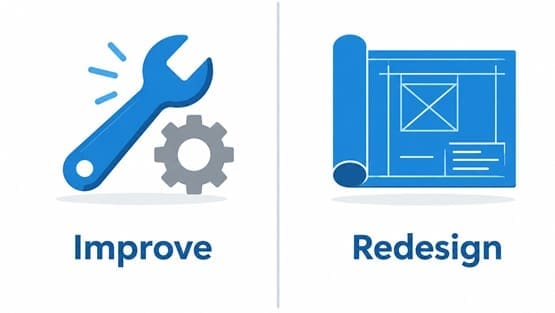
One of the most important distinctions in process improvement is understanding the difference between Business Process Improvement and Business Process Reengineering.
BPI improves an existing process.
BPR replaces it altogether.
Organizations often confuse the two, leading to projects that are larger, more expensive, and more disruptive than necessary.
Use BPI when a process generally works but suffers from identifiable issues, such as delays, defects, rework, or bottlenecks.
Use BPR when the process is fundamentally outdated, built around obsolete technology, or no longer supports business objectives.
| Question | Likely Approach |
| Does the process generally work but contain specific pain points? | BPI |
| Is the process built around outdated systems or assumptions? | BPR |
| Would redesigning from scratch be easier than fixing it? | BPR |
| Can the team identify where breakdowns occur? | BPI |
Also Read: What are Six Sigma Tools? Your Essential Guide to Quality Improvement
The Three Foundations of Modern BPI
Most process improvement initiatives are built around Lean, Six Sigma, Kaizen, or a combination of the three.
Lean
Lean focuses on identifying and eliminating activities that do not create value for the customer.
The methodology targets waste in all forms, including unnecessary movement, delays, overproduction, excess inventory, and redundant process steps.
The fundamental Lean question is:
“Does this activity create value for the customer?”
If the answer is no, the activity deserves scrutiny.
Six Sigma
Six Sigma focuses on reducing variation and defects.
Rather than concentrating primarily on speed, Six Sigma uses data and statistical analysis to understand why processes produce inconsistent results and how those issues can be prevented.
The central question becomes:
“Why does this process fail, and how can we make failure less likely?”
For organizations dealing with quality issues, customer complaints, rework, or error-prone processes, Six Sigma provides a disciplined framework for improvement.
Kaizen
Kaizen emphasizes continuous improvement through small, ongoing changes.
Rather than relying solely on large-scale projects, Kaizen encourages frontline employees to identify and implement improvements on a regular basis.
These seemingly small gains often create substantial long-term results when applied consistently.
Why Lean Six Sigma Has Become the Industry Standard
In reality, most organizations do not choose one methodology exclusively.
Instead, they combine Lean’s efficiency focus with Six Sigma’s analytical rigor, creating a balanced approach that improves both speed and quality simultaneously.
This combination is why Lean Six Sigma has become the dominant business process improvement methodology across manufacturing, healthcare, finance, logistics, government, and service industries.
The DMAIC Framework: The Backbone of Process Improvement

For Six Sigma professionals, DMAIC serves as the primary roadmap for business process improvement.
Define
The Define phase establishes the problem, project scope, business impact, and customer requirements.
A vague problem statement such as:
“Shipping takes too long.”
becomes:
“Average shipping time is six days while customer expectations are three days.”
Clarity at this stage drives success throughout the project.
Measure
The Measure phase establishes the current state.
Teams collect data and document how the process actually performs, not how people assume it performs.
This step regularly reveals that the perceived problem and the actual problem are not the same.
Analyze
The Analyze phase identifies root causes.
Tools such as Fishbone Diagrams and the Five Whys help teams move beyond symptoms and uncover the factors truly driving poor performance.
Successful improvement depends on fixing causes rather than treating symptoms.
Improve
The Improve phase develops, tests, and implements solutions.
Rather than rushing to a full-scale rollout, effective teams validate improvements through pilots or controlled testing whenever possible.
Only confirmed solutions move forward.
Control
The Control phase ensures gains are sustained.
This often includes:
- Control charts
- Standard operating procedures
- Process ownership
- Performance dashboards
- Escalation triggers
Many organizations underestimate this phase, yet it is frequently the difference between a lasting improvement and a short-term success story.
Without control mechanisms, processes tend to drift back toward previous performance levels.
Choosing the Right Process to Improve
Not every problem deserves a formal improvement project.
Before launching a BPI initiative, ask three questions:
1. Is the problem measurable?
If the issue cannot be quantified, it becomes difficult to establish success.
2. Does the process affect business results?
Strong projects connect directly to cost, quality, customer experience, revenue, compliance, or operational performance.
3. Is reliable data available?
Without data, teams often end up making decisions based on assumptions rather than facts.
Processes that satisfy all three criteria typically make strong candidates for Lean Six Sigma projects.
Common BPI Tools and Where They Fit
| Tool | Purpose | DMAIC Phase |
| SIPOC Diagram | Defines suppliers, inputs, process, outputs, and customers | Define |
| Value Stream Map | Visualizes workflow and identifies waste | Measure |
| Fishbone Diagram | Organizes potential root causes | Analyze |
| Five Whys | Drives root-cause investigation | Analyze |
| Control Chart | Monitors ongoing process performance | Control |
| Standard Work Document | Standardizes improved procedures | Control |
Real-World Example: Invoice Approval Cycle Improvement
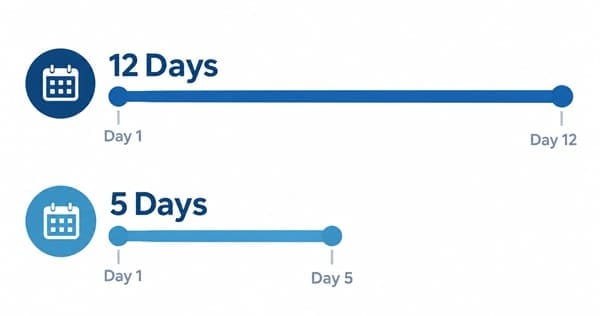
Consider an invoice approval process.
Define
Invoices currently require an average of 12 days for approval. The target is five days.
Measure
The team collects data for one month and tracks delays at each approval stage.
Analyze
The data reveals that most invoices sit awaiting a single managerial signature, creating the primary bottleneck.
Improve
The organization replaces paper approvals with electronic authorization and implements automated reminders after 24 hours.
Control
A dashboard flags any invoice pending approval for more than two days.
The lesson is straightforward: specific problems produce actionable solutions. A general objective such as “improve invoicing” would not have identified the actual bottleneck.
Also Read: Continuous Improvement Consulting and Training
Why Business Process Improvement Efforts Fail?
While methodologies are well established, execution often falls short.
Three issues appear repeatedly across industries.
Teams Skip Measurement
Organizations often move directly from identifying a problem to implementing a solution.
Without measurement, they risk fixing the wrong problem.
Teams Ignore Control
Many projects achieve short-term success but fail to establish monitoring mechanisms.
As performance slips, old habits gradually return.
Leadership Treats Improvement as a One-Time Event
Organizations that achieve the greatest results treat process improvement as a capability rather than a project.
Sustained success requires ongoing training, coaching, and application.
Why Six Sigma Training Matters?
A successful project delivers one improvement.
A trained workforce delivers hundreds.
This is where Lean Six Sigma certification creates lasting value. Green Belts and Black Belts learn a repeatable framework that can be applied across functions, departments, and business challenges.
Rather than relying on outside consultants every time a problem emerges, organizations develop internal capability to diagnose issues, identify root causes, and sustain improvement over time.
That capability becomes a competitive advantage.
Final Words
Business Process Improvement is most effective when it focuses on a specific process, a measurable problem, and a structured solution. Whether organizations use Lean, Six Sigma, Kaizen, or a combination of all three, the objective remains the same: improve performance in a sustainable way.
The DMAIC framework provides the discipline that makes process improvement successful. It forces teams to understand the problem before implementing solutions and to establish controls before declaring victory. Skip the Measure phase or the Control phase, and even well-intentioned improvements often fail to last.
For professionals pursuing Six Sigma certification, understanding BPI is foundational. The tools and methods learned through Lean Six Sigma are designed not only to fix today’s process challenges but also to build a culture of continuous improvement for years to come.
Build Internal Process Improvement Capability with SSDSI
Improving a single process can deliver meaningful results. Building internal improvement capability creates lasting organizational value.
SSDSI provides IASSC-accredited Yellow Belt, Green Belt, and Black Belt training through onsite, live virtual, public, and self-paced delivery formats. SSDSI has certified 5,322+ professionals across 600+ organizations in 52 cities and is backed by a 5-star Google review rating.
Through structured Lean Six Sigma training, professionals learn the DMAIC methodology and practical process improvement skills needed to identify opportunities, solve root causes, and sustain performance gains long after a project is complete.
About Six Sigma Development Solutions, Inc.
Six Sigma Development Solutions, Inc. offers onsite, public, and virtual Lean Six Sigma certification training. We are an Accredited Training Organization by the IASSC (International Association of Six Sigma Certification). We offer Lean Six Sigma Green Belt, Black Belt, and Yellow Belt, as well as LEAN certifications.
Book a Call and Let us know how we can help meet your training needs.


