

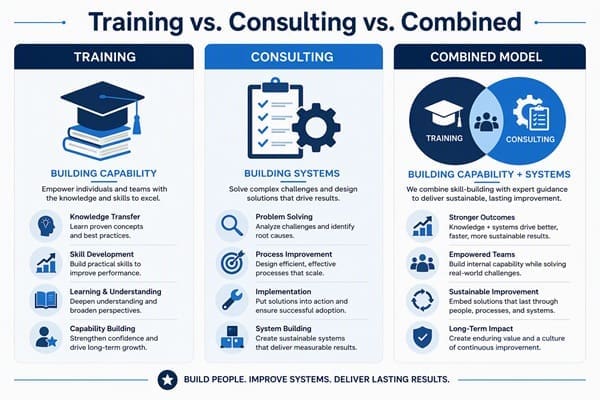
Continuous improvement consulting and training solve two different problems, and most organizations need both at different points in their improvement journey. Training builds capability: it teaches employees and leaders the tools, language, and certification credentials (Yellow Belt, Green Belt, Black Belt) they need to run improvement projects themselves.
Consulting builds systems: outside experts work alongside your team to design the daily management structure, governance model, and project pipeline that makes improvement sustainable after the engagement ends.
Executive Lean Six Sigma workshops sit at the intersection of the two. A workshop trains leaders in the sponsorship skills consulting engagements assume they already have, which is why the strongest continuous improvement programs sequence executive training and consulting support together rather than treating them as separate purchases.
Quick-Reference Table: Training vs. Consulting vs. Combined Model
| Dimension | Training Only | Consulting Only | Training + Consulting Combined |
| What it builds | Individual skill and certification | Organizational systems and infrastructure | Skill and system together |
| Who delivers the work | Your certified employees, after training | Outside consultants, embedded with your team | Both, working from a shared curriculum |
| Typical engagement length | Days to weeks per cohort | Months to multiple years | Ongoing, phased |
| Best fit | Organizations with time to build internal capability gradually | Organizations needing faster results or lacking internal bandwidth | Organizations building a program meant to outlast the initial engagement |
| Common failure mode | Certified employees lack organizational support to apply skills | Improvements fade once consultants leave | Rare when properly sequenced |
| Executive’s role | Sponsor projects after a Champion-level workshop | Approve and fund consultant recommendations | Actively lead the transformation with trained internal support |
Table of contents
Key Takeaways
- Training and consulting answer different questions. Training answers “who on our team can run this project,” while consulting answers “how do we build a system that keeps improvement running.”
- A consulting engagement without trained internal staff usually fades once the consultants leave, because the organization never develops the internal capability to sustain what the consultants built.
- Training without consulting support often stalls at the individual level. A certified Green Belt returns to the same organizational structure that existed before the certification, without the systems in place to apply the new skill at scale.
- Executive Lean Six Sigma workshops are the connective layer between the two. They give leadership the sponsorship literacy that both a standalone training rollout and a standalone consulting engagement depend on.
- The right sequence usually starts with an executive workshop, moves into parallel belt-level training and light consulting support, and shifts toward internally led continuous improvement as the internal bench of certified staff grows.
What Continuous Improvement Consulting and Training Actually Mean
Continuous improvement training teaches people specific skills through a structured curriculum, and it usually results in a recognized credential such as a Yellow Belt, Green Belt, or Black Belt certification.
Continuous improvement consulting places outside experts inside your organization to diagnose problems, design solutions, and often lead the improvement work directly alongside your team. The two terms get used interchangeably in marketing copy across the industry, but they describe different deliverables, and a buyer who conflates them frequently purchases the wrong service for their actual need.
A simple test clarifies which service an organization needs. If the core question is “who on our staff can do this work,” the organization needs training. If the core question is “how do we design a system that makes this work sustainable,” the organization needs consulting. Most organizations eventually need an answer to both questions, which is why the strongest programs blend the two rather than choosing one permanently.

Public, Onsite, Virtual, and Online Six Sigma Certification Training!
- We are accredited by the IASSC.
- Live Public Training at 52 Sites.
- Live Virtual Training.
- Onsite Training (at your organization).
- Interactive Online (self-paced) training,
Why Training Alone Often Stalls
A newly certified Green Belt returns to their department with a new skill set, but the department itself has not changed. The daily meeting structure, the reporting relationships, and the incentive system all remain exactly as they were before the certification began. The employee now knows how to run a DMAIC project, but nothing in the surrounding organization asks them to.
This gap explains a pattern that shows up repeatedly across organizations that invest heavily in certification without pairing it with structural support: certification rates climb, but project completion rates and sustained results lag behind. The training built the skill correctly; the organization simply never built the system that puts the skill to use.
Why Consulting Alone Often Fades
Consulting engagements solve the opposite problem, and they create a different failure pattern. An outside consulting team studies the organization, redesigns a process, and installs a new daily management routine, and results often improve immediately because experienced specialists are directly managing the change. The risk surfaces later, once the engagement ends and the consultants leave the building.
If no one inside the organization understands the methodology deeply enough to maintain it, the new system slowly reverts toward the old one. Employees who watched the consultants work but never learned the underlying framework cannot troubleshoot the system when it breaks, adapt it to a new department, or train the next round of new hires on it. The consulting engagement delivered a result, but it did not transfer the capability to sustain that result internally.
Also Read: Best Lean Manufacturing Process Improvement Certification
The Combined Model: Why Executive Workshops Are the Connective Layer
An executive Lean Six Sigma workshop solves a specific piece of this puzzle that neither pure training nor pure consulting addresses on its own: leadership’s ability to sponsor and sustain whichever model the organization chooses.
A consulting engagement assumes executives can evaluate consultant recommendations, protect the engagement’s budget through competing priorities, and hold the organization accountable once the consultants leave. A training rollout assumes executives will actively sponsor the projects that newly certified employees attempt to run. Both assumptions fail more often than providers admit, and an executive workshop exists specifically to make those assumptions true rather than aspirational.
The workshop itself teaches a narrower, higher-leverage curriculum than either training or consulting requires on their own: how to read a project dashboard, how to select which improvement opportunities deserve formal attention, and how to model the behaviors that signal an initiative is a genuine priority rather than a temporary program.
A leader who completes this workshop becomes qualified to sponsor training-led projects, evaluate consulting recommendations, or oversee a combined engagement that uses both.
How to Sequence Training and Consulting Together

Organizations that successfully combine training and consulting generally follow a phased sequence rather than purchasing both services simultaneously on day one.
- Executive workshop first. Leadership completes a Champion-level workshop before any large-scale training or consulting spend begins, which ensures the people approving budget and reviewing results can do so competently from the start.
- Diagnostic consulting engagement. A short consulting engagement assesses the organization’s current state, identifies where formal DMAIC projects will produce the highest return, and recommends which departments should train first.
- Parallel belt-level training and light consulting support. Green Belt and Black Belt cohorts begin training while consultants provide project coaching, review project charters, and help the first cohort avoid common early mistakes.
- Consulting support tapers as internal capability grows. As certified employees successfully complete projects independently, the organization gradually reduces reliance on outside consultants and shifts toward internally led continuous improvement.
- Sustainment becomes an internal function. The organization’s own Black Belts and Champions take over the governance, auditing, and refresher training that consultants originally provided, and outside support becomes occasional rather than continuous.
Also Read: Lean Metrics
Signs Your Organization Needs Training, Consulting, or Both
| Signal | Points Toward |
| You have time to build capability gradually and no urgent deadline | Training-led approach |
| You need results within months, not years, and lack internal bandwidth | Consulting-led approach |
| Previous training produced certified employees who never ran projects afterward | Consulting support paired with existing training |
| A previous consulting engagement improved results that faded after the consultants left | Training to build internal capability the engagement didn’t transfer |
| Leadership has never been trained to sponsor or evaluate improvement projects | An executive workshop, regardless of which other service you choose |
Common Mistakes When Buying Continuous Improvement Services
Organizations regularly make one of three purchasing mistakes when evaluating continuous improvement providers.
- The first mistake treats training and consulting as interchangeable line items on a proposal, when a provider who genuinely delivers both should clearly define which service solves which organizational problem.
- The second mistake skips executive training entirely and sends only individual contributors through certification, which leaves the organization without the sponsorship layer that determines whether certified employees ever get the support to apply their skills.
- The third mistake purchases a multi-year consulting engagement without a parallel plan to build internal certification capability, which guarantees permanent dependence on the outside firm rather than a program the organization eventually owns.
What a Well-Structured Combined Engagement Looks Like
A well-structured continuous improvement program typically produces three visible outcomes within its first eighteen months. Leadership completes executive-level training and actively sponsors a defined set of improvement projects.
A growing internal bench of certified Green Belts and Black Belts independently runs new projects with decreasing reliance on outside consultants. And the organization’s daily management system — the meetings, dashboards, and escalation paths that make improvement part of normal operations — continues functioning whether or not an outside consultant is present that week.
Frequently Asked Questions on Continuous Improvement Training and Consulting
What is the difference between continuous improvement training and continuous improvement consulting?
Training teaches individuals a skill set, usually resulting in a certification such as Green Belt or Black Belt, that they can apply to run improvement projects themselves. Consulting places outside experts directly inside your organization to diagnose problems and often lead the improvement work, building organizational systems rather than individual skills.
Do we need both training and consulting, or just one?
Most organizations eventually need both, though not necessarily at the same time. Training builds the internal skill to run projects, while consulting builds the systems and governance that make those projects sustainable, and organizations that invest in only one often see results stall or fade.
Where do executive Lean Six Sigma workshops fit into this?
Executive workshops train leadership in the sponsorship and evaluation skills that both training-led and consulting-led approaches assume executives already possess. They function as a connective layer that supports whichever combination of services an organization ultimately chooses.
How long does a combined training and consulting engagement typically take?
A phased engagement often starts with an executive workshop and diagnostic consulting assessment lasting a few weeks, followed by parallel belt-level training and consulting support over six to eighteen months, with consulting involvement tapering as internal certified staff take over project leadership.
Why did our previous consulting engagement’s results fade after the consultants left?
This pattern usually indicates the engagement improved processes without transferring the underlying methodology to internal staff. Without employees trained deeply enough to maintain and adapt the new system, it gradually reverts toward previous behavior once outside oversight ends.
Why did our employees get Green Belt certified but never actually run projects?
Certification alone does not change the organizational structure around a newly certified employee. Without executive sponsorship, a defined project pipeline, and organizational support, a certified employee often returns to a role and reporting structure that gives them no clear path to apply the new skill.
Final Words
Continuous improvement consulting and training solve different halves of the same problem, and the organizations that get the most value from either service are the ones that stop treating the choice as either-or. Training builds the people who can run the work. Consulting builds the systems that make the work stick.
Executive Lean Six Sigma workshops connect the two by making sure the leaders funding, sponsoring, and evaluating the initiative are equipped to do so from day one, rather than learning the role by trial and error while budget and credibility are on the line.
Build a Combined Program with SSDSI
Organizations rarely need training or consulting in isolation, and SSDSI structures its programs around that reality. SSDSI delivers IASSC-accredited Yellow Belt, Green Belt, and Black Belt training alongside executive-level workshops that prepare leadership to sponsor the initiative from the start, through onsite, live virtual, public, or self-paced formats.
SSDSI has certified 5,322+ professionals across 600+ organizations in 52 cities, backed by a 5-star Google review rating. A conversation about your current mix of internal capability and outside support is the clearest way to identify what your organization needs next.
About Six Sigma Development Solutions, Inc.
Six Sigma Development Solutions, Inc. offers onsite, public, and virtual Lean Six Sigma certification training. We are an Accredited Training Organization by the IASSC (International Association of Six Sigma Certification). We offer Lean Six Sigma Green Belt, Black Belt, and Yellow Belt, as well as LEAN certifications.
Book a Call and Let us know how we can help meet your training needs.


