

Beta testing is a phase of validation where a nearly finished product, feature, or process is released to a limited group of real, external users who interact with it under normal, uncontrolled conditions before the full launch. It matters because it surfaces usability problems, edge cases, and real-world friction that internal testing teams rarely catch, since developers and testers already know how the product is supposed to work.
In practice, a team defines clear objectives, recruits a representative group of testers, runs the test for a fixed period (typically two to six weeks), and collects structured feedback on functionality, usability, and reliability. The outcome is a prioritized list of fixes and a go/no-go decision grounded in real user behavior rather than internal assumption.
Quick Reference Table
| Element | What It Means | Why It Matters | Example |
| Beta Testing | External validation with real users in real conditions | Confirms the product works outside a controlled lab environment | A software company releases a near-final app to 500 outside users |
| Alpha Testing | Internal validation, usually by employees not on the build team | Catches major defects before external users ever see the product | QA staff test a feature internally before it reaches beta testers |
| Open Beta | Anyone can opt in to test the product | Generates a large, diverse volume of feedback | A game studio opens beta access to the public before launch |
| Closed Beta | A specific, invited group tests the product | Produces more targeted, higher-quality feedback on defined questions | A SaaS company invites 50 existing customers to test a new feature |
| Pilot Run | A small-scale trial of a process or manufacturing system under real production conditions | The closest Six Sigma equivalent to beta testing, applied to processes rather than software | A manufacturer runs one production line before a full-scale rollout |
Table of contents
Key Takeaways
- Beta testing validates real-world use, not just functionality. Alpha testing checks whether a feature works; beta testing checks whether real users can use it successfully.
- Beta testers are external and use the product in their own uncontrolled environment, which is what makes their feedback different from internal QA feedback.
- There are two primary formats: open and closed beta. Open beta maximizes feedback volume; closed beta maximizes feedback precision.
- Beta testing and a pilot run solve a similar problem for different domains. Beta testing validates software or product experience; a pilot run validates a manufacturing or business process. SSDSI’s guide to pilot runs covers the process-validation side in depth.
- A beta test needs defined objectives before it starts, or the feedback collected will be too scattered to act on.
- Most beta tests run two to six weeks, long enough to surface real usage patterns without losing tester engagement.
- Beta testing is not the same as Beta Risk. Beta Risk is a statistical term (the probability of a Type II error in hypothesis testing); beta testing is a product validation activity. The shared word is coincidental.
What Is Beta Testing?
Beta testing is a form of external, real-world validation conducted with an unfinished but functionally complete version of a product, feature, or process. Instead of internal staff, actual end users interact with the product in their own environment, on their own devices, under their own normal conditions.
The product at this stage is typically 90 to 95 percent complete, meaning core functionality is built and stable, but the team is still gathering evidence on usability, reliability, and edge cases before a full release. Beta testing sits at the end of the development or validation cycle, after internal testing has already caught the most obvious defects.

Public, Onsite, Virtual, and Online Six Sigma Certification Training!
- We are accredited by the IASSC.
- Live Public Training at 52 Sites.
- Live Virtual Training.
- Onsite Training (at your organization).
- Interactive Online (self-paced) training,
Why Does Beta Testing Matter?
The core value of beta testing is that it replaces internal assumption with external evidence. Development teams and internal testers already understand how a product is supposed to work, which makes them poor substitutes for someone encountering it for the first time.
Three specific benefits follow from that shift in perspective:
- Real environments surface real problems. A feature that works perfectly on a controlled test device may fail on a different operating system, network condition, or hardware configuration that internal testing never covered.
- Genuine user behavior replaces predicted behavior. Beta testers use the product the way they actually want to, not the way a test script assumes they will, which surfaces workflow gaps a test plan would miss.
- Early, cheaper fixes. Identifying a usability problem before general release is dramatically less costly than fixing it after a full-scale launch, when the issue has already reached the broader customer base.
Types of Beta Testing
Not every beta test looks the same. The right format depends on what the team needs to learn.
| Type | Description | Best For |
| Open Beta | The product is released publicly; anyone interested can opt in | Testing at scale, stress-testing infrastructure, gathering broad feedback |
| Closed Beta | A specific, invited group of testers participates | Focused feedback on a particular feature or audience segment |
| Technical Beta | Testers focus specifically on stability, performance, and bugs | Products where reliability under load is the primary risk |
| Focused Beta | Testers are asked to evaluate one specific feature or workflow, not the whole product | Validating a single new capability without noise from unrelated feedback |
How do open and closed beta testing differ in practice?
Open beta trades feedback precision for volume and infrastructure stress-testing, since anyone can join. Closed beta trades volume for precision, since a curated group can be asked more targeted questions and held to a defined testing protocol.
Also Read: Acceptance Sampling: Quality Control Without Testing Everything
How Does Beta Testing Work?
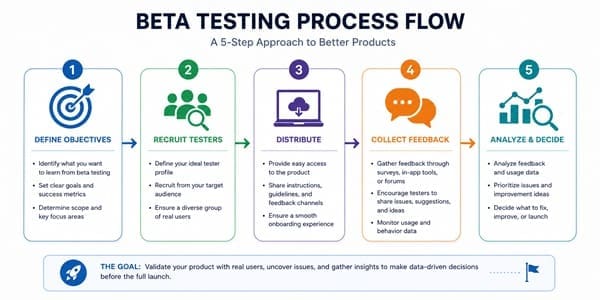
A structured beta test moves through five stages, each with a distinct purpose.
1. Define Objectives
Before recruiting a single tester, the team documents what it needs to learn: Is this validating core functionality, usability, performance under real conditions, or market interest? Vague objectives produce feedback that is hard to prioritize later.
2. Recruit a Representative Tester Group
Testers should reflect the actual target audience, not just whoever is easiest to reach. A closed beta group of 30 to 200 users is common for B2B products; open betas for consumer products can run into the thousands.
3. Distribute the Beta Version
The near-final product is released to testers through a defined channel (an app testing platform, a limited production environment, or a controlled rollout), along with clear instructions on what to test and how to report issues.
4. Collect and Categorize Feedback
Feedback is typically split into three categories: critical bugs that block core functionality, usability issues that create friction without blocking use, and feature requests that fall outside the current scope. Categorizing feedback this way prevents low-priority requests from crowding out fixes that matter most.
5. Analyze, Fix, and Decide
The team reviews categorized feedback, fixes what is feasible within the release timeline, and makes a go/no-go decision on full launch. Critical, unresolved bugs typically justify a second testing round rather than proceeding to release.
How to Run a Beta Test
- Set specific, measurable objectives. Decide in advance what “success” looks like for this beta round, whether that is a bug count threshold, a usability score, or completion rate on key tasks.
- Choose open or closed format based on your goal. Use closed beta when you need targeted answers to specific questions; use open beta when you need volume and infrastructure validation.
- Recruit testers who match your actual target audience. A beta group that does not resemble your real users will produce feedback that does not generalize.
- Set a fixed testing window. Most beta tests run two to six weeks. Open-ended testing periods tend to lose tester engagement and produce diminishing feedback quality over time.
- Use a structured feedback channel, not scattered emails or informal messages, so feedback can be categorized and prioritized consistently.
- Close the loop with testers. Communicating which issues were fixed builds tester trust and improves participation in future rounds.
Beta Testing vs. Pilot Run: How Do They Compare?
Beta testing and a pilot run answer a similar underlying question, “does this work in the real world?”, but they apply to different domains. SSDSI’s Pilot Run guide covers this comparison in full detail; the short version is below.
| Factor | Beta Testing | Pilot Run |
| Applies to | Software, apps, digital products | Manufacturing and business processes |
| Environment | Real-world user environments | Controlled or on-site production setup |
| Primary focus | Functionality, usability, user satisfaction | Process validation, readiness for full-scale production |
| Feedback type | Mostly qualitative (bug reports, usability feedback) | Both qualitative and quantitative (production data, performance logs) |
If the thing being validated is a process, production line, or operational change, a pilot run is the closer fit. If it is a software product, app, or digital feature, beta testing is the appropriate method.
Also Read: Beta Risk (Type II Error): Definition, Formula, and Six Sigma Examples
Beta Testing vs. Alpha Testing
Alpha and beta testing are sequential, not interchangeable. Alpha testing happens first, conducted internally by employees or testers not directly involved in building the product, focused on catching functional defects before anyone outside the organization sees it. Beta testing happens second, conducted externally by real users, focused on usability and real-world reliability rather than raw functionality.
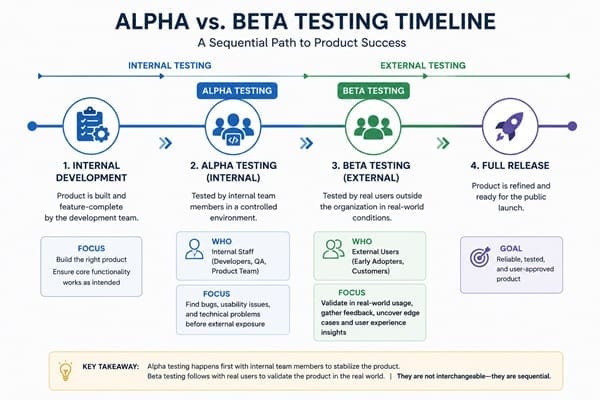
A product that has not passed alpha testing (meaning major bugs are still present) should not move into beta. Sending a broken product to external testers wastes their time and damages the quality of feedback in the round that matters most.
Beta Testing in a Lean Six Sigma Context
Within a DMAIC (Define, Measure, Analyze, Improve, Control) project, beta testing functions as a validation checkpoint, most often bridging the Improve and Control phases when the “product” being improved is software, a digital tool, or a customer-facing system rather than a physical process.
Where a pilot run validates a manufacturing or operational process change under production conditions, beta testing validates a digital solution under real user conditions before the team locks in a Control plan. Both serve the same underlying DMAIC purpose: confirming a proposed solution actually performs as expected before committing to full-scale implementation.
For a Six Sigma practitioner, the practical guidance is straightforward: use beta testing when validating software, apps, or digital workflows, and use a pilot run when validating a manufacturing process, physical product, or operational workflow. Some initiatives, such as a new customer portal supporting a redesigned service process, may require both.
Real-World Example (Hypothetical)
Problem: A logistics company redesigns its customer-facing tracking portal as part of an Improve-phase solution to reduce support call volume. Internal QA has confirmed the portal functions correctly, but the team has no evidence on whether real customers will actually use it successfully.
Analysis: The team recognizes that internal testers already know how the new portal works, so their experience cannot predict how a confused first-time customer will behave.
Six Sigma approach: A closed beta is run with 150 customers who called support in the prior month, the group most likely to use the new self-service portal. Objectives are defined in advance: task completion rate on “find my shipment status” and number of unresolved usability issues.
Action: Feedback is categorized into critical bugs, usability friction points, and feature requests. Two navigation issues are fixed before full rollout; feature requests are logged for a future cycle.
Result (hypothetical): The team enters the Control phase with usability data supporting the redesign, rather than an untested assumption. This is a hypothetical illustration of a common validation pattern, not a documented case study.
Common Mistakes in Beta Testing
- Skipping alpha testing and going straight to beta. External testers waste time and lose confidence in the product when they hit defects internal testing should have caught.
- Recruiting testers who don’t match the real target audience. Convenient testers (internal staff, friendly customers) often produce optimistic feedback that does not generalize.
- Leaving objectives undefined. Without a specific question to answer, feedback arrives as a disorganized list with no clear prioritization.
- Running the beta test for too long or too short a period. Too short misses real usage patterns; too long causes tester fatigue and declining feedback quality.
- Not closing the loop with testers. Failing to report back on what was fixed reduces future participation and signals that feedback was not taken seriously.
When Should You Use Beta Testing?
Use beta testing when:
- The solution being validated is software, an app, or a digital customer-facing tool.
- Internal testing has already confirmed core functionality works, and the open question is real-world usability.
- You need evidence from actual target users before committing to a full release.
Consider a pilot run instead when:
- The solution is a manufacturing process, physical product, or operational workflow.
- You need quantitative process data (yield, defect rate, cycle time) rather than primarily qualitative user feedback.
Frequently Asked Questions (FAQs) on Beta Testing
Q: What is the difference between alpha testing and beta testing?
A: Alpha testing is internal, conducted by employees not on the build team, and focuses on catching functional defects. Beta testing is external, conducted by real users in real conditions, and focuses on usability and real-world reliability.
Q: What is the difference between beta testing and a pilot run?
A: Beta testing validates software, apps, or digital products with real users in real environments. A pilot run validates a manufacturing or business process under real production conditions. They serve the same underlying purpose for different domains.
Q: How long should a beta test last?
A: Most beta tests run two to six weeks. That window is typically long enough to capture real usage patterns without losing tester engagement over an extended period.
Q: What are the main types of beta testing?
A: The two primary formats are open beta (publicly available to anyone interested) and closed beta (limited to an invited group). Technical and focused betas are narrower variations used to target specific concerns like stability or a single feature.
Q: Who participates in beta testing?
A: External users outside the development team, ideally a group that reflects the actual target audience rather than convenient internal staff or overly friendly customers.
Q: Is beta testing part of DMAIC?
A: It is not a named DMAIC step, but it functions as a validation activity between the Improve and Control phases when the improvement involves software or a digital customer-facing system, similar to how a pilot run validates a physical process change.
Final Words
Beta testing exists to replace internal assumption with external evidence before a full launch. The teams that get the most value from it define clear objectives, recruit testers who genuinely represent their real audience, and commit to a fixed testing window with a structured way to categorize feedback. Used well, alongside its process-validation counterpart, the pilot run, it turns “we think this works” into “we confirmed this works” before the cost of being wrong gets higher.
Whether you are validating a digital solution through beta testing or a process change through a pilot run, the underlying discipline is the same: confirm before you commit.
Six Sigma Development Solutions, Inc. (SSDSI) is IASSC-accredited and 5-star rated on Google Reviews, having certified 5,322+ professionals across 600+ organizations in 52 cities. Our onsite, live virtual, public, and online training programs teach the Improve and Control phase tools, including validation methods like beta testing and pilot runs, that turn proposed solutions into confirmed results. Explore SSDSI’s training formats to build that discipline into your next project.
View our upcoming live virtual Green Belt or Black Belt training schedule and train with a curriculum built on a verified accreditation standard.
About Six Sigma Development Solutions, Inc.
Six Sigma Development Solutions, Inc. offers onsite, public, and virtual Lean Six Sigma certification training. We are an Accredited Training Organization by the IASSC (International Association of Six Sigma Certification). We offer Lean Six Sigma Green Belt, Black Belt, and Yellow Belt, as well as LEAN certifications.
Book a Call and Let us know how we can help meet your training needs.


