Lean Six Sigma is a method that uses a specific set of tools to improve business processes. It combines two major ideas. Lean removes waste. Six Sigma reduces defects and variation. This makes processes stable and predictable.
In simple words, Lean Six Sigma helps you do things right the first time and faster.
Six Sigma Development Solutions Inc. understands that service industry success requires a specific focus. Unlike a physical product, a service is often intangible. The “defect” might be a long wait time or a confusing form. SSDSI’s Strategies address this unique need by prioritizing the customer experience and the flow of information.
Let us now discuss the foundational elements of SSDSI’s Strategies for the service industry.
Table of contents
Why Service Industry Lean Six Sigma Needs a Special Approach?
One must understand that service processes are somewhat different from manufacturing.
- People-Centric: Service quality often depends on human interaction.
- Variable Demand: Customer demand is highly unpredictable.
- Invisible Process Flow: The process, like opening a new bank account, is not clearly seen. It can be quite complex.
SSDSI’s Strategies for Service Industry Lean Six Sigma Success are designed to tackle these very points. The training ensures your team knows how to map an invisible process. They learn to measure a “defect” even when it is just customer unhappiness.
Focusing on Customer-Defined Value with SSDSI
The most crucial point in Service Industry Lean Six Sigma is the Voice of the Customer (VOC). If the customer does not see value, it is a waste. SSDSI’s Strategies begin by intensely studying what the customer truly wants and needs.
In finer terms, we look for the Critical to Quality (CTQ) features. Is it speed, accuracy or friendly service? SSDSI training teaches you how to translate vague customer comments into measurable project goals. This means every Lean Six Sigma effort is focused on the actual client experience.
Mapping the Process: A Core Part of SSDSI’s Strategies
A major part of any successful Lean Six Sigma project is clearly seeing the process. In a factory, you can see the product move. In the service industry, you must visualize the flow of information or the customer’s journey.
SSDSI’s Strategies heavily use process mapping tools. This is so as to identify hidden waste.
Value Stream Mapping (VSM) in the Service Industry
Value Stream Mapping is a powerful Lean tool. It maps the entire flow of steps required to deliver a service.
SSDSI training teaches you how to create a VSM for a service process. This map shows all the steps, both value-added and non-value-added.
- Value-Added: Steps the customer is willing to pay for. For example, processing a loan application.
- Non-Value-Added (Waste): Steps that add no value. For example, waiting for approval, fixing errors, or double-checking data.
SSDSI’s Strategies teach teams to look for the “Eight Wastes of Lean” in the service context.
- Defects (errors in forms or data)
- Overproduction (printing too many copies)
- Waiting (customer waiting for a call back)
- Non-Utilized Talent (not using an employee’s full skill set)
- Transportation (moving physical files too much)
- Inventory (too many open cases or backlogs)
- Motion (employees looking for files or data)
- Extra Processing (asking for the same information twice)
Simply put, SSDSI helps you see the “DOWNTIME” in your service operations. Resultantly, you can attack the specific wastes slowing down your service delivery.

Public, Onsite, Virtual, and Online Six Sigma Certification Training!
- We are accredited by the IASSC.
- Live Public Training at 52 Sites.
- Live Virtual Training.
- Onsite Training (at your organization).
- Interactive Online (self-paced) training,
How SSDSI Uses the DMAIC Methodology?
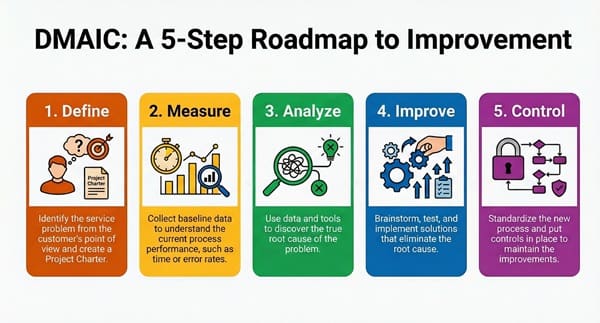
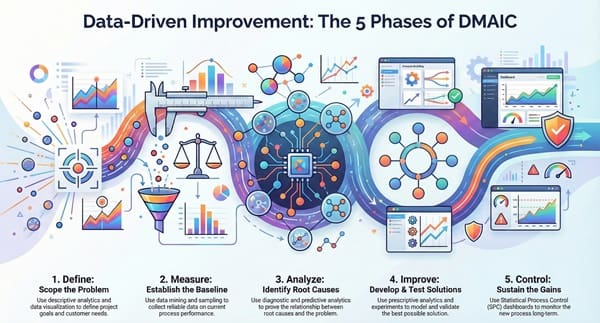
The DMAIC roadmap is central to Lean Six Sigma. This stands for Define, Measure, Analyze, Improve, and Control. SSDSI’s Strategies for Service Industry Lean Six Sigma Success customize this structure.
- Define: You define the service problem from the customer’s point of view. You create a Project Charter.
- Measure: You collect baseline data. How long does the process currently take? What is the current error rate?
- Analyze: You use data and tools to find the root cause of the problem. Why is the wait time somewhat long?
- Improve: You brainstorm and test solutions. You create a future-state process that eliminates the root cause.
- Control: You put controls in place to keep the improved process stable. You standardize the new way of working.
SSDSI teaches practical ways to use DMAIC in areas like billing, IT support, and sales. For example, in the Measure phase, we teach you how to collect data on subjective items like “service friendliness.”
Also Read: Lean Six Sigma in Mining Industry
SSDSI’s Strategies for Measuring Service Quality
Service Industry Lean Six Sigma can sometimes feel quite difficult because services are less tangible. How do you measure an email response time in a way that truly matters?
SSDSI’s Strategies provide clear, actionable tools for measurement.
Defining Service Defects in Lean Six Sigma
In a service business, a defect is nothing but a failure to meet a customer requirement. It is essential to understand this point.
SSDSI helps define the Defects Per Unit (DPU) in a service context.
- Unit: The product or service delivered. For example, a processed invoice or a customer service call.
- Defect: Any error. An incorrect name on the invoice or a dropped call during the service interaction.
By focusing on the number of chances for error—the Defects Per Opportunity (DPO)—you can measure process capability. This is highly sensitive information that tells you how well your process is performing.
Role of Statistical Tools in SSDSI Training
We can divide the statistical tools into basic and advanced. SSDSI training makes these tools easily accessible to everyone.
- Basic Tools: Things like histograms, Pareto charts, and run charts. These are primarily used to visualize data and spot major problem areas. A Pareto chart, for instance, clearly shows which 20% of errors cause 80% of the rework.
- Advanced Tools: Regression analysis and Hypothesis testing. These are used to determine if a suspected cause truly impacts the outcome. For example, does training level truly affect the error rate? SSDSI Black Belts are skilled in using these tools.
SSDSI’s Strategies ensure you use the right tool for the job. You do not need a complex t-test if a simple bar chart clearly indicates the problem.
Must Visit: Onsite Lean Six Sigma Training for Industry
Implementation and Control
Finding the root cause and creating a solution is only half the battle. The real Service Industry Lean Six Sigma Success comes from making the improvements stick. This is where the Improve and Control phases shine.
Implementing Improvements and Risk Management
SSDSI’s Strategies rely on a tool called Failure Mode and Effects Analysis (FMEA).
FMEA is a systematic way to predict what might go wrong with a new process and how to prevent it. We need to know this before implementing the solution.
- FMEA basically involves: listing potential failure points, analyzing the severity of the failure, and putting in place controls.
- The goal is to reduce the Risk Priority Number (RPN). This is quite an effective way to manage risk.
With this said, SSDSI ensures that solutions are well-tested and sustainable. You reduce the chances of unintended negative consequences, thereby leading to a smoother transition.
Maintaining Lean Six Sigma Success with Control
The Control phase of DMAIC is essential. How do you keep the process from going back to the old, wasteful ways?
SSDSI’s Strategies use control plans and statistical process control (SPC).
- Control Plans: These are nothing but a set of documented procedures. They define how to monitor the new process. They cover the steps, the measurement, the specification limits, and the reaction plan if the process goes out of control.
- Statistical Process Control (SPC): This involves creating control charts. These charts clearly show if the process variation is normal or if a special, fixable event is happening.
It must be noted that SSDSI training puts a highly sensitive focus on the Control phase. We do not want the team to lose the gains they have worked so hard to achieve. The goal is long-term Service Industry Lean Six Sigma Success.
SSDSI’s Strategies for Culture
A key difference in SSDSI’s Strategies is the focus on the people involved. Lean Six Sigma is not just a toolset; it is a way of thinking.
Training and Certification with SSDSI
SSDSI provides onsite and public Lean Six Sigma trainings for different belts. This is a crucial element of our strategy.
- Yellow Belts learn the basic concepts and help with data collection.
- Green Belts lead smaller projects within their own work area.
- Black Belts lead large, complex, and cross-functional projects. They also coach Green Belts.
SSDSI training ensures that every level of your organization can speak the same improvement language. This makes project communication quite easy and highly effective. We train people to be not only technical experts but also effective change agents.
Building a Continuous Improvement Culture
SSDSI’s Strategies aim to make process improvement an everyday activity.
Talking about culture, it is about involving everyone. It is about celebrating small wins. It is about continuously looking for ways to eliminate waste.
SSDSI teaches leaders how to support Lean Six Sigma initiatives. This support is mainly due to them understanding the investment’s value. The leadership team must ensure that employees have the time and resources to do improvement work. This is the only way to sustain long-term Lean Six Sigma excellence.
Key Takeaways
- Lean Six Sigma combines waste reduction from Lean and defect reduction from Six Sigma to enhance business processes.
- Strategies for Service Industry focus on customer experience and process improvement due to the unique challenges faced in service delivery.
- SSDSI emphasizes the Voice of the Customer (VOC) and the Critical to Quality (CTQ) features to meet customer expectations effectively.
- The DMAIC methodology is tailored for service contexts, focusing on defining problems, measuring data, analyzing causes, improving processes, and controlling outcomes.
- SSDSI develops a continuous improvement culture by training employees at all levels, ensuring everyone contributes to Service Industry Lean Six Sigma Success.
Final Words
We have discussed the essential parts of SSDSI’s Strategies for Service Industry Lean Six Sigma Success. These strategies cover everything from deeply understanding the customer to putting in place controls to make the improvements permanent. We prioritize process mapping, precise measurement, and building a strong, problem-solving culture within your business.
SSDSI believes in writing for humans and training for impact. We do not just teach theory. We equip your team with practical, real-world skills that change your processes on day one.
Are you ready to stop guessing and start measuring? Do you want to eliminate the wait times and errors that frustrate your customers?
Six Sigma Development Solutions Inc. is dedicated to your success. Our focus is on providing you with the highest quality, most practical Lean Six Sigma training in the industry.
Contact us today to explore our onsite and public Lean Six Sigma training options. Let us help you achieve a new level of operational excellence and customer delight.

About Six Sigma Development Solutions, Inc.
Six Sigma Development Solutions, Inc. offers onsite, public, and virtual Lean Six Sigma certification training. We are an Accredited Training Organization by the IASSC (International Association of Six Sigma Certification). We offer Lean Six Sigma Green Belt, Black Belt, and Yellow Belt, as well as LEAN certifications.
Book a Call and Let us know how we can help meet your training needs.