For many years, the idea of applying corporate efficiency tools to government work seemed impossible. People believed the public sector’s mission—serving citizens, not generating profit—made it incompatible with business methodologies. You might even question if a system designed for a factory floor can truly help your local government office.
This view misses the point. When you work in a government agency or public office, you know the job is tough. You face pressure to deliver services faster, cut down on wasteful spending, and increase public satisfaction, all while managing tight budgets and complex rules. How can your organization meet these demands without sacrificing quality or adding bureaucracy?
The truth is, a proven, data-driven approach exists that directly addresses your core challenges. This methodology helps public organizations become leaner, more efficient, and far more accountable to the people they serve. It provides the structured tools necessary to eliminate errors and streamline critical citizen services.
By understanding the core principles, you will see exactly how this system transforms service delivery from the ground up, guaranteeing better results for your agency and the citizens who rely on you.
Table of contents
- What is Six Sigma, and How Does it Serve Your Government Agency?
- Comparing Six Sigma in the Public Sector vs. Private Business
- DMAIC and Its Role in Public Service Improvement
- Significant Six Sigma Benefits for the Public Sector
- Drastically Reducing Costs and Waste (Lean Principles)
- Boosting Service Quality and Citizen Satisfaction
- Improving Regulatory Compliance and Process Predictability
- Creating a Data-Driven Culture and Better Decisions
- Enhancing Employee Morale and Operational Efficiency
- Addressing the Challenges of Implementing Six Sigma in Government
What is Six Sigma, and How Does it Serve Your Government Agency?
Let us understand the core concept first. Six Sigma can be understood as a disciplined, data-driven methodology that provides organizations with the tools to significantly improve the capability of their business processes. It focuses intently on eliminating defects and reducing variation in any process—from manufacturing a part to processing a permit application.
What does this mean for you, the public servant? Simply put, it means less wasted time and fewer mistakes in your daily operations. The primary goal of Six Sigma is to achieve a process performance level of 3.4 defects per million opportunities (DPMO). For your agency, this translates directly to processes that are highly predictable and deliver consistent, high-quality results for every citizen.
Six Sigma benefits for the public sector center on accountability and quality. Unlike a private business where the core metric is profit, your success is measured by how efficiently and accurately you provide essential services like issuing licenses, processing benefits, or managing public works. This methodology gives you the structure to measure, analyze, and dramatically improve these crucial interactions.

Public, Onsite, Virtual, and Online Six Sigma Certification Training!
- We are accredited by the IASSC.
- Live Public Training at 52 Sites.
- Live Virtual Training.
- Onsite Training (at your organization).
- Interactive Online (self-paced) training,
Comparing Six Sigma in the Public Sector vs. Private Business
While both sectors strive for quality, their ultimate goals, drivers, and measures of success are fundamentally different. It is important to note these differences so that you can correctly apply the tools within your public organization. The following comparison helps clarify the unique focus required when implementing this powerful methodology in government.
| Basis for Comparison | Private Sector Implementation | Public Sector Implementation |
| Primary Driver | Profit maximization and market share | Citizen service, accountability, and mission fulfillment |
| Key Metric | Return on Investment (ROI), cost of goods, defects | Cycle time, service accuracy, compliance, public trust |
| “Customer” | The paying consumer or client | The citizen, taxpayer, and community |
| Goal of Improvement | Competitive advantage, shareholder value | Six Sigma benefits for the public sector focus on optimizing use of taxpayer funds |
| Waste Focus | Inventory, defects, overproduction | Over-bureaucracy, slow processing, redundant paperwork |
Six Sigma applies the same rigorous tools in both settings, but the definition of a “defect” changes. In a private company, a defect might be a faulty product. In your government office, a defect is a service error, a delayed permit, or an inaccurate benefit calculation. On the other hand, the Six Sigma benefits for the public sector directly impact the quality of life for the entire community.
Also Read: What is a Project? Project Management Role, Types & Key Characteristics
DMAIC and Its Role in Public Service Improvement
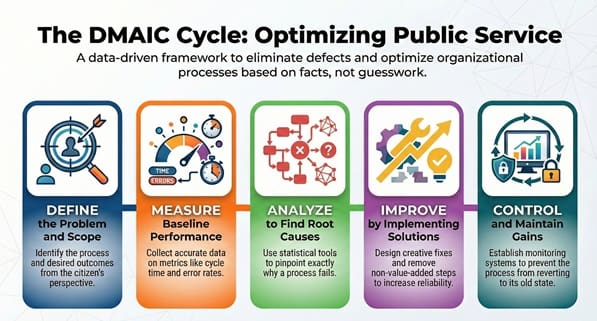
To achieve the impressive improvements that this methodology promises, you must follow a structured plan. The core of any Six Sigma improvement project is the DMAIC cycle. DMAIC is nothing but an acronym that stands for Define, Measure, Analyze, Improve, and Control. This cycle is a systematic process designed to optimize existing processes and remove the root causes of variation and defects.
Let us now discuss the five sequential steps of the DMAIC process:
- Define: First, your team must clearly define the problem, the process involved, and the desired outcome from the perspective of the citizen (the customer). This requires identifying the project scope and setting clear goals that align with the agency’s mission.
- Measure: Then, you must collect data from the existing process to establish a baseline performance level. This step involves measuring key metrics like cycle time, error rate, and DPMO. Accurate data collection ensures your efforts focus on the areas that need the most attention.
- Analyze: Next, your team analyzes the collected data to determine the root causes of the defects or delays. This means using statistical tools to test hypotheses and pinpoint exactly why the process fails to meet the citizen’s needs. Due to this detailed analysis, you move past guesswork and focus on facts.
- Improve: Subsequently, the team designs and implements solutions aimed at removing the identified root causes. This step requires creative problem-solving and often involves integrating Lean principles to strip away non-value-added steps, thereby making the process faster and more reliable.
- Control: Finally, the team establishes checks and balances to ensure the improvements are maintained over time. This involves creating updated standard operating procedures and implementing monitoring systems that help in preventing the process from reverting to its old, flawed state. Six Sigma ensures the gains stay locked in.
Significant Six Sigma Benefits for the Public Sector
The strategic adoption of this methodology delivers significant advantages that directly benefit taxpayers and improve the operational health of your agency. Six Sigma benefits for the public sector go far beyond simple cost-cutting; they fundamentally change how public services are delivered.
Drastically Reducing Costs and Waste (Lean Principles)
Six Sigma focuses on eliminating non-value-added activities, which often manifest as waste in public administration. This means targeting common forms of waste (known as ‘Muda’) like excessive waiting times for documents, over-processing forms, and bureaucratic steps that do not serve the citizen. Due to the focus on efficiency, significant budget relief results.
Six Sigma benefits for the public sector translate directly to the optimal use of public funds. When your team maps a process, they can identify and remove steps that add cost but no value. For example, consolidating forms or automating a manual review process reduces labor hours and printing costs. This systematic approach ensures that your agency spends taxpayer money wisely, which is a key mandate of public accountability.
Boosting Service Quality and Citizen Satisfaction
The core purpose of any government body is service delivery. Six Sigma benefits for the public sector are most visible in the improvement of the citizen experience. A smooth, error-free interaction builds trust and increases confidence in government operations.
Six Sigma ensures that essential services—such as processing tax refunds, issuing driver’s licenses, or handling public inquiries—are delivered correctly the first time. By reducing the defect rate in these transactions, you minimize the need for citizens to contact the agency multiple times, thereby reducing their frustration.
The methodology provides a comprehensive framework to measure citizen satisfaction (Voice of the Customer) and adjust processes accordingly, resulting in consistently positive public outcomes.
Also Read: Profitability Index
Improving Regulatory Compliance and Process Predictability
Government agencies often operate under a complex web of laws, regulations, and departmental rules. Failure to comply leads to fines, legal exposure, and damage to the public trust. Six Sigma helps in managing this complexity.
Six Sigma benefits for the public sector ensure all regulatory requirements are built directly into the process design. When you implement the Control phase of DMAIC, you standardize the workflow, leaving no room for subjective interpretation or shortcuts.
This standardized process makes audits easier and guarantees that every transaction meets legal mandates. Furthermore, the reduction in process variation ensures that the output is highly predictable, making it simpler for your leadership team to plan and allocate resources effectively.
Creating a Data-Driven Culture and Better Decisions
In many public organizations, decisions rely on historical practices or individual experience. This often leads to inconsistent results. Six Sigma changes this by making data the fundamental driver for all process changes.
Six Sigma applies statistical analysis to pinpoint the exact factors affecting a process. This means your leaders can move away from making decisions based on opinion and move toward making decisions based on verified facts.
By promoting a culture where process metrics are constantly tracked and analyzed, you allow your organization to proactively fix problems before they become major public issues. This shift to a data-driven mindset is a vital component of successful Six Sigma benefits for the public sector.
Enhancing Employee Morale and Operational Efficiency
When government processes are convoluted and prone to error, employees become frustrated. They spend valuable time fixing mistakes, navigating unnecessary bureaucracy, and dealing with angry citizens. Six Sigma improves the work environment.
Six Sigma benefits for the public sector often mean a clearer, less stressful workday for your team. By streamlining inefficient workflows, the methodology removes common sources of workplace friction. Employees, trained in Lean Six Sigma principles, feel empowered to identify and solve problems themselves. This participation in process improvement leads to greater job satisfaction and a highly effective workforce focused on serving the public mission.
Addressing the Challenges of Implementing Six Sigma in Government
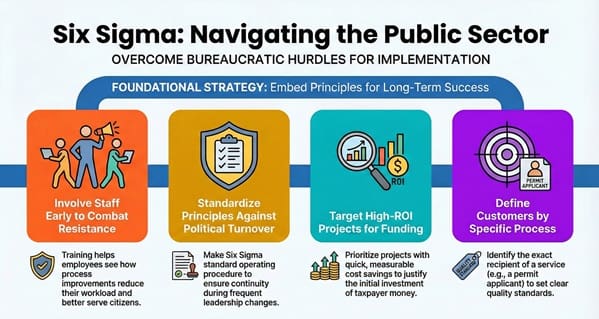
Implementing a new methodology in a large, established bureaucracy presents unique obstacles. However, applying Six Sigma is still achievable when you keep these common public sector challenges in mind.
Six Sigma was initially developed for manufacturing, which has led some government leaders to view its tools as overly complicated or unsuitable for service-oriented work. Overcoming this skepticism requires clear communication about how the tools are adapted to administrative and information processes. We must remember that process is process, whether it involves a widget or a welfare application.
The following are some common hurdles and solutions for your agency:
- Resistance to Change: Public sector employees often handle sensitive data and regulations and may resist changes to established, though inefficient, routines. A solution is proper training and involving staff early, ensuring that they understand the benefits for the citizen and for their own workload.
- Political Cycles and Leadership Turnover: Frequent changes in political leadership can disrupt long-term improvement projects. A solution is to embed Six Sigma principles into the organization’s foundational strategic plan, making them standard operating procedure rather than a short-term initiative.
- Funding Constraints: Dedicated budgets for training and projects can be hard to secure. The solution here is to emphasize that Six Sigma benefits for the public sector deliver quick, measurable cost savings that justify the initial investment. Focus on projects that offer the highest return on investment (ROI) in terms of taxpayer money saved.
- Defining the “Customer” and “Defect”: Unlike the private sector, the government’s customer definition is broad (citizen, stakeholder, taxpayer). The solution is to clearly define the specific “customer” for each process (e.g., the permit applicant) and use their defined requirements to set the defect standard.
Also Read: Six Sigma Certification Cost
Frequently Asked Questions about Six Sigma Benefits for Public Sector
In order to clarify the application of this essential methodology, let us answer some common questions you may have.
What is the main goal of Six Sigma in a government setting?
The main goal of Six Sigma in a government setting is not profit; it is to maximize the value delivered to the citizen using the available public resources. This means achieving high process accuracy and speed while eliminating waste. The purpose is to create reliable, predictable, and fair processes for all members of the public.
Does Six Sigma work for small public agencies?
Yes, absolutely. The principles and tools of Six Sigma are completely scalable. While a large federal agency might tackle a massive project, a small municipal office can use the exact same DMAIC structure to improve processes like managing utility billing or handling public records requests. The methodology’s focus on structured problem-solving works regardless of the size of your organization.
What kind of problems can Six Sigma solve for your department?
Six Sigma is highly effective at solving problems where the outcome is inconsistent or takes too long. Examples include:
- Reducing the time it takes to approve a small business license.
- Lowering the error rate on data entry for social service benefits.
- Eliminating backlogs in judicial paperwork processing.
- Standardizing inspection protocols to ensure fairness and compliance.
How is Lean Six Sigma different from just Six Sigma in government work?
Lean Six Sigma is an integrated approach. The “Lean” component focuses on speed and removing waste (non-value-added steps) from the process flow. The “Six Sigma” component focuses on quality and reducing variation (defects). For the public sector, the two are essential partners.
Lean removes the unnecessary bureaucracy, and Six Sigma ensures the remaining, crucial steps are completed without error. Together, they provide comprehensive Six Sigma benefits for the public sector.
Key Takeaways
So, with the above discussion, you should have a clear understanding of the methodology’s power in your field. Here are the essential points to keep in mind:
- Six Sigma provides the necessary structure to eliminate defects in government services, leading to 3.4 defects per million opportunities.
- The primary benefit is the optimal use of taxpayer funds through a drastic reduction in waste and unnecessary process steps (Lean principles).
- Six Sigma benefits for the public sector enhance citizen satisfaction by ensuring services are delivered accurately and on time.
- The DMAIC cycle offers a step-by-step roadmap for solving chronic performance issues within any public agency.
- Implementing Six Sigma creates a vital data-driven culture, replacing decisions based on tradition with decisions based on hard evidence.
Final Words
The demand for government efficiency and accountability will only increase in the coming years. You, the public service professional, hold the vital role of ensuring your agency meets this challenge with confidence and precision.
Six Sigma is more than just a tool; it is a commitment to continuous improvement and high-quality governance. By adopting this proven methodology, you guarantee that every taxpayer dollar is respected, every process serves the citizen with integrity, and your team operates at peak efficiency.
We firmly believe that the most successful government is the one that relentlessly focuses on maximizing service value for its community. Embrace these principles, and you will not only save millions in costs but also strengthen the public trust that defines your mission.
Contact us today for Six Sigma Certifications.

About Six Sigma Development Solutions, Inc.
Six Sigma Development Solutions, Inc. offers onsite, public, and virtual Lean Six Sigma certification training. We are an Accredited Training Organization by the IASSC (International Association of Six Sigma Certification). We offer Lean Six Sigma Green Belt, Black Belt, and Yellow Belt, as well as LEAN certifications.
Book a Call and Let us know how we can help meet your training needs.