

Abbott applies Six Sigma differently than most companies: as a direct quality metric for its diagnostic instruments and assays, not only as an internal process improvement program. Abbott reports that 86% of its clinical chemistry assays achieve Six Sigma quality, which the company states gives it the highest proportion of Six Sigma assays in the industry.
This Sigma metric framework comes from the Westgard Sigma Rules methodology widely used in clinical laboratory quality control. In a documented customer case study, a diagnostic lab using Abbott’s total laboratory solution reached 90% of assays at 5 Sigma or higher, while cutting quality control rejections, saving hundreds of staff hours annually, and reducing instrument downtime.
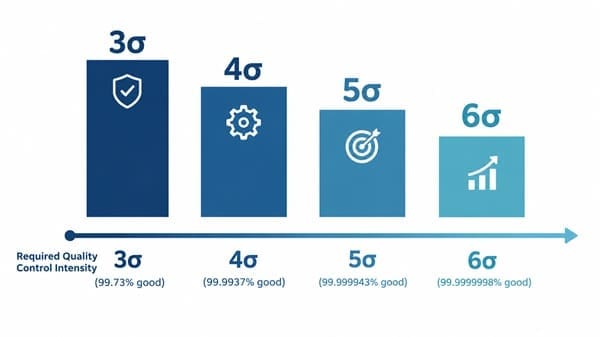
Quick-Reference Table: Abbott’s Six Sigma Approach
| Element | What It Means |
| Sigma metric | A statistical score measuring how far an assay’s results sit from acceptable error limits |
| Six Sigma quality (assay) | An assay performing with extremely low error, requiring minimal quality control checks |
| 86% figure | Share of Abbott’s clinical chemistry assays Abbott reports achieving Six Sigma quality |
| Verified customer result | 90% of assays at 5 Sigma or higher, reported in Abbott’s Medic-Lab case study |
Table of contents
Why Abbott’s Six Sigma Story Is Different?
Most Six Sigma case studies describe a company using DMAIC to fix an internal process, like a warehouse or a billing cycle. Abbott’s application sits closer to the original statistical roots of Six Sigma, using it as a direct quality score for a physical product category: diagnostic assays run on laboratory instruments.
Abbott’s own materials describe Six Sigma metrics as a way to objectively and quantitatively assess the performance of an assay or instrument. This approach lets a laboratory score each test on a defined scale, rather than relying on a general sense that results “look accurate enough.”
This matters because of a known pattern in clinical laboratory science. The amount of quality control testing a lab needs to run scales directly with how far below Six Sigma an assay performs, a relationship clinical chemistry expert James Westgard explains in Abbott’s own Healthcare Catalyst publication: a lab running near Six Sigma needs far less QC checking than one running near Three Sigma, since a process that far from target requires constant control testing just to catch likely errors.
Why the Cost of a Missed Error Matters More Than QC Cost
Westgard also frames the real financial stakes behind this metric. The most expensive outcome in a lab is not the cost of running quality control. It is an external failure, a wrong result that reaches a patient and leads to a misdiagnosis or incorrect treatment. Every dollar a lab spends on internal QC exists specifically to prevent that single, far more costly outcome.
This framing explains why Abbott builds Sigma metrics directly into its instrument design, rather than treating Six Sigma as a separate improvement initiative layered on top of existing equipment. Abbott states its instruments and their technologies are designed with Sigma metrics in mind from the start, aiming to improve efficiency, productivity, and patient flow as a built-in feature.

Public, Onsite, Virtual, and Online Six Sigma Certification Training!
- We are accredited by the IASSC.
- Live Public Training at 52 Sites.
- Live Virtual Training.
- Onsite Training (at your organization).
- Interactive Online (self-paced) training,
A Verified Customer Case Study: Medic-Lab
Abbott published a detailed case study showing this Sigma metric approach applied at a real diagnostic lab, Medic-Lab in Vietnam. The lab adopted Abbott’s total laboratory solution, including the Alinity ci-series analyzers and Alinity PRO informatics software, aiming to improve efficiency, turnaround time, and cost control while maintaining its market position.
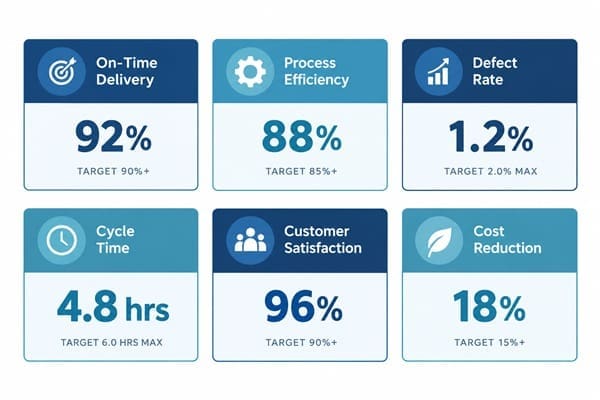
The documented results were specific and measurable.
| Result | Reported Figure |
| Assays achieving 5 Sigma or higher | 90% |
| Increase in testing capacity | 10% |
| Reduction in lab space used | 40% |
| Improvement in tests per square meter | 81% |
| Manual steps eliminated, hours saved annually | 645 hours |
| Added analyzer uptime | 133+ hours |
Two specific mechanisms explain how Medic-Lab reached these numbers. First, achieving a higher Sigma metric on 90% of assays directly reduced quality control rejections and material use, since fewer out-of-range results meant fewer repeat tests and less wasted reagent. Second, Abbott’s load-on-the-fly instrument capability removed manual steps from the workflow, which is where most of the 645 annual hours in savings came from.
This case study shows the two halves of Abbott’s Six Sigma approach working together. The Sigma metric improvement (fewer errors per assay) and the workflow automation improvement (fewer manual touchpoints) reinforced each other, rather than operating as separate initiatives.
Also Read: Six Sigma in Clinical Nursing Workflows: Reducing Medical Errors
Turnaround Time: The Christus Health Data Point
Abbott also reports a workflow analysis conducted at Christus Health, a global healthcare system, showing a 17% decrease in turnaround time tied to Abbott’s clinical chemistry solution. While this data point is narrower than the full Medic-Lab case study, it reinforces the same underlying pattern: a higher Sigma metric assay reduces the rework and repeat-testing cycles that otherwise slow down how quickly a lab can report results back to a physician.
Turnaround time matters clinically, not just operationally. A faster, more reliable result reaches a treating physician sooner, which connects this quality metric directly back to patient care rather than only to lab efficiency.
How the Sigma Metric Actually Works?
Understanding the actual calculation makes Abbott’s claims verifiable rather than abstract. The Sigma metric used in clinical laboratories, developed through Westgard’s quality control framework, is calculated using three inputs specific to each assay: the total allowable error for that test, the assay’s measured bias, and its coefficient of variation.
A higher Sigma score means an assay has more room between its typical performance and its allowable error limit. An assay scoring at Six Sigma has enough of that margin that errors needing correction become statistically rare. An assay scoring at Three Sigma or lower sits close enough to its error limit that the lab must run frequent quality control checks just to catch problems before they reach a patient report.
This is why Abbott markets the 86% Six Sigma assay figure as a specific competitive claim, not a vague marketing phrase. It is a calculable, auditable statistic tied to a recognized clinical laboratory quality standard, which a lab can independently verify against its own assay performance data.
Also Read: Design Review: Types, Process, and DFSS Tollgate Connection
Lessons for Other Organizations
Abbott’s approach offers a different kind of lesson than a typical internal-process Six Sigma story.
- Six Sigma can function as a product quality specification, not only an internal improvement project. Abbott builds the Sigma metric into how it designs and markets its diagnostic instruments, rather than applying Six Sigma only after a product already exists.
- A single metric can unify two different improvement goals. Medic-Lab’s results show quality improvement (fewer QC rejections) and efficiency improvement (fewer manual steps, less space) working from the same underlying Sigma metric foundation.
- Tie a quality metric to a real financial and safety stakes argument. Westgard’s framing, that QC cost exists specifically to prevent the far larger cost of a misdiagnosed patient, gives the Sigma metric concept a business case that extends beyond pure process efficiency.
- Publish verifiable, specific case study numbers. Abbott’s Medic-Lab figures, like 90% of assays at 5 Sigma and 645 hours saved annually, are precise enough that a prospective customer can sanity-check them against their own operation, which builds more credibility than a general improvement claim.
Frequently Asked Questions on Abbott’s Six Sigma case study
How does Abbott use Six Sigma in its business?
Abbott applies Six Sigma primarily as a quality metric for diagnostic assay and instrument performance, built directly into its product design, rather than using it only as an internal process improvement framework.
What percentage of Abbott’s assays achieve Six Sigma quality?
Abbott reports that 86% of its clinical chemistry assays achieve Six Sigma quality, which the company states represents the highest proportion of Six Sigma assays in the industry.
What real customer results has Abbott published using this approach?
In a documented case study, Medic-Lab in Vietnam reached 90% of assays at 5 Sigma or higher using Abbott’s total laboratory solution, while increasing testing capacity by 10%, reducing lab space by 40%, and saving 645 staff hours annually through workflow automation.
What is a Sigma metric in a clinical laboratory?
A Sigma metric is a statistical score, calculated from an assay’s allowable error, bias, and coefficient of variation, that measures how much margin an assay has before it risks producing an out-of-range result requiring correction.
Why does a higher Sigma metric reduce quality control costs?
A higher Sigma metric means an assay performs with a wide margin before reaching its error limit, so a lab needs far fewer quality control checks to catch problems, compared to an assay running closer to Three Sigma that requires frequent control testing.
Final Words
Abbott’s Six Sigma case study stands apart from a typical operational improvement story because it ties the methodology directly to a measurable product quality standard: the Sigma metric score of a diagnostic assay.
The Medic-Lab case study shows this approach producing real, auditable results, 90% of assays at 5 Sigma or higher, alongside concrete efficiency gains in space, staff hours, and uptime. For any organization in a quality-sensitive industry, Abbott’s model offers a specific lesson: a single, well-defined statistical metric can anchor both a quality improvement story and an efficiency improvement story at the same time, rather than treating them as separate initiatives.
Build Your Own Six Sigma Quality Framework with SSDSI
Abbott’s results show what happens when Six Sigma becomes a measurable, auditable standard rather than a vague improvement goal. SSDSI delivers IASSC-accredited Yellow Belt, Green Belt, and Black Belt training through onsite, live virtual, public, and self-paced formats, teaching the statistical foundation behind metrics like these.
SSDSI has certified 5,322+ professionals across 600+ organizations in 52 cities, backed by a 5-star Google review rating. If your organization wants to build a real, measurable quality standard into its own processes, a conversation about the right certification path is a solid next step.
About Six Sigma Development Solutions, Inc.
Six Sigma Development Solutions, Inc. offers onsite, public, and virtual Lean Six Sigma certification training. We are an Accredited Training Organization by the IASSC (International Association of Six Sigma Certification). We offer Lean Six Sigma Green Belt, Black Belt, and Yellow Belt, as well as LEAN certifications.
Book a Call and Let us know how we can help meet your training needs.


