
Six Sigma tools for the automobile industry offer a proven way to sharpen your manufacturing processes and slash costly errors. Have you ever wondered why some car brands consistently top reliability charts while others struggle with recalls? It usually comes down to how they handle data. In an industry where a single loose bolt can lead to a massive safety risk, precision isn’t just a goal; it’s a requirement.
To be honest, we’ve all seen how much waste can creep into a factory floor. Whether it’s extra movement, scrap metal, or time lost to machine downtime, these leaks drain your profits. That is where Six Sigma (6σ) steps in to save the day. It’s a data-driven method that helps you find flaws and fix them for good.
But which tools should you actually use? While there are dozens of options, four specific ones stand out for car makers. These tools help you understand what your customers want and ensure every car that rolls off the line is top-notch.
Table of contents
Why Use Six Sigma in the Automotive World?
Before we jump into the specific tools, let’s talk about the “why.” The automotive sector is fast-paced and high-stakes. Customers expect vehicles that are safe, efficient, and smart. At the same time, companies must keep costs low to stay competitive.
In my experience, the magic of 6σ is that it takes the guesswork out of the equation. Instead of saying, “I think we have a problem in the assembly line,” you can say, “The data shows a 5% variance in torque application.” This clarity lets you fix the right problem the first time.

Public, Onsite, Virtual, and Online Six Sigma Certification Training!
- We are accredited by the IASSC.
- Live Public Training at 52 Sites.
- Live Virtual Training.
- Onsite Training (at your organization).
- Interactive Online (self-paced) training,
Six Sigma Tools for The Automobile Industry
1. Failure Modes and Effects Analysis (FMEA)
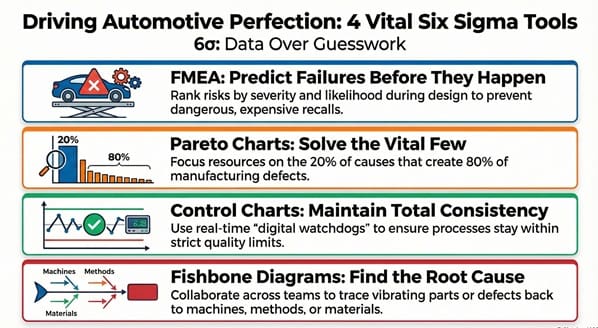
The first of our Six Sigma tools for the automobile industry is FMEA. Think of this as a “what if” tool for engineers. It’s a structured way to look at a product or process and figure out where it might fail before it actually does.
When we use FMEA, we rank potential failures based on three things:
- How likely is it to happen?
- How hard is it to detect?
- How severe is the impact?
In the car world, we use this during the design phase. For instance, what if a brake sensor fails? We assign a score and prioritize the most dangerous risks. By catching these issues early, we prevent expensive recalls later. Isn’t it better to fix a drawing than a thousand cars already on the road?
Also Read: 10 Proven Waste Reduction Strategies for a Greener Tomorrow
2. Pareto Charts: The 80/20 Rule
Have you heard of the Pareto principle? It says that 80% of your problems usually come from 20% of the causes. A Pareto chart is a bar graph that helps you visualize this. It ranks issues from the most frequent to the least.
When you’re looking at Six Sigma tools for the automobile industry, this one is great for focus. Imagine a car plant where doors aren’t fitting right, paint is peeling, and the radio doesn’t work. You can’t fix everything at once. A Pareto chart might show that 85% of your defects are actually just paint issues.
That said, once you know where to look, you can put your best people on that specific problem. It prevents you from spreading your resources too thin.
3. Control Charts
Maintaining consistency is the name of the game in car manufacturing. Control charts are one of the most vital Six Sigma tools for the automobile industry because they track process performance over time.
A control chart has a center line (the average) and upper and lower limits. As long as your data points stay between those lines, your process is “in control.” If a point jumps out, you know something went wrong—maybe a tool wore out or a new batch of steel was poor quality.
We use these charts to monitor things like engine temperature during testing or the thickness of a car’s frame. It’s like having a digital watchdog that barks the moment things start to drift. This constant monitoring helps we maintain that “perfect” 3.4 defects per million opportunities.
4. Cause-and-Effect (Fishbone) Diagrams
Sometimes called the Ishikawa diagram, the fishbone tool helps teams brainstorm root causes. When a car comes off the line with a vibrating steering wheel, you need to know why. Is it the machine? The material? The method? Or the people?
You draw a line (the spine) and add “bones” for different categories. This helps the team think beyond the obvious. In my view, this is one of the best tools for collaboration because it gets everyone from the floor workers to the engineers talking.
Once you map out the potential causes, you can use the “5 Whys” to dig deeper. Why is the wheel vibrating? Because the alignment is off. Why is the alignment off? Because the robot isn’t calibrated. Why isn’t it calibrated? You get the idea.
Also Read: What is a Lean Management System?
Real-World Success: The Case of Toyota and Ford
Many people think 6σ is just for math nerds, but the results are very real. Take Ford, for example. In the early 2000s, they used these methods to improve their customer satisfaction scores significantly. They didn’t just guess what people wanted; they used data to prove it.
Toyota is another great example. While they are famous for “Lean” manufacturing, they use 6σ tools to reduce variation. By combining the speed of Lean with the precision of 6σ, they created a powerhouse system. We’ve all seen the results—Toyota’s reputation for reliability is legendary for a reason.
Implementing These Tools in Your Plant
If you’re looking to start, don’t try to use every tool at once. Start with the “Define” phase of the DMAIC (Define, Measure, Analyze, Improve, Control) cycle. What is the one thing costing you the most money right now?
Here is the thing: 6σ isn’t a one-time project. It’s a culture. You’ll need to train your staff (Yellow Belts, Green Belts, etc.) so they speak the same language. When everyone is looking at the same data, the path to improvement becomes much clearer.
Key Takeaways on Six Sigma Tools for The Automobile Industry
- FMEA helps you find and prevent failures before they happen.
- Pareto Charts show you which 20% of problems are causing 80% of your headaches.
- Control Charts act as a watchdog to keep your processes consistent over time.
- Fishbone Diagrams help your team find the root cause of a problem, not just the symptom.
- Data over Guesswork: Always trust the numbers over your gut feeling in the factory.
Frequently Asked Questions About Six Sigma Tools for The Automobile Industry
What is the main goal of Six Sigma in cars?
The main goal is to reduce defects and variation. This makes cars safer, improves quality, and lowers the cost of manufacturing by reducing waste.
Do I need to be a math expert to use these?
No! While the math behind them is complex, most of these tools are visual. Modern software handles the heavy lifting, so you can focus on making decisions based on the results.
How does Six Sigma differ from Lean?
Roughly speaking, Lean is about speed and removing waste (like extra steps). Six Sigma is about quality and removing variation (making every part exactly the same). Most car companies use both together.
Is Six Sigma still relevant in 2026?
Absolutely. With the rise of Electric Vehicles (EVs) and self-driving tech, precision is more important than ever. A tiny software bug or a battery defect can be a huge issue, so these tools are essential.
Final Words
At Six Sigma US, we believe that quality shouldn’t be a mystery. Our team is dedicated to helping you turn complex data into actionable wins. We’ve spent years helping leaders in the automotive space find their path to “near-perfection.” Whether you’re a small parts supplier or a major manufacturer, your success is our priority. We’re not just here to teach; we’re here to partner with you on your journey to excellence.
Contact SSDSI today for expert training and consulting tailored to your plant’s needs.

About Six Sigma Development Solutions, Inc.
Six Sigma Development Solutions, Inc. offers onsite, public, and virtual Lean Six Sigma certification training. We are an Accredited Training Organization by the IASSC (International Association of Six Sigma Certification). We offer Lean Six Sigma Green Belt, Black Belt, and Yellow Belt, as well as LEAN certifications.
Book a Call and Let us know how we can help meet your training needs.