Ever feel like farming is just one big game of “wait and see”? You plant the seeds, apply the fertilizer, and cross your fingers that the weather behaves. But in 2026, we’re moving past the guesswork. Precision agriculture is changing the rules, and it’s doing so by borrowing a page from the world’s most efficient factories. Specifically, we’re talking about Six Sigma.
I’ve seen plenty of growers try every new gadget on the market only to end up with a pile of data they can’t use. It’s frustrating. That’s why we need a system. Imagine treating every acre not just as a piece of dirt, but as a high-precision production line. That is exactly what happens when you combine data-driven farming with a methodology designed to kill waste and boost quality.
Why Use Six Sigma in Precision Agriculture?
You might wonder why a manufacturing tool from the 1980s matters to a corn farmer today. Here’s the thing: farming is full of “defects.” A defect in your field isn’t a broken widget; it’s a patch of yellowing leaves, an underwatered corner, or a spot where you dumped too much nitrogen.
When we apply Precision Agriculture techniques, we use sensors and GPS to see these flaws. But Six Sigma (SS) gives us the “how-to” for fixing them permanently. It’s about reducing variation. If one part of your field yields 200 bushels and another yields 120, that variation is a problem we can solve.

Public, Onsite, Virtual, and Online Six Sigma Certification Training!
- We are accredited by the IASSC.
- Live Public Training at 52 Sites.
- Live Virtual Training.
- Onsite Training (at your organization).
- Interactive Online (self-paced) training,
The Cost of Doing Nothing
In my experience, most waste in farming is invisible until you look for it. We’re talking about:
- Over-application: Wasting expensive fertilizer where the soil is already rich.
- Under-performance: Missing out on potential profit because of a simple drainage issue.
- Fuel Waste: Running tractors over the same path twice because of poor mapping.
Also Read: Best Lean Six Sigma Training in Calgary
The DMAIC Framework for Higher Yields
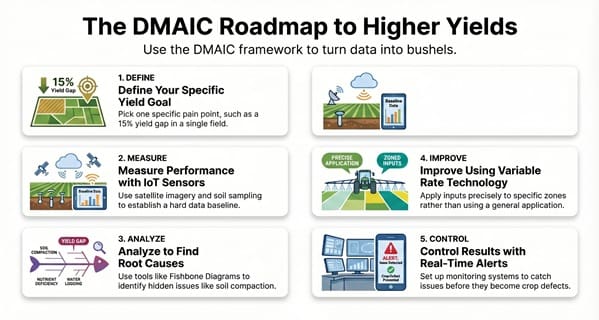
If you want to maximize crop yields, you need a roadmap. In the SS world, we use DMAIC. It stands for Define, Measure, Analyze, Improve, and Control. Let’s break down how this looks in the dirt.
Define Your Yield Goals
First, what are we trying to fix? Are we looking to increase overall bushels per acre, or are we trying to lower the cost of inputs? We’ve all been there—trying to fix everything at once and accomplishing nothing. Pick a specific “pain point” in your operation. Maybe it’s the 15% yield gap between your north and south fields.
Measure Your Current Performance
You can’t manage what you don’t measure. This is where Precision Agriculture shines. We use IoT sensors, satellite imagery, and soil sampling to get a baseline. We aren’t just guessing; we’re collecting hard numbers on soil pH, moisture levels, and nitrogen content. This is your “before” picture.
Analyze the Root Causes
Here is where it gets interesting. Why is that north field underperforming? Is it a pest issue? Is the soil compacted? We use tools like “Fishbone Diagrams” to dig into the root cause. To be honest, sometimes the answer is simpler than we think, like a leaky irrigation valve that’s been ignored for two seasons.
Improve the Process
Now we act. Using Variable Rate Technology (VRT), we can apply exactly what the crop needs—and nothing more. If the analysis showed a nitrogen deficiency in a specific zone, we program the sprayer to hit only that zone. This is the heart of Precision Agriculture—it’s about being “precise” rather than “general.”
Control for Long-Term Success
Don’t just walk away once the harvest is in. The “Control” phase ensures the problem doesn’t come back. We set up monitoring systems—like real-time moisture alerts—to catch issues before they become defects.
Reducing Waste with Lean Principles
While Six Sigma focuses on quality, “Lean” focuses on speed and waste. Together, they are a powerhouse. In farming, we often deal with “Motion Waste.” Think about how much time your team spends driving back and forth for tools or supplies.
By organizing the farm using the 5S system (Sort, Set in order, Shine, Standardize, Sustain), you’d be surprised how much “hidden” time you find. I once worked with a vineyard that saved roughly 10 hours a week just by moving their compost staging area closer to the actual rows. It sounds small, but over a season? That’s massive.
Common Agricultural “Defects”
- Seed Placement: Planting too deep or too shallow.
- Chemical Drift: Pesticides hitting the wrong area.
- Post-Harvest Loss: Grain rotting because of poor moisture control in the silo.
Also Read: Carbon Footprint
Real-World Success: Data Over Intuition
Picture this: A large-scale soybean operation in the Midwest noticed their profits were dipping despite record-high prices. They decided to stop relying on “gut feelings” and started a Six Sigma project.
By analyzing three years of yield maps, they found that they were over-applying lime in areas that didn’t need it. They switched to a high-precision grid sampling method. Fast-forward to the next harvest, and they reduced their chemical spend by 12% while increasing yield by 5%.
It wasn’t magic. It was just better math. Does your current strategy rely on data, or are you still doing what your grandfather did because “that’s how it’s done”?
Key Technologies Driving the Change
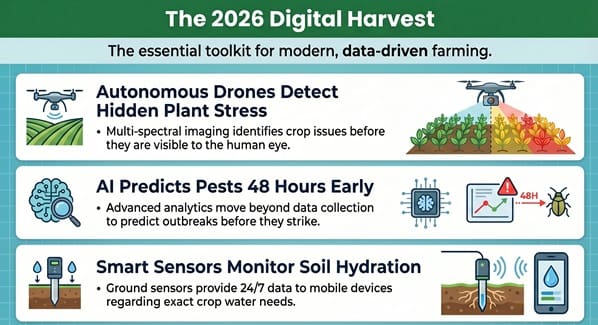
To make Precision Agriculture work with SS, you need the right tools in your shed. In 2026, these aren’t just luxuries; they’re standard equipment.
- Autonomous Drones: These “eyes in the sky” provide multi-spectral images that show plant stress before the human eye can see it.
- AI-Driven Analytics: We’re moving from just “seeing” data to “understanding” it. AI can predict a pest outbreak 48 hours before it hits.
- Smart Sensors: These live in the soil 24/7, feeding data to your phone about exactly when your corn is thirsty.
Frequently Asked Questions on Six Sigma in Precision Agriculture
Is Six Sigma too expensive for small farms?
Actually, no. While the tech for Precision Agriculture costs money, the “thinking” part of Six Sigma is free. Start small by measuring one variable, like fuel use or seed waste. You don’t need a million-dollar tractor to start thinking like a scientist.
How long does it take to see results?
You’ll often see “quick wins” in the first season, especially regarding waste reduction. However, the real “yield boom” usually happens in year two or three once you have enough data to spot long-term trends.
Do I need a “Black Belt” to do this?
You don’t need a formal certification to apply the logic. However, understanding the basic DMAIC steps will keep you from making expensive mistakes. Many modern agronomists are now getting trained in these methods to help their clients.
Key Takeaways on Six Sigma in Precision Agriculture
- Precision Agriculture provides the data; Six Sigma provides the strategy to act on it.
- The DMAIC process (Define, Measure, Analyze, Improve, Control) is a foolproof way to find and fix yield gaps.
- Reducing “defects”—like over-fertilizing or poor seed depth—is the fastest way to increase your bottom line.
- Lean principles help eliminate physical waste and “motion waste” on the farm.
- Data-driven decisions beat “intuition” every single time in modern farming.
Final Words
At the end of the day, your farm is a business. Whether you’re managing 50 acres or 5,000, the goal is the same: get the most out of every seed. By embracing Precision Agriculture and the disciplined approach of Six Sigma, you’re not just farming; you’re engineering a harvest.
We’ve all seen the industry change rapidly over the last decade. It can feel overwhelming, we’ve all been there. But we believe that by putting the right tools in the hands of hardworking people, there’s no limit to what we can grow. Our focus has always been on your success, because when your yield goes up, we all win. Let’s stop guessing and start growing with precision.

About Six Sigma Development Solutions, Inc.
Six Sigma Development Solutions, Inc. offers onsite, public, and virtual Lean Six Sigma certification training. We are an Accredited Training Organization by the IASSC (International Association of Six Sigma Certification). We offer Lean Six Sigma Green Belt, Black Belt, and Yellow Belt, as well as LEAN certifications.
Book a Call and Let us know how we can help meet your training needs.