Let us understand the power of Six Sigma. You know this process improvement methodology helps companies save millions. It targets defects and variation in any business process. The core idea is simple: Six Sigma focuses on making sure your work always stays within six standard deviations of the mean. This leads to near-perfect performance.
However, success with the Six Sigma methodology is not automatic. Many organizations try to implement this powerful system. They often find themselves hitting serious roadblocks. What are the common Six Sigma challenges that stop progress?
You want to know how to get the most from your investment. We will walk you through the most significant Six Sigma challenges you will face. More importantly, we show you clear ways to overcome them. This guide will help you prepare your team and your company for real, lasting change.
Table of contents
Comparing the Top Six Sigma Challenges
You need a clear picture of the main problems before you start. The various Six Sigma challenges fall into different groups. These challenges can relate to people, data, or the business itself. Knowing the source helps you plan a better solution.
| Basis for Comparison | Lack of Leadership Commitment | Resistance to Change | Poor Data Quality | Scope Creep |
| Nature of Challenge | Strategic/Cultural | Organizational/People | Technical/Analytical | Project Management |
| Primary Impact | Loss of project funding; Lack of organizational priority; Stalling of projects. | Low employee morale; Slow adoption of new processes; Return to old habits. | Wrong solutions selected; Misunderstanding the root cause; Inaccurate business decisions. | Failure to complete projects on time; Wasted resources; Loss of focus. |
| Solution Focus | Clear communication of vision; Connecting projects to business goals; Active leader participation. | Involving employees early; Clear communication of project benefits; Training and coaching. | Investing in better measurement systems; Standardizing data collection; Validating data accuracy. | Clear project charter; Strict change control process; Defining measurable boundaries. |
What Are the Common Six Sigma Challenges You Will Face?
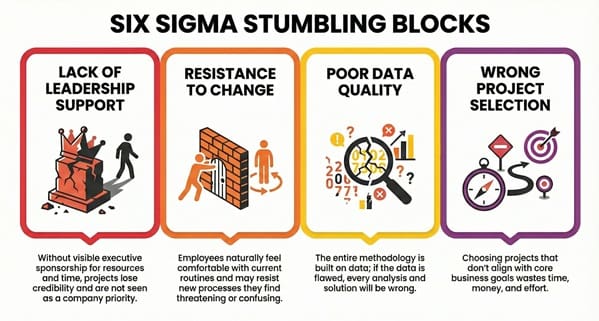
Six Sigma challenges come in many forms. These challenges often center on people and culture, not just the technical steps. Focusing on the people side of change plays a vital role in avoiding project failure.
Lack of Leadership Commitment
Lack of leadership commitment is one of the most critical Six Sigma challenges. The system is based on a top-down approach. If your leaders do not fully believe in and support the effort, your program will likely fail.
These challenges arise when leaders see Six Sigma as just another cost. They do not actively sponsor projects. Leadership commitment means giving resources, time, and visible support. Without this support, project managers lose credibility. Employees quickly realize the effort is not a company priority. This makes it difficult to drive change.
Six Sigma challenges demand that top executives champion the cause. This means that they participate in project reviews. They communicate successes across the entire organization. Their action helps guarantee that the Six Sigma methodology truly embeds itself into the company culture.
Resistance to Change and Team Issues
Resistance to change is a universal Six Sigma challenge. People feel comfortable with their current way of working. New processes often feel threatening or confusing. The Six Sigma methodology asks people to change their daily routines. This is because the projects fix problems caused by old, familiar ways.
When team members resist, they may slow down data collection. They might also express negativity about the project goal. The Six Sigma challenges here involve human emotions. Employees need to understand the benefit to them. They often ask, “Why should I change what I have been doing for years?”
Successfully managing this change requires a clear, empathetic communication plan. You must involve the people who do the work from the start. They need a voice in defining the new process. This helps in reducing fear and building ownership.

Public, Onsite, Virtual, and Online Six Sigma Certification Training!
- We are accredited by the IASSC.
- Live Public Training at 52 Sites.
- Live Virtual Training.
- Onsite Training (at your organization).
- Interactive Online (self-paced) training,
Insufficient Six Sigma Training and Expertise
Insufficient Six Sigma training is a significant roadblock. Six Sigma relies on a structured, technical approach. If team members lack the proper skills, they cannot execute the DMAIC process correctly.
You need Black Belts, Green Belts, and Yellow Belts with the right knowledge. These challenges appear when companies cut corners on training. A belt holder who only has a basic certificate may not know how to run a complex statistical analysis. For example, they might use the wrong tool for identifying a root cause.
Proper Six Sigma training ensures that your team applies the tools correctly. It is to be noted that a strong mentor or Master Black Belt plays a vital role in this area. They help in coaching the lower-level belts through difficult projects.
Poor Data Quality and Measurement Problems
Poor data quality presents a huge technical Six Sigma challenge. The entire Six Sigma methodology is based on facts and data. The DMAIC process starts with the Define and Measure phases. If your data is flawed, every analysis that follows will be wrong.
These challenges include:
- Data collection issues: The method for gathering the data is not stable or accurate.
- Inconsistent definitions: Different parts of the company define the same metric differently.
- Missing or incomplete data: The information needed for analysis simply does not exist.
Six Sigma challenges involving measurement require a focus on Measurement System Analysis (MSA). This means that you verify the data before you use it. In other words, you must trust the numbers. If you put bad data into the system, you will get a bad solution out.
Also See: Army Six Sigma Black Belt
Focusing on the Wrong Six Sigma Projects
Selecting the right projects is an essential Six Sigma challenge. Some companies choose projects that:
- Do not align with the overall business strategy.
- Are too small to provide a real return on investment (ROI).
- Are too large or complex for the available resources.
The Six Sigma methodology aims at problems that have a clear impact on the customer or the bottom line. Therefore, every project needs a sponsor, a clear financial target, and a defined scope.
Due to poor project selection, companies waste time and money. When you choose a project, always ask: “Will success on this project move our business goals forward?” If the answer is not a clear “yes,” select a different project.
Scope Creep and Project Delay
Scope creep is another common project management Six Sigma challenge. It refers to the tendency of a project’s goals to grow larger and larger after the work begins. A project team might discover an interesting related issue. They decide to add it to the original project goal.
The result of scope creep is almost always project delay. The team must work on more tasks than planned. The original timeline gets missed. This leads to frustration from the sponsor and a loss of confidence in the Six Sigma methodology.
To prevent this challenge, the project charter must be very clear. The charter defines the project’s boundaries, deliverables, and timeline. Any changes to the scope require a formal review and approval process. This helps in keeping the team focused on the original, agreed-upon goal.
Overcoming the Six Sigma Challenges: Strategies for Success
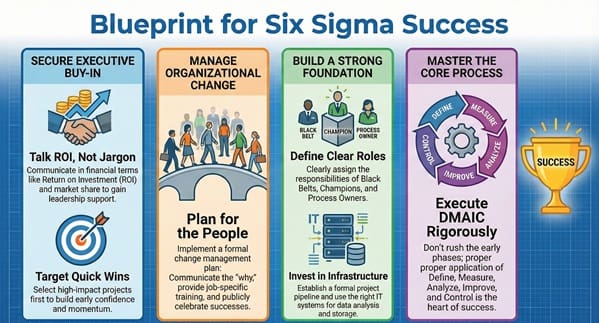
You can overcome these Six Sigma challenges. Success depends on a clear strategy that addresses both the technical and cultural issues. You must act decisively to build a strong foundation for process improvement.
Securing Executive Buy-in and Support
The key to solving the leadership Six Sigma challenge is clear value. You must show executives the financial return. With the aim of securing buy-in, you focuses on the money saved or the increase in customer satisfaction.
- Communicate in their language: Use terms like Return on Investment (ROI), net profit, and market share.
- Select high-impact projects first: Early, quick successes build confidence.
- Establish a clear governance structure: A Steering Committee of senior leaders determines project priorities and reviews progress.
Managing Organizational Change Effectively
Addressing the resistance to change Six Sigma challenge involves careful people management. You need a formal plan to manage the human side of the effort.
This process comprises of the following steps:
- Assess Readiness: Measure how ready the organization is for the change.
- Communicate: Clearly explain the “why” behind the change. In simple words, how does this new process benefit the individual employee?
- Train: Provide job-specific training for the new process, not just belt certification.
- Coach: Have leaders and mentors coach employees through the transition period.
- Reinforce: Publicly celebrate successes and reward new behaviors.
Also Read: SSDSI’s Strategies for Service Industry Lean Six Sigma Success
Building a Strong Six Sigma Infrastructure
You must have the right structure to support the program. This infrastructure comprises the people, roles, and systems needed for daily operation.
- Define Roles: Clearly assign the responsibilities of Black Belts, Champions, and Process Owners. This ensures that everyone knows their role in solving the Six Sigma challenges.
- Establish a Project Pipeline: A formal system for collecting, reviewing, and prioritizing new project ideas is essential.
- Invest in IT Systems: You require the right software for statistical analysis and data storage. This helps in minimizing the poor data quality challenge.
Ensuring Proper Application of the DMAIC Process
The DMAIC (Define, Measure, Analyze, Improve, Control) model is the heart of Six Sigma. Many Six Sigma challenges arise when teams rush through the early phases.
The following points help in proper execution:
- Define Phase: Focuses on creating a crystal-clear project charter. This controls the scope creep challenge.
- Measure Phase: Aims at proving the measurement system is accurate (MSA). This addresses the data quality challenge.
- Analyze Phase: Requires the team to use statistical tools to find the actual root cause.
- Improve Phase: Deals with testing and implementing the solution. It is to be noted that the solution must directly fix the root cause.
- Control Phase: Ensures the new process remains stable over time. Therefore, the team puts controls and monitoring plans in place.
Key Takeaways for Six Sigma Challenges
To succeed in process improvement, you must acknowledge and plan for Six Sigma challenges.
- Leadership is King: Without active executive support, your Six Sigma effort is based on weak foundations.
- People Drive Change: Resistance to change is a natural reaction. Effective communication and training facilitates adoption of the new process.
- Data is the Foundation: You must maintain accurate, reliable data. You cannot solve a problem you do not properly measure.
- Discipline Matters: Strict adherence to the DMAIC process and the project charter helps in preventing common Six Sigma project challenges like scope creep.
- Focus on Value: Always select projects that tie directly to the company’s financial or strategic goals. This ensures that the effort provides a clear return on investment (ROI).
Frequently Asked Questions About Six Sigma Challenges
Q. What is the biggest hurdle to Six Sigma success?
The single biggest Six Sigma challenge is usually the lack of organizational buy-in. This means that if leadership and employees do not fully support the effort, project success cannot happen. The technical steps are secondary to the cultural commitment.
Q. How can we reduce resistance to change in Six Sigma projects?
You can reduce resistance by involving employees in the project early. In other words, let them help measure the problem and define the solution. Furthermore, you must clearly communicate how the new process will make their job better or easier.
Q. What is the role of the Steering Committee in addressing Six Sigma challenges?
The Steering Committee, comprised of senior leaders, plays a crucial role. They determine which projects to fund and prioritize. They act as a barrier to scope creep. Also., they help in removing organizational roadblocks that the project team cannot fix on its own.
Q. What does “Six Sigma” actually mean?
Six Sigma refers to the goal of reducing process variation so that defects are statistically rare. This means that the process output falls within six standard deviations of the average. Simply put, this leads to $3.4$ defects per million opportunities.
Final Words
We have discussed the most common and difficult Six Sigma challenges you will face. We know that the Six Sigma methodology provides a powerful roadmap to achieving perfection. However, the journey is demanding. These challenges are not reasons to quit. They are areas where you must focus your strategy.
Your success depends on your ability to manage both the numbers and the people. Therefore, your investment in training and leadership commitment is essential for lasting process improvement. By facing these Six Sigma challenges head-on with a clear plan, your organization will achieve the efficiency and profitability that Six Sigma promises.
We believe in the power of your team to execute this change. Do you need help in setting up a robust governance model or designing a custom training program to manage your specific Six Sigma challenges? We are ready to assist you in building a foundation for sustainable, high-impact process improvement.
Contact us today for Six Sigma Certifications.

About Six Sigma Development Solutions, Inc.
Six Sigma Development Solutions, Inc. offers onsite, public, and virtual Lean Six Sigma certification training. We are an Accredited Training Organization by the IASSC (International Association of Six Sigma Certification). We offer Lean Six Sigma Green Belt, Black Belt, and Yellow Belt, as well as LEAN certifications.
Book a Call and Let us know how we can help meet your training needs.