
Have you ever wondered how top companies continuously improve their processes and save millions? The secret often lies in a powerful methodology: Lean Six Sigma (LSS). By using LSS, businesses systematically find and remove waste while reducing errors. This creates huge demand for skilled professionals. Lean Six Sigma careers offer you the chance to become a vital part of this success, solving real-world problems and significantly boosting your salary.
In this guide, we explore the specific roles, the necessary certifications, and how you can build a rewarding career in Lean Six Sigma. You will learn exactly how to move up the ranks, from a foundational role to a leadership position, and discover which path is the best fit for your skills.
Table of contents
What is Lean Six Sigma?
Before we dive into the career paths, we must understand the core concept. Lean Six Sigma is a dual-methodology approach. It brings together two powerful concepts: Lean and Six Sigma.
- Lean focuses on maximizing customer value by eliminating waste. Waste, in this context, refers to any step or action in a process that does not add value. Lean methodology helps speed up processes.
- Six Sigma focuses on improving process quality by reducing variation. This means ensuring a process consistently produces the same result, nearly defect-free. Six Sigma aims for near perfection.
When we combine them, Lean Six Sigma is nothing but a systematic, data-driven approach. It helps an organization run its processes faster, better, and with much lower error rates.
- Lean Six Sigma can be understood as a business improvement strategy. It uses statistical methods to minimize defects and a waste-reduction mindset to increase efficiency. This, in turn, boosts profit.
Now, the question arises: what skills do you need to begin one of these Lean Six Sigma jobs?

Public, Onsite, Virtual, and Online Six Sigma Certification Training!
- We are accredited by the IASSC.
- Live Public Training at 52 Sites.
- Live Virtual Training.
- Onsite Training (at your organization).
- Interactive Online (self-paced) training,
Core Skills for Lean Six Sigma Professionals
To succeed in a Lean Six Sigma career, you need both technical and soft skills.
- Analytical Skills: You must analyze data to determine the root cause of a problem. This involves using statistical tools and charts.
- Problem-Solving Skills: Lean Six Sigma professionals use the DMAIC (Define, Measure, Analyze, Improve, Control) method. This structured problem-solving technique ensures you fix the right problem correctly.
- Change Management: Since LSS projects always change how people work, you must communicate and manage resistance effectively. This is a crucial element.
- Team Leadership: Most projects require working with cross-functional teams. You must lead, motivate, and guide these teams towards the project goal.
Also Read: How Six Sigma Boosts Your Career Development and Growth?
The Hierarchy of Lean Six Sigma Careers
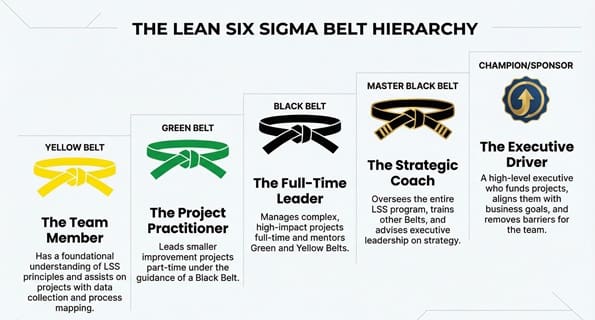
The structure of a Lean Six Sigma career is military-inspired. It uses a belt ranking system to show experience, expertise, and role within the organization. As you gain more knowledge and experience, you move up the belt rankings.
1. Yellow Belt: The Foundational Role in Lean Six Sigma
- What is the Yellow Belt? The Lean Six Sigma Yellow Belt serves as the introductory level. It provides a basic understanding of LSS principles and the DMAIC methodology.
- Role and Responsibilities: A Yellow Belt professional works as a key team member on small-scale projects. They often assist Green Belts and Black Belts. Their main role is data collection and process mapping.
- Focus Keyword Use: Lean Six Sigma Yellow Belt training gives you the fundamental vocabulary for quality improvement discussions.
- Example: In a manufacturing setting, a Yellow Belt might map the flow of raw materials. This helps the team identify potential bottlenecks.
2. Green Belt: The Core Practitioner of Lean Six Sigma
- What is the Green Belt? The Lean Six Sigma Green Belt is the core-level practitioner. This certification signifies a deep understanding of the methodology and statistical tools.
- Role and Responsibilities: A Green Belt typically leads smaller, less complex projects under the supervision of a Black Belt. The Green Belt executes the project, gathers data, performs analysis, and implements the solution. They spend part of their time (usually 25% to 50%) on LSS projects while maintaining their primary job role.
- Focus Keyword Use: A Green Belt certification validates your ability to manage and deliver substantial improvements.
- Example: A Green Belt in a customer service department might lead a project to reduce the average call handling time by 10%.
3. Black Belt: The Full-Time Project Leader in Lean Six Sigma
- What is the Black Belt? The Lean Six Sigma Black Belt is a full-time professional dedicated to LSS projects. This is the top technical and execution level.
- Role and Responsibilities: A Black Belt leads complex, high-impact, and strategic projects. They train and mentor Green Belts and Yellow Belts. The Black Belt ensures projects align with the organization’s strategic goals and deliver significant financial returns. They determine the correct statistical tools and drive the overall project success.
- Focus Keyword Use: A Lean Six Sigma Black Belt is generally recognized as a master of the DMAIC framework and statistical analysis.
- Example: A Black Belt might lead a company-wide initiative to reduce operational costs by $5 million over two years.
4. Master Black Belt (MBB): The Strategic Leader and Coach
- What is the Master Black Belt? The Lean Six Sigma Master Black Belt is the highest certification. It is the program manager and mentor role.
- Role and Responsibilities: An MBB does not usually run individual projects. Instead, they oversee the entire LSS program across the organization. They train, mentor, and certify Black Belts and Green Belts. The MBB ensures the correct selection and scoping of projects. They are the primary advisor to executives on LSS implementation and strategy.
- Focus Keyword Use: The Master Black Belt is vital for institutionalizing the Lean Six Sigma culture.
- Example: An MBB designs the internal training curriculum and advises the CEO on which business units need process improvement most.
5. Champion/Sponsor: The Executive Driver
- What is the Champion/Sponsor? The Champion or Sponsor is a high-level executive (often VP or Director). They select, fund, and support the LSS projects.
- Role and Responsibilities: The Champion removes* political and resource barriers for the project teams. They ensure the project goal is clear and aligned with the business strategy. This role is crucial for project success but is not a belt certification level.
- Focus Keyword Use: Lean Six Sigma cannot succeed without a committed executive Champion.
Comparison of Key Lean Six Sigma Roles
To understand the differences clearly, we will compare the core practitioner roles. This will help you decide the best path for your career in Lean Six Sigma.
| Basis for Comparison | Green Belt | Black Belt | Master Black Belt (MBB) |
| Primary Focus | Executes small to medium projects; supports Black Belt projects. | Leads complex, high-impact, strategic projects. | Trains, mentors, and manages the entire LSS program. |
| Time Commitment | Part-time (25%-50% on LSS) | Full-time (100% on LSS) | Full-time (100% on LSS) |
| Statistical Skills | Intermediate; focuses on basic and advanced statistical tools. | Expert; masters complex statistical analysis and software. | Expert; develops new methodologies and teaches advanced concepts. |
| Mentorship Role | None; is mentored by a Black Belt. | Mentors Green Belts and Yellow Belts. | Mentors and certifies Black Belts and Green Belts. |
| Project Scope | Departmental or functional, mid-level complexity. | Cross-functional, high complexity, major business impact. | Program level; focuses on strategic initiatives. |
| Required Experience | 3+ years of relevant work experience. | 5+ years of relevant work experience and prior Green Belt project success. | Extensive experience as a Black Belt (typically 5+ years). |
Specialized Lean Six Sigma Jobs
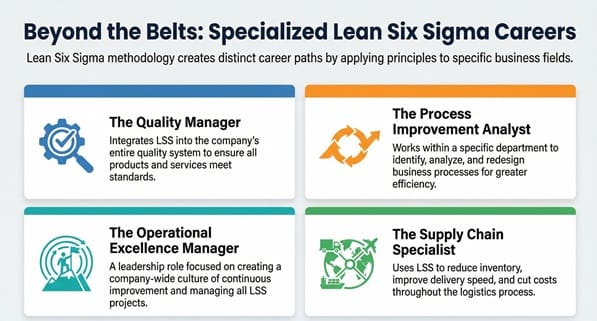
The LSS methodology is so versatile that it creates many specialized roles. These roles apply the principles to specific fields, offering unique career in Lean Six Sigma options.
1. Quality Manager/Director
- A Quality Manager in Lean Six Sigma is generally responsible for the organization’s entire quality system. This role ensures all products and services meet quality standards.
- Role: They integrate LSS into the company’s Quality Management System (QMS). The Quality Manager focuses on quality control and continuous improvement.
2. Process Improvement Analyst
- The Process Improvement Analyst is often a Green Belt or Black Belt who works within a specific department (e.g., IT, Finance, HR). This Lean Six Sigma job requires strong analytical skills.
- Role: They identify, analyze, and redesign existing business processes. They are often the primary user of process mapping tools. The Process Improvement Analyst targets quick wins and efficiency gains.
3. Operational Excellence Manager
- Operational Excellence Manager is a common title for a Black Belt or MBB. This role focuses on creating a culture of continuous improvement across the entire company.
- Role: The Manager oversees all improvement activities and manages the portfolio of LSS projects. This Lean Six Sigma leadership role requires executive communication skills.
4. Supply Chain and Logistics Specialist
- Lean Six Sigma is perfect for optimizing supply chains. A specialist in this area uses LSS to reduce inventory, improve delivery speed, and cut logistics costs.
- Focus Keyword Use: A career as a Lean Six Sigma Supply Chain Specialist leverages Lean principles to remove waste from the end-to-end flow of materials.
How Do You Start a Career in Lean Six Sigma?
Starting your journey is simpler than you might think. Let us understand the typical sequential pattern to enter this field.
1. Gain Awareness and Basic Training
- Action: Start with a Lean Six Sigma White Belt or Yellow Belt course.
- Purpose: This action provides you with foundational knowledge. It allows you to speak the language of LSS. Many organizations offer this training internally.
2. Get Certified as a Green Belt
- Action: Enroll in a recognized Lean Six Sigma Green Belt certification program.
- Purpose: The Green Belt training teaches you the DMAIC roadmap and the essential statistical tools. This certification requires you to pass an exam and often complete a live project. The Green Belt designation is the professional entry point for many Lean Six Sigma jobs.
3. Lead Projects to Become a Black Belt
- Action: Spend several years leading and successfully completing multiple, complex Green Belt projects. Then, pursue the Black Belt certification.
- Purpose: This step enables you to handle the most significant business challenges. The Black Belt level requires a deep, hands-on understanding of LSS execution and leadership.
4. Strategic Development to Master Black Belt
- Action: After significant time as a Black Belt, focus on program management, mentoring, and strategic contribution.
- Purpose: The Master Black Belt* aims at turning LSS from a project-based activity into a core business philosophy.
Also Read: Quality Engineer: Key Skills, Duties, and Career Insights
Which industries need Lean Six Sigma professionals the most?
- Manufacturing: The birthplace of Lean. It is constantly looking for LSS experts to reduce production defects and speed up assembly lines.
- Healthcare: Hospitals use Lean Six Sigma to improve patient flow, reduce wait times, and minimize medical errors.
- Financial Services: Banks and insurance companies* use LSS to streamline processes like loan approval, claims processing, and compliance.
- Information Technology (IT): IT uses Lean Six Sigma to improve software development processes (often combined with Agile) and enhance service delivery.
Frequently Asked Questions (FAQs) about Lean Six Sigma Jobs
What is the typical salary for a Lean Six Sigma Black Belt?
- The salary for a Lean Six Sigma Black Belt is generally very competitive. It depends on the industry and location. Typically, a Black Belt earns significantly more than a Green Belt due to the strategic impact of their work.
Do I need a specific degree to start a career in Lean Six Sigma?
- No specific degree is necessary. A degree in Engineering, Business, or Finance is common. However, the certifications (Yellow, Green, Black Belt) matter more than the degree itself. The ability to demonstrate successful project completion is the most vital aspect.
How long does it take to get certified as a Black Belt?
- The training itself usually takes around four weeks of intense classroom or online work. However, the certification process requires you to complete at least two full-scale projects. This may take anywhere from six months to over a year after your initial training.
Is Lean Six Sigma still relevant in the age of Artificial Intelligence (AI)?
- Yes, it is more relevant than ever. AI, with its ability to process massive data, provides LSS professionals with better “Analyze” tools. Lean Six Sigma provides the structured method (DMAIC) and human-led insights to decide what to improve. AI helps automate the “Measure” and “Analyze” steps effectively.
Key Takeaways for Your Career in Lean Six Sigma
Lean Six Sigma is not just a passing trend; it is a proven methodology for continuous improvement that high-performing organizations rely on.
- Structure: The LSS career path follows a clear belt hierarchy—Yellow, Green, Black, and Master Black Belt.
- Impact: Black Belts and Master Black Belts lead high-impact strategic initiatives. These professionals influence the company’s financial results directly.
- Versatility: The principles apply across every major industry—from banking to healthcare. The Lean Six Sigma skillset makes you highly marketable.
Take the Next Step in Your Lean Six Sigma Career
The demand for professionals who can solve complex problems and deliver measurable results continues to grow. A career in Lean Six Sigma offers stability, high earning potential, and the opportunity to become a key decision-maker in any company.
We encourage you to explore the available Green Belt training programs and find one that fits your learning style. Invest in your certification today and position yourself as a leader who delivers true, lasting value to the business. Take control of your future and begin your journey toward one of the most rewarding Lean Six Sigma jobs available.
Contact us today for Six Sigma Certifications.

About Six Sigma Development Solutions, Inc.
Six Sigma Development Solutions, Inc. offers onsite, public, and virtual Lean Six Sigma certification training. We are an Accredited Training Organization by the IASSC (International Association of Six Sigma Certification). We offer Lean Six Sigma Green Belt, Black Belt, and Yellow Belt, as well as LEAN certifications.
Book a Call and Let us know how we can help meet your training needs.