
Lockheed Martin’s Six Sigma program didn’t stay a factory-floor tool. In 1999, the company launched LM21, one combined system for Lean, Six Sigma, and CMMI. By 2004, then-CEO Vance Coffman confirmed LM21 had delivered more than $5 billion in savings. He also credited it with helping win the Joint Strike Fighter bid. Here’s exactly how that system works, and what Lockheed Martin trains its people to do.
Table of contents
Key Takeaways
- LM21 launched in 1999 as Lockheed Martin’s operating excellence program.
- The initiative delivered more than $5 billion in net savings by 2004.
- Six Sigma helped Lockheed Martin win the Joint Strike Fighter contract bid.
- Lockheed Martin trains employees as Black Belts, Green Belts, and Master Black Belts.
- The company layers 5S, Lean, Six Sigma, and DFSS into one improvement system.
How Lockheed Martin Built Its Six Sigma Program
Lockheed Martin started using Six Sigma and Lean in the late 1990s. Early efforts stayed scattered across small teams and sites. Leaders wanted one shared system instead.
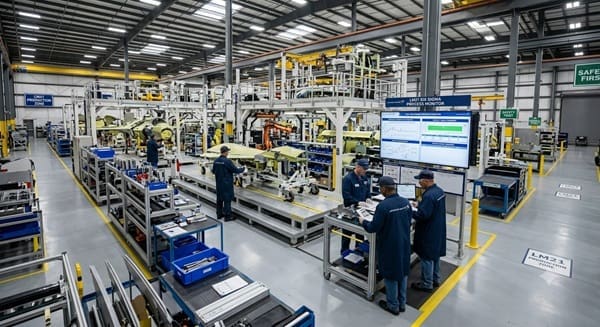
In 1999, the company launched LM21, short for Lockheed Martin in the 21st Century. LM21 became the company’s main vehicle for continuous improvement. It combined Lean manufacturing, Six Sigma, and CMMI practices into one framework.
Lockheed Martin’s 2003 announcement on its Support Center Practices certification confirms this structure. The company described LM21, Six Sigma, and CMMI as its core improvement vehicles. It said these tools helped benchmark performance against top industry standards.

Public, Onsite, Virtual, and Online Six Sigma Certification Training!
- We are accredited by the IASSC.
- Live Public Training at 52 Sites.
- Live Virtual Training.
- Onsite Training (at your organization).
- Interactive Online (self-paced) training,
Six Sigma Results: What Lockheed Martin Achieved
Results speak louder than methodology alone. Lockheed Martin’s own leadership shared specific outcomes publicly.
Former Chairman and CEO Vance Coffman described LM21’s financial impact in March 2004. He stated that LM21 had produced more than $5 billion in net savings. He called LM21 “a catalyst for facilitating improvements” across design and manufacturing.
Coffman also linked these savings to lower costs for customers. He said the gains created streamlined operations and reduced overhead. He noted the results included less rework and better quality.
Six Sigma also shaped Lockheed Martin’s biggest contract wins. Coffman credited LM21’s lean and Six Sigma work for the Joint Strike Fighter bid. He said these methods proved cost and cycle-time savings during development.
Importantly, Lockheed Martin did not limit Six Sigma to factories. The company applied Lean Six Sigma to purchasing, sales, and order processing. It extended the approach into human resources and product development too.
Also Read: Six Sigma at General Electric: A Case Study in Results
A Real Example: Six Sigma in Lockheed Martin’s Support Centers
Lockheed Martin’s own announcements show Six Sigma reaching support operations too. In February 2003, the company confirmed a certification win in Orlando, Florida. Its Commercial Enterprise Solutions Outsourcing Center earned Support Center Practices certification.
This certification required a detailed on-site audit process. Auditors measured performance against more than one hundred business elements. Lockheed Martin leadership tied this win directly to LM21 and Six Sigma.
Robert Lohfeld, then president of Commercial Enterprise Solutions, spoke about the achievement. He framed the certification as proof of continuous process improvement. He named LM21, Six Sigma, CMMI, and SCP as the tools behind it.
This example matters for one clear reason. Six Sigma at Lockheed Martin was never confined to jets or missiles. The same discipline shaped customer support and back-office operations too.
What Is Six Sigma?
Six Sigma is a data-driven method for reducing defects and variation. Teams use it to make processes more consistent and predictable. Lockheed Martin applies Six Sigma across manufacturing, purchasing, and administrative work.
The method relies on statistical tools and structured problem-solving steps. Certified practitioners, called belts, lead these improvement projects. Belt levels range from Yellow to Master Black Belt.
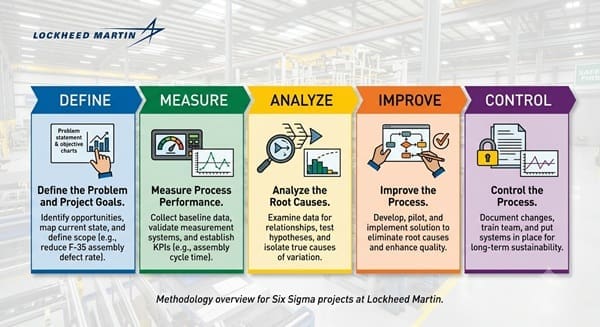
Most Six Sigma projects follow the DMAIC cycle. DMAIC stands for Define, Measure, Analyze, Improve, and Control. Teams define the problem, then measure current process performance.
Next, teams analyze root causes behind defects or delays. They test and implement improvements based on that analysis. Finally, they build controls to sustain the gains.
This structure gives large organizations a repeatable playbook. Lockheed Martin used this exact structure across very different departments. That consistency is part of why LM21 scaled so widely.
Inside Lockheed Martin’s Improvement Framework
Lockheed Martin structures its improvement work in five connected layers. Each layer builds capability for the next stage of maturity.
The framework starts with 5S plus Safety. This stage focuses on workplace structure, procedures, and visible abnormalities. Lockheed Martin’s training materials define 5S using five Japanese terms. These are Seiri, Seiton, Seiso, Seiketsu, and Shitsuke. The English equivalents are Sort, Set in Order, Shine, Standardize, and Sustain. Lockheed Martin adds a sixth step, Safety, to protect workers during changes.
The second layer is Kaizen, covering visual management and continuous improvement culture. Teams use Kaizen to build daily improvement habits.
Layer three is Lean, targeting stable processes and waste elimination. Lean tools help teams control flow and pull material efficiently.
Layer four is Six Sigma itself, focused on capability and reducing variation. Teams use statistical tools and in-process controls here. This is where formal DMAIC projects typically begin.
The final layer is Design for Six Sigma (DFSS). DFSS targets robustness before problems ever reach production. It uses Quality Function Deployment to build quality into new designs.
Lockheed Martin also tracks waste using the acronym TIMWOOD. This stands for Transportation, Inventory, Motion, Waiting, Over-processing, Over-production, and Defects. The “I” also covers Injury, tying safety directly into waste reduction. This framework connects shop-floor cleanliness to full Six Sigma capability.
Also Read: Six Sigma at 3M: A Verified Case Study in Corporate-Wide Implementation
How Lockheed Martin Trains Its Workforce
Lockheed Martin builds Six Sigma skill through structured belt training. Employees progress from basic awareness toward full project leadership.
Training materials walk teams through workplace organization first. Workers learn to sort, straighten, and standardize their work areas. This groundwork prepares teams for deeper statistical process work later.
Lockheed Martin also uses visual checklists to track progress. Teams rate their workspace across five maturity levels. This turns abstract quality goals into daily, measurable habits.
The company pairs this training with management reviews. Leaders track cleanliness, safety, and process discipline together. This keeps Six Sigma tied to daily operations, not just special projects.
Why Lockheed Martin’s Six Sigma Program Still Matters
Lockheed Martin’s experience shows Six Sigma works beyond the factory floor. It touches design, procurement, and even hiring processes. That range makes it a strong model for other large organizations.
The program also shows why training depth matters. Lockheed Martin invested heavily in Black Belts and Green Belts across its workforce. Structured belt training turned scattered improvement efforts into a company-wide system.
Organizations exploring Six Sigma can learn directly from this approach. Building one shared framework beats running disconnected pilot projects. Consistent training and clear metrics drive lasting results.
Three lessons stand out from Lockheed Martin’s journey. First, leadership must publicly back the program from the top. Coffman’s own statements show executive commitment mattered.
Second, Six Sigma needs a clear starting point. Lockheed Martin’s 5S plus Safety layer builds discipline before deeper statistical work begins. Skipping this foundation risks shallow, short-lived improvements.
Third, results must connect to real business outcomes. Lockheed Martin tied Six Sigma directly to cost savings and contract wins. That link kept the program funded and relevant for decades.
How Six Sigma Development Solutions Inc. Can Help Your Team
Lockheed Martin’s results took years of disciplined training and practice. Your organization can start building similar capability today.
Six Sigma Development Solutions Inc. offers onsite, live virtual, and online Six Sigma training. Our programs cover Yellow Belt through Master Black Belt certification. We help teams apply DMAIC, Lean, and DFSS to real business problems.
Ready to build your own Six Sigma success story? Explore our training options and get certified today.
Frequently Asked Questions on Lockheed Martin
Q: Does Lockheed Martin use Six Sigma?
A: Yes. Lockheed Martin uses Six Sigma through its LM21 program. LM21 has run since 1999 across the company.
Q: What is LM21 at Lockheed Martin?
A: LM21 stands for Lockheed Martin in the 21st Century. It is the company’s Lean Six Sigma operating system.
Q: How much money has Six Sigma saved Lockheed Martin?
A: Lockheed Martin reported more than $5 billion in net savings. This figure covers savings through March 2004 alone.
Q: What Six Sigma belts does Lockheed Martin use?
A: Lockheed Martin trains Yellow, Green, Black, and Master Black Belts. Belt holders lead structured improvement projects company-wide.
Q: Does Lockheed Martin only use Six Sigma in manufacturing?
A: No. Lockheed Martin applies Six Sigma to purchasing, sales, and HR. It also uses Six Sigma in product development.
Want to bring Lockheed Martin-level process discipline to your organization? Six Sigma Development Solutions offers onsite, live virtual, and online training for every belt level.
About Six Sigma Development Solutions, Inc.
Six Sigma Development Solutions, Inc. offers onsite, public, and virtual Lean Six Sigma certification training. We are an Accredited Training Organization by the IASSC (International Association of Six Sigma Certification). We offer Lean Six Sigma Green Belt, Black Belt, and Yellow Belt, as well as LEAN certifications.
Book a Call and Let us know how we can help meet your training needs.


