

Lean Six Sigma for AI model training is the secret to stopping the endless cycle of failed experiments and wasted budget. Have you ever felt like your machine learning projects are stuck in a loop of “train, fail, repeat” without a clear reason why?
It’s a common frustration. While most teams focus on fancy new architectures, the real bottleneck usually lies in the messy, unoptimized processes surrounding the data. What if the solution isn’t a better algorithm, but a better way to build your pipeline?
Table of contents
- The Process Engineering Reality of Machine Learning
- Identifying the Eight Wastes in AI Training
- The Categories of Waste in ML
- Applying DMAIC to AI Model Training Quality
- The DMAIC Breakdown for ML Teams
- Data Quality: The Primary Process Failure
- Fixing the Measurement System
- Reducing Variation in Experiment Reproducibility
- Locking Down the Variables
- Value Stream Mapping: Finding the Handoff Gaps
- Key Takeaways on Six Sigma for AI Model Training
- Frequently Asked Questions on Six Sigma for AI Model Training
- Final Words
- Related Articles
The Process Engineering Reality of Machine Learning
Training a machine learning (ML) model is more than a single scientific event. It is a sequence of repeatable steps: gathering data, cleaning it, engineering features, and running evaluations. Each step has a cost and a defect rate. To be honest, we often treat these steps like a laboratory experiment rather than a factory line. This is where we run into trouble.
When we view Lean Six Sigma for AI model training as a process engineering solution, everything changes. We stop guessing and start measuring. Did you know that roughly 87% of ML projects never reach production? That’s a staggering amount of waste. By treating your pipeline as a process, you can identify where the “garbage” enters the system before it costs you thousands in compute fees.
Why Your Pipeline is Leaking Value
In my experience, teams lose time because they lack a standard way of working. Poor labeling consistency or untracked experiments act like a slow leak in a pipe. You might not see the puddle immediately, but eventually, the whole system loses pressure.
- Data Preparation: Consumes 60-80% of project time.
- Production Gaps: Most models die in the lab, never seeing a real user.
- Retraining Costs: Uncontrolled cycles can triple or quintuple your expenses.

Public, Onsite, Virtual, and Online Six Sigma Certification Training!
- We are accredited by the IASSC.
- Live Public Training at 52 Sites.
- Live Virtual Training.
- Onsite Training (at your organization).
- Interactive Online (self-paced) training,
Identifying the Eight Wastes in AI Training
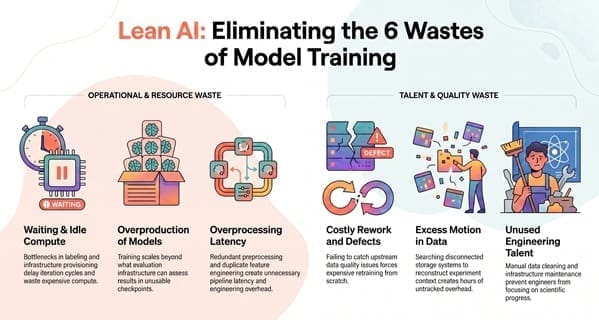
The Lean Six Sigma for AI model training methodology uses a specific lens to find inefficiency. In Lean, we look for “waste.” Picture this: an engineer spends four hours hunting for the specific dataset used in a run from three months ago. That is “Motion” waste, and it kills productivity.
The Categories of Waste in ML
- Waiting: Your team sits idle because the data labeling queue is backed up.
- Overproduction: You train ten versions of a model when the deployment team only needed one.
- Defects: You finish a three-day training run only to realize the data was corrupted at the start.
- Overprocessing: Adding five layers of validation when two would have done the job.
- Motion: Searching through messy folders and Slack messages to find experiment notes.
- Inventory: Letting raw data pile up without a plan to use it.
- Transportation: Moving massive datasets between cloud regions unnecessarily.
- Unused Talent: Asking your best PhD researchers to manually fix typos in a CSV file.
How many of these do you see in your current workflow? Identifying them is the first step toward a leaner operation.
Also Read: Six Sigma in Training: How to Perfect Skill Development & Coaching
Applying DMAIC to AI Model Training Quality
The Lean Six Sigma for AI model training approach relies on a five-step framework called DMAIC. It stands for Define, Measure, Analyze, Improve, and Control. We’ve all been there—trying to “fix” a model by changing the code without actually knowing what was broken. DMAIC stops that guesswork.
The DMAIC Breakdown for ML Teams
| Phase | What We Do in the AI Pipeline | The Result |
| Define | We pick one stage, like data labeling, and define what a “defect” looks like. | A clear Project Charter. |
| Measure | We count how often labels disagree or how much training results vary. | Baseline metrics (like Cohen’s Kappa). |
| Analyze | We use a “Fishbone” diagram to find why data keeps failing quality checks. | Root cause identification. |
| Improve | We build “poka-yoke” (error-proofing) gates to stop bad data. | A pilot of the new pipeline. |
| Control | We set up automated alerts to watch for “drift” in our process. | Long-term stability. |
Data Quality: The Primary Process Failure
When we look at why ML projects fail, Lean Six Sigma for AI model training reveals a clear winner: bad data. It’s the “garbage in, garbage out” rule. Most teams try to fix this by hiring more people to label data. But wait—is the problem the number of people, or the instructions they are following?
Fixing the Measurement System
In Six Sigma, we treat labeling as a “measurement system.” If two people look at the same image and give it different tags, your “ruler” is broken. We use a metric called Cohen’s Kappa to see how often they agree.
If your score is below 0.6, your training signal is noisy. Adding more data won’t help if the data is wrong! Instead of hiring more staff, try a “5-Why” analysis. Ask why they disagreed. Was the manual confusing? Was the image blurry? Fixing the root cause is much cheaper than scaling a broken process.
“In my view, most ‘AI problems’ are actually ‘data process’ problems in disguise.”
Also Read: Express Mail On-Time Delivery Case Study
Reducing Variation in Experiment Reproducibility
A core goal of Lean Six Sigma for AI model training is consistency. Have you ever had a “unicorn” run? That’s a training session that performs amazingly well, but you can’t seem to make it happen again. In the world of Six Sigma, that’s called “uncontrolled variation.”
Locking Down the Variables
To fix this, we need to treat training like a controlled experiment. This means:
- Version Everything: Not just code, but the exact data split.
- Seed Control: Always record your random seeds.
- Environment Sync: Use containers so the “lab” is the same every time.
By reducing this noise, you can finally tell if a model improvement is real or just a lucky roll of the dice. That’s how you build authority in your results.
Value Stream Mapping: Finding the Handoff Gaps
Lean Six Sigma for AI model training often uses a tool called Value Stream Mapping (VSM). This is just a fancy way of drawing a map of how data travels from “raw” to “deployed.”
When we do this, we usually find that the data spends 80% of its life just waiting. It waits for an engineer to be free. It waits for a server to start. Also, it waits for a manager to hit “approve.” By focusing on these gaps, you can speed up your shipping time without even touching the model code.
Key Takeaways on Six Sigma for AI Model Training
- Process over Science: Treat your pipeline like a factory, not just a lab.
- Stop the Waste: Use the eight wastes to find where you are losing money.
- Data Gates: Build “poka-yoke” checks to stop bad data early.
- Measure Agreement: Use Cohen’s Kappa to ensure your labels are reliable.
- Vanish the Wait: Focus on handoffs to speed up your development cycle.
Frequently Asked Questions on Six Sigma for AI Model Training
Does this work for Large Language Models (LLMs)?
Yes! Actually, it’s even more important there. Because LLMs cost so much to train, a single defect can cost millions. Lean methods help prevent those expensive restarts.
How is this different from MLOps?
MLOps gives you the tools (the “how”), but Lean Six Sigma gives you the strategy (the “why”). They work best when used together.
Is this too complex for a small startup?
Not at all. You don’t need a black belt. Just starting with a “5-Why” analysis on your last failed run can save you weeks of work.
Final Words
At the end of the day, Lean Six Sigma for AI model training isn’t about adding more paperwork. It’s about giving your team the freedom to do great science by removing the operational junk that gets in the way. We believe that a disciplined process is the fastest path to innovation.
We’re committed to helping our clients turn chaotic research into a reliable engine for growth. If you’re tired of “unexplained” failures and want a pipeline that delivers every time, it’s time to look at the process. Let’s build something that lasts.
About Six Sigma Development Solutions, Inc.
Six Sigma Development Solutions, Inc. offers onsite, public, and virtual Lean Six Sigma certification training. We are an Accredited Training Organization by the IASSC (International Association of Six Sigma Certification). We offer Lean Six Sigma Green Belt, Black Belt, and Yellow Belt, as well as LEAN certifications.
Book a Call and Let us know how we can help meet your training needs.


