Have you noticed bottlenecks in your sales process? Do inconsistencies in your sales cycle make forecasting a guessing game? You can gain a powerful edge by blending two proven business methods.
Lean Six Sigma essentials offer you a systematic, data-driven framework to make your sales operations both efficient and highly consistent. You do not have to settle for wasted time or lost opportunities. This dual approach will not just help you meet customer expectations; it will exceed them.
Lean Six Sigma is a game-changer. It joins the speed focus of Lean with the quality focus of Six Sigma. Lean concentrates on eliminating waste (like waiting or extra steps) to create flow. Six Sigma focuses on reducing variation and defects to ensure near-perfect quality.
Table of contents
Principles of Lean Six Sigma
What exactly is Lean Six Sigma? It is a structured tactic to achieve high performance by cutting cost, boosting quality, and streamlining your processes. This method ensures that you only focus on activities that add value for your customer.
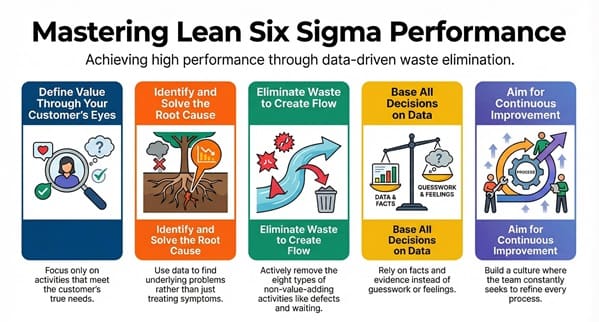
The core of Lean Six Sigma relies on several key principles:
- Focus on the Customer: You must define value through your customer’s eyes. What does the customer truly need?
- Identify the Root Cause: Never treat symptoms. You must use data to find the actual underlying causes of problems.
- Eliminate Waste to Create Flow: You actively look for and remove non-value-adding activities—the eight types of waste (defects, waiting, unnecessary motion, etc.).
- Data-Driven Decisions: You always base your decisions on facts, not just feelings or guesswork.
- Aim for Continuous Improvement: You build a culture where your team constantly looks for ways to refine every process.

Public, Onsite, Virtual, and Online Six Sigma Certification Training!
- We are accredited by the IASSC.
- Live Public Training at 52 Sites.
- Live Virtual Training.
- Onsite Training (at your organization).
- Interactive Online (self-paced) training,
Lean Six Sigma vs. Traditional Six Sigma
While both methods aim for better business results, they approach improvement from different angles. Lean Six Sigma simply combines the best of both worlds.
| Basis for Comparison | Six Sigma (Traditional) | Lean Six Sigma (Integrated) |
| Primary Focus | Reducing variation and defects (Quality) | Reducing waste and reducing variation (Efficiency and Quality) |
| Main Goal | Achieve near-perfect quality (3.4 defects per million opportunities) | Improve flow and speed while eliminating defects |
| Core Method | DMAIC (Define, Measure, Analyze, Improve, Control) | DMAIC + Lean tools (Value Stream Mapping) |
| Tools Used | Statistical analysis, control charts, hypothesis testing | Lean tools (5S, Poka-Yoke) plus Six Sigma statistical tools |
| Impact | Process stability and predictability | Faster cycle time and broader business impact |
The truth is, modern Six Sigma training often includes the Lean essentials. This creates the more powerful, hybrid approach you call Lean Six Sigma.
Also Read: What is Little’s Law? The Core Formula of Queueing Theory
Applying the Lean Six Sigma DMAIC Method to Sales
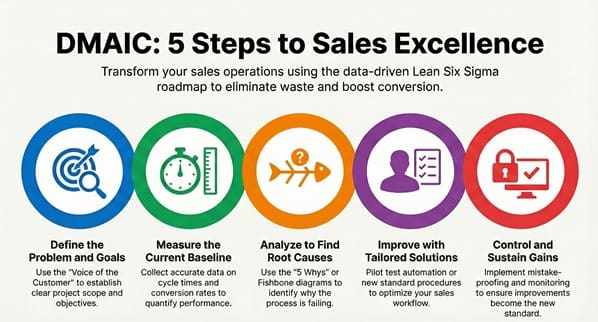
The Lean Six Sigma roadmap for improving an existing sales process is the DMAIC cycle. DMAIC stands for Define, Measure, Analyze, Improve, and Control. Each step helps your sales team solve chronic problems with a systematic, data-driven approach.
1. Define: Targeting the Right Problem
The Define phase sets the foundation for your entire improvement project. You clearly define the problem or opportunity.
Lean Six Sigma practitioners use tools like the Voice of the Customer (VOC) to understand what your clients expect. For example, are customers dissatisfied with the time it takes to receive a proposal?
Key questions you ask:
- What is the specific sales process we need to improve?
- What is the desired outcome or goal?
- Who are the stakeholders?
This phase produces a clear project charter which outlines the focus and scope.
2. Measure: Establishing the Baseline
The Measure phase focuses on collecting accurate data to understand the current state of your sales process. You must quantify the problem.
Lean Six Sigma teams establish a performance baseline using trustworthy data. If your project focuses on the speed of quote generation, you measure the average time it currently takes from inquiry to delivery.
- How long does each step of the sales cycle take right now?
- What is the current conversion rate?
Tools like a process map record activities, showing you the real-world flow.
3. Analyze: Finding the Root Cause
The Analyze phase investigates the collected data to find the root causes of variation and poor performance. Remember, you must find why the process is failing, not just that it is failing.
Lean Six Sigma employs techniques like the 5 Whys or a cause-and-effect diagram (often called a Fishbone diagram) to drill down to the source. Analyzing data reveals the critical inputs that influence the final output.
- Why does it take that long to generate a quote? Is it waiting for legal approval, or is the template too complex?
By analyzing the data, you pinpoint the true drivers of the defect.
4. Improve: Implementing Tailored Solutions
The Improve phase develops and implements solutions to address the root causes found in the Analyze phase. You work to optimize the process.
Lean Six Sigma aims for creative, tested solutions. The sales team might implement a new standard operating procedure (SOP) for proposal approval. They might also use automation tools to cut down manual data entry.
- What simple changes can eliminate waste in this step?
Teams often use pilot testing to validate the effectiveness of the solutions on a small scale before a full rollout.
5. Control: Sustaining the Gains
The Control phase ensures that the improvements you made last over time. You must maintain the new, high-performance level.
Lean Six Sigma uses a control plan and statistical process control to monitor the key metrics. Mistake-proofing (or poka-yoke) is vital here, making it almost impossible for your team to revert to old, inefficient ways.
- How do we ensure the new, faster quote process remains fast?
This step ensures that your effective sales operations become the new, sustained standard.
Lean Six Sigma and Sales Operation Projects
Lean Six Sigma essentials apply directly to numerous sales functions. Sales operations teams use this method to streamline workflows, eliminate redundant tasks, and allocate resources more wisely.
Sales operations projects often focus on these key areas:
- Lead Generation Process: Use Lean Six Sigma to remove delays in moving a lead from marketing to sales. You can measure the cycle time for lead qualification.
- Sales Proposal Procedures: Standardize the proposal creation process. You can greatly reduce variation in proposal quality and speed up delivery.
- Sales Forecasting: Reduce variation in your forecasts by using more reliable data and consistent input methods.
- Customer Onboarding: Improve flow by mapping the customer journey and cutting non-value-added waiting time after a deal closes.
Lean Six Sigma ensures that your sales processes are predictable and consistent, which reduces the risk of unpredictable outcomes.
Also Read: What is Enterprise Agility?
Key Takeaways for Effective Sales Operations
- Lean Six Sigma is a powerful hybrid approach that reduces waste (Lean) and reduces defects/variation (Six Sigma).
- The DMAIC framework (Define, Measure, Analyze, Improve, Control) is your roadmap for solving chronic sales process problems.
- You must prioritize the Voice of the Customer to define what “value” and “defect” mean in your sales cycle.
- Successful implementation requires leadership commitment and a dedicated, cross-functional team focused on data-driven decision-making.
- Effective sales operations are efficient, consistent, and always focused on the customer experience.
Frequently Asked Questions about Lean Six Sigma
What are the 8 Wastes in Lean Six Sigma?
The eight major wastes, often remembered by the acronym DOWNTIME, are: Defects, Overproduction, Waiting, Non-utilized Talent, Transportation, Inventory, Motion, and Extra-Processing. Lean Six Sigma helps you find and eliminate waste in your sales activities.
Who is responsible for Lean Six Sigma implementation?
While leadership commitment is essential, the entire team is involved. Formal roles, like Green Belts and Black Belts, are trained experts who lead the improvement projects.
How does Lean Six Sigma reduce cost in sales?
Lean Six Sigma reduces cost by eliminating waste (less time spent on rework, less unnecessary process steps) and reducing defects (fewer errors in quotes, fewer lost sales due to poor quality). This leads to higher profit margins.
Final Words
Lean Six Sigma gives your company the tools to build a sales engine that runs at peak efficiency. You must now implement these structured steps to identify and eliminate the waste that slows your team down. This powerful method ensures that your processes serve your clients perfectly every time.
Are you ready to transform your sales operations from a slow, error-prone cycle into a fast, reliable source of revenue? You must take action now.
Contact us today to start your first Lean Six Sigma certification and put your sales team on the path to becoming a high-performance machine.

About Six Sigma Development Solutions, Inc.
Six Sigma Development Solutions, Inc. offers onsite, public, and virtual Lean Six Sigma certification training. We are an Accredited Training Organization by the IASSC (International Association of Six Sigma Certification). We offer Lean Six Sigma Green Belt, Black Belt, and Yellow Belt, as well as LEAN certifications.
Book a Call and Let us know how we can help meet your training needs.