
Do you have a Six Sigma certification but feel like your job applications fall flat? You hold a valuable qualification that proves you can improve processes and deliver measurable results. However, simply listing the certification on your resume is not enough. You must actively market your CV as a Six Sigma practitioner to stand out in today’s competitive job market.
A Six Sigma certification signifies that you possess the skills to identify waste, reduce variation, and drive efficiency. These are traits every top company seeks. You need to craft your CV to clearly communicate the tangible value you bring. You should not wait to fully reveal how to effectively translate your training into a compelling career narrative.
In this section, we will discuss precisely how you transform your standard resume into a powerful marketing tool. This allows you to effectively present your skills and experience to potential employers.
Table of contents
- Why Your Lean Six Sigma Certification Makes Your CV Stand Out?
- What Six Sigma Skills Do Employers Seek?
- Structure Your CV to Highlight Your Six Sigma Expertise
- Six Sigma Terminology: The Belt Hierarchy
- Focusing on Six Sigma Projects and Quantifiable Results
- How do you integrate DMAIC into your bullet points?
- Actionable Tips to Market Your Six Sigma CV
Why Your Lean Six Sigma Certification Makes Your CV Stand Out?
The Lean Six Sigma certification is nothing but a formal confirmation of your ability to solve complex business problems. Companies hire Six Sigma practitioners because these professionals guarantee operational excellence and financial savings.
Lean Six Sigma certification immediately signals a specific skillset. This is a crucial element that sets you apart from other applicants. You need to understand the core value of this certification to properly market your CV.

Public, Onsite, Virtual, and Online Six Sigma Certification Training!
- We are accredited by the IASSC.
- Live Public Training at 52 Sites.
- Live Virtual Training.
- Onsite Training (at your organization).
- Interactive Online (self-paced) training,
What Six Sigma Skills Do Employers Seek?
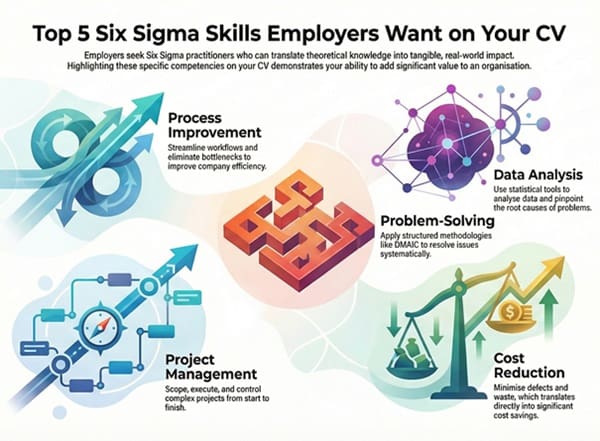
Employers seek candidates who can translate theoretical knowledge into real-world impact. They look for specific competencies on your CV. Six Sigma practitioners must clearly indicate these skills.
- Process Improvement: You understand how to streamline workflows and eliminate bottlenecks. This helps a company improve its efficiency.
- Data Analysis: You possess the ability to use statistical tools to analyze data and make informed decisions. Data analysis skills are vital for pinpointing the root causes of problems.
- Problem-Solving: You use a structured methodology, such as DMAIC (Define, Measure, Analyze, Improve, Control), to resolve issues systematically.
- Cost Reduction: Your projects aim at minimizing defects and reducing waste, which directly translates to significant cost savings.
- Project Management: You know how to scope, execute, and control complex projects.
Six Sigma skills are not soft skills; they are measurable competencies. Make sure your CV reflects this precision.
Also See: Online Lean Six Sigma Black Belt Certification
Structure Your CV to Highlight Your Six Sigma Expertise
A well-structured CV ensures the recruiter quickly grasps your Six Sigma expertise. Your CV is the first communication you have with a potential employer. You must organize it logically.
Start with a Powerful Six Sigma Practitioner Summary
Your CV summary, also known as the professional profile, must immediately grab attention. It refers to a concise 3–4 sentence paragraph that summarizes your career and primary qualifications. Use strong action verbs and mention your Six Sigma belt level right away.
Example of a good opening:
Highly results-driven Lean Six Sigma Black Belt with 10+ years of experience in optimizing supply chain and manufacturing processes. Successfully implemented DMAIC projects that achieved a 25% reduction in cycle time and $1.5 million in annual cost savings. I aim to leverage advanced statistical analysis to drive organizational efficiency and sustainable process change.
This Six Sigma practitioner summary directly states the qualification and, more importantly, the quantifiable results.
Listing Your Six Sigma Certification Correctly
You must list your Six Sigma certification in the right section of your CV. This helps maintain clarity and emphasizes its importance. Most professionals list it in the Certifications or Education section.
What is the correct way to list the certification?
The correct approach includes the full name, the certifying body, and the completion year.
- Full Certification Name: Lean Six Sigma Black Belt Certification
- Certifying Body: (e.g., The Council for Six Sigma Certification, ASQ)
- Completion Year: 20XX
The Six Sigma certification acts as a stamp of your professional development.
Six Sigma Terminology: The Belt Hierarchy
Recruiters immediately understand the level of your expertise based on your Six Sigma belt. Each belt level implies a specific scope of responsibility and depth of knowledge.
| Basis for Comparison | Six Sigma Green Belt | Six Sigma Black Belt | Six Sigma Master Black Belt |
| Role | Team leader for smaller projects; supports Black Belts. | Leads complex, cross-functional, and high-impact DMAIC projects. | Trains and coaches Black Belts; manages the organization’s Six Sigma program. |
| Focus | Data collection, analysis, and execution within defined project scope. | Statistical analysis, advanced problem-solving, and driving significant financial results. | Strategy, deployment, program infrastructure, and organizational change. |
| Project Scope | Departmental or specific process issues. | Enterprise-wide or complex business problems. | Multiple, interconnected organizational initiatives. |
| Knowledge Depth | Fundamental Six Sigma tools and methodologies. | Advanced statistical tools and deep understanding of process variation. | Expert-level knowledge across all methodologies and organizational deployment. |
Six Sigma expertise starts with a clear understanding of your current belt’s responsibilities.
Also See: Online Lean Six Sigma Green Belt Certification
Focusing on Six Sigma Projects and Quantifiable Results
The true power of your CV lies in the Six Sigma projects you highlight. Six Sigma is a methodology based on facts and data. Therefore, your CV must speak the language of metrics. Simply saying, “I improved a process” is vague. Saying, “I reduced defects by 30%” is powerful.
Use the Six Sigma Language: DMAIC and Results
When describing your work experience, you must frame your achievements using the DMAIC (Define, Measure, Analyze, Improve, Control) structure. This immediately validates your approach to problem-solving. Six Sigma practitioners use this methodology to ensure lasting improvements.
How do you integrate DMAIC into your bullet points?
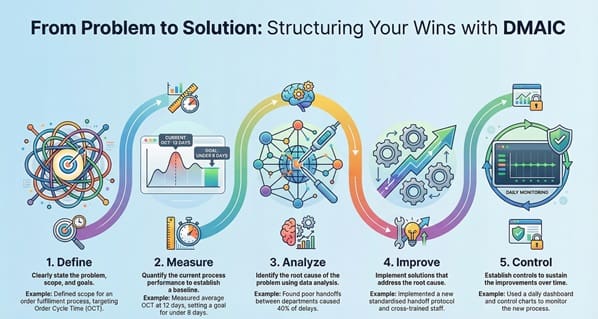
- Define: Defined the scope for a critical order fulfillment process, focusing on key metrics like Order Cycle Time (OCT).
- Measure: Measured current OCT at an average of 12 days, establishing a baseline and setting a project goal to reduce cycle time to under 8 days.
- Analyze: Analyzed process data using Pareto charts and Root Cause Analysis to find that poor handoff between departments caused 40% of delays.
- Improve: Improved the process by implementing a new standardized handoff protocol and cross-training staff on key tasks.
- Control: Controlled the new process by implementing a daily dashboard to monitor OCT and training supervisors on control charts to maintain efficiency.
This systematic breakdown proves your capability. Six Sigma practitioners must show a clear path from problem to solution.
Power of Quantifiable Results and Cost Savings
The most compelling part of your CV is the result column. You need to use numbers to show the impact of your work. Cost savings are the language of senior management.
- Reduced defects by 35% (from 1500 to 975 units per quarter) using Statistical Process Control.
- Generated $850,000 in annual cost savings by reducing waste in the manufacturing line, which led to a 20% increase in profit margin.
- Accelerated client onboarding time by 45% (from 14 days to 7.7 days) by streamlining document verification processes.
Focus on your key achievements. What is the monetary value of your process improvement? What are the key metrics you influenced?
Actionable Tips to Market Your Six Sigma CV
To successfully market your CV, you must think like a marketing professional. You are selling a solution (your skills) to a client (the employer). This involves careful keyword targeting and strategic phrasing.
Using Six Sigma Keywords for Applicant Tracking Systems (ATS)
Most large companies use Applicant Tracking Systems (ATS) to filter resumes. The system looks for specific keywords to determine relevance. Therefore, you must use topic appropriate, keyword-based language.
Six Sigma keywords to integrate naturally:
- Main Keyword: Six Sigma practitioner, Six Sigma certification, Lean Six Sigma
- LSI/Semantic Keywords: Process improvement, DMAIC, Kaizen, Root Cause Analysis, Statistical Process Control, Variation Reduction, Operational Efficiency, Cost Reduction, Waste Elimination, Voice of the Customer (VOC).
- Long-tail Keywords: Six Sigma Black Belt for supply chain optimization, implementing Lean Six Sigma in service industries.
Make sure you avoid keyword stuffing. You should use these terms naturally within your project descriptions. Six Sigma practitioners use specific terminology in their daily work; your CV should reflect that.
Tailoring Your CV for Different Roles
A Six Sigma background is valuable for many different positions, not just “Process Improvement Manager.” You must tailor your CV based on the specific job description.
For example, when applying for a:
- Project Manager Role: Emphasize your ability to manage the DMAIC process timeline, scope, and team leadership skills.
- Quality Assurance Role: Focus on your experience with Statistical Process Control and defect reduction methodologies.
- Financial Analyst Role: Highlight the cost savings and return on investment (ROI) that your Six Sigma projects delivered.
Tailoring the content ensures the recruiter sees you as a perfect fit for that specific opportunity. This shows you understand the requirement.
Frequently Asked Questions (FAQs) About Six Sigma CVs
Now, the question arises, what are the most common concerns job seekers have when building a CV? Six Sigma practitioners often need clarification on how to present their credentials.
Should I List My Six Sigma Certification if I Do Not Have Experience?
If you recently completed your training but lack professional project experience, you should still list your Six Sigma certification prominently. You must describe your training projects or simulated projects under a dedicated section. Six Sigma training often includes a project phase; you should detail the scope, methodology, and outcome of that training project. This shows a commitment to the methodology.
Where Should I Place the Six Sigma Logo on My CV?
You can certainly include the logo next to your certification title in the Certifications section. However, you must prioritize the textual content and the results. The logo acts as a visual cue but the words carry the actual weight of your experience.
What is the Most Effective Way to Describe the ROI of a Six Sigma Project?
You must describe the ROI (Return on Investment) of a Six Sigma project in two ways: financial and non-financial.
- Financial: Use monetary figures like “$1.2 million saved annually” or “22% cost reduction.”
- Non-Financial: Mention improvements in areas like “customer satisfaction (up by 15 points),” “cycle time reduction,” or “employee morale.”
This comprehensive approach showcases the full value of Six Sigma.
Key Takeaways for the Six Sigma Practitioner
You are not merely an employee; you are a professional problem-solver and a change agent. Marketing your CV effectively means you translate your technical training into a narrative of business impact.
Six Sigma practitioners must always remember these critical points:
- Lead with Results: Always focus on quantifiable results and cost savings achieved through your Six Sigma projects.
- Speak the DMAIC Language: Frame your professional achievements using the DMAIC steps to validate your structured approach.
- Use Keywords Strategically: Naturally weave in terms like process improvement, waste elimination, and your specific belt level to satisfy both the ATS and the human reader.
- Structure for Scanability: Use clear headings, bullet points, and a comparison table to make your CV easy to digest on any mobile device.
Final Words
Your Six Sigma certification is a powerful tool. You possess the proven ability to drive operational efficiency and deliver significant cost savings. By using this guide, you now know how to transform your CV into a high-impact document. You will attract the attention of top-tier employers who are looking for exactly the kind of process-focused results you provide.
Ready to take the next step? Now you must apply these strategies to your CV. We ensure your professional success by providing actionable insights and comprehensive guidance that places you at the forefront of the talent pool. Let us help you secure the high-value role your expertise demands.
About Six Sigma Development Solutions, Inc.
Six Sigma Development Solutions, Inc. offers onsite, public, and virtual Lean Six Sigma certification training. We are an Accredited Training Organization by the IASSC (International Association of Six Sigma Certification). We offer Lean Six Sigma Green Belt, Black Belt, and Yellow Belt, as well as LEAN certifications.
Book a Call and Let us know how we can help meet your training needs.