
Employee engagement refers to how much your workers commit to your company. It measures their passion for the work and their connection to your mission. In simple words, employee engagement shows if your employees truly care about your success.
When workers are only doing what they must, your company loses value. Highly engaged employees go the extra mile without being asked. They look for new markets or fix problems on their own. This proactive spirit is what drives growth.
Why does low employee engagement matter? Low employee engagement can break a company at a crucial time. It causes high turnover and poor customer service. It costs businesses billions every year. You want every person on your team to strive toward the same goals. How do you fix a low employee engagement rate using proven methods?
This issue requires a focused, data-driven solution. Trying to simply “motivate” employees often fails because it ignores the true problems. We will show you how you can use Six Sigma to increase your employee engagement rate permanently.
Table of contents
What is Six Sigma and Why It Boosts Employee Engagement?
Six Sigma refers to a set of techniques and tools for process improvement. Six Sigma aims to find and remove the causes of errors or defects in any process. It seeks to reduce variation until only $3.4$ defects occur per million opportunities.
In simple words, Six Sigma makes things run nearly perfectly. While often used in manufacturing, you can use the same methods on business processes like human resources. Six Sigma focuses on creating better outcomes for customers. When you apply it to people, the “customer” is the employee.
Why is Six Sigma perfect for the employee engagement rate? Six Sigma is objective and neutral. It removes guesswork and personal opinions from the problem. The goal is to find the root cause of poor employee engagement and fix the process that causes it. This systematic method allows you to truly increase your employee engagement rate in a measurable way.
You can use the Six Sigma DMAIC methodology. DMAIC stands for Define, Measure, Analyze, Improve, and Control. This cycle is your roadmap to a more energized and productive workplace.
Defining Low Employee Engagement: The Six Sigma Start
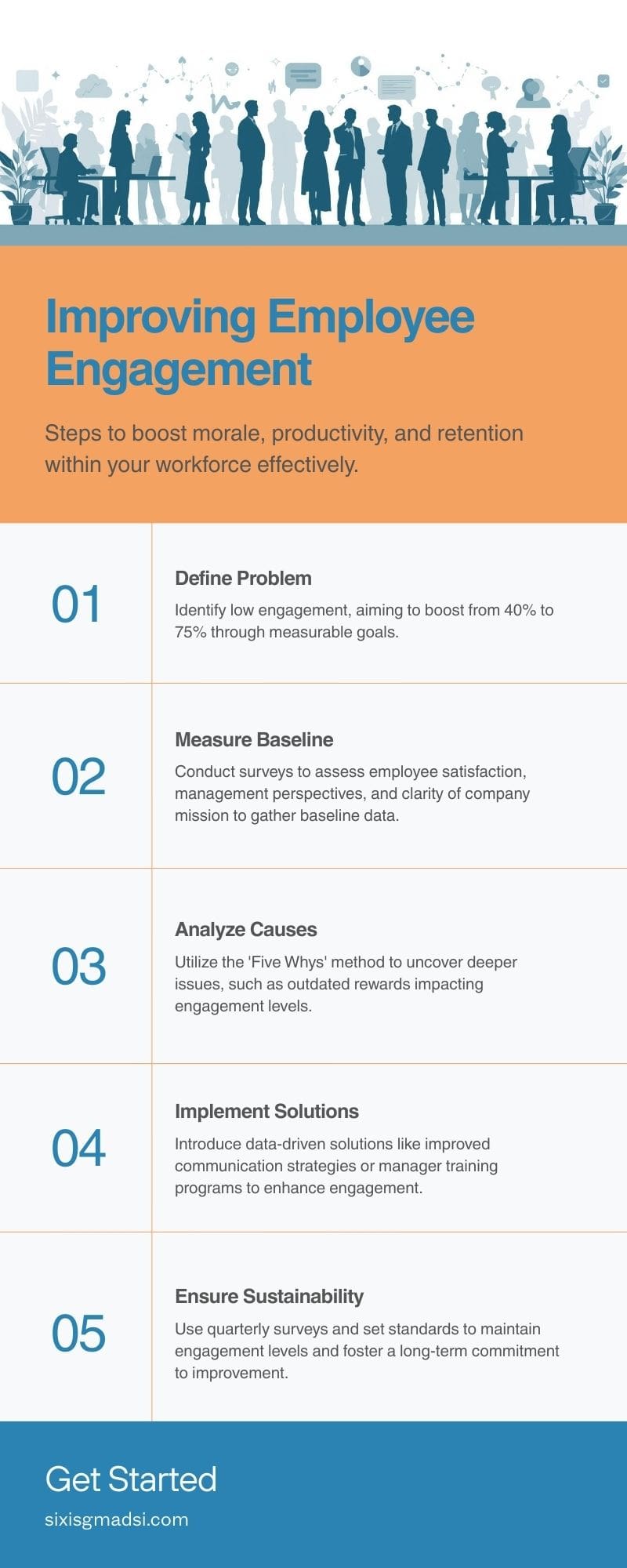
The first step in any improvement effort is the Define phase. This is where you clearly state the problem and the goals.
Six Sigma projects always start with defining the problem from the customer’s viewpoint. For this project, you need to define the issue from the employee’s point of view. What are the signs of low employee engagement in your company?
The Define phase requires you to clearly outline the project scope. You need to know what a highly engaged employee looks like. You must also decide which parts of the organization will be part of this project. Are you focusing on one department, or the whole company?

Public, Onsite, Virtual, and Online Six Sigma Certification Training!
- We are accredited by the IASSC.
- Live Public Training at 52 Sites.
- Live Virtual Training.
- Onsite Training (at your organization).
- Interactive Online (self-paced) training,
Measuring Your Employee Engagement Rate with Six Sigma
The next critical step is the Measure phase. You cannot fix what you cannot measure. This is where you establish a baseline for your employee engagement rate.
Six Sigma professionals, like Green Belts and Yellow Belts, are excellent at collecting this data. They use tools to get accurate information. How exactly do you measure something as complex as employee feelings?
Employee engagement is typically measured by surveys. Short and sweet surveys assess how employees view the company’s vision and their role within it. These surveys also gauge employees’ contribution to the overall company performance and productivity. You must gather data on key characteristics, such as:
- Employee satisfaction with management.
- Belief in the product or service.
- Feeling valued by the company.
- Clarity on corporate mission.
The Measure phase collects the initial data. This data will be organized and displayed accurately. For example, a Black Belt professional might use charts to show exactly where the lowest employee engagement scores are. This data tells you the size of the gap between your current state and your desired state.
Analyzing Causes of Low Employee Engagement
Once you have your data, you move to the Analyze phase. This is the detective work of the Six Sigma project. You must find the true, underlying reasons for the low employee engagement rate.
Employee engagement problems usually have many surface-level symptoms. However, you need to find the root cause. A lack of effective management, loss of faith in the product, or an absence of clear corporate culture are common causes.
The Analyze phase uses tools like the “Five Whys.” You ask “Why?” repeatedly until you find the core issue.
For instance, your survey might show low scores for “feeling valued.”
- Why do employees not feel valued? Because they never get recognition.
- Why do they never get recognition? Because the current reward system is complex and only used once a year.
- Why is the reward system complex? Because it was designed 15 years ago by a former manager.
The true root cause is an outdated process, not simply ungrateful employees. Finding this root cause is how Six Sigma creates lasting fixes. This detailed analysis ensures that the solutions you choose will actually increase your employee engagement rate.
How Six Sigma Improves Employee Engagement?
Now you reach the Improve phase. This is where you use the analysis data to create and test solutions. This is the action part of your plan to increase your employee engagement rate.
Six Sigma solutions must be data-driven. The improvements are not based on hunches or what worked at a different company. They are tailored exactly to the root causes you found in your analysis.
Employee engagement improves when you fix broken processes. If you found that slow internal communication frustrates employees, the Improve phase designs a faster, clearer system. If you found that middle managers are not offering enough guidance, the Improve phase launches a new, specific training program for them.
Six Sigma helps you choose the best fixes. You may brainstorm many ideas, but you only implement those that have the highest chance of success. This keeps you from wasting time and money on solutions that do not stick.
You might use small tests, called pilot programs, to prove that your new process works before rolling it out company-wide. This careful testing ensures you successfully increase your employee engagement rate.
Controlling High Employee Engagement Rates
The last step in DMAIC is the Control phase. This is arguably the most important step for long-term success. You must put systems in place to keep the employee engagement rate high.
Six Sigma teaches that any process can fall back into old habits without monitoring. You need controls to ensure the new, improved processes stick. You must put your successful solutions into the standard way of operating.
Employee engagement monitoring requires new metrics. For instance, you might create a simple, quarterly pulse survey to track key engagement scores. This survey acts like a control chart for your human capital. If the scores start to drop below a certain line, you know a problem is returning, and you can fix it fast.
Six Sigma Black Belts will document all the new standards. They train other employees on the new process. This control prevents the need to start another large-scale employee engagement project later. Maintaining this high employee engagement rate is easier than constantly fixing a low one.
Benefits of Using Six Sigma for Employee Engagement
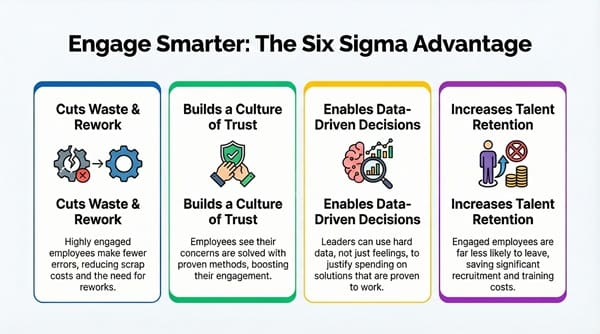
Using Six Sigma to increase your employee engagement rate provides many benefits. This scientific approach ensures that your effort is worthwhile and delivers real returns.
- Six Sigma removes waste caused by low employee engagement. When employees are highly engaged, they make fewer errors and deliver better quality work. This reduces reworks and scrap costs.
- It creates a culture of continuous improvement. Employees see that their concerns are taken seriously and solved using proven methods. This trust further boosts their employee engagement.
- It gives leaders hard data, not just feelings. This allows project managers to justify resource spending on solutions that are proven to work. The investment to increase your employee engagement rate becomes a clear business case.
- Six Sigma helps you retain talent. Highly engaged employees are far less likely to leave the company. This saves the huge cost of constantly recruiting and training new staff. This retention dramatically improves company stability.
Key Differences: Traditional vs. Six Sigma Employee Engagement
It is helpful to compare the two ways of addressing engagement. The Six Sigma approach is vastly different from traditional methods.
| Basis for Comparison | Traditional Engagement Approach | Six Sigma Employee Engagement |
| Meaning | Uses general motivation strategies like parties or one-off bonuses. | Uses data and process analysis to remove root causes of unhappiness. |
| Nature | Emotional, reactive, and often based on management’s guess. | Objective, proactive, and based on verified statistical data. |
| Examples | A new break room or a pizza party after a bad quarter. | Redesigning a faulty reporting process that causes employee stress. |
| Goal | To temporarily boost morale or satisfaction. | To permanently fix a broken system that causes low employee engagement. |
| Key Characteristic | Focuses on treating the symptoms. | Focuses on treating the illness, leading to a higher employee engagement rate. |
Six Sigma employee engagement focuses on fixing the system, not the person. While a pizza party is nice, it does not fix a broken ordering system that causes hours of frustrating work every week. Only by using Six Sigma to fix the process can you increase your employee engagement rate and keep it there.
Also Read: Employee Voice: Strengthening Your Workforce for Success
Key Takeaways
- Employee engagement measures how committed workers are to your company and affects overall value.
- Low employee engagement harms businesses by increasing turnover and lowering customer service.
- Six Sigma provides a data-driven approach to identify and solve root causes of low employee engagement.
- The DMAIC methodology—Define, Measure, Analyze, Improve, Control—guides the process of enhancing engagement.
- By using Six Sigma, companies can create a culture of improvement, retain talent, and increase their employee engagement rate.
Final Words
In a nutshell, employee engagement is vital for any thriving business. By applying the proven, systematic approach of Six Sigma, you can stop guessing and start solving. You define the specific problem, measure the current state, analyze the root causes, improve the process with targeted fixes, and control the new high standards. This DMAIC cycle is how you successfully increase your employee engagement rate and keep it high.

About Six Sigma Development Solutions, Inc.
Six Sigma Development Solutions, Inc. offers onsite, public, and virtual Lean Six Sigma certification training. We are an Accredited Training Organization by the IASSC (International Association of Six Sigma Certification). We offer Lean Six Sigma Green Belt, Black Belt, and Yellow Belt, as well as LEAN certifications.
Book a Call and Let us know how we can help meet your training needs.