Are you searching for ways to boost your company’s production while keeping costs low? Do you need your factory to change product lines without long shutdowns? You are looking for a system that gives you the best mix of mass production speed and custom product flexibility. That system exists today.
We are entering an era where adaptability determines business success. The manufacturing world requires the ability to produce many different product types quickly. This demand is changing how factories operate right now.
A system that solves this problem involves integrated machine tools, material handlers, and central computer control. This powerful combination helps you handle sudden shifts in market demand.
Table of contents
What Flexible Manufacturing System (FMS) Signifies in Manufacturing?
A Flexible Manufacturing System (FMS) can be understood as an advanced production method. It combines automated machinery, material transport, and a central computer brain. This combination allows the system to adjust easily to changes in the type and quantity of products you manufacture.
Flexible Manufacturing Systems (FMS) refers to the use of technology to gain production efficiency. This is because FMS maintains the high efficiency of a fixed assembly line. At the same time, it keeps the flexibility of a job shop where workers make custom products. FMS is designed to process a variety of different parts or product styles simultaneously. It does this without requiring extensive retooling or manual setup changes.
In simple words, FMS signifies the ability to adapt production without stopping operations. It enables you to switch from making Part A to making Part B with minimal delay. This capability plays a vital role in meeting the fast-changing demands of today’s market.

Public, Onsite, Virtual, and Online Six Sigma Certification Training!
- We are accredited by the IASSC.
- Live Public Training at 52 Sites.
- Live Virtual Training.
- Onsite Training (at your organization).
- Interactive Online (self-paced) training,
The Flexible Manufacturing System (FMS) vs. Hard Automation
You may wonder how FMS differs from older, more rigid manufacturing setups. The most significant contrast is in the ability to adapt.
Hard automation, or fixed automation, is nothing but a system built for one purpose. It is designed to make a single product or a very limited range of similar products. While hard automation provides extremely high production rates and low cost per unit, changing the product design necessitates a complete and costly system redesign.
Flexible Manufacturing Systems, on the other hand, embrace change. FMS is highly automated, but it uses programmable machines. This capability allows the system to produce diverse products simply by changing the software commands. Therefore, FMS is more suitable for medium-volume production of a high variety of parts.
Let us now discuss the key distinctions in this table:
| Basis for Comparison | Flexible Manufacturing System (FMS) | Hard Automation (Fixed Automation) |
| Product Variety | High variety of parts in the same family. | Single product or very limited variation. |
| Production Volume | Medium volume of production. | Very high volume of production. |
| Flexibility | High (quick changeover is possible). | Low (changeover necessitates major retooling). |
| Initial Investment | High, due to complex computer controls and versatile machines. | High, due to specialized, custom-built machinery. |
| Cost Per Unit | Moderate to low. | Very low. |
| Suitable For | Batch production, mixed-model manufacturing. | Mass production, continuous flow processes. |
| Changeover Time | Near-zero or minimum setup time. | Long time required for modification. |
The most important distinction is production flexibility. Flexible Manufacturing Systems allow quick changeover of operating instructions and physical setup. Hard automation cannot provide this critical function. Due to the high investment in specialized machinery, hard automation cannot adapt to variations easily.
Also Read: Andon System in Lean Manufacturing: Real-Time Problem Alerts
Flexible Manufacturing System Architecture (Components)
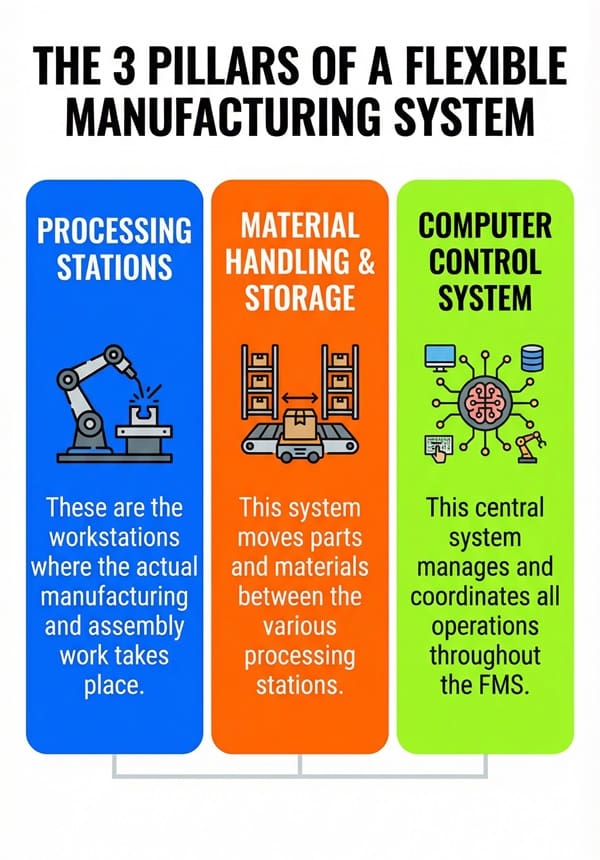
A Flexible Manufacturing System comprises three essential, interconnected subsystems. These subsystems work together in synchronization to ensure seamless and adaptive production. This is because the system relies on the coordination of physical machines, material flow, and data management.
FMS technology always depends on these three components:
- Processing Stations: Where the work takes place.
- Material Handling and Storage System: That moves parts among stations.
- Computer Control System: That manages and coordinates all operations.
Processing Stations
Flexible Manufacturing Systems use advanced, programmable processing equipment. These stations perform various operations on the work parts. Examples include machining, welding, inspection, and assembly.
- Computer Numerical Control (CNC) Machines: FMS relies primarily on CNC machining centers. These machines can perform multiple operations, such as milling, drilling, and tapping, using a variety of tools. This ability to execute different tasks on one machine facilitates machine flexibility.
- Load/Unload Stations: Work parts enter and leave the FMS at these stations. Manual loading and unloading are prevalent, but automated handling devices assist the operator with heavy parts.
- Assembly Stations: Industrial robots are often used here. They are programmable and can perform assembly tasks with variations in motion patterns. This ensures that the system handles different product styles.
Automated Material Handling System (AMHS) in FMS
The material handling system acts as the factory’s circulatory system. It is responsible for the movement of raw materials, work-in-process (WIP), and finished parts. The core function of the material handling system ensures random and independent movement of work parts between stations.
FMS material handling includes several key elements:
- Automated Guided Vehicles (AGVs): These mobile robots follow predefined paths or computer controls to move pallets and fixtures. AGVs are highly flexible because the central computer can easily adjust their routes.
- Conveyors and Shuttles: These systems move parts quickly between specific points.
- Automated Storage and Retrieval Systems (AS/RS): These systems provide temporary storage for WIP and tooling. They guarantee that necessary tools and parts are available precisely when needed.
This automation in material movement ensures that a delay at one workstation does not stop the entire Flexible Manufacturing System.
Computer Control System
The computer control system is the central nervous system of the entire FMS. It oversees and coordinates every single activity within the system. This system ensures that all components—machines, robots, and AGVs—work together seamlessly.
The computer control system performs several vital functions:
- Workstation Control: It distributes operational instructions to the CNC machines.
- Production Control: This function involves scheduling parts and managing inventory levels. The system ensures just-in-time production.
- Traffic Control: It manages the routes of the automated guided vehicles. This prevents collisions and optimizes the path of parts.
- Performance Monitoring: The system tracks the status of all machines, tools, and material handlers in real-time. This allows for quick identification of issues.
Flexible Manufacturing Systems rely heavily on this integrated computer control. This is because it provides the ability to recognize and react quickly to deviations in the manufacturing plan.
How Does a Flexible Manufacturing System Work?
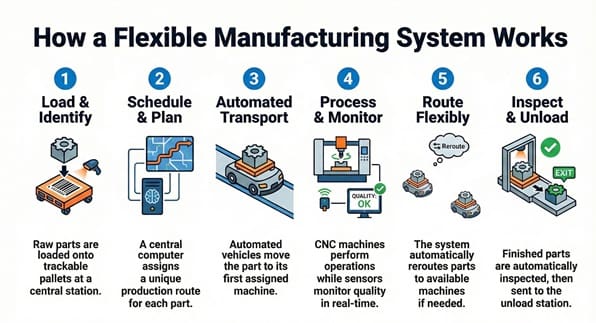
The Flexible Manufacturing System works on the principle of integrated automation and real-time control. This is a sequential process designed to minimize human intervention and maximize machine utilization.
FMS Steps
- Material Loading: First, an operator or robot loads the raw work part onto a pallet at the load/unload station. The pallet often contains a unique identifier, such as a barcode. This allows the computer control system to recognize and track the part.
- Production Scheduling: The central computer system schedules the production process. Taking into account the current product mix and machine availability, it assigns a specific routing sequence. The system’s precision in planning reduces work-in-process inventories.
- Automated Transport: Then, the automated material handling system moves the pallet with the work part to the first available workstation. The computer controls the movement of the AGVs or shuttles.
- Processing and Monitoring: Next, the CNC machine executes the required operation based on the instructions received from the control system. Integrated sensors continuously monitor the machine’s status and the quality of the part.
- Part Routing: When the operation is complete, the material handling system moves the part to the next station in its unique sequence. If a machine is busy or requires maintenance, the computer automatically reroutes the part to an alternative machine that can perform the same task. This routing flexibility is a core benefit of FMS.
- Quality Control and Unloading: Finally, after all processes are complete, the part moves to an automated inspection station. The system verifies the part’s quality. Thereafter, the material handling system routes the finished product to the unload station for shipment or storage.
In this way, the entire Flexible Manufacturing System operates continuously. It makes different parts in sequence without stopping production for setup changes.
Also Read: Process Monitor in Manufacturing
Different Types of Flexible Manufacturing System Setups
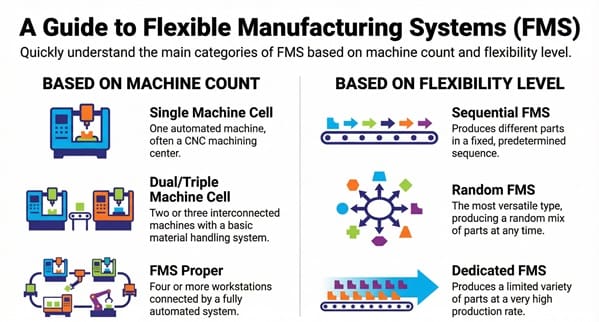
Not all Flexible Manufacturing Systems are the same. The design and complexity depend on the required production volume and the degree of part variety. FMS can be categorized based on the number of machines involved and the level of flexibility achieved.
FMS Based on Machine Number
Flexible Manufacturing System technology can range from a single machine to a vast, complex network.
- Single Machine Cell: This setup uses only one processing machine, usually a CNC machining center. It is capable of making a variety of parts automatically and often includes a tool storage unit. This simple FMS is sometimes called a Flexible Machining Module (FMM).
- Dual or Triple Machine Cell: This system comprises two or three machines interconnected by a basic material handling system. The setup also includes a load/unload station. This arrangement provides route flexibility because more than one machine can perform the same operation.
- Flexible Manufacturing System (FMS) Proper: This system comprises four or more processing workstations. They connect to a common, fully automated distribution system and are regulated by a central computer.
FMS Based on Level of Flexibility
The flexibility of a manufacturing system can be characterized by how easily and quickly it adapts to changes in parts, volume, and routing.
- Sequential FMS: Flexible Manufacturing Systems of this type produce a series of parts in a predetermined sequence. The system manufactures one type of part, and then the machinery prepares to manufacture the next type in a planned order.
- Random FMS: This is the most versatile type of FMS. It can produce a random mix of different parts at any given time. The machines handle varied product configurations. This type of Flexible Manufacturing System is essential for high-mix, low-volume production where orders frequently change.
- Dedicated FMS: This system is less flexible than the random type. It focuses on producing a limited, narrow mix of parts continuously for long periods. Although the variety is limited, the production rate is very high. A dedicated FMS aims to maintain the high efficiency of fixed automation while allowing for minor part variations.
Now, the question arises, which type is best for you? The answer depends entirely on your specific market requirements and production volume.
Why Choose a Flexible Manufacturing System?
Implementing a Flexible Manufacturing System provides numerous strategic advantages that enhance your company’s competitive position. These benefits lead directly to lower operational costs and better responsiveness to market shifts.
Flexible Manufacturing Systems reduce costs and improve quality.
- Increased Equipment Utilization: FMS ensures that machine tools operate for longer periods. The automated handling components free the machines from waiting on personnel. Changeover tasks are completed externally while the machine is still working on another job. This minimizes downtime.
- Reduced Manufacturing Cost: The highly automated nature of FMS removes the need for most repetitive manual tasks. This reduces direct labor costs. Furthermore, the efficiency gains translate into lower cost per unit of output.
- Improved Quality and Consistency: Human error is inevitable in manual systems. An FMS lessens these mistakes due to machine-driven accuracy and precision. This helps in maintaining consistency and reliability across all production runs.
- Reduced Work In Process (WIP) Inventory: The control system’s precision planning reduces the amount of partially finished goods held in storage. This feature of FMS supports just-in-time manufacturing principles. FMS leads to reduced parts inventories.
- Shorter Lead Times: FMS shortens the manufacturing process. This is achieved through improved operational control and the round-the-clock availability of automated equipment. Your company can deliver products faster.
- Enhanced Adaptability: Flexible Manufacturing Systems allow quick reaction to demand variations. If customer requirements change, the computer can instantly reprogram the system. This provides a clear competitive edge in a dynamic marketplace.
Real-World Flexible Manufacturing System Applications
Flexible Manufacturing Systems play a vital role across various demanding industrial sectors. They are particularly useful in environments characterized by high product complexity and frequent design changes.
FMS is highly beneficial in industries such as:
- Automotive Industry: FMS manages the simultaneous production of different car models and engine parts on the same line. The system allows manufacturers to change product specifications without costly shutdowns.
- Aerospace Industry: The aerospace sector requires extremely high precision for low-volume, complex parts. Flexible Manufacturing Systems handle various materials and intricate machining tasks accurately.
- Consumer Electronics: Product lifecycles are very short in this industry. FMS enables the efficient assembly and testing of different gadgets and components. This keeps pace with rapid technological advancements.
- Medical Devices: The production of specialized medical equipment often requires customization and strict quality control. The precision and adaptability of the Flexible Manufacturing System are crucial for meeting stringent regulatory standards.
- Tool and Die Making: FMS can efficiently produce various jigs, fixtures, and molds needed for other manufacturing processes.
Flexible Manufacturing Systems essentially enable a make-to-order strategy. This allows customers to customize the products they want.
Frequently Asked Questions (FAQs) About FMS
We understand that adopting such a sophisticated technology involves many questions. Here are some answers to common queries about this vital production system.
What are the primary types of flexibility in an FMS?
The system provides several types of flexibility. These include:
- Machine Flexibility: This refers to the ease with which machines can process a variety of part styles.
- Routing Flexibility: This denotes the ability to move a part from one machine to an alternative machine if the primary machine is busy.
- Mix Flexibility: This signifies the ability to change the relative proportions of different parts being produced.
- Volume Flexibility: This implies the ability to adjust the total production quantity economically.
What is the main drawback of implementing a Flexible Manufacturing System?
The primary drawback is the high initial investment required. Buying and installing complex specialized equipment, automated material handling, and the integrated computer control system is costly. However, the long-term cost savings and improved efficiency usually justify this expenditure.
Does an FMS eliminate the need for human labor?
No, an FMS does not eliminate human labor; it changes the nature of the work. It removes the need for repetitive manual tasks. However, it requires highly skilled workers and engineers. These individuals monitor, maintain, program, and troubleshoot the sophisticated computer control systems. Human expertise remains a critical component of the system.
Is FMS suitable for mass production?
While the system is often applied to medium-volume, high-variety batch production, an FMS can also be implemented for mass production. It achieves the high efficiency of mass production while retaining the flexibility to quickly adapt to design changes.
Key Takeaways
- A Flexible Manufacturing System (FMS) combines automated machinery and central control for adaptable production.
- FMS allows quick shifts between product types, minimizing downtime compared to hard automation.
- The system includes three main components: processing stations, material handling, and a computer control system.
- FMS provides advantages such as increased equipment utilization, reduced costs, and improved product quality.
- Industries like automotive and aerospace benefit from FMS due to its flexibility and efficiency in handling diverse production needs.
Final Words
So, with the above discussion, we can say that the Flexible Manufacturing System (FMS) represents the logical next step in manufacturing evolution. It moves beyond the limitations of rigid automation. FMS technology is nothing but an integrated solution that provides speed, efficiency, and crucial adaptability.
FMS empowers your business to respond quickly to market needs and customer demands. Flexible Manufacturing Systems not only help reduce direct labor costs and inventory but also ensure superior and consistent product quality. This makes your company more competitive in the global arena.
We believe in supporting manufacturers who aim for precision and agility. We provide solutions that ensure your production capabilities are always ready to pivot. Choose Flexible Manufacturing Systems to build a future where change is an opportunity, not a roadblock.

About Six Sigma Development Solutions, Inc.
Six Sigma Development Solutions, Inc. offers onsite, public, and virtual Lean Six Sigma certification training. We are an Accredited Training Organization by the IASSC (International Association of Six Sigma Certification). We offer Lean Six Sigma Green Belt, Black Belt, and Yellow Belt, as well as LEAN certifications.
Book a Call and Let us know how we can help meet your training needs.