

Startups benefit from Lean Six Sigma, but only in small, targeted doses. The value comes from protecting cash and building good habits early. A full corporate-style rollout is the wrong move for most early teams.
This is a resource question before it is a methodology question. A startup has limited runway. Every hour and every dollar spent on a broken process is an hour and a dollar not spent on growth.
Lean Six Sigma was not built for startups. It was built for large manufacturing operations decades ago. That history does not disqualify it. It just means startups need to apply it differently than a factory floor would.
Table of contents
Key Takeaways
- Lean Six Sigma pays off for startups once a process repeats often enough to measure.
- Six Sigma began at Motorola in 1987 and later scaled through General Electric.
- Lean traces back to the Toyota Production System and its focus on removing waste.
- The biggest startup risk is not waste itself. It is guessing instead of measuring.
- Full certification is not required to start. One trained team member can lead a pilot.
- Six Sigma Development Solutions offers onsite, live virtual, and online training for teams at any stage.
What Lean Six Sigma Actually Solves?
Lean Six Sigma is not one method. It is two methods working together.
Six Sigma reduces variation in a process using data. It started at Motorola in 1987. General Electric later turned it into a company-wide discipline.
Lean removes steps that do not add value for the customer. It grew out of the Toyota Production System in Japan.
A process can be fast and still produce bad results. A process can also be accurate and still waste time. Lean Six Sigma is built to fix both problems in the same project.
For a startup, that combination matters more than the label. Founders do not need to know the history. They need a way to stop losing money on broken processes while they are still small.

Public, Onsite, Virtual, and Online Six Sigma Certification Training!
- We are accredited by the IASSC.
- Live Public Training at 52 Sites.
- Live Virtual Training.
- Onsite Training (at your organization).
- Interactive Online (self-paced) training,
The Real Risk Startups Face Is Not Waste. It Is Guessing.
Every startup has waste somewhere. That is not unique to startups.
The bigger risk is different. Most early founders make decisions on instinct because they have no other option. There is no historical data yet. There is no dedicated analyst reviewing metrics.
That instinct works for a while. It stops working the moment the company grows past what one founder can personally track.
This is where Lean Six Sigma offers something startups rarely build on their own: a habit of measuring before deciding. A founder who tracks a number weekly catches a problem in week three. A founder who relies on gut feeling catches the same problem in month six, after losing customers.
The financial cost of that six-month delay is often larger than the cost of any training program.
Also Read: Performance Baseline Measure: What It Is and How to Build One
A Three-Stage Way to Think About Timing

Not every startup should adopt Lean Six Sigma on day one. Timing depends on how repeatable the business has become.
Stage 1: Idea Validation. The team is still testing what the product should be. Processes change weekly. Speed matters more than consistency here. Full Lean Six Sigma adoption at this stage usually slows the team down without adding value.
Stage 2: Early Traction. A core process has started repeating. Onboarding, fulfillment, or billing now happens the same way each time. This is the right moment to run one small pilot project.
Stage 3: Scaling. The company hires beyond the founding team. Processes need to work the same way without the founder in the room. This is where a structured methodology protects quality as headcount grows.
Applying Lean Six Sigma too early wastes effort on a process that will change again soon. Applying it too late means inefficiency has already compounded across a larger team.
Where Lean Six Sigma Pays Off First for a Startup
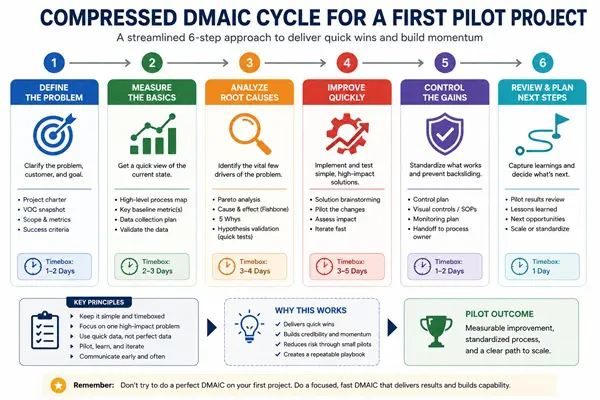
Startups rarely need every Lean Six Sigma tool at once. A short list covers most early wins.
- Customer onboarding. A confusing or slow onboarding process drives early churn. A single DMAIC project can shorten it and remove unnecessary steps.
- Support response time. Startups lose trust fast when support is inconsistent. Measuring response time exposes where delays happen.
- Billing and fulfillment errors. These mistakes cost real money and damage trust with early customers.
- Hiring and onboarding of new staff. Inconsistent onboarding creates uneven performance across a growing team.
Each of these is measurable within weeks. None requires a company-wide program to start.
How to Run a First Project Without Slowing the Team Down
A startup does not need a Six Sigma department. It needs one clear project and a short cycle.
- Choose one process that costs real time or money.
- Write down the current performance using actual numbers, not impressions.
- Set a specific, realistic target for improvement.
- Map the process and find the step causing the biggest delay or error.
- Test one change and measure the result for two weeks.
- Keep the change if it works. Document it so the fix does not get lost.
This is a compressed version of DMAIC. It fits inside a normal sprint cycle. It does not require pausing daily operations to run.
Also Read: Lean Six Sigma for AI Model Training: Reducing Waste in ML Pipelines
The Cash Runway Argument for Startups

Founders often treat process improvement as a nice-to-have. That framing misses the actual math.
Every wasted hour on a broken process is an hour not spent on product or sales. Every dollar lost to rework or errors shortens the company’s runway. A startup with twelve months of cash cannot afford six of those months spent on avoidable mistakes.
Lean Six Sigma, applied narrowly, is a runway-protection tool as much as a quality tool. The goal is not perfection. The goal is removing the specific costs that threaten survival.
Where Lean Six Sigma Can Work Against a Startup
Honesty matters here as much as enthusiasm. Lean Six Sigma is not free of downside if misapplied.
A team of three people does not need a formal control plan for every task. Over-structuring a process that changes weekly wastes more time than it saves. Founders should resist the urge to apply every tool at once.
The fix is scope, not avoidance. Pick one process. Prove the value. Expand only after that first project shows results.
Building the Skill Before the Company Needs It
Startups that wait until they have fifty employees to learn process discipline often struggle to catch up. Bad habits become part of company culture by then.
Training one or two early employees in Lean Six Sigma basics changes this. It builds a shared vocabulary for describing problems. It creates a habit of asking for data before assuming a cause.
This does not require a Black Belt certification on day one. A Yellow Belt or Green Belt gives a founder enough tools to run a first project correctly.
How Six Sigma Development Solutions Inc. Supports Early-Stage Teams
Six Sigma Development Solutions Inc. builds training for teams that cannot pause operations for weeks. Startups need practical tools, applied quickly, without unnecessary theory.
Training is available in three formats:
- Onsite training — delivered at your location, built around your actual processes.
- Live virtual training — instructor-led sessions with real-time exercises.
- Online training — self-paced Green Belt and Black Belt certification.
A founder or early team lead can complete Green Belt training and lead a first pilot project within weeks, not months.
Frequently Asked Questions: Lean Six Sigma for Startups
Q: At what stage should a startup start using Lean Six Sigma?
A: Once a core process repeats consistently, usually during early traction. Idea validation stages move too fast for formal methods.
Q: Does a startup need full certification to begin?
A: No. A Yellow Belt or Green Belt gives enough skill to run a first pilot project.
Q: What is the fastest way to see results?
A: Pick one costly process. Measure it, test one change, and track the result for two weeks.
Q: Can Lean Six Sigma slow down a very small team?
A: Yes, if applied too broadly too soon. Limiting scope to one process avoids this problem.
Final Words
Startups do not need a factory-scale process improvement program. They need one measured project and a habit of checking data before deciding.
Applied narrowly, Lean Six Sigma protects cash, protects early customer trust, and builds a foundation the company can scale later.
Start with one process this month. Measure it honestly, fix one thing, and confirm the result before expanding further.
Ready to build this skill on your team? Explore Six Sigma Development Solutions’ Green Belt training programs and choose the format that fits your stage of growth.
About Six Sigma Development Solutions, Inc.
Six Sigma Development Solutions, Inc. offers onsite, public, and virtual Lean Six Sigma certification training. We are an Accredited Training Organization by the IASSC (International Association of Six Sigma Certification). We offer Lean Six Sigma Green Belt, Black Belt, and Yellow Belt, as well as LEAN certifications.
Book a Call and Let us know how we can help meet your training needs.


