
Are you feeling stuck in your current role despite having years of experience? Six Sigma Black Belt training might be the spark you need to reignite your career. To be honest, most professionals reach a plateau where hard work alone doesn’t cut it anymore. You need a specific set of tools to solve complex problems that others can’t touch.
In my experience, moving from a Green Belt to a Black Belt isn’t just about a color change; it is about becoming a leader in organizational change. Have you ever wondered why some managers consistently deliver high-impact results while others struggle with repetitive errors? The secret often lies in their ability to master data-driven decision-making.
Six Sigma Black Belt training provides you with the high-level expertise required to lead cross-functional teams and mentor junior belts. It is an intellectual process that shifts your focus from just “doing” to “optimizing.” Let us look at why this certification is a game-changer for your professional life.
Table of contents
- Top 10 Reasons for Six Sigma Black Belt Training
- 1. Career Advancement Opportunities
- 2. Mastering Advanced Problem Solving
- 3. Financial Impact for Your Organization
- 4. Leadership Development
- 5. Enhanced Data Analysis Skills
- 6. Global Professional Recognition
- 7. Standardizing Processes
- 8. Mentorship and Coaching Roles
- 9. Customer Satisfaction Improvement
- 10. Strategic Business Alignment
- Key Takeaways for Reasons for Six Sigma Black Belt Training
- FAQs for Reasons for Six Sigma Black Belt Training
Top 10 Reasons for Six Sigma Black Belt Training
1. Career Advancement Opportunities
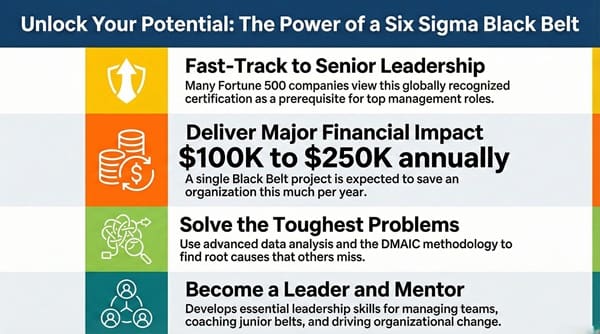
Six Sigma Black Belt training opens doors that are usually locked for general managers. Many Fortune 500 companies view this certification as a prerequisite for senior leadership roles. Why? Because a Black Belt is a proven change agent who can handle pressure.
When you hold this credential, you demonstrate that you possess a high level of business acumen. It shows you can manage large-scale projects and deliver measurable results. In today’s competitive job market, wouldn’t you want a resume that screams “problem solver”?
2. Mastering Advanced Problem Solving
Six Sigma Black Belt training teaches you how to look past symptoms to find the actual root cause of a problem. Most people fix the surface issue, which is why the problem returns. You will learn the DMAIC (Define, Measure, Analyze, Improve, Control) methodology at a much deeper level than in previous tiers.
Black Belts are equipped to handle the most difficult challenges within an organization. You use statistical tools to prove your theories rather than relying on “gut feelings.” This scientific approach removes the guesswork from business operations.

Public, Onsite, Virtual, and Online Six Sigma Certification Training!
- We are accredited by the IASSC.
- Live Public Training at 52 Sites.
- Live Virtual Training.
- Onsite Training (at your organization).
- Interactive Online (self-paced) training,
3. Financial Impact for Your Organization
Six Sigma Black Belt training focuses heavily on the bottom line. As a Black Belt, your primary goal is to reduce waste and save money. Most organizations expect a Black Belt project to save at least $100,000 to $250,000 annually.
Here is the thing: companies love people who make them money. By identifying non-value-added activities, you directly increase the company’s profitability. To be honest, your salary becomes a minor expense compared to the millions you can save the business over time. Have you thought about how much waste is currently hidden in your daily processes?
4. Leadership Development
Six Sigma Black Belt training is essentially a leadership course disguised as a statistics class. You don’t just sit behind a computer; you lead people. You must learn how to manage stakeholders who might be resistant to change.
In my experience, the “soft skills” you gain are just as vital as the technical ones. You learn how to facilitate meetings, resolve conflicts, and motivate a team toward a common goal. This training transforms you into a visionary leader who can bridge the gap between technical teams and executive boards.
Also See: FAST-TRACK Online Six Sigma Black Belt Certification
5. Enhanced Data Analysis Skills
Six Sigma Black Belt training introduces you to advanced statistical software like Minitab or SigmaXL. You will move beyond simple averages and learn about regression analysis, hypothesis testing, and Design of Experiments (DOE).
Six Sigma Black Belt training ensures you can interpret complex data sets to predict future outcomes. Instead of reacting to what happened yesterday, you start predicting what will happen tomorrow. This shift from reactive to proactive management is what separates a Black Belt from a standard project manager.
6. Global Professional Recognition
Six Sigma Black Belt training is a globally recognized standard. Whether you are in New York, London, or Tokyo, the language of Six Sigma remains the same. This makes you a highly mobile professional.
The certification proves you have reached a specific level of professional excellence. It is a badge of honor that tells recruiters you understand quality management systems (QMS) and operational excellence. It is one of the few certifications that carries weight across almost every industry, from healthcare to manufacturing.
7. Standardizing Processes
Six Sigma Black Belt training emphasizes the importance of consistency. A process that works differently every time is a broken process. You learn how to create Standard Operating Procedures (SOPs) that ensure every employee delivers the same high quality.
One should note that variation is the enemy of quality. By implementing Black Belt strategies, you reduce this variation. This leads to a more predictable business environment where errors are rare. Wouldn’t life be easier if every process in your office worked perfectly every single time?
Also Read: How SSDSI Helps Students with Six Sigma Black Belt Certification?
8. Mentorship and Coaching Roles
Six Sigma Black Belt training prepares you to be a teacher. Part of your role is to coach Green Belts and Yellow Belts. This mentorship is crucial for building a culture of continuous improvement within the company.
By sharing your knowledge, you multiply your impact. You aren’t just one person solving a problem; you are building an army of problem solvers. This ability to develop others is a hallmark of senior management and is highly valued by HR departments.
9. Customer Satisfaction Improvement
Six Sigma Black Belt training teaches you to see the world through the eyes of the customer. We call this the Voice of the Customer (VOC). If the customer isn’t happy, nothing else matters.
Through this training, you learn how to align your internal processes with what the customer actually values. Reducing defects means the customer receives a better product or service. Happy customers lead to repeat business and a stronger brand reputation.
10. Strategic Business Alignment
Six Sigma Black Belt training helps you understand the “big picture.” Black Belts don’t just pick random projects; they pick projects that align with the company’s strategic goals.
You learn how to use a Project Charter to ensure your work supports the CEO’s vision. This alignment ensures that your efforts aren’t wasted on minor issues while the main business goals are ignored. It makes you a strategic partner to the executive team rather than just a technical specialist.
Key Takeaways for Reasons for Six Sigma Black Belt Training
If you are considering this path, keep these points in mind:
- Black Belt certification is a high-level credential that signifies leadership and technical expertise.
- The training focuses on the DMAIC methodology to drive significant financial savings.
- You will master advanced statistical tools to make data-driven decisions.
- Mentorship and coaching of junior belts is a core responsibility.
- The certification is applicable across diverse industries globally.
- It serves as a bridge to senior management and executive roles.
FAQs for Reasons for Six Sigma Black Belt Training
Q: Do I need to be a Green Belt before taking Six Sigma Black Belt training? A: While it is helpful, many programs allow you to jump straight into Black Belt training if you have sufficient project experience. However, a solid understanding of basic Six Sigma principles is essential.
Q: How long does the certification process take? A: Typically, the classroom or online portion takes 2 to 4 weeks. However, full certification often requires completing a real-world project, which can take several months.
Q: Is the math very difficult in Black Belt training? A: You will use statistics, but modern software handles most of the heavy lifting. The focus is more on interpreting the data rather than doing manual calculations.
Q: Can I apply these skills in a service industry like banking? A: Absolutely. Six Sigma is just as effective in reducing loan processing times or bank errors as it is in a car factory.
Final Words
Six Sigma Black Belt training is a significant investment in your future. It requires dedication, logical thinking, and a passion for excellence. To be honest, it is not for everyone. It is for those who want to lead, innovate, and drive real change.
Six Sigma Development Solutions Inc. values the growth of our clients and believes that empowering individuals with these tools creates a better world for everyone. If you are ready to stop guessing and start knowing, this is your next step. Take the leap and become the expert your industry needs.
Contact us today for Black Belt Training and Certification.
About Six Sigma Development Solutions, Inc.
Six Sigma Development Solutions, Inc. offers onsite, public, and virtual Lean Six Sigma certification training. We are an Accredited Training Organization by the IASSC (International Association of Six Sigma Certification). We offer Lean Six Sigma Green Belt, Black Belt, and Yellow Belt, as well as LEAN certifications.
Book a Call and Let us know how we can help meet your training needs.