Six Sigma in training is the secret weapon for companies that want to stop guessing and start growing. Have you ever felt like your corporate coaching programs are just “throwing spaghetti at the wall” to see what sticks? We’ve all been there. You spend thousands on a shiny new seminar, but a month later, your team is back to their old habits. It’s frustrating, right? To be honest, most training fails because it lacks a data-driven backbone.
That is where Six Sigma comes in. Traditionally, people think of this as a tool for car factories or chemical plants. However, in my view, it is even more powerful when applied to human behavior and skill development. It’s about reducing “defects” in learning.
What is a defect in training? It is a missed sale, a coding error, or a misunderstood instruction. By applying these structured methods, we can make sure every minute spent coaching actually turns into a measurable result.
What is Six Sigma in Training?
The term Six Sigma in training refers to a disciplined, data-driven approach for eliminating defects in any process. When we apply this to coaching, we’re looking at the gap between what a student knows and what they need to know. Think of it as a GPS for your career development. Instead of a vague “we need better leadership,” we look for specific, measurable points of failure.
In most training setups, the “process” is the delivery of knowledge. If a teacher explains a concept but the student can’t apply it, the process has failed. Six Sigma helps us find out why. Is the material too hard? Is the coaching style wrong? Or is there a lack of practice?
By treating skill development like a high-precision assembly line, we ensure that the “final product”—a skilled employee—is top-tier every single time.

Public, Onsite, Virtual, and Online Six Sigma Certification Training!
- We are accredited by the IASSC.
- Live Public Training at 52 Sites.
- Live Virtual Training.
- Onsite Training (at your organization).
- Interactive Online (self-paced) training,
Why Does Your Coaching Need a Methodology?
Without a system like Six Sigma in training, coaching is just a series of nice conversations. Don’t get me wrong, rapport matters. But rapport doesn’t fix a 20% error rate in your customer service department. You need a way to measure growth.
We’ve seen this in our own consulting work. One client was struggling with a high turnover rate during the onboarding phase. They thought their trainers weren’t “engaging” enough. After looking at the data, we found the real defect: the training manual used words that didn’t match the software the employees actually used. It was a simple process error. Once we fixed the “defect,” retention jumped by 40%. This is the power of moving from “I think” to “I know.”
The DMAIC Framework for Skill Development
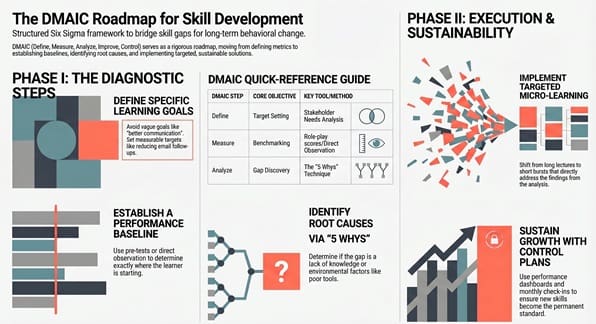
If you want to master Six Sigma in training, you have to live by the DMAIC acronym. It stands for Define, Measure, Analyze, Improve, and Control. This is the roadmap for any coach who wants to see real change.
1. Define the Learning Goals
First, you must define what success looks like. You can’t just say you want “better communication.” You need to say, “We want to reduce the number of email follow-ups required to close a ticket by 15%.”
Who is the customer here? In training, the “customer” is often the department manager who needs a skilled worker. What do they need? Once you define the specific skill gap, you have a target to hit.
2. Measure the Current Skill Level
Now, let’s discuss the “Measure” phase. How do you know how much someone needs to learn if you don’t know where they are starting? This is where many coaching programs fall apart. They give the same training to everyone.
Instead, use pre-tests, role-play scores, or direct observation. If you are teaching a sales team, measure their current conversion rate. This gives you a baseline. Without a baseline, you are just running a race without a starting line.
3. Analyze the Gaps
In this section, we will look for the root cause of the skill gap. Why isn’t the team performing? Is it a lack of knowledge, or is the environment holding them back?
In my experience, we often find that the “defect” isn’t the person; it’s the tools they use. To be honest, even the best coach can’t help a runner with broken shoes. Use the “5 Whys” technique here. Ask why the error happens, then ask why again, until you hit the core issue.
4. Improve the Coaching Delivery
Now, let’s discuss how we actually fix the problem. This is where we get creative with Six Sigma in training. You might change the format from long lectures to short, 5-minute “micro-learning” bursts.
Maybe you introduce peer-to-peer coaching. Whatever the solution, it must directly address the “Analyze” phase findings. If the data showed that people forget the material after two days, your “Improve” step should include a follow-up quiz 48 hours later.
5. Control the Results
Finally, you must ensure the new skills stick. This is the “Control” phase. We’ve all seen people do great during a workshop and then go back to their old ways on Monday.
To prevent this, create a “Control Plan.” This could be a monthly check-in or a performance dashboard. The goal is to make sure the “new way” becomes the “only way.”
Reducing Variation in Corporate Coaching
A major goal of Six Sigma in training is reducing variation. Imagine you have two trainers. One is a rockstar, and the other is just “okay.” This means your employees are getting different levels of help. That’s a problem for a growing company.
Standardizing the Coach’s Playbook
To get consistent results, you need a standard process. This doesn’t mean your coaches have to be robots. It means they should all follow the same core steps.
Think about it like a professional kitchen. Every chef might have their own flair, but the recipe for the signature dish stays the same. This ensures the customer always gets what they paid for. In the same way, your employees deserve a high standard of coaching, no matter who is leading the session.
Also Read: How Six Sigma Online Training Enhances Learning Experience?
The Role of Feedback Loops
How often do you ask your students for feedback? And no, those “smile sheets” at the end of a class don’t count. We need real, honest data.
- Did the training make your job easier?
- What was the most confusing part?
- Have you used this skill in the last 24 hours?
When you treat feedback as data, you can constantly refine your Six Sigma in training approach. It becomes a living, breathing system that gets better every day.
Measuring the ROI of Skill Development
Let’s talk money for a second. Executives love Six Sigma because it focuses on the bottom line. When you use Six Sigma in training, you stop looking at “hours spent in a classroom” and start looking at “Return on Investment” (ROI).
Calculating the Cost of Training Defects
A “defect” in training is expensive. If a new hire takes six months to become productive instead of three, that’s three months of “wasted” salary.
By using DMAIC, you can shorten that “time to productivity.” If you reduce onboarding time by just 10%, how much money does that save the company? Usually, it’s a lot more than the cost of the training itself. This is how you prove to your boss that coaching isn’t just a “nice-to-have” expense.
Moving Beyond Completion Rates
I’ve seen so many HR departments brag about “100% course completion.” But who cares if everyone finished the video if nobody learned the skill?
Six Sigma in training pushes us to look at “Capability Indices.” Are the employees actually capable of doing the task within the required limits? That is the only metric that truly matters.
Common Challenges in Lean Training
It isn’t all sunshine and rainbows. Implementing Six Sigma in training can be tough. Some people might feel that data “takes the soul out” of coaching.
Here is the thing: Data doesn’t replace empathy; it directs it. When I know exactly where you are struggling, I can be a more supportive coach. I’m not wasting your time on things you already know. I am helping you where it hurts.
Overcoming Resistance to Change
People hate being measured. It makes them nervous. To fix this, you have to show them that Six Sigma is a tool for their growth, not a weapon to use against them.
When employees see that the new training methods actually make their jobs easier, the resistance melts away. We are all humans, after all. We want to be good at what we do.
Also Read: Top 10 Reasons for Six Sigma Black Belt Training
Key Takeaways for Your Strategy
Before we wrap up, let’s look at the most important points for using Six Sigma in training effectively:
- Focus on Defects: Identify the specific gaps in knowledge that lead to errors.
- Use the DMAIC Cycle: Never start a coaching session without Defining and Measuring first.
- Reduce Variation: Ensure every employee gets the same high-quality coaching experience.
- Prioritize ROI: Measure the financial impact of your skill development programs.
- Keep it Simple: Don’t let the statistics overwhelm the human element of learning.
Frequently Asked Questions
Does Six Sigma work for soft skills like leadership?
Yes, absolutely. You just have to define the metrics. For leadership, you might measure team retention rates, 360-degree feedback scores, or project deadline hit rates. If you can observe it, you can measure it.
Is Six Sigma in training too expensive for small businesses?
Not at all. You don’t need fancy software to start. You just need a spreadsheet and a commitment to the DMAIC process. Start small by fixing one specific training problem and grow from there.
How long does it take to see results?
You will often see “quick wins” in the first 30 days, especially in the “Measure” and “Analyze” phases. However, a full culture shift toward data-driven coaching usually takes six months to a year.
Do trainers need to be Black Belts to use this?
While a Six Sigma certification helps, the basic principles of DMAIC are easy to learn. Anyone can start using these steps to improve their coaching today.
Final Words
At our core, we believe that every person has the potential to be a high-performer. They just need the right roadmap. Six Sigma in training isn’t about turning people into machines; it’s about clearing the path so they can shine. We’re dedicated to helping our clients build coaching systems that are both kind and incredibly efficient.
When you focus on the data, you respect your employees’ time and your company’s resources. It’s a win-win for everyone involved. Our values are built on this bridge between human potential and process excellence. We don’t just teach; we transform the way your organization learns.

About Six Sigma Development Solutions, Inc.
Six Sigma Development Solutions, Inc. offers onsite, public, and virtual Lean Six Sigma certification training. We are an Accredited Training Organization by the IASSC (International Association of Six Sigma Certification). We offer Lean Six Sigma Green Belt, Black Belt, and Yellow Belt, as well as LEAN certifications.
Book a Call and Let us know how we can help meet your training needs.