Six Sigma and electric mobility are teaming up to change how we move from place to place. Have you ever wondered why some electric cars feel like spaceships while others struggle with basic battery issues? It usually comes down to how the company manages its manufacturing math.
Here’s the thing: making an Electric Vehicle (EV) isn’t just about swapping an engine for a motor. It’s a total shift in how we build machines. We’re moving from oily gears to high-voltage software on wheels. To make this work without breaking the bank or compromising safety, car makers need a rigorous system. That’s where the 6S methodology shines.
In my experience, the transition to green energy is messy. There are many moving parts—literally and figuratively. But when you apply data-driven logic to the assembly line, the “messy” parts start to disappear. We’ve all seen headlines about battery recalls, right? Those are the exact nightmares that a solid quality framework aims to prevent.
Table of contents
What is Six Sigma and Electric Mobility Integration?
When we talk about Six Sigma and electric mobility, we’re discussing the quest for near-perfection. In simple terms, this methodology focuses on reducing defects. It uses a five-step process called DMAIC: Define, Measure, Analyze, Improve, and Control.
In the EV world, “defects” aren’t just scratches on the paint. They are microscopic flaws in battery cells or tiny glitches in the car’s brain. If a gas car has a fuel leak, it’s bad. If an EV has a battery thermal runaway, it’s a catastrophe. Therefore, the margin for error is almost zero.
Why do we need this now? Because the EV market is growing faster than the supply chain can keep up. Manufacturers are rushing. When people rush, they make mistakes. By using 6S, companies can move fast without breaking things—or at least, without breaking the things that keep you safe on the highway.

Public, Onsite, Virtual, and Online Six Sigma Certification Training!
- We are accredited by the IASSC.
- Live Public Training at 52 Sites.
- Live Virtual Training.
- Onsite Training (at your organization).
- Interactive Online (self-paced) training,
The Role of Data in EV Manufacturing
Data is the fuel for this process. We don’t guess; we measure. To be honest, most people think car manufacturing is just robots welding metal. In reality, it’s a constant stream of numbers. How much heat did that weld produce? What is the exact voltage of that cell?
By analyzing this data, engineers can spot a problem before it even happens. It’s like having a crystal ball, but the ball is made of spreadsheets and statistical models. Isn’t it better to fix a machine on Tuesday than to recall 50,000 cars on Friday?
Six Sigma and Electric Mobility: Improving Battery Life
The battery is the most expensive part of any electric ride. It’s also the most sensitive. One of the biggest hurdles for Six Sigma and electric mobility is ensuring battery consistency.
Have you noticed how your phone battery gets worse after a year? Now, imagine that happening to your car. To prevent this, manufacturers use the “Analyze” and “Improve” stages of DMAIC to perfect the chemical coating on battery electrodes.
Also Read: Six Sigma Certification Exam Preparation
Reducing Variation in Cell Production
Variation is the enemy of quality. If one battery cell is slightly different from the other 4,000 cells in a pack, the whole pack suffers. It’s like a chain that’s only as strong as its weakest link.
- Step 1: Measure the thickness of the lithium coating.
- Step 2: Use statistical tools to find out why some are thicker than others.
- Step 3: Adjust the machinery to hit the “sweet spot” every single time.
This precision is how we get cars that can travel 300 miles on a single charge for ten years straight. Without these checks, we’d be stuck with expensive paperweights after a few thousand miles.
How Six Sigma and Electric Mobility Reduce Costs
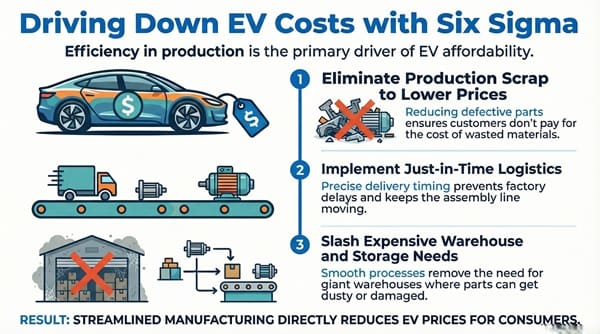
Let’s be real: EVs are still pricey. We want them to be cheaper so everyone can drive one. One way to lower the price is to stop wasting money during production.
In the world of Six Sigma and electric mobility, waste is often referred to as “Lean” thinking. If a factory produces 100 motors but has to scrap 10 because they didn’t pass the test, that’s a 10% waste of money. The customer ends up paying for those 10 scrapped motors through a higher car price.
Streamlining the Supply Chain
Many EV parts come from all over the globe. Cobalt from one place, nickel from another, and chips from somewhere else. If the timing is off, the factory stops.
By applying 6S principles to logistics, companies can ensure parts arrive “Just in Time.” This reduces the need for giant, expensive warehouses. It also means the parts don’t sit around getting dusty or damaged. When the process is smooth, the car is cheaper to build.
Also Read: Integrating Six Sigma with Lean & ISO
Improving Safety Through Six Sigma and Electric Mobility
Safety is the biggest concern for new EV buyers. We’ve all heard the stories about fires. While EVs are statistically safer than gas cars in terms of fire risk, the perception remains.
The Six Sigma and electric mobility framework addresses this through “Failure Mode and Effects Analysis” (FMEA). This is a fancy way of saying, “Let’s brainstorm every possible way this could break and fix it now.”
Testing Software Integrity
Modern EVs are basically computers on wheels. A bug in the code could mean the brakes don’t engage or the car accelerates unexpectedly.
- Define: What is the critical software function?
- Control: How do we ensure the software doesn’t “drift” or fail over time?
By treating software updates with the same rigor as physical parts, manufacturers create a shield of safety around the driver. Does it feel better knowing your car’s brain was tested against billions of simulated miles? I certainly think so.
Six Sigma and Electric Mobility in Charging Infrastructure
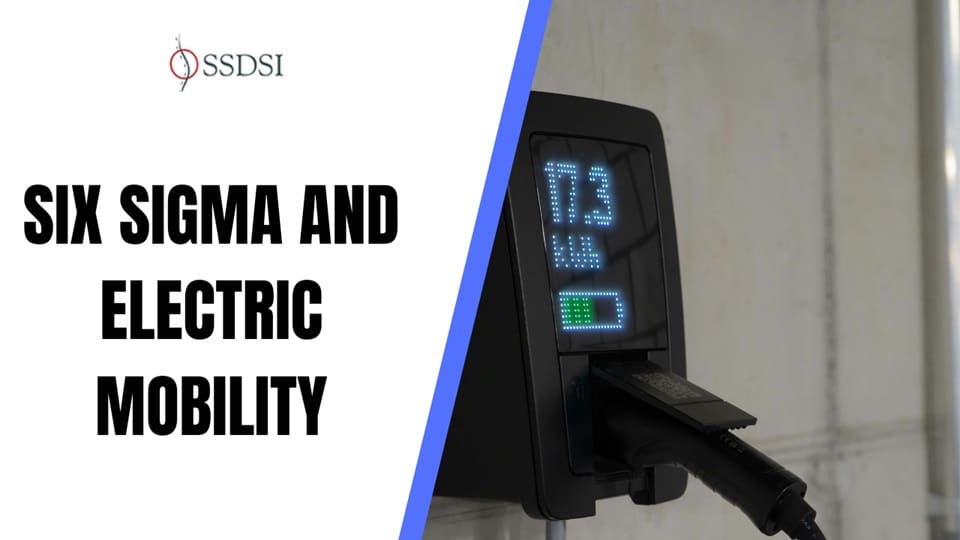
It’s not just about the cars. We need chargers that actually work. Have you ever pulled up to a public charger only to find it out of order? It’s frustrating.
The Six Sigma and electric mobility approach applies to the “uptime” of charging networks. Companies use data to track which parts fail most often in a charger. Is it the cable? The payment screen? The cooling fan?
Once they identify the culprit, they can redesign the part. This leads to a world where “Range Anxiety” becomes a thing of the past because you can trust the plug.
The Future of Six Sigma and Electric Mobility
As we move toward 2030, we’re going to see even more automation. Robots will be doing most of the heavy lifting. But even robots need a manager. That manager is the Six Sigma professional.
The future of Six Sigma and electric mobility will likely involve AI. Imagine a system that sees a tiny vibration in a drill and automatically corrects it in a microsecond. We’re not quite there yet, but the foundation is being built today.
We’ve all been there—buying a product that feels “cheap.” In the EV era, we can’t afford “cheap.” We need “reliable.” By sticking to the math, we ensure the green revolution is a successful one.
Key Takeaways
- Six Sigma reduces defects in complex EV parts like batteries and motors.
- DMAIC provides a roadmap for solving manufacturing glitches.
- Lowering waste leads to more affordable electric vehicles for you.
- Rigorous testing ensures that EV software and hardware are safer than ever.
- Quality control extends to charging stations, making them more reliable.
Frequently Asked Questions
Is Six Sigma still relevant for modern tech like EVs?
Yes, it’s more relevant than ever. Because EVs have so many electronic components, the chance for small errors is high. 6S helps manage that complexity.
How does Six Sigma help the environment?
By reducing waste and “rework,” factories use less energy and fewer raw materials. This makes the whole production process greener.
Do I need to be a math genius to understand Six Sigma?
Not really! While the pros use heavy stats, the basic idea is just about being organized and making decisions based on facts rather than feelings.
Final Words
At the end of the day, Six Sigma and electric mobility are about trust. You want to trust that your car will start, that it’s safe, and that it will last. We believe in a world where technology works for people, not the other way around. Our focus is always on the client—ensuring you get a product that is as reliable as it is innovative. We don’t just build for today; we engineer for a sustainable tomorrow.

About Six Sigma Development Solutions, Inc.
Six Sigma Development Solutions, Inc. offers onsite, public, and virtual Lean Six Sigma certification training. We are an Accredited Training Organization by the IASSC (International Association of Six Sigma Certification). We offer Lean Six Sigma Green Belt, Black Belt, and Yellow Belt, as well as LEAN certifications.
Book a Call and Let us know how we can help meet your training needs.