

In the published paper, the authors state they are unaware of any prior published literature describing Lean Six Sigma (LSS) applied to non-clinical-trial epidemiologic research operations. That distinction matters: this is not simply a customer success story. It documents how a structured continuous-improvement framework can be adapted to large-scale academic research administration, a use case the authors say had not previously appeared in the published literature.
Six Sigma Development Solutions, Inc. (SSDSI) trained 20 operations staff at the Nurses’ Health Studies (NHS), a Harvard-affiliated research platform run through Brigham and Women’s Hospital’s Channing Division of Network Medicine, in Lean Six Sigma (LSS) methodology.
Over a 40-hour classroom program and a six-month mentored project period, teams cut medical record retrieval turnaround time by 90%, reduced undeliverable participant questionnaires by 31%, and shortened biorepository freezer maintenance cycles by 18%, saving an estimated 6.5 person-weeks of staff time annually.
Fourteen staff earned Lean Six Sigma Green Belt certification, building process-improvement expertise that now lives inside the NHS operations team rather than with an outside vendor. The results were peer-reviewed and supported by formal statistical testing, then published in the American Journal of Epidemiology (Oxford University Press) in April 2026. The study’s authors state they were unaware of any prior published literature describing Lean Six Sigma applied to non-clinical-trial epidemiologic research operations.
Quick-Reference Table: Case Study at a Glance
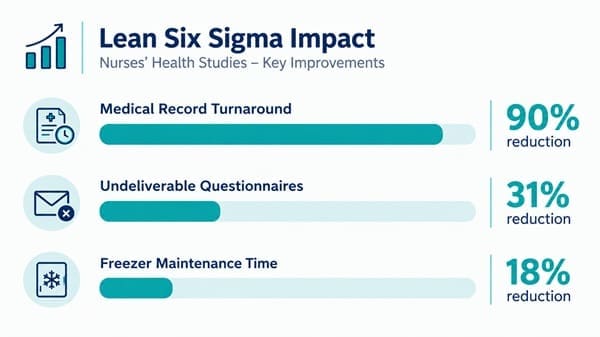
| Metric | Baseline | After Improvement | Change |
| Medical record retrieval turnaround (median) | 357 days | 35 days | 90% reduction |
| Undeliverable NHS/NHSII questionnaires | 63.2% | 43.6% | 31% reduction |
| Biweekly freezer maintenance cycle time (mean) | 236 person-minutes | 193 person-minutes | 18% reduction (~6.5 person-weeks/year saved) |
| Staff completing classroom curriculum | 20 enrolled | 19 completed | 95% completion |
| Staff earning Green Belt certification | 17 attempted projects | 14 certified | 82% of project participants certified |
Table of contents
- Quick-Reference Table: Case Study at a Glance
- Key Takeaways
- Background: Why a 50-Year-Old Research Platform Needed Process Improvement
- Why Lean Six Sigma, and Why It Was Untested in This Setting
- The Three Projects: What Changed and By How Much
- Beyond Efficiency: What These Improvements Mean for Research Quality
- Why This Case Study Is Different From Most Six Sigma Marketing Claims
- What This Means If You’re Considering Lean Six Sigma for a Research or Service Operation
- Bring This Kind of Result to Your Operation
- About Six Sigma Development Solutions, Inc.
Key Takeaways
- The study’s authors state they are unaware of any prior published literature describing Lean Six Sigma applied to non-clinical-trial epidemiologic research, extending the framework’s documented use beyond manufacturing and clinical trials.
- This is a peer-reviewed case study, published in the American Journal of Epidemiology (Oxford University Press), not a self-reported testimonial.
- The training operation was non-manufacturing, applying LSS tools to research administration, participant communications, and biospecimen logistics for one of the longest-running cohort studies in public health.
- All three completed subprojects produced statistically significant, measurable improvements, verified using formal hypothesis testing (log-rank test, z-test, and t-test).
- Fourteen of twenty starting participants earned Green Belt certification, building durable internal process-improvement capacity that remains within the organization long after the engagement ended.
- Beyond operational efficiency, the improvements reduced sources of research bias and strengthened data quality: fewer non-response gaps, faster and more complete diagnostic ascertainment, and better-preserved biospecimens.
Background: Why a 50-Year-Old Research Platform Needed Process Improvement
The Nurses’ Health Studies have run continuously since 1976 and collectively include more than 300,000 participants across three cohorts (NHS, NHSII, and NHS3), contributing to nearly 5,000 peer-reviewed publications that have shaped public health policy and medical research worldwide.
Few research infrastructures of this scale and influence exist; the operational improvements described here occurred inside one of the most established epidemiologic research platforms in the world. The infrastructure supporting that research, custom-built decades ago, had changed little since its founding even as data volume and operational complexity grew.
With federal infrastructure funding for large-scale cohort studies declining, the Channing Division of Network Medicine needed a way to modernize workflows and reduce operating overhead without expanding staff. Leadership identified undocumented processes, disorganized workflows, and recurring bottlenecks as the starting point, and turned to Lean Six Sigma training to build internal capacity for solving them.

Public, Onsite, Virtual, and Online Six Sigma Certification Training!
- We are accredited by the IASSC.
- Live Public Training at 52 Sites.
- Live Virtual Training.
- Onsite Training (at your organization).
- Interactive Online (self-paced) training,
Why Lean Six Sigma, and Why It Was Untested in This Setting
Lean Six Sigma is well established in manufacturing and has been adapted to FDA-regulated clinical trials. The study’s authors state they were unaware of any prior published literature describing its use in non-clinical-trial epidemiologic research operations.
That gap mattered because research administration workflows, participant communications, and biospecimen handling look different from a factory floor or a drug trial, and a training program built entirely around manufacturing examples risks losing the audience before it reaches the tools.
Also Read: Six Sigma in Retail Banking: A Better Way to Manage Operations
Training Program Design and Delivery

SSDSI Master Black Belt instructors Kevin Clay and Keith Schellenberger designed and delivered a 40-hour classroom curriculum, split into two 20-hour weeks, one delivered in person and one by video conference, in September 2024. Twenty staff members were selected across every operational domain: NHS3 and GUTS, Programming, Disease and Tissue Follow-up, Biorepository, NHS and NHSII Questionnaires and Coding, Bioinformatics, and Transformation.
The curriculum combined lecture with hands-on work on trainees’ own real processes, so teams began applying DMAIC (Define, Measure, Analyze, Improve, Control) tools under direct mentorship from the first week rather than waiting until after training ended.
From Classroom to Certification
After the classroom portion, five teams moved into a six-month mentored project period. Each team was required to:
- Collect at least 30 baseline data points on their target process
- Develop and implement an improvement plan
- Collect at least 30 post-improvement data points
- Build a control plan to sustain the gains
- Present their results for Green Belt certification review
Nineteen of 20 staff (95%) completed the classroom curriculum, 17 (85%) went on to participate in projects, and 14 ultimately completed all requirements for Lean Six Sigma Green Belt certification. That 82% certification rate among project participants reflects the program’s core goal: not a one-time consulting engagement, but lasting, internally held process-improvement expertise.
The Three Projects: What Changed and By How Much
Medical Record Retrieval: 90% Faster Turnaround

The disease and tissue follow-up team targeted the time between a participant’s signed consent for a breast cancer medical record and closeout of that record. In the baseline period, 336 requests had a median turnaround of 357 days, with 78% of records eventually received. Using cause-and-effect analysis and FMEA, the team identified standard operating protocols, operator variation, and e-consent handling as the top drivers of delay.
After revising the e-consent workflow, updating mailroom procedures, retraining staff, and adding visual process reminders, median turnaround time dropped to 35 days across 206 new requests, a 90% reduction confirmed by log-rank testing.
Undeliverable Questionnaires: 31% Reduction
The NHS and NHSII questionnaire and coding team found that 63.2% of a sample of mailed questionnaires came back undeliverable. Value stream mapping showed most of that cycle time was non-value-added delay, and SIPOC analysis pointed to outdated participant contact information as the core input problem. FMEA revealed that research assistants updated participant files only when time allowed after other tasks, rather than as a scheduled responsibility.
The team revised the standard operating procedure to allocate dedicated time for updating participant files and to prioritize returned mail by participant record rather than by postal error code. The result: the undeliverable rate dropped from 63.2% to 43.6% overall, a statistically significant 31% reduction, with the largest gains seen in the original NHS cohort.
Freezer Maintenance: 18% Faster Cycles, 6.5 Person-Weeks Saved Annually
The biorepository team manages more than 100 liquid nitrogen freezers across two sites. Baseline data on 53 maintenance cycles showed an average of 236 person-minutes per cycle, with over 20% of that time spent walking between freezer rooms rather than performing maintenance itself.
After capping maintenance teams at four staff, reducing check frequency on modern freezers, repositioning tools closer to each unit, and mapping faster travel routes, mean cycle time dropped to 193 person-minutes, an 18% reduction confirmed by an unpaired t-test. Extrapolated across the year’s maintenance cycles, the team estimated a savings of roughly 6.5 person-weeks of staff time annually.
Beyond Efficiency: What These Improvements Mean for Research Quality
The paper is explicit that these gains are not just about speed or cost. Each project change also reduced a specific source of bias or error that can affect research validity:
- Reducing the undeliverable questionnaire rate lowers loss to follow-up and non-response bias in the underlying cohort data.
- Faster medical record retrieval supports more timely and complete diagnostic ascertainment, reducing the risk of disease misclassification.
- More reliable freezer maintenance helps preserve specimen integrity, reducing measurement error and data loss from compromised samples.
Together, these changes improve data completeness and integrity, which the authors note helps mitigate threats to the internal validity of downstream research findings. For research, healthcare, and academic audiences, this may matter more than the operational metrics alone: the same process changes that saved staff time also made the underlying science more reliable.
Also Read: Six Sigma Principles in Amazon’s Operations and Reducing Wait Times
Why This Case Study Is Different From Most Six Sigma Marketing Claims
Many published Lean Six Sigma results are presented as organizational case studies written by the training provider. This engagement’s results instead went through the standard academic peer-review process and were published in the American Journal of Epidemiology, a journal of the Johns Hopkins Bloomberg School of Public Health, distributed by Oxford University Press.
That distinction matters for anyone evaluating a Six Sigma training provider: a peer-reviewed publication requires methodology disclosure, statistical testing, and editorial scrutiny that a testimonial or case study on a vendor’s own website does not.
Read the full peer-reviewed study: Building process improvement capacity in epidemiologic research operations: the Nurses’ Health Studies experience, American Journal of Epidemiology, 2026.
What This Means If You’re Considering Lean Six Sigma for a Research or Service Operation
The Nurses’ Health Studies engagement suggests three practical lessons for any research, healthcare, or service organization evaluating Lean Six Sigma:
- Manufacturing-oriented curriculum needs adaptation. Staff surveys noted the classroom material initially felt geared toward manufacturing; engagement improved once instructors tailored examples to research operations.
- Project-based certification builds durable internal capacity. Training 14 staff to Green Belt level, rather than certifying a handful of specialists, distributed process-improvement skills across every operational team.
- Operational gains can directly improve data quality. Reducing undeliverable questionnaires lowers loss to follow-up and non-response bias; faster medical record retrieval reduces diagnostic misclassification risk. In a research setting, efficiency gains and data integrity gains are the same gain.
FAQs
Q: What organization was this Lean Six Sigma case study based on?
A: The Nurses’ Health Studies, a set of long-running cohort studies with more than 300,000 participants, operated through the Channing Division of Network Medicine at Brigham and Women’s Hospital and Harvard Medical School.
Q: What results did the Lean Six Sigma training produce?
A: A 90% reduction in median medical record retrieval turnaround time, a 31% reduction in undeliverable participant questionnaires, and an 18% reduction in biweekly freezer maintenance cycle time, saving an estimated 6.5 person-weeks of staff time annually.
Q: How many staff were trained and certified?
A: Twenty staff began the 40-hour classroom program, 19 completed it, 17 went on to project work, and 14 earned Lean Six Sigma Green Belt certification.
Q: Where was this case study published?
A: In the American Journal of Epidemiology, published by Oxford University Press on behalf of the Johns Hopkins Bloomberg School of Public Health, in April 2026, after formal peer review.
Q: Can Lean Six Sigma work in research or academic settings, not just manufacturing?
A: Yes. The study’s authors state they are unaware of prior published literature describing Lean Six Sigma applied to non-clinical-trial epidemiologic research operations, and this engagement produced statistically significant improvements across three separate projects.
Q: Does this study represent an endorsement of SSDSI by Harvard, Brigham and Women’s Hospital, or Oxford University Press?
A: No. SSDSI, and LSS experts Kevin Clay and Keith Schellenberger, are named in the study’s acknowledgments and cited for the DMAIC, SIPOC, value stream mapping, and FMEA frameworks used in training. This reflects their role in delivering the training and mentoring, not an endorsement of SSDSI by Harvard, Brigham and Women’s Hospital, or Oxford University Press.
Final Words
The study’s authors state they are unaware of any prior published literature describing Lean Six Sigma applied to non-clinical-trial epidemiologic research, which places this engagement beyond a typical process-improvement success story.
The Nurses’ Health Studies engagement shows what mentored, project-based Lean Six Sigma training can produce even in a setting the methodology was never originally built for: a 50-year-old academic research operation with no manufacturing floor and no assembly line. Ninety percent faster medical record turnaround, a third fewer undeliverable questionnaires, and a fifth less time spent on biorepository maintenance were achieved not through outside consultants doing the work, but through internal staff trained to Green Belt level and mentored through real DMAIC projects.
The fact that these results were peer-reviewed and supported by formal statistical testing, rather than resting on marketing language alone, is what separates this case study from most claims in the Six Sigma training market.
Bring This Kind of Result to Your Operation
SSDSI is an IASSC accredited Lean Six Sigma training organization, rated 5 stars on Google Reviews, with 5,322+ professionals certified across 600+ organizations in 52 cities.
The Nurses’ Health Studies engagement above was led by SSDSI Master Black Belt instructors Kevin Clay and Keith Schellenberger, who mentored trainees through all five DMAIC phases over a six-month project period, not just the classroom weeks. If your operations team could use similar results, whether in research, healthcare, or another service-based setting, reach out to discuss what a mentored Green Belt program could look like for your staff.
About Six Sigma Development Solutions, Inc.
Six Sigma Development Solutions, Inc. offers onsite, public, and virtual Lean Six Sigma certification training. We are an Accredited Training Organization by the IASSC (International Association of Six Sigma Certification). We offer Lean Six Sigma Green Belt, Black Belt, and Yellow Belt, as well as LEAN certifications.
Book a Call and Let us know how we can help meet your training needs.


