Do you feel like your office work takes too long? Does the flow of information seem to get stuck in certain places? If you run a business, you know that keeping customers happy, cutting costs, and making everything run smoothly are crucial for success. Many people focus on making the factory or production line lean, but the administrative processes—the back-office tasks, information systems, and paperwork—often get ignored.
These office functions, which include customer service, accounting, HR, and purchasing, are where a huge amount of hidden waste lives. In fact, most of the cost of meeting a customer’s request can come from these support activities.
This is where the Lean Office methodology steps in. It takes the powerful principles of Lean Manufacturing, which Toyota pioneered, and applies them directly to your white-collar, administrative environment. Lean Office focuses on creating value for your customer by finding and getting rid of everything that does not add value.
You can dramatically improve your business efficiency, save money, and get work done much faster when you focus on eliminating waste in administrative processes.
Table of contents
How Does Lean Office Define Value and Waste?
Lean Office is about a mindset change. You need to look at every process through the eyes of the customer.
Value: The Customer’s Viewpoint
Value can be understood as any action or step in a process that the customer is willing to pay for. If an activity does not directly help to produce the final product or service the customer wants, then it is non-value-added.
For example, when a customer places an order, the act of entering that order into the system is value-added. However, the time the order spends waiting for approval is not. Lean Office aims to maximize the time spent on value-added activities.

Public, Onsite, Virtual, and Online Six Sigma Certification Training!
- We are accredited by the IASSC.
- Live Public Training at 52 Sites.
- Live Virtual Training.
- Onsite Training (at your organization).
- Interactive Online (self-paced) training,
The Seven Wastes of the Lean Office
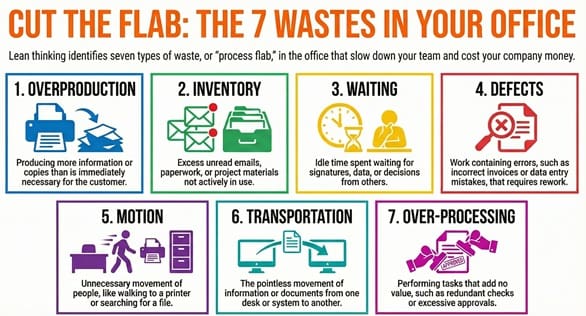
The main focus of Lean Office is to identify and eliminate waste, which Lean Thinking calls Muda. These wastes—or process flab—slow down your team and cost your company money.
The seven common wastes in administrative and office processes include:
- Overproduction: Producing more information than necessary for the customer at that moment. This includes sending too many reports or printing excess copies.
- Inventory: Having more information, documents, or project material available than needed. Too much paperwork, unread emails, or excess filing cabinets represent inventory waste.
- Waiting: Time of inactivity that happens when people or information are not ready. Waiting for signatures, data, or decisions causes delays.
- Defects: Work that is incomplete or contains errors. Mistakes in data entry, incorrect invoices, or flawed documents all require rework.
- Motion: Any unnecessary movement of people that does not add value. For instance, walking across the office to find a shared file or printer is wasted motion.
- Transportation: The movement of information or documents that is unnecessary. Moving a file from one desk to another for no real reason is a transportation waste.
- Over-Processing: Performing labor that generates no value from the customer’s point of view. This includes extra checks, redundant data entry, or requiring too many approvals for simple tasks.
Identifying these areas is the very first step toward having a Lean Office. You must learn to see the process flab that exists in your daily work.
Also Read: Lean Six Sigma Project to Reduce Office 365 Outlook Incident Tickets
Lean Office vs. Lean Manufacturing: Understanding the Difference
While Lean Office uses the concepts of Lean Manufacturing, the application is different because of the work environment.
| Basis for Comparison | Lean Office | Lean Manufacturing |
| Primary Flow | Information, knowledge, and documents | Physical materials and products |
| Visibility of Work | Less visible; often hidden in systems and desks | High visibility on the shop floor |
| Nature of Processes | Highly variable, often less structured, people-oriented | Structured, repetitive, typically sequential |
| Key Waste Target | Waiting, Defects, Over-Processing, Information Inventory | Physical Defects, Transportation, Material Inventory |
| Focus | Streamlining information flow and decision-making | Optimizing production flow and assembly |
Lean Office specifically aims to streamline information flow in any administrative function. This is in contrast to Lean Manufacturing, which focuses on material flow. Both systems ensure that all activities add value for the end customer.
Key Steps to Implement a Lean Office
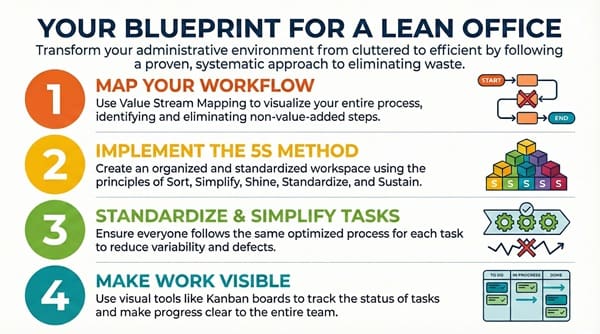
You cannot simply wish for a more efficient office. Achieving a Lean Office requires a systematic approach.
1. Map Your Administrative Processes
To understand your processes better and eliminate waste, you must first map the flow of work.
- Process Mapping refers to visually charting the steps in a process, such as order entry or accounts payable.
- The Value Stream Mapping (VSM) tool is vital here. It lets you see the current state of a process, identify value-added steps versus non-value-added steps, and determine the total lead time.
- Once you map the current state, you can determine where bottlenecks happen and where you need to remove waste for the future state process.
2. Implement the 5S Methodology
The 5S principles, originally from manufacturing, are crucial for achieving organization and standardization in the office.
- Sort (Seiri): Separate the necessary from the unnecessary. You need to get rid of old files, excess supplies, and rarely used documents.
- Simplify (Seiton): Do away with everything that makes work complicated by organizing the necessary items. Everything should have a clear place.
- Shine (Seiso): Clean and inspect the office area regularly. This ensures that you spot problems, like a broken printer or missing supplies, right away.
- Standardize (Seiketsu): Establish clear guidelines for how work is done and how the area is organized. This step ensures everyone does the process the same way.
- Sustain (Shitsuke): Make the Lean Office approach part of your office’s culture and DNA. You must constantly monitor and adjust the new system.
3. Standardize and Simplify Administrative Processes
Why does standardization matter? Because many people doing the same task will often do it their own way. This variability creates defects and increases the time spent on training.
- Process Standardization ensures that everyone follows the same steps for a given circumstance. This is key to reducing process variability.
- Simplification means reducing the number of steps and handoffs. Often, 75 to 90 percent of the steps in a service process add no value. You should aim to eliminate redundant tasks.
- This simplification can involve low-cost automation, such as setting up automatic email acknowledgments for customers.
4. Use Visual Management Tools
Since information flow is less visible than a physical product, you must make the office work visible.
- Kanban is a signaling tool that promotes the visualization of activities. You can use a simple “To Do,” “In Progress,” and “Done” board to see the status of tasks.
- Andon tools, which alert employees through color-coding about problems in real-time, can signal overdue tasks with a digital red flag.
- Using Production Boards for daily management helps teams track goals and see progress easily.
Also Read: Lean Six Sigma in Las Vegas Casinos
Why Your Organization Needs a Lean Office Mindset
Applying a Lean Office system helps your company achieve operational excellence. It offers benefits at every level of your organization.
Enhancing Customer Satisfaction
- Lean Office allows you to meet customer demand faster. By eliminating process flab like long waiting times, you drastically reduce the total lead time from order to fulfillment.
- It improves the quality of your output. When you reduce defects in paperwork and data, your customers receive correct information the first time.
Boosting Employee Productivity and Morale
- When you streamline processes, employees spend less time on frustrating, non-value-added tasks. They have more time for activities that truly matter.
- Empowering people is a core principle. Employees who are trained to identify and eliminate waste feel more engaged and responsible for their team’s success.
- Cross-training, a Lean Office technique, increases team flexibility. This allows you to adjust staff easily when demand fluctuates.
Achieving Bottom-Line Savings
Do you know how much money you spend on unnecessary tasks? Lean Office directly affects the bottom line.
- Cost Reduction: By simplifying work and eliminating waste, you reduce labor costs associated with rework, searching for files, and lengthy approvals.
- Better Resource Use: You ensure a better use of your work area and time. You are no longer wasting space on excess inventory (files, supplies).
What is the biggest waste you currently deal with? Most people struggle with waiting time and rework due to defects.
The Three Key Wastes That Hide in the Office
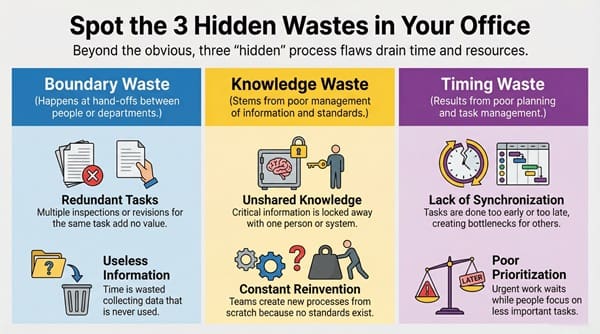
In addition to the traditional seven wastes, administrative environments often struggle with three specific kinds of process flab that are hard to spot. Addressing these is essential for a high-performing Lean Office.
1. Boundary Waste
Boundary Waste happens because of hand-offs or transfers between different people, departments, or even external companies.
- Useless Information: Costs associated with collecting information that you will never use. You must reduce useless information flow.
- Large Batches of Information: Lead time increases significantly when you wait for large batches of information to be compiled before moving to the next step.
- Redundant Tasks: Many processes include redundant tasks, like multiple inspections or revisions, that you can safely eliminate.
2. Knowledge Waste
This occurs when your knowledge system has a lack of standardization or quality management.
- Unshared Knowledge: Important information processed by a few individuals or stored in a single computer system is not shared with others. The team cannot act on what they do not know.
- Reinvention: This includes having to create new knowledge because there is no standard. If every person creates their own report template, this is knowledge waste.
- Quality Problems: Rework and information of a substandard quality being transacted.
3. Timing Waste
Timing Waste results from poor time management around task planning and execution.
- Lack of Synchronization: Tasks are done too early or too late, which forces other departments to wait. You must determine the right moment to start a task.
- Poor Prioritization: When priorities are unclear, people work on less important tasks while urgent work waits.
Key Takeaways for Your Lean Office Journey
- Focus on Value: Always look at your administrative processes from the customer’s point of view to find what truly adds value.
- Eliminate Process Flab: Actively search for the seven traditional wastes (Overproduction, Inventory, Waiting, Defects, Motion, Transportation, Over-Processing) and the three key hidden wastes (Boundary, Knowledge, Timing).
- Standardize Work: Map your processes, especially using Value Stream Mapping, to ensure everyone follows the same, efficient path.
- Make it Visual: Use tools like Kanban and Andon to track progress and problems, ensuring that information flow is transparent.
- Empower Your Team: Get the entire team involved in identifying and fixing waste, as they perform the work daily and know the pain points best.
Frequently Asked Questions About Lean Office
What is the main objective of the Lean Office methodology?
The main objective is to eliminate waste (non-value-added activities) in administrative, service, and office processes. This aims to reduce costs, cut down on lead time, and improve overall quality and customer satisfaction.
Is Lean Office only for large companies?
No, the Lean Office approach is for any organization, regardless of size, that has administrative and support processes. Every company has paperwork, HR functions, and customer service that can benefit from streamlining processes and eliminating waste.
What is the most common waste in the office environment?
Waiting is one of the most common and damaging wastes in the office. This involves waiting for approvals, waiting for information, or waiting for a colleague to finish a task, all of which significantly increase lead time.
How is Lean Office sustained?
You sustain the Lean Office by creating a continuous improvement culture. This requires strong leadership commitment, constant training, and making process standardization part of your team’s everyday work. You must continuously monitor and adjust your improved processes.
Final Words
You do not have to settle for slow, wasteful, and frustrating administrative work. By adopting the principles of the Lean Office, you gain the power to eliminate process flab and transform your support functions into efficient, value-adding parts of your business. This approach is not just a trend; it is a proven, systematic approach for creating a business that runs with the highest efficiency and the lowest possible cost.
Ready to see how fast your order-to-cash cycle can truly be? Let us work with you to map your administrative processes, identify waste, and build a clear plan for your Lean Office transformation. We focus on providing solutions that put your customer first, ensuring that every step your team takes adds value.
Contact us today to learn how we implement the Lean Office approach for measurable success.

About Six Sigma Development Solutions, Inc.
Six Sigma Development Solutions, Inc. offers onsite, public, and virtual Lean Six Sigma certification training. We are an Accredited Training Organization by the IASSC (International Association of Six Sigma Certification). We offer Lean Six Sigma Green Belt, Black Belt, and Yellow Belt, as well as LEAN certifications.
Book a Call and Let us know how we can help meet your training needs.