The Input Process Output model, or IPO for short, serves as the basic building block for how almost every system in our world functions. Whether you’re baking a cake, coding a mobile app, or managing a giant corporate team, you’re using this model. But what exactly happens between the moment you start a task and the moment you see the finished result?
To be honest, we often overlook the “process” part. We focus so much on what we put in and what we want out that the middle bit becomes a mystery. Have you ever wondered why two people can have the same ingredients but end up with totally different results?
That’s the IPO model in action. In this guide, we’ll break down this framework so you can use it to make your work—and your life—a lot smoother.
Table of contents
What is the Input Process Output Model?
The Input Process Output model is a functional graph that identifies the inputs, outputs, and required processing steps for a system. Think of it like a map. It shows where things come from, where they go, and how they change along the way.
In its simplest form, the model looks like a straight line:
- Input: The raw materials or data you start with.
- Process: The actions or tasks that change the input.
- Output: The final product or information you get at the end.
In my view, the beauty of the IPO model lies in its simplicity. You don’t need a PhD to understand it. However, it’s powerful enough to run a global supply chain. We use it in computer science to explain how software works, in business to improve efficiency, and even in psychology to study how humans think.

Public, Onsite, Virtual, and Online Six Sigma Certification Training!
- We are accredited by the IASSC.
- Live Public Training at 52 Sites.
- Live Virtual Training.
- Onsite Training (at your organization).
- Interactive Online (self-paced) training,
Components of the IPO Model
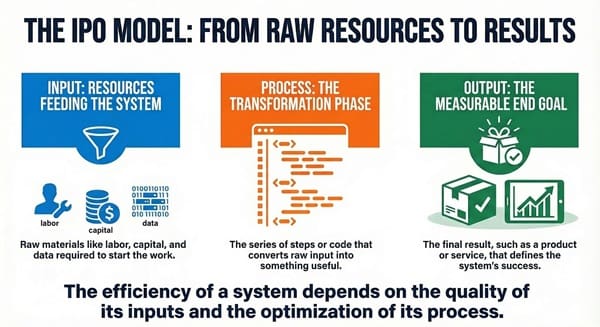
To really get how this works, we need to look at each piece of the puzzle. It’s not just about listing things; it’s about understanding how they interact.
1. The Input Phase
Inputs are the resources we feed into a system. Without high-quality inputs, your output will likely struggle. We’ve all heard the phrase “garbage in, garbage out,” right? Well, that’s exactly what this refers to.
Inputs can be physical things like flour and eggs for a baker. They can also be digital, like the numbers you type into a calculator. In a business setting, inputs include:
- Labor: The people doing the work.
- Capital: The money and equipment used.
- Information: Data, market research, or customer feedback.
- Time: The most valuable input we often forget to measure.
2. The Processing Phase
This is where the magic happens. The process is the series of steps that transforms your raw input into something useful. If you’re using the Input Process Output model to analyze a software program, the “process” is the code running in the background.
If you’re looking at a manufacturing plant, the process involves assembly lines, welding, and quality checks. This stage is usually where you’ll find the most “friction.” It’s where delays happen and where most of your costs live. That’s why smart managers spend most of their time optimizing this middle section.
3. The Output Phase
The output is the end goal. It’s the reason the system exists in the first place. This could be a physical product, a completed service, or even just a piece of information.
In the Input Process Output model, outputs must be measurable. If you can’t measure it, how do you know if your process worked? For a retail store, the output is a sale. For a teacher, the output is a student who has learned a new skill.
Also Read: Business Process Modeling
Why the Input Process Output Model Matters in Business?
You might be thinking, “This sounds a bit basic. Why do I need a whole model for this?” Here’s the thing: businesses fail because they lose track of their IPO flow. When a company grows, things get messy.
Picture this: A small startup starts hiring more people. Suddenly, the inputs (new staff) are increasing, but the outputs (completed projects) are slowing down. By using an IPO diagram, the owners can see that the “process” is broken. Maybe they have too many meetings or not enough tools.
Improving Efficiency
When we look at the Input Process Output model, we can spot bottlenecks. A bottleneck is like a narrow part of a bottle that slows down the liquid. In business, it’s the one step that stops everything else from moving forward.
We’ve all been there—waiting for one manager to sign off on a paper before anything else can happen. That’s a process failure. By mapping it out, you can see exactly where to apply pressure to fix the flow.
Better Quality Control
If your outputs aren’t meeting standards, you have two places to look. Is the input bad? Or is the process flawed? It’s much easier to fix a problem when you know which bucket it falls into.
The Role of Feedback in the IPO Model
While the basic model is a straight line, real life is usually a loop. This is where we add Feedback. Feedback is the information that comes from the output and goes back to the input or process.
Let’s say you’re a chef. Your input is a recipe. Your process is cooking. Your output is a soup. If a customer says the soup is too salty (feedback), you change your input (less salt) for the next batch.
Without feedback, the Input Process Output model is “open-loop.” This means it just keeps running without learning from its mistakes. Most successful systems are “closed-loop,” meaning they use feedback to get better over time.
IPO in Different Fields: Real-World Examples
To show you how versatile this is, let’s look at a few different industries. You’ll see that while the “stuff” changes, the structure stays the same.
Computer Science and Programming
In coding, the IPO model is the standard way to design a function.
- Input: The user types their username and password.
- Process: The server checks those credentials against a database.
- Output: The user is either logged in or sees an error message.
Also Read: ADKAR Change Model
Economics
Economists use a version of this called the Input-Output model to track how different industries interact. They look at how the output of the steel industry becomes an input for the car industry. It helps governments understand how a change in one area will affect the whole country.
Psychology and Team Dynamics
In 2005, researchers like Ilgen and Hollenbeck looked at how teams work using the Input Process Output model.
- Inputs: Individual skills, team size, and available tools.
- Process: How the team communicates and handles conflict.
- Output: The performance of the team and how satisfied the members are.
Wait, does a bigger team always mean better output? Not necessarily. Sometimes adding more inputs (people) makes the process more complicated, which actually lowers the output. It’s a fascinating way to look at human behavior.
How to Create Your Own IPO Diagram
Ready to try it? You don’t need fancy software. A piece of paper or a simple digital whiteboard will do. Follow these steps to map out your own tasks:
- Identify the Output: Start at the end. What is the final result you want? Be specific.
- List the Inputs: What do you need to reach that goal? List your tools, people, data, and materials.
- Define the Process: What are the major steps? Don’t get bogged down in every tiny detail yet. Just focus on the big “transformation” stages.
- Add the Feedback Loop: How will you know if you succeeded? What information will you use to improve next time?
Common Mistakes to Avoid
Even though it’s a simple model, people still trip up. Here are a few things to watch out for:
- Ignoring the Process: Many people think that if they just buy the best tools (inputs), they will get the best results. But a bad process will ruin great inputs every time.
- Vague Outputs: “Success” is not a good output for a diagram. “10% increase in sales” is much better.
- Forgetting External Factors: Sometimes things outside your system affect your IPO. For example, the weather might be an “unplanned input” that ruins a construction process.
Key Takeaways
- The Input Process Output model is a three-part framework used to understand how systems transform resources into results.
- Inputs are the resources (data, materials, people) you start with.
- The Process is the middle step where actions are taken to change the inputs.
- Outputs are the final products or information generated by the system.
- Feedback is critical for making the model a continuous loop of improvement.
- You can apply this model to almost any field, from computer programming to team management.
Frequently Asked Questions
What is the main purpose of the IPO model?
The main goal is to simplify complex systems. It helps people see the flow of work, identify where problems are happening, and make things more efficient.
Can the IPO model be used for personal goals?
Absolutely! If your goal is to get fit, your inputs are your food and gym gear. The process is your workout routine. The output is your health data. If you aren’t seeing results, you can check if your inputs or your process need a change.
How does the IPO model relate to the “Systems Approach”?
The IPO model is actually the foundation of the systems approach. It treats an organization as a set of interconnected parts rather than just a group of people working separately.
Is the IPO model still relevant today?
Yes, it’s more relevant than ever. With the rise of AI and big data, understanding how data (input) is processed to give us answers (output) is essential for everyone.
Final Words
Understanding the Input Process Output model gives you a new way to see the world. It turns a chaotic mess of tasks into a clear, manageable flow. By focusing on your inputs, refining your process, and measuring your outputs, you’re setting yourself up for long-term success.
At our core, we believe that clarity is the key to growth. We’re dedicated to helping our clients find the most efficient paths to their goals. Whether we’re building software or helping you manage a team, our focus remains on delivering high-quality results that truly matter to you.
Ready to streamline your workflow? Let’s map out your success together!

About Six Sigma Development Solutions, Inc.
Six Sigma Development Solutions, Inc. offers onsite, public, and virtual Lean Six Sigma certification training. We are an Accredited Training Organization by the IASSC (International Association of Six Sigma Certification). We offer Lean Six Sigma Green Belt, Black Belt, and Yellow Belt, as well as LEAN certifications.
Book a Call and Let us know how we can help meet your training needs.