Have you ever walked through your office or factory and felt like something was just… off? Maybe you noticed a pile of paperwork sitting idle for days. Perhaps you saw a machine running, but it wasn’t actually producing anything useful.
To be honest, most of us feel that “gut instinct” when a process is bloated. But here is the thing: a gut feeling won’t convince your boss to change the workflow. You need hard data. You need to know exactly how much money is leaking out of your pockets every single hour.
Six Sigma offers a way to turn that vague feeling of “we are slow” into a precise measurement of “this is exactly where we are failing.” It is not just about quality; it is about hunting down the hidden trash in your daily operations.
Table of contents
Understanding Lean and Six Sigma Synergy
Before we dive into the math, we should clear up a common mix-up. People often ask me, “Isn’t waste reduction a Lean thing, not a Six Sigma thing?”
Well, yes and no. Lean focuses on speed and the removal of waste. Six Sigma focuses on reducing variation and defects. However, when you combine them into Lean Six Sigma, you get a powerhouse.
In my experience, you cannot fix a defect (Six Sigma) without looking at the waste (Lean) that caused it. If your process has too much variation, you will inevitably create waste in the form of scrap or rework. They are two sides of the same coin.
Think of it like this: Lean clears the path so Six Sigma can drive the car perfectly. If the path is cluttered with garbage, it doesn’t matter how good the driver is. You must clean the “landscape” of your operations first.

Public, Onsite, Virtual, and Online Six Sigma Certification Training!
- We are accredited by the IASSC.
- Live Public Training at 52 Sites.
- Live Virtual Training.
- Onsite Training (at your organization).
- Interactive Online (self-paced) training,
How Six Sigma Measures Process Waste Level?
Six Sigma uses data-driven metrics to identify how much of your process adds value versus how much is just “noise.”
When we talk about measuring waste, we are looking at Process Cycle Efficiency (PCE). This is a simple but brutal calculation. You take the time that actually adds value to the product and divide it by the total time the product spends in your system.
Now, here is an insight that usually shocks my clients: In most unoptimized processes, the Value-Added (VA) time is often less than 5%. That means 95% of your time is spent waiting, moving, or fixing mistakes.
Six Sigma helps you measure:
- Defects Per Million Opportunities (DPMO): How often do you mess up?
- Rolled Throughput Yield (RTY): What is the probability that a unit goes through the whole process without a single error?
- Cost of Poor Quality (COPQ): How much is the waste actually costing you in dollars?
When you put numbers to these things, the “invisible” waste suddenly becomes very visible.
Also Read: Business Process Modeling
The Eight Deadly Wastes (DOWNTIME)
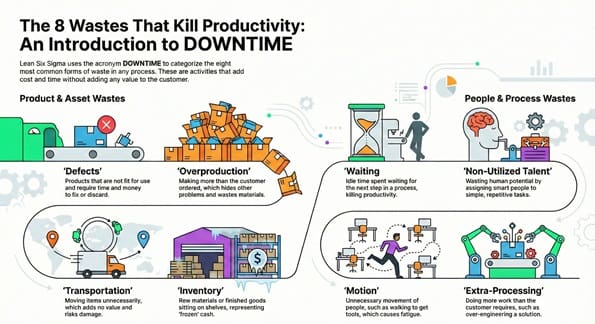
To measure waste, you first need to know what you are looking for. In the world of Lean Six Sigma, we use the acronym DOWNTIME.
Let us discuss each of these wastes in detail:
1. Defects
Defects are the most obvious form of waste. This is when a product is not fit for use. Every time you have to throw something away or spend time fixing it, you are losing money.
2. Overproduction
Overproduction is often called the “Mother of all Wastes.” Why? Because making more than what the customer ordered hides all other problems. It creates a false sense of security while eating up your cash in materials and storage.
3. Waiting
Waiting is the silent killer of productivity. Have you ever stood by a printer waiting for a report? Or waited for an email approval before you could start your next task? That is waste. In a Six Sigma project, we measure “idle time” to see where the bottlenecks are.
4. Non-Utilized Talent
This is a “human” waste. Non-utilized talent happens when you hire smart people but give them boring, repetitive tasks that a machine could do. Are you using your team’s brainpower, or just their hands?
5. Transportation
Transportation involves moving items from one place to another. Every time a forklift moves a pallet across a warehouse, there is a risk of damage, and it adds zero value to the customer. The customer doesn’t care if the product traveled 5 miles or 50 feet inside your factory; they just want the product.
6. Inventory
Inventory is just “frozen” cash. Whether it is raw materials or finished goods sitting on a shelf, it represents money you cannot spend elsewhere. Six Sigma looks at inventory levels to ensure you aren’t over-stocking.
7. Motion
Motion is different from transportation. It refers to the movement of people. If a worker has to reach too far or walk across the room to get a tool, that is wasted motion. It causes fatigue and slows down the process.
8. Extra-Processing
Extra-processing is when you do more work than the customer asked for. If you are polishing the inside of a metal box that no one will ever see, you are wasting time. Are you over-engineering your solutions?
Using the DMAIC Roadmap for Waste Reduction
The most effective way to measure and kill waste is through the DMAIC framework. This stands for Define, Measure, Analyze, Improve, and Control.
Define the Waste
First, you must define what “value” looks like for your customer. Anything that doesn’t contribute to that value is waste. We often use a Project Charter here to set the boundaries.
Measure the Current State
Now the “math” happens. You collect data on your current process. How long does it take? How many defects occur? You might use a Value Stream Map (VSM) to visualize the flow.
Analyze the Root Cause
Why is the waste happening? Is it a bad machine? Is it a confusing instruction? In this stage, we use the 5 Whys or a Fishbone Diagram to get to the bottom of the issue.
Improve the Process
Once you know the “why,” you can fix it. You might implement 5S to organize the workspace or use Kaizen events for quick improvements. The goal is to eliminate the waste identified in the measurement phase.
Control the Results
You don’t want the waste to crawl back in. Control involves setting up monitors, like Statistical Process Control (SPC) charts, to ensure the process stays lean and efficient.
Also Read: Process Optimization in Manufacturing
Key Tools for Measuring Process Waste Levels
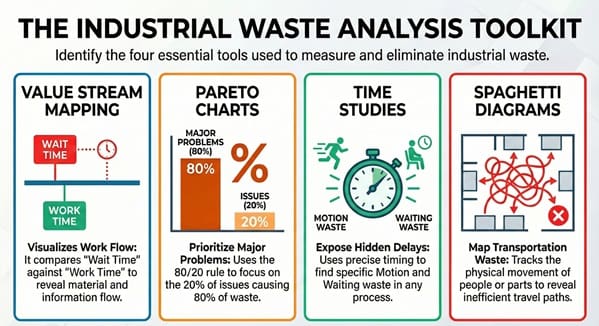
If you want to get serious about measuring waste, you need the right “toolkit.” Here are the heavy hitters:
- Value Stream Mapping (VSM): This is your primary tool. It shows the flow of materials and information. It helps you see the “Wait Time” vs. “Work Time.”
- Pareto Charts: This tool follows the 80/20 rule. It shows you that 80% of your waste likely comes from just 20% of your problems. It helps you prioritize.
- Time Studies: Literally sitting with a stopwatch and recording how long each step takes. It sounds old-school, but it is incredibly effective for finding Motion and Waiting waste.
- Spaghetti Diagrams: You draw a line following a person or a part throughout the day. If the paper ends up looking like a plate of spaghetti, you have a Transportation and Motion problem.
Practical Case: The “Hidden” Office Waste
I once worked with a legal firm that was struggling with slow document processing. They thought they needed more staff.
When we applied Six Sigma metrics, we found that the “Value-Added” time for a single contract was only 2 hours. However, the total “Lead Time” from start to finish was 14 days!
Where was the waste?
- Waiting: Contracts sat in “Inboxes” for 90% of the time.
- Extra-Processing: They were formatting internal memos as if they were court documents.
- Defects: 15% of the forms had typos that required a full restart.
By measuring the Process Waste Level, we didn’t hire more people. We simply rearranged the flow. The lead time dropped from 14 days to 3 days in just one month. That is the power of data over “gut feeling.”
Key Takeaways
- Waste is often invisible until you use data to “uncover” it.
- Six Sigma provides the mathematical rigor to measure exactly how much waste exists.
- The DOWNTIME acronym is your checklist for identifying the eight types of waste.
- Value Stream Mapping is the best tool to visualize where your process is “bleeding” time and money.
- Focusing on Process Cycle Efficiency will show you how much of your work actually matters to the customer.
Frequently Asked Questions (FAQs) on Process Waste Level
Q1: Can Six Sigma be used in service industries, or is it just for manufacturing? To be honest, it is often more effective in service industries. In a factory, you can see a pile of scrap. In an office, waste is hidden in servers and email chains. Six Sigma makes that digital waste visible.
Q2: How do I calculate the Cost of Poor Quality (COPQ)? You add up the cost of labor for rework, the cost of scrapped materials, and the potential loss of customer trust (which you can estimate through churn rates). It is usually a much higher number than people expect!
Q3: Is Six Sigma too expensive for small businesses? Not at all. You don’t need expensive software to start. A whiteboard, some sticky notes for a Value Stream Map, and a basic Excel sheet for data are enough to find your biggest wastes.
Q4: What is the first step I should take to measure waste? Start with a “Gemba Walk.” Go to where the work happens. Don’t look at reports in your office; go talk to the people doing the job and watch the process with your own eyes.
Ready to Clean Up Your Process?
At the end of the day, Six Sigma is about excellence. It is about respecting your resources, your employees’ time, and your customers’ money. By measuring your process waste level, you aren’t just cutting costs; you are building a smoother, happier, and more profitable workplace.
We believe that every second saved is a second you can spend on innovation and growth. Don’t let your potential get buried under a pile of waste.
Contact us today for Six Sigma Certifications.

About Six Sigma Development Solutions, Inc.
Six Sigma Development Solutions, Inc. offers onsite, public, and virtual Lean Six Sigma certification training. We are an Accredited Training Organization by the IASSC (International Association of Six Sigma Certification). We offer Lean Six Sigma Green Belt, Black Belt, and Yellow Belt, as well as LEAN certifications.
Book a Call and Let us know how we can help meet your training needs.