
The oil and gas industry faces more pressure today than ever before. Between fluctuating market prices and strict environmental rules, companies must find ways to work smarter. Have you ever wondered how giant energy firms keep their costs down while keeping safety levels high? This is where Lean Six Sigma becomes the secret weapon for operational excellence.
To be honest, the energy sector is messy by nature. You are dealing with massive machines, remote locations, and dangerous materials. In my experience, even a tiny delay in a drilling rig can cost a company millions of dollars. By using LSS, businesses can spot these delays before they happen. They turn “firefighting” mode into a smooth, predictable process.
But how exactly does a manufacturing methodology apply to an oil rig or a refinery? It comes down to two things: speed and quality. Lean focuses on removing waste to speed things up. Six Sigma focuses on removing defects to ensure quality. When you combine them, you get a powerhouse framework that saves time and lives.
Table of contents
- What is Lean Six Sigma in the Energy Sector?
- Why Does the Oil and Gas Industry Need LSS Now?
- Improving Upstream Operations with Lean Six Sigma
- Streamlining the Midstream and Downstream Segments
- Common LSS Tools Used on the Job
- Safety and Environmental Impact
- Real-World Case Examples
- Overcoming Challenges in Implementation
- Key Takeaways for Your Business
- Frequently Asked Questions
- Final Words
- Related Articles
What is Lean Six Sigma in the Energy Sector?
Before we jump into the deep end, let’s look at the basics. Lean Six Sigma is a step-by-step method for improving performance. It combines the “waste-free” mindset of Lean with the “error-free” goals of Six Sigma. In the oil and gas world, we often call this LSS.
In this industry, “waste” isn’t just trash. It is idle time for a crew waiting for a part. It is the extra energy used by an inefficient pump. It is the paperwork that sits on a desk for three days. On the other hand, a “defect” might be a faulty weld on a pipeline or an incorrect data entry in a seismic report.
We’ve all been there—stuck in a process that feels like it has too many steps. LSS asks: “Does this step add value for the customer?” If the answer is no, we look for ways to cut it. This doesn’t mean cutting corners on safety. In fact, most LSS projects in energy actually make sites safer by reducing human error.

Public, Onsite, Virtual, and Online Six Sigma Certification Training!
- We are accredited by the IASSC.
- Live Public Training at 52 Sites.
- Live Virtual Training.
- Onsite Training (at your organization).
- Interactive Online (self-paced) training,
Why Does the Oil and Gas Industry Need LSS Now?
The “easy oil” is mostly gone. Now, companies have to drill deeper or use complex tech like fracking. This makes the margin for error very slim. Have you noticed how volatile gas prices have been lately? When prices drop, companies can’t control the market, but they can control their internal costs.
Here is the thing: many oil companies still use “old school” management. They rely on gut feelings instead of data. Lean Six Sigma changes that. It forces teams to look at the numbers. It moves the needle from “I think we have a problem” to “the data shows a 15% bottleneck in the supply chain.”
Also Read: Six Sigma and Electric Mobility: Driving Quality in the EV Revolution
Improving Upstream Operations with Lean Six Sigma
The upstream sector involves finding and extracting crude oil. This is the most expensive part of the business. Every hour a rig isn’t drilling, the company loses money. How can LSS help here?
One common project involves “Non-Productive Time” or NPT. Picture this: a drilling crew is ready to go, but the specialized drill bit is still on a truck three states away. That is waste. By using the Lean “Just-in-Time” principle, companies sync their supply chains. We’ve seen cases where better scheduling reduced NPT by over 20%.
Another area is equipment maintenance. Instead of waiting for a pump to break, teams use the DMAIC (Define, Measure, Analyze, Improve, Control) roadmap. They analyze when parts usually fail. Then, they replace them just before they break. This “predictive” approach keeps the oil flowing without surprise shutdowns.
Streamlining the Midstream and Downstream Segments
Once the oil is out of the ground, it needs to move and be refined. Midstream is all about pipelines and transport. Here, Lean Six Sigma focuses on flow. Any leak or blockage is a massive defect. LSS helps engineers monitor pressure data to find tiny irregularities that a human might miss.
Downstream is where the refining happens. Refineries are like giant chemistry sets. If the temperature is off by a few degrees, the quality of the gasoline drops. Six Sigma tools like “Statistical Process Control” help operators keep the chemicals in the perfect range. This leads to more high-quality fuel and less “re-work” or waste.
Don’t you think it’s better to get the recipe right the first time? In a refinery, “getting it right” means millions in added profit every month.
Common LSS Tools Used on the Job
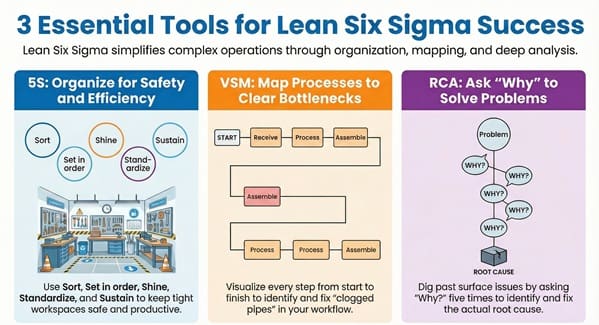
You don’t need a PhD to use LSS, but you do need the right tools. Here are a few that we see most often in the field:
- 5S (Sort, Set in order, Shine, Standardize, Sustain): This is about workspace organization. On an offshore rig, space is tight. If a tool isn’t where it should be, someone could get hurt or work stops.
- Value Stream Mapping (VSM): This is a giant map of a process. It shows every step from the moment a project starts to the moment it finishes. It’s great for seeing where the “clogged pipes” in the office are.
- Root Cause Analysis (RCA): When something goes wrong, don’t just fix the surface. Ask “Why?” five times. Why did the pipe leak? The seal broke. Why did it break? It was the wrong material. Why? The buyer chose the cheapest one. Now you found the real problem!
Safety and Environmental Impact
Safety is the biggest priority in oil and gas. One mistake can lead to an environmental disaster. People often ask: “Does Lean Six Sigma sacrifice safety for speed?” Actually, it’s the opposite.
Most accidents happen because of “variability”—something unexpected happens. Six Sigma is the enemy of variability. By making processes standard and predictable, you make them safer. When everyone knows exactly how to handle a valve, the chance of a spill goes down.
To be honest, being “green” is also good for business. Reducing waste (Lean) means using less water and emitting less carbon. It’s a win-win for the planet and the company’s wallet.
Also Read: Hazard and Operability Study (HAZOP)
Real-World Case Examples
Let’s look at a realistic scenario. A mid-sized oil firm was struggling with their “Procure-to-Pay” process. It took them 60 days to pay a vendor. This led to late fees and grumpy suppliers.
We used a Lean Six Sigma approach. We mapped the process and found that an invoice needed five different signatures. Why? “Because that’s how we’ve always done it.” We cut it down to two signatures for any bill under $10,000. Fast-forward to three months later: the cycle time dropped to 15 days. They saved $100,000 in late fees in the first year alone.
Another example involves a refinery. They had a high rate of “off-spec” product. By using Six Sigma data analysis, they found that a specific sensor was vibrating too much. They stabilized the sensor, and the defects dropped by 40%. It’s about these small wins that add up to huge numbers.
Overcoming Challenges in Implementation
Is it easy to start LSS in an oil company? Roughly speaking, no. The biggest hurdle is the culture. “We’ve done it this way for 30 years” is a phrase we hear a lot.
To succeed, you need buy-in from the top. If the CEO doesn’t care about data, the engineers won’t either. It also helps to start small. Don’t try to fix the whole company at once. Pick one “pain point,” solve it with LSS, and show everyone the results. Success is contagious.
Key Takeaways for Your Business
- Waste is Everywhere: From wait times on rigs to paperwork in the office, LSS identifies and kills waste.
- Data Over Gut Feelings: Use Six Sigma to make decisions based on facts, not just experience.
- Safety First: Standardizing processes through LSS reduces the variability that leads to accidents.
- Upstream to Downstream: Whether you’re drilling or refining, these tools apply to the whole chain.
- Small Wins Matter: You don’t need a multi-million dollar project to see the benefits of LSS.
Frequently Asked Questions
How long does a Lean Six Sigma project take in oil and gas?
Most projects take between 3 to 6 months. It depends on how complex the problem is and how much data you have.
Do I need to be a math expert for Six Sigma?
Not at all. While there is some math, most of it is handled by software today. You just need to understand the logic.
Is LSS only for big companies like Shell or Exxon?
No. Smaller service companies often see the biggest percentage gains because they can move faster than the giants.
What is the “Lean” part of Lean Six Sigma?
Lean is about speed and flow. It’s about getting rid of the eight types of waste, like waiting, over-processing, and excess inventory.
Can LSS help with digital transformation?
Yes! Before you automate a process with AI or software, you should use LSS to make sure the process is efficient. Automating a bad process just makes a bad process happen faster.
Final Words
The oil and gas industry is entering a new era. Efficiency isn’t just a “nice to have” anymore; it’s a survival skill. By using Lean Six Sigma, companies can navigate the tough market with confidence. It empowers your workers to find solutions and gives your leaders the data they need to grow.
At our core, we believe that every process can be better. We are dedicated to helping our clients find those hidden efficiencies. Our team focuses on your specific needs, ensuring that your journey toward operational excellence is smooth and rewarding. Are you ready to stop guessing and start improving?

About Six Sigma Development Solutions, Inc.
Six Sigma Development Solutions, Inc. offers onsite, public, and virtual Lean Six Sigma certification training. We are an Accredited Training Organization by the IASSC (International Association of Six Sigma Certification). We offer Lean Six Sigma Green Belt, Black Belt, and Yellow Belt, as well as LEAN certifications.
Book a Call and Let us know how we can help meet your training needs.