Are you tired of pouring time and money into social media marketing without seeing clear, consistent results? Do your campaigns sometimes feel like guesswork? Many businesses face this exact problem: high effort, but inconsistent performance and wasted resources.
You know that social media holds massive potential for reaching your target audience and boosting revenue. But how do you change chaos into predictable, profitable outcomes?
The solution is not a new platform or a trendy hashtag. Instead, you need a systematic approach to fix the flaws in your current marketing process. That is where Six Sigma comes in. By applying the principles of Six Sigma, a method used by global companies to achieve near-perfection in manufacturing, you can transform your social media efforts. You will stop guessing and start making data-driven decisions that generate reliable success.
Let us explore how Six Sigma provides the framework for social media marketing excellence.
Table of contents
What is Six Sigma and Why Does it Matter for Social Media Marketing?
Six Sigma can be understood as a data-driven methodology. It aims to eliminate defects or errors in any process. The goal is simple: achieve just 3.4 defects per one million opportunities. While this started in manufacturing, its power extends to all business areas, including your social media marketing strategy.
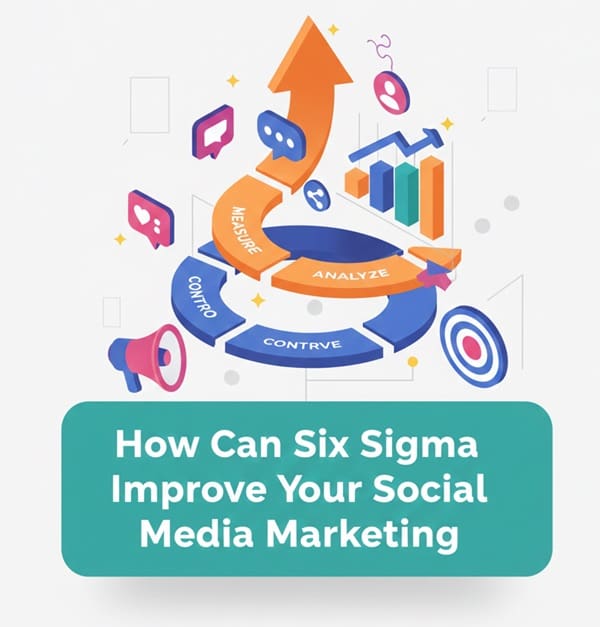
In the context of marketing, a “defect” is anything that fails to meet your customer’s expectations or your business goal. Examples include a low click-through rate, a high bounce rate, or a bad quality lead. Six Sigma helps you see these as flaws in the process, not failures of the people running the campaign. It focuses on reducing variation in results. When you reduce variation, your campaigns become stable and predictable.
This methodology plays a vital role in creating high-quality leads and improving customer experience. By cutting out waste and focusing on what truly matters to the customer, you make every dollar spent on social media marketing count.

Public, Onsite, Virtual, and Online Six Sigma Certification Training!
- We are accredited by the IASSC.
- Live Public Training at 52 Sites.
- Live Virtual Training.
- Onsite Training (at your organization).
- Interactive Online (self-paced) training,
Six Sigma for Marketing vs. Traditional Marketing
To understand this better, we can contrast the Six Sigma approach with a more traditional marketing approach. The Six Sigma method replaces guesswork and intuition with hard data and statistical analysis.
| Basis for Comparison | Six Sigma Approach to Marketing | Traditional Marketing Approach |
| Focus | Process Improvement and Variation Reduction. | Campaign Creation and Execution. |
| Decision Making | Data-driven and statistically proven. | Based on intuition, trends, or past success. |
| Problem View | Sees problems (low ROI, bad leads) as process defects. | Sees problems as a failure of a specific ad or team member. |
| Goal | Near-perfection (3.4 defects per million) and stable results. | Hitting short-term targets. |
| Main Method | DMAIC (Define, Measure, Analyze, Improve, Control). | Ad-hoc testing and quick fixes. |
In simple words, the Six Sigma approach ensures that your social media marketing success is repeatable. You build a system, not just a single winning campaign.
Also Read: How to Improve Logistics With Six Sigma?
The DMAIC Roadmap: Transforming Your Social Media Process
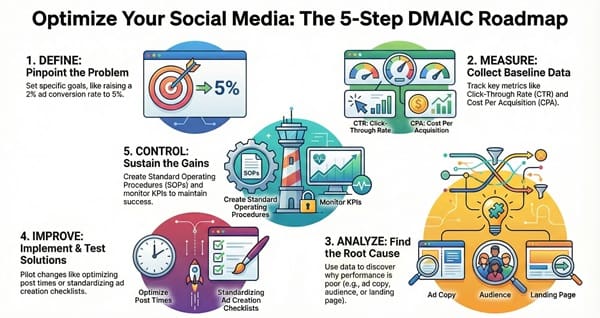
The core of applying Six Sigma to social media marketing involves the DMAIC framework. DMAIC is a sequential pattern of five phases: Define, Measure, Analyze, Improve, and Control. This method helps you systematically optimize your social media marketing.
Let us now discuss how each step in the DMAIC process enables you to refine your social media marketing efforts.
1. Define: Clarifying the Social Media Marketing Problem
The first step in the DMAIC process is to Define the problem, the goals, and the scope of your project. You must be specific about what you are trying to fix. Vague problems like “we need better engagement” do not work here.
What is the exact defect in your social media marketing?
- Definition Pattern: Define the business problem, the customer, and their requirements.
- Example: “The conversion rate from our Facebook Ad clicks to newsletter sign-ups is too low, currently sitting at 2%. Our goal is to increase this to 5% within the next three months.”
In this phase, you draft a Project Charter. This document defines the focus and the expected return on investment (ROI). It ensures that all team members understand the scope. You must also capture the Voice of the Customer (VOC) to understand what your audience truly wants from your social presence.
2. Measure: Getting Data for Social Media Marketing
The second phase, Measure, focuses on collecting accurate data to establish a baseline for your current performance. This provides a clear picture of the current state.
To understand this better, you must identify the right metrics. For social media marketing, this includes:
- Click-Through Rate (CTR)
- Cost Per Acquisition (CPA)
- Engagement Rate (likes, shares, comments)
- Conversion Rate (lead, sign-up, or sale)
Measure your campaign’s performance against the defined goal. You must ensure your measurement systems are effective. If your tracking is broken, the entire effort fails. This step involves using statistical tools to map your process and collect trustworthy data.
3. Analyze: Finding the Root Cause of Social Media Marketing Defects
When you have the data, the next step is to Analyze it to determine the root cause of the poor performance or high variation. This is where you move beyond symptoms and find out why the problem exists.
Analyze the data using tools like the Pareto Chart or the Five Whys technique.
- Causation Pattern: Due to inconsistent posting times, our organic reach varies significantly.
- Listing Pattern: Analysis involves looking for patterns, such as which content types generate the highest engagement and which demographics convert most often.
You look for correlations: is the low conversion rate due to the ad copy, the landing page speed, or the target audience segment? Analyzing the process involves identifying bottlenecks that are hindering your social media marketing success.
4. Improve: Implementing Social Media Marketing Solutions
The Improve phase refers to the moment you develop and implement solutions to address the root causes found in the Analyze phase. The aim is to find the most effective and efficient solution.
You will brainstorm potential changes and then pilot test them on a smaller scale to validate their effectiveness. For example, if the analysis showed that mobile users are dropping off during checkout, you would Improve the mobile landing page design.
Improvement actions could include:
- Standardizing the ad creation checklist to reduce errors.
- Optimizing the time of day for posting to align with peak audience activity.
- Eliminating inefficient ad spending on underperforming segments.
Action Verbs: You implement the best solution, test its impact, and refine it until you achieve the desired results, moving your performance closer to that Six Sigma standard.
5. Control: Sustaining Social Media Marketing Gains
Once you achieve the improvement, the final phase is Control. This step focuses on standardizing the new process to ensure the positive gains stick and the problem does not return.
Control involves establishing a monitoring system and setting up Standard Operating Procedures (SOPs).
- Purpose Pattern: Monitor key performance indicators (KPIs) continuously so as to detect any process drift before it becomes a major defect.
- Conditional Pattern: If a social media marketing metric falls below a set Control limit, then the team must follow a predefined reaction plan to fix it immediately.
You maintain the new, improved process by documenting every step and training all team members on the new standard. This ensures your social media marketing success is sustainable.
Key Benefits of Using Six Sigma for Social Media
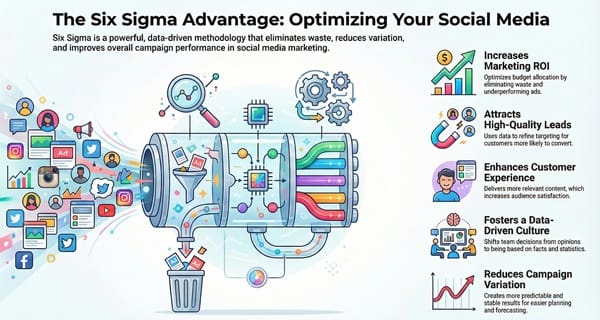
Applying this powerful methodology to your social media marketing brings several significant benefits that help you gain a competitive edge.
- Increases ROI: When you cut out waste and eliminate underperforming ads, you spend less and get more from your budget. Six Sigma helps you optimize resource allocation.
- Gets High-Quality Leads: The Analyze phase helps you determine the characteristics of a bad lead. This allows you to adjust your targeting to attract customers who are more likely to convert.
- Improves Customer Experience: You stop pushing ads and content that annoy or do not appeal to your audience. This makes your message more relevant and increases customer satisfaction.
- Creates a Data Culture: Your team begins making decisions based on facts and statistics, not just opinions. This enhances overall effectiveness across all campaigns.
- Reduces Variation: Your results become more predictable and stable. You know what to expect from your campaigns, making planning and forecasting much easier.
Also Read: How Six Sigma can improve DIFOT Rate?
Frequently Asked Questions (FAQs) About Six Sigma in Marketing
Q. Is Six Sigma only for big companies, or can a small business use it for social media marketing?
A. Six Sigma principles are scale-agnostic. The methodology refers to the structure of problem-solving. A small business can easily apply the DMAIC steps to improve a single social media campaign or a content creation workflow. The principles of reducing waste and using data are fundamental to success for any business size.
Q. What is the difference between DMAIC and DMADV?
A. The DMAIC process is used to improve an existing process that is not meeting expectations. DMADV (Define, Measure, Analyze, Design, Verify) is used to design a new product or process that does not exist yet. For optimizing an existing social media marketing campaign, you use DMAIC. For creating a brand-new social media presence, you use DMADV.
Q. What kind of tools do I need for the Measure and Analyze phases?
A. You need basic statistical and process mapping tools. Examples include: Google Analytics, social media platform native analytics, simple spreadsheets for data collection, Pareto Charts to prioritize problems, and Fishbone Diagrams (Cause-and-Effect diagrams) to determine root causes. The focus is on the data, not expensive software.
Key Takeaways
Six Sigma is a proven path to achieving consistent, high-impact results in your social media marketing. It is not a quick fix; it is a commitment to process excellence.
- Six Sigma is nothing but a disciplined, data-driven approach to reducing process variation and defects.
- The DMAIC process provides the five-step roadmap: Define the problem, Measure the baseline, Analyze the root cause, Improve the process, and Control the new standard.
- By adopting this methodology, you reduce waste, increase ROI, and deliver a more relevant experience to your audience.
Your business deserves a marketing process that works reliably every time. We help you transform your current methods into a predictable, profit-generating machine. Do not let your next campaign be a gamble. Start building a foundation of social media marketing excellence today.
Final Words
Six Sigma provides the essential framework to stabilize and optimize your social media marketing process. By strictly applying the five steps of DMAIC, you replace guessing with data-driven decision-making. This method helps you systematically identify and eliminate defects, which translates directly into higher ROI and better lead quality.
It ensures your campaigns deliver consistent, predictable success by reducing variation and focusing only on actions that truly add value to your customer.
We believe that every marketing dollar should generate maximum impact. Start using Six Sigma today and turn your chaotic campaigns into a streamlined system that guarantees social media marketing excellence.

About Six Sigma Development Solutions, Inc.
Six Sigma Development Solutions, Inc. offers onsite, public, and virtual Lean Six Sigma certification training. We are an Accredited Training Organization by the IASSC (International Association of Six Sigma Certification). We offer Lean Six Sigma Green Belt, Black Belt, and Yellow Belt, as well as LEAN certifications.
Book a Call and Let us know how we can help meet your training needs.