
Have you ever seen a small, fast boat change direction quickly in the water? Company agility is somewhat similar, but for a whole business. When the world changes quickly—maybe a new technology comes out, or customers want something different—a company needs to change just as fast to stay successful. This ability to adapt quickly and effectively is called enterprise agility.
But how do you take a large, maybe somewhat slow-moving company and make it quick and responsive?
This article will help you understand what enterprise agility transformation is. We will discuss why it is important for your company and how you can achieve enterprise business agility. We will also explore the necessary frameworks and tools, such as Atlassian Jira Align, that make this change possible.
Table of contents
What is Enterprise Agility?
Enterprise agility is defined as the ability of an organization to sense changes in its environment, decide on a response, and quickly act to deliver value.
In simple words, enterprise agility means your whole business can adapt to changes in the market easily and fast. This is important because the business world is highly volatile today.

For instance, consider a major phone company. If a rival suddenly releases a phone with a great new feature, the agile company can quickly change its plans, update its product, and launch a counter-move. This means the company agility is high. If the company is not agile, it loses out.
Enterprise agility is nothing but a major change in how the whole business thinks and works.
Let us now understand what this transformation involves.

Public, Onsite, Virtual, and Online Six Sigma Certification Training!
- We are accredited by the IASSC.
- Live Public Training at 52 Sites.
- Live Virtual Training.
- Onsite Training (at your organization).
- Interactive Online (self-paced) training,
Enterprise Agility Transformation Versus Department-Level Agility
You might already know about agile development or Scrum. Usually, teams like software developers use these methods to work faster. This is sometimes called team-level agility.
However, enterprise agility transformation is quite different.
- Team Agility: This focuses on a small team delivering work faster.
- Enterprise Agility Transformation: This focuses on aligning all parts of the organization—from the board of directors to the finance, marketing, and legal teams—to a common, quick goal.
Essentially, enterprise agility ensures that every department supports the main goal. It is not enough for just the IT team to be fast; the sales team must also be fast at selling the new product, and the legal team must be fast at checking contracts.
Also Read: Enterprise Risk Management (ERM)
Core Pillars of Enterprise Business Agility
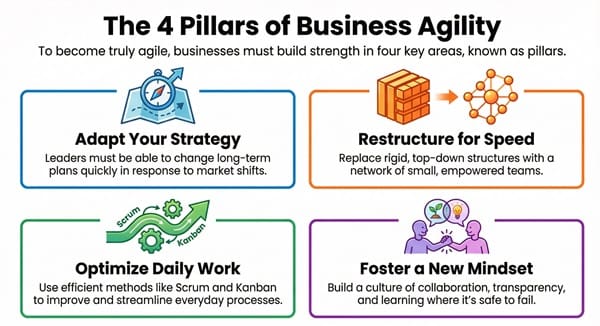
To achieve enterprise business agility, you need to focus on four major areas. These are the main parts that make a business truly agile.
1. Strategic Agility
Strategic agility refers to the ability of the leaders to quickly change the company’s long-term plans.
If a new competitor enters the market, the leaders must quickly decide how to respond. Strategic agility helps them do this quickly. This involves reviewing the company’s main strategy more often, not just once a year.
Strategic agility is somewhat difficult to achieve. It requires adaptive leadership, which is quite important. Adaptive leadership means leaders help the company change without causing chaos. They give teams the power to make quick decisions, thereby speeding up the whole business.
2. Organizational Agility
Organizational agility means designing the structure of the business itself for speed.
This usually involves replacing a rigid structure—where orders come only from the top down—with a network of small, empowered teams. These teams usually work somewhat independently on specific projects. They are able to communicate quickly and avoid unnecessary delays.
Organizational agility means moving from a fixed, somewhat heavy structure to a flexible, light structure. Enterprise agility transformation majorly involves this structural change.
3. Operational Agility
Operational agility focuses on the methods the company uses every day to create and deliver products.
This involves using agile enterprise framework methods like Scrum and Kanban, but across all operational parts of the business. You can think of it as using efficient assembly lines for everything, not just manufacturing. Operational agility is achieved by always improving the way work is done and looking for waste or delays.
4. Cultural Agility
This is perhaps the most important, but also the most difficult, part of the enterprise agility transformation.
Cultural agility means changing how people think and behave. People must feel safe to try new things and even to fail sometimes. This allows for quick learning. When people fear trying something new, they slow down.
Cultural agility involves three key aspects:
- Collaboration: Teams must work together, not in silos.
- Transparency: Everyone sees the work being done, which builds trust.
- Learning: The business values learning from mistakes and quickly making changes.
Enterprise Agility Frameworks: The Roadmap
To make this large change, companies usually follow proven roadmaps called enterprise agile frameworks. These frameworks provide a structure for all parts of the business to adopt agile ways of working.
Let us now discuss a couple of these important enterprise agile frameworks.
1. Scaled Agile Framework (SAFe)
SAFe is one of the most widely used enterprise agile frameworks. It gives a detailed guide on how to apply agility at every level of a large organization.
SAFe helps in:
- Alignment: It makes sure that all teams work on the right things that support the overall business agility transformation.
- Collaboration: It includes events and structures that force teams to talk to each other and plan together.
- Delivery: It helps teams release products or services to customers somewhat frequently and consistently.
2. Disciplined Agile (DA)
DA is another important framework. Unlike SAFe, which is somewhat fixed, DA is a “tool kit” of choices. It suggests you start where you are and make smart decisions based on your specific situation.
DA is highly flexible. It aims to help you find the best way of working for your team and company.
Also Read: ERP (Enterprise Resource Planning): Streamline Business Operations
Role of Tools in Enterprise Agility Transformation
Tools are essential for connecting strategy to execution, thereby making the enterprise agility transformation real.
Atlassian Jira Align: Connecting the Dots
Atlassian Jira Align is a powerful tool specifically designed for enterprise agility. It helps to align every team’s work to the company’s main goals.
- Visibility: It clearly shows how a small task done by one team connects to the big strategy of the company.
- Roadmaps: It helps leaders plan the product development for the next several months, allowing for somewhat faster adjustments.
- Metrics: It provides clear numbers that show if the enterprise business agility is improving.
Using a tool like Atlassian Jira Align is quite important because it connects the work of hundreds or thousands of people to a single, shared goal.
Business Agility Consulting: Getting Expert Help
Many companies find the enterprise agility transformation quite difficult. This is so because it requires major changes to culture and structure. Business agility consulting or enterprise agility consulting firms can help with this.
Agility consulting firms bring in experts who have guided other companies through this change. They can help you with:
- Assessment: They find out how agile your company is right now.
- Roadmap: They create a specific plan for your enterprise agility transformation.
- Training: They train your leaders and teams on new ways of working.
Engaging with a good agility consulting firm can save your company time and money. They bring knowledge about the best agile enterprise framework practices.
Key Insights from Thought Leaders
One must understand that the ideas behind enterprise agility are not new. People like Jim Highsmith have been writing about agile methods for decades.
Jim Highsmith is a major figure in the agile movement. His work primarily emphasizes that successful companies are adaptive. They do not just plan and execute; they constantly sense and respond to their environment. Jim Highsmith suggests that businesses must use agile values to manage projects and product development.
This insight makes it clear: Enterprise agility is about survival and growth in the modern economy.
Comparison: Traditional vs. Enterprise Agile
To understand the value of the enterprise agility transformation, we can compare the traditional way of working with the modern enterprise agile approach.
| Feature | Traditional Way of Working | Enterprise Agile Way of Working |
| Structure | Rigid, bureaucratic, top-down structure. | Network of empowered, flexible teams. |
| Planning | Long-term, fixed plans (usually 1-3 years). | Short-term cycles, constant re-planning. |
| Customer Feedback | Late in the process, often after the product is finished. | Early and continuous feedback loops. |
| Goal | Sticking to the original plan and budget. | Delivering maximum value to the customer quickly. |
| Change | Viewed as a somewhat risky problem to avoid. | Viewed as an opportunity and a normal part of business. |
As you can clearly see, the enterprise agile way is designed for the modern pace of change.
Key Takeaways for Your Enterprise Agility Transformation
Here are the most crucial points to remember about enterprise agility:
- Focus on Value: The main goal of enterprise agility transformation is not just to work faster but to deliver more customer value faster.
- It’s Not Just an IT Thing: Enterprise agility must involve every department, from finance to HR, to be effective. The entire company agility relies on this.
- Culture Drives Success: Change the structure, but mainly change the culture. People must feel safe to suggest new ideas and make smart decisions.
- Tools Enable Alignment: Tools like Atlassian Jira Align help connect the high-level strategy to the day-to-day work of teams, thereby ensuring everyone is aligned.
Frequently Asked Questions (FAQs) on Enterprise Agility
What is the difference between business agility transformation and digital transformation?
Business agility transformation primarily focuses on changing the culture, structure, and processes of the company to be more adaptive. Digital transformation, on the other hand, mainly focuses on using new technology to improve operations and customer experience. However, the two usually go hand-in-hand. You need to be agile to quickly adopt new digital tools.
What does the term “agility in the enterprise” mean?
Agility in the enterprise means that the whole company, or enterprise, possesses the ability to respond somewhat quickly to market changes and customer needs. It is essentially another term for enterprise agility.
Is a fixed budget possible in an enterprise agile development project?
In pure enterprise agile development, the scope of the project is somewhat flexible, while the time and budget are usually fixed. Instead of asking teams to build a fixed list of features, you ask them to build the most valuable features possible within a fixed time and budget. This is a crucial shift in the enterprise agility framework.
Who needs enterprise agility consulting?
Any large company struggling to keep up with competitors, experiencing slow product releases, or having trouble coordinating work across many departments usually needs enterprise agility consulting.
Final Words
Achieving true enterprise business agility is somewhat challenging, but it is highly essential for long-term success. It is not just a trend; it is the new way of doing business. You need a clear roadmap, the right enterprise agile frameworks, and business agility consulting support to make this change correctly.
We focus on helping your company move from slow, complex processes to fast, value-driven work. We believe in providing clear, actionable plans that bring about true company agility. Let us help you start your enterprise agility transformation today so as to maintain your leadership position in your market.

About Six Sigma Development Solutions, Inc.
Six Sigma Development Solutions, Inc. offers onsite, public, and virtual Lean Six Sigma certification training. We are an Accredited Training Organization by the IASSC (International Association of Six Sigma Certification). We offer Lean Six Sigma Green Belt, Black Belt, and Yellow Belt, as well as LEAN certifications.
Book a Call and Let us know how we can help meet your training needs.