
You seek to build high-quality software that truly serves its purpose. If you want to achieve this goal, you must master defect management. This process is vital for ensuring your product meets all requirements and user expectations. A weak approach to defects creates costly delays and unhappy customers.
We will explore the framework that leading teams use to minimize bugs and produce effective software. Defect management allows you to identify, prioritize, and resolve errors efficiently, transforming your development lifecycle.
Table of contents
What is Defect Management?
Defect management refers to the comprehensive process that handles software defects from their identification until they are successfully resolved and closed. The core purpose of defect management is to make the software more effective and efficient to increase its overall quality. A defect, often called a bug, can be understood as any condition in a software product which fails to meet a stated requirement or reasonable end-user expectation.
Defect management is nothing but a structured way to handle the inevitable errors that arise during development. This systematic approach minimizes the impact of these errors on the project timeline and budget. The cost of finding and correcting defects represents one of the most expensive software development activities.
Therefore, investing in a robust defect management process yields significant returns by catching defects early.
Defect management is a formal process. It includes several methods for handling errors, such as defect prevention, defect discovery, and defect resolution.

Public, Onsite, Virtual, and Online Six Sigma Certification Training!
- We are accredited by the IASSC.
- Live Public Training at 52 Sites.
- Live Virtual Training.
- Onsite Training (at your organization).
- Interactive Online (self-paced) training,
Defect Management vs. Defect Tracking
When you talk about quality, two terms often arise: defect management and defect tracking. While related, they signify different levels of the process.
Defect management is the overarching strategy. It comprises the entire process, including the policies, procedures, organizational structure, and tools used to handle defects. This management process aims at prevention, analysis, baselining, discovery, and final resolution.
Defect tracking, on the other hand, refers to the mechanics. Defect tracking is the specific activity of logging, monitoring, and updating the status of a single defect through its lifecycle using specialized tools. Defect tracking acts as a crucial subset within the broader defect management system.
To understand this better, consider the key differences in a tabular format.
| Basis for Comparison | Defect Management | Defect Tracking |
| Scope | Comprehensive, strategic process covering prevention, analysis, and resolution. | Operational activity focused on logging, monitoring, and status updates for individual bugs. |
| Objective | To ensure overall product quality and minimize the creation and impact of defects. | To trace the progress of a specific defect from finding to fixing and verifying. |
| Focus | Process, policy, roles, and metrics (e.g., Defect Removal Efficiency). | Individual defect reports (e.g., ID, Description, Status). |
| Personnel | Managed by Test Managers, Project Managers, and Quality Assurance teams. | Performed by Testers, Developers, and QA Analysts. |
Also Read: Defects Per Unit (DPU)
Four Key Phases of the Defect Management Process
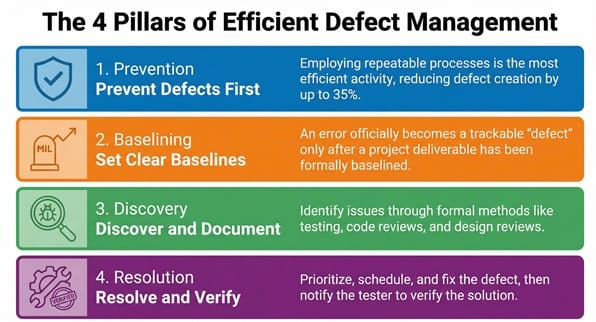
The systematic framework for handling defects is divided into four sequential phases. Each phase plays a vital role in minimizing the number and impact of errors in your project.
1. Defect Prevention in Defect Management
Defect management starts with prevention. Defect prevention refers to the implementation of techniques, methodology, and standard processes so as to reduce the risk of defects being inserted in the first place. This is the most efficient activity, as preventing a defect saves significant time and cost compared to fixing it later.
Effective defect prevention includes:
- Clearly defining roles and responsibilities—this reduces the number of defects created by up to 15%.
- Using formalized procedures—this can reduce the number of defects created by up to 25%.
- Employing repeatable processes—this ensures consistency and can reduce defects by up to 35%.
- Placing controls and measures in place—this reduces the risk of defects being inserted by up to 30%.
2. Deliverable Baselining in Defect Management
Defect management relies on establishing clear expectations. Deliverable baselining sets milestones where certain project components will be considered complete and ready for further development. When a deliverable is baselined, any future changes come under strict control.
The importance of this stage is clear. Errors in a deliverable are not actually considered defects until after the deliverable has achieved its baseline status. This formal sign-off dictates when a reported issue moves from being a simple error to a tracked defect.
3. Defect Discovery in Defect Management
Defect discovery is the phase where testing teams identify, record, and report issues. This stage is often executed through formal testing, code reviews, and design reviews. A defect is only deemed discovered when testing teams document it and development teams acknowledge it as a valid error.
Discovery techniques include:
- Formal Testing: This helps remove up to 25% of potential defects.
- Reviews: Requirements reviews, design reviews, and code reviews play a vital role in identifying issues before execution.
- Quick Attacks: These provide a rapid assessment of the system’s stability, often yielding initial bugs quickly.
- Boundary Conditions: This technique reduces an infinite test set into a manageable number, helping you cover requirements thoroughly.
4. Defect Resolution in Defect Management
Defect resolution involves the work required by the development team to prioritize, schedule, and fix a defect. The final part of resolution requires documenting the fix and notifying the tester to verify the change.
Defect resolution follows a specific workflow, which we call the defect life cycle. Developers must perform various actions during this stage, such as analyzing the bug, debugging the code, and applying the necessary correction.
Defect Life Cycle
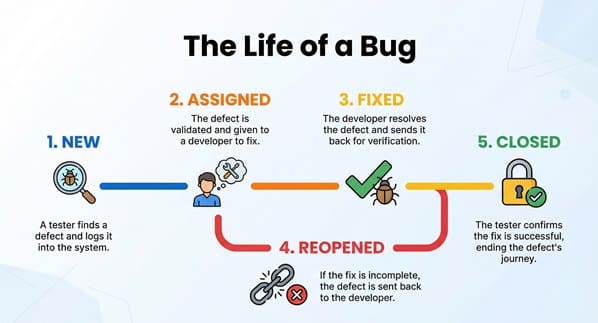
The defect life cycle is the complete journey of a defect from its initial identification to its final closure. This cycle typically involves multiple status changes that developers and testers use to communicate the defect’s current state.
The life cycle comprises the following standard statuses:
- NEW: The tester finds a defect and posts it with this status. This defect is yet to be approved or studied.
- ASSIGNED / OPEN: The Test Lead or Project Lead studies the NEW defect. If the lead finds the defect valid, it is assigned to a member of the Development Team.
- DEFERRED: If the team finds the defect valid but decides to fix it in an upcoming release instead of the current one, the status becomes DEFERRED.
- DROPPED / REJECTED: If the lead determines the NEW defect is invalid or cannot be reproduced, it is rejected. Note that the team must always state the specific reason for this action.
- COMPLETED / FIXED / RESOLVED: The assigned developer fixes the defect. The status changes to COMPLETED, and the defect is then assigned back to the Test Team for verification.
- REASSIGNED / REOPENED: If the tester finds the fixed defect is still not fully resolved or is only partially fixed, the defect is reassigned to the developer who completed the fix. A REASSIGNED defect must return to the COMPLETED status again.
- CLOSED / VERIFIED: This is the final stage. The tester verifies that the defect is indeed fixed and poses no further concern. This means the defect management process for this specific issue ends successfully.
This systematic journey ensures clear accountability and promotes effective defect resolution.
Also Read: Defects per Opportunity (DPO)
How to Classify Defects for Effective Defect Management?
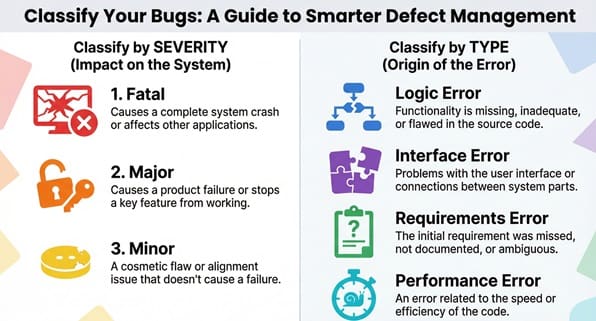
Proper defect classification helps your team prioritize work and determine root causes. You classify defects in several ways, primarily by severity, status, and error type.
Defect Classification by Severity
Severity denotes the degree of impact the defect has on the system’s operation or functionality.
- Fatal: A defect that causes the entire system to crash or close abruptly. This affects other applications and demands immediate attention.
- Major: A defect which will cause an observable product failure or a definite departure from stated requirements. This requires quick fixing but may not halt the system.
- Minor: A defect that will not cause a failure in the execution of the product. This might include alignment issues or cosmetic flaws.
Defect Classification by Type of Error
Categorizing defects by type helps teams understand where the errors originate within the development life cycle.
- Computational Error: This implies improper computation of a formula or incorrect business validations in the underlying code.
- Logic Error: This refers to missing, inadequate, irrelevant, or ambiguous functionality in the source code.
- Interface Error: This concerns internal or external interfacing errors, incorrect handling of parameters, or alignment issues in the user interface.
- Missing Requirements: This signifies that implicit or explicit requirements were not documented or missed during the initial requirement phase.
- Ambiguous Requirements: This means the requirement lacks clarity for the reviewer, possibly due to vague words like may be or could be.
- Database Error: This denotes an error in the database schema or design.
- Performance Error: An error related to the speed or optimality of the code’s execution.
Understanding these categories allows development managers to direct resources for specific code reviews or focused training, improving overall defect prevention efforts.
Measuring Success: Defect Management Metrics
Defect management requires you to measure efficiency. The use of specific quality metrics helps you evaluate the effectiveness of your team’s defect resolution process. These metrics allow you to analyze past experience and determine the degree of improvement or deterioration in handling defects.
Key metrics used for evaluating Defect Management include:
- Defect Resolution: You check the consistency and efficiency in resolving defects by tracking the Cumulative Defect Arrival Pattern versus the Defect Closure Pattern over time. An efficient process shows the closure curve staying near the arrival curve.
- Defect Removal Rate: This measures the proportion of defects resolved out of the total defects submitted for a particular period. A high removal rate indicates an efficient process.
- Backlog Management: This is the ratio of closed defects to arrived defects during a period. It measures your capability to handle the queue of pending defects.
- Defect Resolution Age: This refers to the number of days elapsed since a defect was reported until the time it is fully resolved and closed. A shorter age reflects higher resolution efficiency.
- Pending Defects: This measures the volume of defects that still need attention. The goal is to see this number decrease or remain constant over time.
These metrics provide quantitative results. They help you pinpoint bottlenecks and improve your overall defect management practices.
Also Read: Defectives in Manufacturing
Reporting a Defect: The Importance of the Defect Template
Reporting a defect properly is just as important as finding it. If your team does not log the defect correctly and clearly, developers cannot address it properly. Therefore, you must use a comprehensive defect template to capture all necessary information.
A defect report template consists of several essential elements:
- ID: The unique identifier assigned to the defect, usually automated by the defect tracking tool.
- Summary: A clear and concise one-line summary of the defect.
- Description: A detailed explanation of the defect, kept simple but comprehensive.
- Steps to Replicate: A numbered, step-by-step description of how to reproduce the defect. Developers rely on this to confirm the issue.
- Actual Result: The result you received when you followed the replication steps.
- Expected Results: The result the software should have produced according to requirements.
- Severity and Priority: The impact (Severity) and the urgency of fixing the defect (Priority).
- Assigned To: The name of the person responsible for analyzing and fixing the defect.
- Status: The current stage in the defect life cycle (e.g., NEW, ASSIGNED, CLOSED).
- Attachments: Any additional information, such as screenshots, logs, or recorded videos.
Defect Management in Agile Development
In contemporary software environments, Agile methodologies play a vital role. Defect management in an Agile setting reduces the risk of developing low-quality software in the first place. Agile development focuses on delivering software in short iterations.
Formal defect management processes help teams build quality software efficiently within these rapid cycles. Each short iteration allows the team to overcome defects quickly, leading to better development and higher end-user satisfaction.
Furthermore, practices like refactoring keep the system clean by actively identifying and removing quality defects throughout the project. For a customer to gain full confidence in the product, defect management should be involved at every stage of the development process.
Key Takeaways for Successful Defect Management
So, with the above discussion, we can say that successful defect management requires both strategy and discipline. It is a fundamental practice that determines the ultimate quality and maintainability of your software.
- Prioritize Prevention: Focus on activities that prevent defects—like code reviews and formalized procedures—over merely discovering them. Prevention proves much more effective and cost-efficient.
- Adopt a Standardized Lifecycle: Implement a clear, defined defect life cycle so that everyone on the team understands the status and accountability of every reported bug.
- Use Metrics for Improvement: Continuously calculate key metrics like Defect Resolution Age and Backlog Management. This enables you to measure your efficiency and find areas for process improvement.
- Embrace Clear Communication: Ensure your team uses a comprehensive defect template for every report. This facilitates quick understanding and resolution by developers.
Frequently Asked Questions about Defect Management
Here, we will discuss some common questions you may have about defect management processes.
Q: What is the difference between severity and priority in Defect Management?
A: Severity refers to the impact of the defect on the system. For example, a system crash is a Fatal severity defect. Priority, conversely, refers to the urgency with which the defect must be fixed. A Minor severity defect may receive High priority if it affects a high-visibility company logo on the main page.
Q: Why does Defect Prevention play a vital role?
A: Defect prevention plays a vital role because discovering and removing defects after they are introduced is an expensive and inefficient process. Organizations that concentrate on defect prevention insert far fewer defects into the code. This results in much less time and effort required for detection and removal later on.
Q: What are some examples of tools used in Defect Management?
A: Defect tracking tools are a core component of the management process. Examples include Bugzilla, Testlink, ClearQuest by IBM Rational tools, and HP Quality Center. These tools facilitate the logging, tracking, and communication of defects throughout the team.
Q: What happens when a developer cannot fix a defect?
A: If a developer cannot fix a defect, several specific statuses may apply. These include: Won’t Fix or Can’t Fix if the defect cannot be resolved due to technical or business reasons; Can’t Reproduce if the developer is unable to replicate the issue; or Need More Information if further clarification is required from the tester.
Final Words
Defect Management keeps your software safe and strong. You want your product to run without any errors. This process helps your team find and fix bugs fast. Do you want to save your project from high costs?
Defect Management makes your team more productive every day. It turns hard problems into simple tasks. You can track every issue until it is gone. This leads to a better app and more sales. You will see a huge change in your work quality.

About Six Sigma Development Solutions, Inc.
Six Sigma Development Solutions, Inc. offers onsite, public, and virtual Lean Six Sigma certification training. We are an Accredited Training Organization by the IASSC (International Association of Six Sigma Certification). We offer Lean Six Sigma Green Belt, Black Belt, and Yellow Belt, as well as LEAN certifications.
Book a Call and Let us know how we can help meet your training needs.