
The best live virtual Lean Six Sigma training in 2026 combines four things: IASSC accreditation, a small class size under 10 students, a Master Black Belt instructor teaching live rather than a recorded video, and real project coaching after the class ends.
Most “online” Six Sigma courses are self-paced video libraries with no live instructor, which is a different product than live virtual training and will not prepare you the same way for a real DMAIC project.
Six Sigma Development Solutions Inc. (SSDSI) runs IASSC-accredited live virtual Green Belt and Black Belt classes capped under 10 students, taught by the same Master Black Belt instructors who lead our in-person courses, with 5,322+ professionals certified across 600+ organizations. This guide breaks down exactly what to evaluate before you book a seat.
| Evaluation Factor | Why It Matters | What SSDSI Live Virtual Training Offers |
| Accreditation | Confirms the curriculum aligns with an independent certification body | IASSC Accredited Training Organization (ATO) |
| Class size | Small classes mean the instructor can engage every student, not just answer chat questions | Capped under 10 students per virtual class |
| Instructor level | A Master Black Belt brings real project experience, not just slide delivery | 15+ years experienced Master Black Belt instructors |
| Live vs. self-paced | Live sessions allow real-time Q&A and correction of misunderstandings | Live instructor-led, not pre-recorded video |
| Interactivity | Hands-on simulations build statistical intuition better than lecture alone | XPult Catapult and Virtual Cannon simulations, breakout rooms |
| Project coaching | Certification without applied coaching rarely survives contact with a real workplace project | DMAIC tollgate coaching included |
| Track record | Volume and reviews signal a program that consistently delivers | 5,322+ certified, 600+ organizations, 5-star Google reviews |
Table of contents
Key Takeaways
- Live virtual Lean Six Sigma training means a real instructor teaching in real time, not a self-paced video course, and the two should never be evaluated by the same criteria.
- IASSC accreditation is the clearest signal that a provider’s curriculum has been independently reviewed against the Body of Knowledge tested in IASSC certification exams.
- Class size is the single most overlooked factor. A virtual class of 40 people cannot replicate the engagement of a class capped under 10.
- Hands-on simulations, like a virtual catapult exercise for teaching statistical variation, close the gap between virtual and in-person learning far better than lecture slides alone.
- Project coaching after certification is what separates training that produces certificate holders from training that produces practitioners who can actually run a DMAIC project.
What Counts as “Live Virtual” Lean Six Sigma Training?
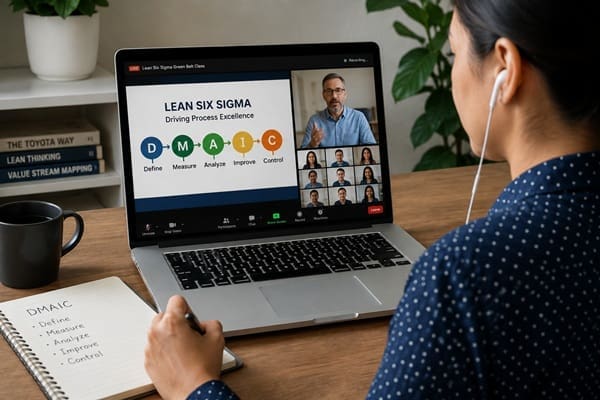
Live virtual Lean Six Sigma training is a certification program delivered by a real instructor teaching a live class on a video platform, with students attending from wherever they are located. This is different from self-paced online training, where a student watches pre-recorded videos on their own schedule with no live instructor present.
The distinction matters more than most searchers realize. According to Training Industry research, 2025 US training expenditures rose 4.9% to $102.8 billion, and instructor-led virtual and blended formats remain standard even as digital delivery expands, because organizations still value real-time interaction for skill-based training.
Six Sigma is a skill-based discipline built on statistical tools, DMAIC methodology, and facilitation ability, all of which benefit from live correction and discussion far more than a passive video ever could.
SSDSI’s live virtual classroom (LVC) format uses a live video platform with breakout rooms, real-time Q&A, and collaborative on-screen activities, designed to replicate the engagement of an in-person class rather than deliver a webinar.

Public, Onsite, Virtual, and Online Six Sigma Certification Training!
- We are accredited by the IASSC.
- Live Public Training at 52 Sites.
- Live Virtual Training.
- Onsite Training (at your organization).
- Interactive Online (self-paced) training,
Live Virtual vs. Self-Paced vs. In-Person: Choosing the Right Format
Every Lean Six Sigma format trades off flexibility against structure. Understanding where live virtual training sits between the other two options makes it easier to know if it fits your situation.
| Format | Structure | Flexibility | Live Interaction | Best For |
| In-Person Public Training | Fixed schedule, physical location | Low | Full | Learners who want zero distractions and in-room networking |
| Live Virtual Training | Fixed schedule, remote attendance | Medium | Full | Professionals who want live instruction without travel |
| Self-Paced Online Training | No fixed schedule | High | None | Disciplined learners who need to fit study around unpredictable hours |
| Onsite Training | Fixed schedule, at your company | Low | Full | Organizations training multiple employees together |
Live virtual training keeps the structure and live coaching of an in-person class, minus the travel cost and time. SSDSI offers all four formats, including live virtual Green Belt and Black Belt certification, so the format decision comes down to your schedule and learning style rather than a tradeoff in instructor quality.
Also Read: What Is a Business Case? Definition, Formula, and Real Examples
Why IASSC Accreditation Matters for Live Virtual Training?
Anyone can call a course a “certification.” Accreditation is what tells you a third party has actually checked the curriculum.
The International Association for Six Sigma Certification (IASSC) is an independent, third-party certifying body that does not itself provide training. Instead, it accredits training organizations that align their curriculum with the IASSC Body of Knowledge, the same knowledge base tested on official IASSC certification exams.
An IASSC Accredited Training Organization (ATO) has furnished evidence to IASSC that its program meets those standards, and IASSC conducts due diligence before granting the designation.
Live virtual training adds a layer worth checking specifically: does the accreditation cover the virtual format, or only the in-person version of the course? SSDSI’s live virtual Lean Six Sigma Green Belt and Black Belt programs carry the same IASSC Accredited Training Organization status as our in-person courses, because they use identical curriculum and identical Master Black Belt instructors, just delivered through a virtual classroom.
What Separates a Best-in-Class Live Virtual Classroom From a Webinar
Plenty of “live virtual” Six Sigma courses are really just a webinar: one instructor talking at a large group with a chat box for questions. That format teaches concepts. It does not teach Six Sigma.
- Small class size. SSDSI caps virtual classes under 10 students, which lets the instructor engage every individual rather than field a handful of chat questions from a crowd of 40 or more.
- Hands-on simulations, not just slides. SSDSI’s virtual sessions use interactive tools like the XPult Catapult and a Virtual Cannon simulation to teach statistical variation and process capability, the same concepts that are difficult to grasp from a static slide deck.
- Breakout rooms for group work. Real Six Sigma projects involve team facilitation. Breakout room exercises during live virtual training build that skill instead of skipping it.
- A Master Black Belt, not a junior facilitator. SSDSI’s live virtual instructors carry 15+ years of hands-on experience, the same instructors who teach our in-person public and onsite courses.
- Reliable technology. A platform that drops video calls mid-lesson defeats the purpose of “live.” Student reviews of SSDSI’s virtual platform specifically note stable performance even when connecting from large corporate networks with restrictive IT environments.
Live Virtual Belt Levels and What Each One Covers
Not every learner needs the same certification. Matching the belt level to your role avoids paying for depth you will not use, or under-training for a role that needs more.
| Belt Level | Who It’s For | Typical Focus |
| White Belt | Executives, support staff, anyone working alongside certified practitioners | Terminology, DMAIC awareness, foundational concepts |
| Yellow Belt | Team members supporting Green and Black Belt projects | Core tools, project support roles |
| Green Belt | Analysts, project leads, process owners | Full DMAIC methodology, statistical tools, leading small-to-mid projects |
| Black Belt | Experienced Green Belts, senior project leaders | Advanced statistics, complex project leadership, team mentoring |
SSDSI’s live virtual Green Belt and Black Belt courses run as two-week, 8-day sessions (roughly 6 hours per day including breaks), matching the depth of our in-person format rather than compressing content into a shorter, shallower virtual version.
Why Virtual Training Demand Is Growing in 2026

This is not a preference shift happening in isolation. According to eLearning Industry’s 2026 market analysis, hybrid delivery has become the default model across workplaces, with organizations combining live facilitation and digital modules rather than choosing one over the other. The same report notes 79% of organizations now use virtual classrooms as part of their standard training delivery, not as a fallback option.
For process improvement certifications specifically, this shift makes sense. A Lean Six Sigma Black Belt candidate leading a project for a manufacturing plant in one state and a distribution center in another does not need to be in the same room as their instructor to learn DMAIC, but they do need a live instructor who can correct a misapplied control chart in real time.
SSDSI’s live virtual format was built around that exact need, letting learners from Canada Post, healthcare systems, and manufacturing clients train together with instructors who have deployed these tools in the field.
Common Mistakes When Choosing Live Virtual Six Sigma Training
- Confusing self-paced with live virtual. Read the course description carefully. “Online” alone does not mean a live instructor is present.
- Ignoring class size. A discounted course with 50 students per session cannot deliver the same instructor attention as a class capped under 10.
- Skipping the accreditation check. Confirm the virtual course specifically, not just the provider’s in-person program, carries IASSC accreditation.
- Overlooking post-certification coaching. A certificate without project support leaves practitioners unprepared for their first real DMAIC tollgate review.
- Assuming all Master Black Belt titles are equal. Ask how many years of hands-on deployment experience the instructor has, not just their certification level.
Frequently Asked Questions on Best Live Virtual Six Sigma Training
Is live virtual Lean Six Sigma training as effective as in-person training?
When the format includes small class sizes, live simulations, and a Master Black Belt instructor, live virtual training delivers the same certification outcome and DMAIC skill development as in-person training, minus the travel.
What is the difference between live virtual training and self-paced online training?
Live virtual training has a real instructor teaching a scheduled class in real time. Self-paced online training is pre-recorded video content with no live instructor, completed on the student’s own schedule.
Does IASSC accreditation apply to live virtual courses?
It depends on the provider. Confirm that the specific virtual course you are booking, not just the organization generally, carries IASSC Accredited Training Organization status.
How long does live virtual Green Belt or Black Belt certification take?
SSDSI’s live virtual Green Belt and Black Belt programs run as two-week, 8-day sessions at roughly 6 hours per day, matching the depth of the in-person course.
Can live virtual training groups include people from different companies?
Yes. Public live virtual classes, like SSDSI’s, mix learners from different organizations in the same live session, while onsite virtual training can be run privately for a single company’s team.
Final Words
The best live virtual Lean Six Sigma training in 2026 is not the cheapest or the most convenient option on paper. It is the program that keeps class sizes small, uses a live Master Black Belt instructor instead of pre-recorded video, backs the curriculum with IASSC accreditation, and supports you through real project coaching after the class ends.
SSDSI is IASSC accredited, rated 5 stars on Google Reviews, and has certified 5,322+ professionals across 600+ organizations, with public training available in 52 cities and live virtual seats open now. Book your seat in our next live virtual Green Belt or Black Belt session and train with a Master Black Belt instructor from anywhere.
About Six Sigma Development Solutions, Inc.
Six Sigma Development Solutions, Inc. offers onsite, public, and virtual Lean Six Sigma certification training. We are an Accredited Training Organization by the IASSC (International Association of Six Sigma Certification). We offer Lean Six Sigma Green Belt, Black Belt, and Yellow Belt, as well as LEAN certifications.
Book a Call and Let us know how we can help meet your training needs.


